NEET Physics Cheatsheet
Cheatsheet Content
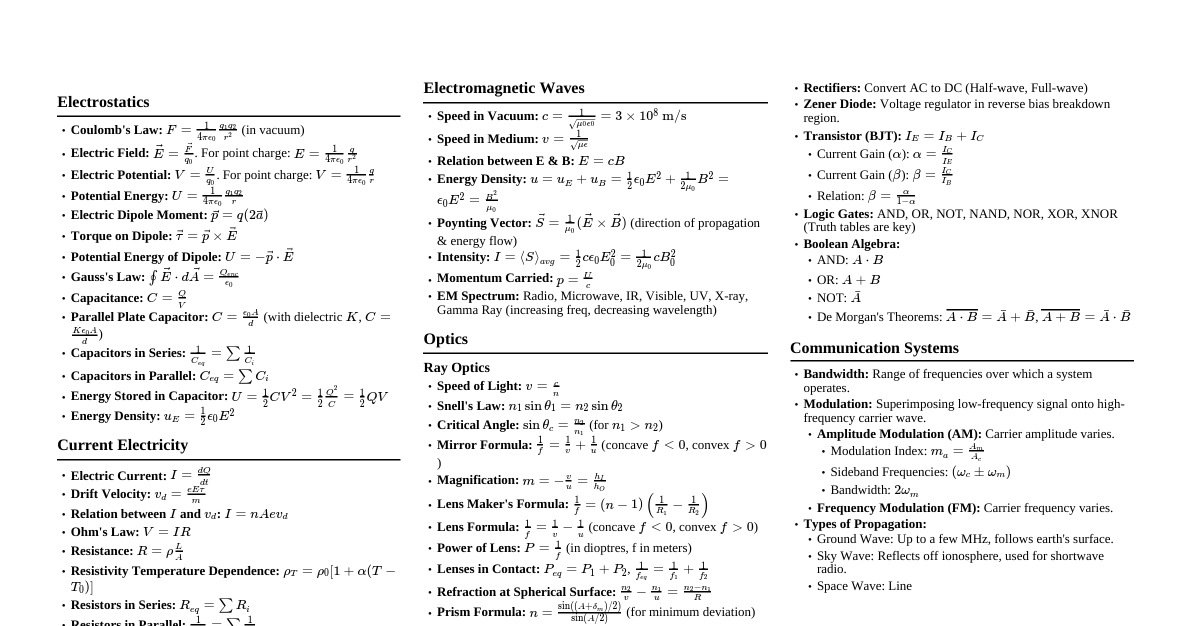
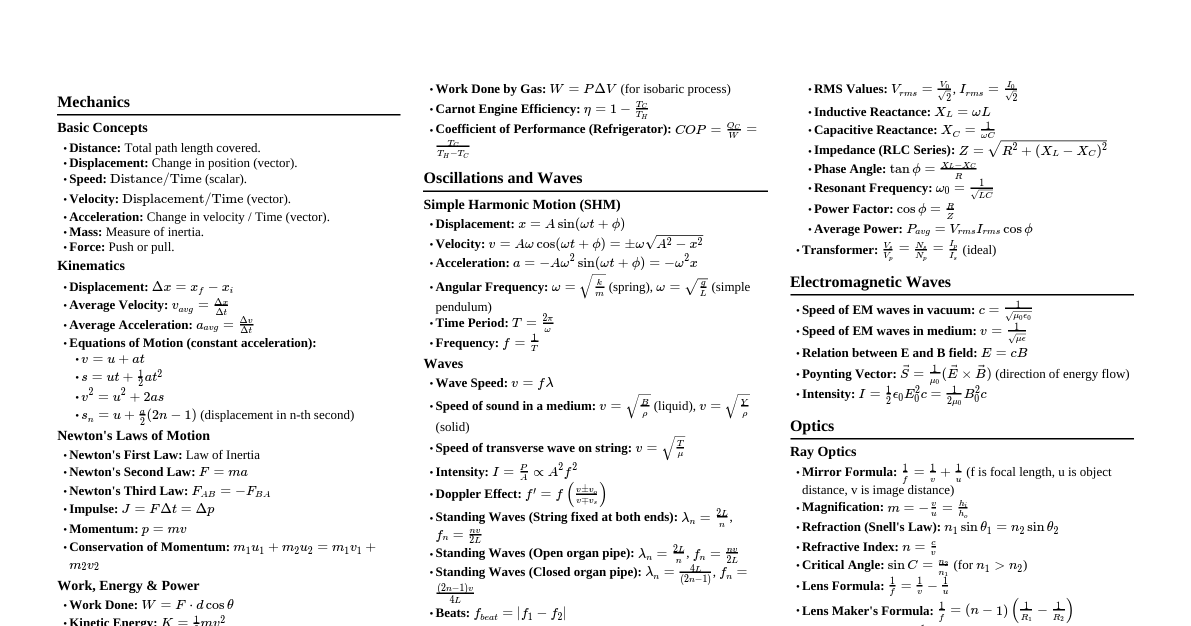
### Units and Dimensions - **Fundamental Quantities:** Length (m), Mass (kg), Time (s), Electric Current (A), Temperature (K), Luminous Intensity (cd), Amount of Substance (mol). - **Derived Quantities:** Expressed in terms of fundamental quantities (e.g., Velocity = m/s). - **Dimensional Analysis:** - Principle of Homogeneity: Dimensions of terms on both sides of an equation must be same. - Uses: Checking correctness of equations, deriving relations between physical quantities, converting units. - **Common Dimensions:** - Force: $[MLT^{-2}]$ - Work/Energy: $[ML^2T^{-2}]$ - Power: $[ML^2T^{-3}]$ - Pressure: $[ML^{-1}T^{-2}]$ - Frequency: $[T^{-1}]$ ### Motion in One Dimension - **Displacement ($\Delta x$):** Change in position ($\vec{r_f} - \vec{r_i}$). Vector quantity. - **Distance:** Total path length covered. Scalar quantity. - **Velocity ($\vec{v}$):** Rate of change of displacement. $\vec{v} = \frac{d\vec{x}}{dt}$. - Average Velocity: $\frac{\Delta x}{\Delta t}$ - Instantaneous Velocity: $\lim_{\Delta t \to 0} \frac{\Delta x}{\Delta t}$ - **Speed:** Rate of change of distance. Scalar quantity. - **Acceleration ($\vec{a}$):** Rate of change of velocity. $\vec{a} = \frac{d\vec{v}}{dt} = \frac{d^2\vec{x}}{dt^2}$. - **Equations of Motion (Constant Acceleration):** 1. $v = u + at$ 2. $s = ut + \frac{1}{2}at^2$ 3. $v^2 = u^2 + 2as$ 4. $s_n = u + \frac{a}{2}(2n - 1)$ (Displacement in $n^{th}$ second) - **Free Fall:** $a = g$ (downwards positive), $a = -g$ (upwards positive). - Max Height: $H = \frac{u^2}{2g}$ - Time of Flight: $T = \frac{2u}{g}$ ### Motion in Two and Three Dimensions - **Position Vector:** $\vec{r} = x\hat{i} + y\hat{j} + z\hat{k}$ - **Velocity Vector:** $\vec{v} = v_x\hat{i} + v_y\hat{j} + v_z\hat{k} = \frac{d\vec{r}}{dt}$ - **Acceleration Vector:** $\vec{a} = a_x\hat{i} + a_y\hat{j} + a_z\hat{k} = \frac{d\vec{v}}{dt}$ - **Projectile Motion:** - Angle of projection $\theta$ with horizontal, initial velocity $u$. - Horizontal component of velocity: $u_x = u\cos\theta$ (constant) - Vertical component of velocity: $u_y = u\sin\theta$ - Time of Flight: $T = \frac{2u\sin\theta}{g}$ - Maximum Height: $H = \frac{u^2\sin^2\theta}{2g}$ - Horizontal Range: $R = \frac{u^2\sin(2\theta)}{g}$ - Max Range when $\theta = 45^\circ$, $R_{max} = \frac{u^2}{g}$ - **Uniform Circular Motion:** - Constant speed, changing velocity (due to change in direction). - Centripetal Acceleration: $a_c = \frac{v^2}{r} = \omega^2 r$, directed towards center. - Centripetal Force: $F_c = \frac{mv^2}{r} = m\omega^2 r$. - Angular Velocity: $\omega = \frac{v}{r} = 2\pi f = \frac{2\pi}{T}$. ### Laws of Motion - **Newton's First Law (Law of Inertia):** An object remains in its state of rest or uniform motion unless acted upon by an external force. - **Newton's Second Law:** $\vec{F} = m\vec{a}$. Force is proportional to rate of change of momentum. $\vec{F} = \frac{d\vec{p}}{dt}$. - **Newton's Third Law:** To every action, there is an equal and opposite reaction. - **Momentum ($\vec{p}$):** $\vec{p} = m\vec{v}$. - **Impulse ($\vec{J}$):** Change in momentum. $\vec{J} = \vec{F}_{avg}\Delta t = \Delta \vec{p}$. - **Conservation of Linear Momentum:** In an isolated system, total linear momentum remains constant. $\sum \vec{p}_i = \sum \vec{p}_f$. - **Friction:** - Static Friction ($f_s$): $f_s \le \mu_s N$. - Kinetic Friction ($f_k$): $f_k = \mu_k N$. Always $f_k ### Work, Energy, and Power - **Work Done (W):** $W = \vec{F} \cdot \vec{d} = Fd\cos\theta$. Scalar quantity. - Work-Energy Theorem: $W_{net} = \Delta K = K_f - K_i$. - **Kinetic Energy (K):** $K = \frac{1}{2}mv^2$. - **Potential Energy (U):** Energy due to position or configuration. - Gravitational PE: $U_g = mgh$. - Elastic PE (Spring): $U_s = \frac{1}{2}kx^2$. - **Conservation of Mechanical Energy:** If only conservative forces act, $E = K + U = \text{constant}$. - **Power (P):** Rate of doing work. $P = \frac{dW}{dt} = \vec{F} \cdot \vec{v}$. - Average Power: $\frac{\Delta W}{\Delta t}$. - Instantaneous Power: $\frac{dW}{dt}$. - **Collisions:** - **Elastic Collision:** Both momentum and kinetic energy are conserved. - **Inelastic Collision:** Momentum conserved, kinetic energy not conserved. - **Perfectly Inelastic Collision:** Bodies stick together after collision. - Coefficient of Restitution ($e$): $e = \frac{\text{relative velocity after collision}}{\text{relative velocity before collision}}$. - For elastic: $e=1$. For perfectly inelastic: $e=0$. ### Rotational Motion - **Angular Displacement ($\theta$):** Angle turned. - **Angular Velocity ($\omega$):** $\omega = \frac{d\theta}{dt}$. - **Angular Acceleration ($\alpha$):** $\alpha = \frac{d\omega}{dt}$. - **Relations between Linear and Angular:** $v = r\omega$, $a_t = r\alpha$ (tangential acc.), $a_c = r\omega^2 = \frac{v^2}{r}$ (centripetal acc.). - **Equations of Rotational Motion (Constant Angular Acceleration):** 1. $\omega = \omega_0 + \alpha t$ 2. $\theta = \omega_0 t + \frac{1}{2}\alpha t^2$ 3. $\omega^2 = \omega_0^2 + 2\alpha\theta$ - **Moment of Inertia (I):** Rotational analogue of mass. $I = \sum m_i r_i^2$. - Parallel Axis Theorem: $I = I_{cm} + Md^2$. - Perpendicular Axis Theorem (for planar bodies): $I_z = I_x + I_y$. - **Torque ($\vec{\tau}$):** Rotational analogue of force. $\vec{\tau} = \vec{r} \times \vec{F}$. - $\tau = I\alpha$. - **Angular Momentum ($\vec{L}$):** $\vec{L} = \vec{r} \times \vec{p} = I\vec{\omega}$. - **Conservation of Angular Momentum:** If net external torque is zero, $\vec{L} = \text{constant}$. - **Rotational Kinetic Energy:** $K_R = \frac{1}{2}I\omega^2$. ### Gravitation - **Newton's Law of Universal Gravitation:** $F = G\frac{m_1 m_2}{r^2}$. - $G = 6.67 \times 10^{-11} Nm^2/kg^2$. - **Acceleration due to Gravity (g):** - On Earth's surface: $g = G\frac{M_e}{R_e^2}$. - Variation with Altitude: $g_h = g(1 - \frac{2h}{R_e})$ for $h \ll R_e$. - Variation with Depth: $g_d = g(1 - \frac{d}{R_e})$. - Variation with Latitude: $g' = g - R_e\omega^2\cos^2\phi$. - **Gravitational Potential Energy:** $U = -\frac{GMm}{r}$. - **Gravitational Potential (V):** $V = -\frac{GM}{r}$. - **Escape Velocity ($v_e$):** Minimum velocity required to escape Earth's gravitational field. $v_e = \sqrt{\frac{2GM}{R}} = \sqrt{2gR}$. - **Orbital Velocity ($v_o$):** Velocity of satellite in circular orbit. $v_o = \sqrt{\frac{GM}{r}}$. - For orbit close to Earth: $v_o = \sqrt{gR}$. - **Time Period of Satellite (T):** $T = 2\pi\sqrt{\frac{r^3}{GM}}$. - **Kepler's Laws:** 1. Law of Orbits: Planets move in elliptical orbits with the Sun at one focus. 2. Law of Areas: The line joining the planet to the Sun sweeps equal areas in equal intervals of time. ($\frac{dA}{dt} = \frac{L}{2m} = \text{constant}$). 3. Law of Periods: The square of the orbital period ($T$) is proportional to the cube of the semi-major axis ($a$) of its orbit. $T^2 \propto a^3$. ### Properties of Bulk Matter #### Elasticity - **Stress:** Restoring force per unit area. $\sigma = \frac{F}{A}$. - **Strain:** Fractional change in dimension. $\epsilon = \frac{\Delta L}{L}$ (longitudinal), $\frac{\Delta V}{V}$ (volume), $\phi$ (shear). - **Hooke's Law:** Stress $\propto$ Strain (within elastic limit). - **Young's Modulus (Y):** $Y = \frac{\text{Longitudinal Stress}}{\text{Longitudinal Strain}} = \frac{FL}{A\Delta L}$. - **Bulk Modulus (B):** $B = \frac{\text{Volume Stress}}{\text{Volume Strain}} = \frac{-P}{\Delta V/V}$. - **Shear Modulus (G):** $G = \frac{\text{Shear Stress}}{\text{Shear Strain}} = \frac{F/A}{\phi}$. - **Poisson's Ratio ($\nu$):** $\nu = -\frac{\text{Lateral Strain}}{\text{Longitudinal Strain}}$. - **Elastic Potential Energy Density:** $\frac{1}{2} \times \text{Stress} \times \text{Strain}$. #### Fluid Mechanics - **Density ($\rho$):** $\rho = \frac{m}{V}$. - **Pressure (P):** $P = \frac{F}{A}$. - Pressure at depth h: $P = P_0 + \rho gh$. - **Pascal's Law:** Pressure applied to an enclosed static fluid is transmitted undiminished to every portion of the fluid and the walls of the containing vessel. - **Archimedes' Principle:** Buoyant force $F_B = \rho_{fluid} V_{submerged} g$. - **Equation of Continuity:** $A_1v_1 = A_2v_2 = \text{constant}$ (for incompressible fluid). - **Bernoulli's Principle:** $P + \frac{1}{2}\rho v^2 + \rho gh = \text{constant}$. - **Viscosity:** Internal friction in fluids. - **Stokes' Law:** Viscous force on a sphere: $F_v = 6\pi\eta rv$. - **Terminal Velocity:** $v_t = \frac{2r^2(\rho - \rho_0)g}{9\eta}$. - **Surface Tension (T):** Force per unit length on liquid surface. $T = \frac{F}{L}$. - Surface Energy: $E = T \times \Delta A$. - Excess Pressure in liquid drop: $\Delta P = \frac{2T}{R}$. - Excess Pressure in soap bubble: $\Delta P = \frac{4T}{R}$. - Capillary Rise: $h = \frac{2T\cos\theta}{\rho rg}$. #### Thermal Properties of Matter - **Heat Capacity (C):** $C = \frac{\Delta Q}{\Delta T}$. - **Specific Heat Capacity (c):** $c = \frac{C}{m} = \frac{1}{m}\frac{\Delta Q}{\Delta T}$. - **Latent Heat (L):** $Q = mL$. - **Thermal Expansion:** - Linear: $\Delta L = L_0 \alpha \Delta T$. - Area: $\Delta A = A_0 \beta \Delta T$, where $\beta = 2\alpha$. - Volume: $\Delta V = V_0 \gamma \Delta T$, where $\gamma = 3\alpha$. - **Heat Transfer:** - **Conduction:** $\frac{dQ}{dt} = -KA\frac{dT}{dx}$. - **Convection:** Heat transfer by mass movement of fluid. - **Radiation:** - Stefan-Boltzmann Law: $P = \sigma e A T^4$. - Wien's Displacement Law: $\lambda_m T = b$. - Newton's Law of Cooling: $\frac{dT}{dt} = -k(T - T_s)$. ### Thermodynamics - **Zeroth Law:** If two systems are in thermal equilibrium with a third system, they are in thermal equilibrium with each other. - **First Law:** $\Delta Q = \Delta U + \Delta W$. - $\Delta Q$: Heat given to system. - $\Delta U$: Change in internal energy. - $\Delta W$: Work done by system. $\Delta W = P\Delta V$. - **Thermodynamic Processes:** - **Isothermal:** $T = \text{constant}$. $\Delta U = 0$. $\Delta Q = \Delta W = nRT\ln(\frac{V_f}{V_i})$. - **Adiabatic:** $\Delta Q = 0$. $\Delta U = -\Delta W$. $PV^\gamma = \text{constant}$, $T V^{\gamma-1} = \text{constant}$, $T^\gamma P^{1-\gamma} = \text{constant}$. - **Isobaric:** $P = \text{constant}$. $\Delta W = P\Delta V$. - **Isochoric:** $V = \text{constant}$. $\Delta W = 0$. $\Delta Q = \Delta U$. - **Specific Heat Capacities of Gases:** - $C_P - C_V = R$ (Mayer's relation). - $\gamma = \frac{C_P}{C_V}$. - **Work Done in PV Diagram:** Area under the curve. - **Second Law:** - Kelvin-Planck Statement: Impossible to construct a device which operates in a cycle and produces no effect other than the extraction of heat from a reservoir and its conversion into work. - Clausius Statement: Impossible for a self-acting machine, unaided by any external agency, to transfer heat from a body at a lower temperature to another body at a higher temperature. - **Carnot Engine:** Most efficient heat engine. - Efficiency: $\eta = 1 - \frac{T_C}{T_H} = \frac{W}{Q_H}$. - **Refrigerator/Heat Pump:** - Coefficient of Performance (COP): $COP = \frac{Q_C}{W} = \frac{T_C}{T_H - T_C}$. ### Kinetic Theory of Gases - **Ideal Gas Equation:** $PV = nRT = NkT$. - **Assumptions of KTG:** - Gas consists of large number of identical, small, rigid, elastic particles. - Negligible volume of molecules compared to volume of gas. - No intermolecular forces. - Collisions are elastic. - Random motion. - **Pressure of an Ideal Gas:** $P = \frac{1}{3}\rho \overline{v^2} = \frac{1}{3}\frac{nm}{V}\overline{v^2}$. - **Average Kinetic Energy per molecule:** $E = \frac{3}{2}kT$. - **Degrees of Freedom (f):** - Monatomic: $f=3$. - Diatomic: $f=5$ (at moderate temp), $f=7$ (at high temp). - Polyatomic: $f=6$ (non-linear), $f=7$ (linear). - **Law of Equipartition of Energy:** Energy per degree of freedom = $\frac{1}{2}kT$. - **Internal Energy of a Gas:** $U = \frac{f}{2}nRT$. - **Specific Heat Capacities:** - $C_V = \frac{f}{2}R$. - $C_P = (\frac{f}{2} + 1)R$. - $\gamma = 1 + \frac{2}{f}$. - **Speeds of Gas Molecules:** - Root Mean Square Speed: $v_{rms} = \sqrt{\frac{3RT}{M}} = \sqrt{\frac{3kT}{m}}$. - Average Speed: $v_{avg} = \sqrt{\frac{8RT}{\pi M}} = \sqrt{\frac{8kT}{\pi m}}$. - Most Probable Speed: $v_{mp} = \sqrt{\frac{2RT}{M}} = \sqrt{\frac{2kT}{m}}$. - $v_{mp} : v_{avg} : v_{rms} = 1 : 1.128 : 1.224$. ### Oscillations - **Simple Harmonic Motion (SHM):** - Restoring force $F = -kx$. - Differential equation: $\frac{d^2x}{dt^2} + \omega^2 x = 0$. - Displacement: $x(t) = A\sin(\omega t + \phi)$ or $A\cos(\omega t + \phi)$. - Velocity: $v(t) = A\omega\cos(\omega t + \phi) = \pm \omega\sqrt{A^2 - x^2}$. - Acceleration: $a(t) = -A\omega^2\sin(\omega t + \phi) = -\omega^2 x$. - Angular Frequency: $\omega = \sqrt{\frac{k}{m}}$. - Time Period: $T = \frac{2\pi}{\omega} = 2\pi\sqrt{\frac{m}{k}}$. - Frequency: $f = \frac{1}{T}$. - **Energy in SHM:** - Kinetic Energy: $K = \frac{1}{2}mv^2 = \frac{1}{2}mA^2\omega^2\cos^2(\omega t + \phi)$. - Potential Energy: $U = \frac{1}{2}kx^2 = \frac{1}{2}kA^2\sin^2(\omega t + \phi)$. - Total Energy: $E = K + U = \frac{1}{2}kA^2 = \frac{1}{2}mA^2\omega^2 = \text{constant}$. - **Simple Pendulum:** - Time Period: $T = 2\pi\sqrt{\frac{L}{g}}$ (for small angles). - **Physical Pendulum:** $T = 2\pi\sqrt{\frac{I}{mgL}}$. - **Spring-Mass System:** $T = 2\pi\sqrt{\frac{m}{k}}$. - Springs in series: $\frac{1}{k_{eq}} = \frac{1}{k_1} + \frac{1}{k_2} + \dots$. - Springs in parallel: $k_{eq} = k_1 + k_2 + \dots$. ### Waves - **Wave Equation:** $y(x,t) = A\sin(kx - \omega t + \phi)$. - Wavelength ($\lambda$): $k = \frac{2\pi}{\lambda}$. - Angular Frequency ($\omega$): $\omega = 2\pi f$. - Wave Speed ($v$): $v = f\lambda = \frac{\omega}{k}$. - **Speed of Transverse Wave on a String:** $v = \sqrt{\frac{T}{\mu}}$, where $\mu$ is linear mass density. - **Speed of Longitudinal Wave (Sound) in a Medium:** - Solids: $v = \sqrt{\frac{Y}{\rho}}$. - Liquids: $v = \sqrt{\frac{B}{\rho}}$. - Gases: $v = \sqrt{\frac{\gamma P}{\rho}} = \sqrt{\frac{\gamma RT}{M}}$. - **Intensity of Wave (I):** $I = \frac{P}{A} = 2\pi^2 f^2 A^2 \rho v$. - **Principle of Superposition:** When two or more waves overlap, the resultant displacement is the vector sum of individual displacements. - **Standing Waves:** Formed by superposition of two identical waves traveling in opposite directions. - Nodes (zero displacement) and Antinodes (max displacement). - **Open Organ Pipe:** $\lambda_n = \frac{2L}{n}$, $f_n = \frac{nv}{2L}$, $n=1,2,3,\dots$ (all harmonics). - **Closed Organ Pipe:** $\lambda_n = \frac{4L}{(2n-1)}$, $f_n = \frac{(2n-1)v}{4L}$, $n=1,2,3,\dots$ (odd harmonics). - **String fixed at both ends:** $\lambda_n = \frac{2L}{n}$, $f_n = \frac{nv}{2L}$, $n=1,2,3,\dots$ (all harmonics). - **Beats:** Produced when two waves of slightly different frequencies $f_1$ and $f_2$ interfere. - Beat Frequency: $f_{beat} = |f_1 - f_2|$. - **Doppler Effect (Sound):** Apparent change in frequency due to relative motion between source and observer. - $f' = f \left(\frac{v \pm v_O}{v \mp v_S}\right)$. - Use '+' for $v_O$ if observer moves towards source, '-' if away. - Use '-' for $v_S$ if source moves towards observer, '+' if away. ### Electrostatics - **Coulomb's Law:** $F = k\frac{|q_1 q_2|}{r^2}$, where $k = \frac{1}{4\pi\epsilon_0} = 9 \times 10^9 Nm^2/C^2$. - **Electric Field ($\vec{E}$):** Force per unit charge. $\vec{E} = \frac{\vec{F}}{q_0}$. - Point charge: $E = k\frac{q}{r^2}$. - **Electric Dipole:** Two equal and opposite charges separated by a small distance. - Dipole Moment: $\vec{p} = q(2\vec{a})$. - Field on axial line: $E_{axial} = \frac{2kp}{r^3}$. - Field on equatorial line: $E_{eq} = -\frac{kp}{r^3}$. - Torque on dipole in uniform field: $\vec{\tau} = \vec{p} \times \vec{E}$. - Potential Energy of dipole: $U = -\vec{p} \cdot \vec{E}$. - **Electric Flux ($\Phi_E$):** $\Phi_E = \vec{E} \cdot \vec{A} = EA\cos\theta$. - **Gauss's Law:** $\Phi_E = \oint \vec{E} \cdot d\vec{A} = \frac{Q_{enc}}{\epsilon_0}$. - Applications: - Infinite line charge: $E = \frac{\lambda}{2\pi\epsilon_0 r}$. - Infinite plane sheet: $E = \frac{\sigma}{2\epsilon_0}$. - Spherical shell (outside): $E = \frac{kQ}{r^2}$, (inside): $E=0$. - Solid conducting sphere (outside): $E = \frac{kQ}{r^2}$, (inside): $E=0$. - Solid insulating sphere (outside): $E = \frac{kQ}{r^2}$, (inside): $E = \frac{kQr}{R^3}$. - **Electric Potential (V):** Work done per unit charge to bring a charge from infinity to a point. $V = \frac{U}{q}$. - Point charge: $V = k\frac{q}{r}$. - Relation between E and V: $\vec{E} = -\nabla V$. - **Capacitance (C):** $C = \frac{Q}{V}$. - Parallel Plate Capacitor: $C = \frac{\epsilon A}{d} = \frac{\kappa \epsilon_0 A}{d}$. - Series: $\frac{1}{C_{eq}} = \frac{1}{C_1} + \frac{1}{C_2} + \dots$. - Parallel: $C_{eq} = C_1 + C_2 + \dots$. - **Energy Stored in Capacitor:** $U = \frac{1}{2}CV^2 = \frac{1}{2}\frac{Q^2}{C} = \frac{1}{2}QV$. - **Energy Density:** $u_E = \frac{1}{2}\epsilon_0 E^2$. ### Current Electricity - **Electric Current (I):** $I = \frac{dQ}{dt}$. - **Drift Velocity ($v_d$):** $I = nAve v_d$. - **Ohm's Law:** $V = IR$. - Resistance: $R = \rho \frac{L}{A}$. - Resistivity: $\rho = \frac{m}{ne^2\tau}$. - Temperature dependence of resistance: $R_T = R_0[1 + \alpha(T - T_0)]$. - **Series Combination of Resistors:** $R_{eq} = R_1 + R_2 + \dots$. - **Parallel Combination of Resistors:** $\frac{1}{R_{eq}} = \frac{1}{R_1} + \frac{1}{R_2} + \dots$. - **Kirchhoff's Laws:** - **Junction Rule (KCL):** Sum of currents entering a junction equals sum of currents leaving. $\sum I = 0$. - **Loop Rule (KVL):** Algebraic sum of changes in potential around any closed loop is zero. $\sum \Delta V = 0$. - **Wheatstone Bridge:** Balanced condition: $\frac{P}{Q} = \frac{R}{S}$. - **Meter Bridge:** Used to find unknown resistance. $R \propto l$. - **Potentiometer:** Used to measure EMF, compare EMFs, measure internal resistance. - Compare EMFs: $\frac{\epsilon_1}{\epsilon_2} = \frac{l_1}{l_2}$. - Internal Resistance: $r = R\left(\frac{L}{l} - 1\right)$. - **Electric Power (P):** $P = VI = I^2R = \frac{V^2}{R}$. - **Joule's Law of Heating:** Heat produced $H = I^2Rt$. ### Magnetic Effects of Current and Magnetism - **Biot-Savart Law:** $d\vec{B} = \frac{\mu_0}{4\pi} \frac{I d\vec{l} \times \vec{r}}{r^3}$. - Magnetic field at center of circular loop: $B = \frac{\mu_0 I}{2R}$. - Magnetic field on axis of circular loop: $B = \frac{\mu_0 IR^2}{2(R^2 + x^2)^{3/2}}$. - Magnetic field due to infinite straight wire: $B = \frac{\mu_0 I}{2\pi r}$. - **Ampere's Circuital Law:** $\oint \vec{B} \cdot d\vec{l} = \mu_0 I_{enc}$. - Long solenoid: $B = \mu_0 nI$. - Toroid: $B = \frac{\mu_0 NI}{2\pi r}$. - **Lorentz Force:** $\vec{F} = q(\vec{E} + \vec{v} \times \vec{B})$. - Force on current-carrying conductor: $\vec{F} = I(\vec{L} \times \vec{B})$. - Force between two parallel current-carrying wires: $F = \frac{\mu_0 I_1 I_2 L}{2\pi d}$. - **Torque on current loop in magnetic field:** $\vec{\tau} = \vec{M} \times \vec{B}$, where $\vec{M} = NI\vec{A}$ (magnetic dipole moment). - **Moving Coil Galvanometer:** Current sensitivity, Voltage sensitivity. - **Conversion of Galvanometer:** - Ammeter: Shunt resistance $S = \frac{I_g G}{I - I_g}$. - Voltmeter: Series resistance $R = \frac{V}{I_g} - G$. - **Earth's Magnetism:** - Magnetic Declination ($\alpha$): Angle between geographic and magnetic meridians. - Magnetic Dip ($\delta$): Angle between Earth's magnetic field and horizontal. - Horizontal Component ($B_H$): $B_H = B_E \cos\delta$. - Vertical Component ($B_V$): $B_V = B_E \sin\delta$. - **Magnetic Properties of Materials:** - **Diamagnetic:** Weakly repelled by magnetic fields. $\mu_r 1$. - **Ferromagnetic:** Strongly attracted by magnetic fields. $\mu_r \gg 1$. ### Electromagnetic Induction and Alternating Current #### Electromagnetic Induction (EMI) - **Magnetic Flux ($\Phi_B$):** $\Phi_B = \vec{B} \cdot \vec{A} = BA\cos\theta$. - **Faraday's Laws of EMI:** 1. Whenever magnetic flux linked with a coil changes, an EMF is induced. 2. Magnitude of induced EMF is proportional to rate of change of magnetic flux: $\epsilon = -N\frac{d\Phi_B}{dt}$. (Lenz's Law for direction). - **Motional EMF:** $\epsilon = Blv$. - **Self-Inductance (L):** $\Phi_B = LI$. Induced EMF: $\epsilon = -L\frac{dI}{dt}$. - Energy stored in inductor: $U = \frac{1}{2}LI^2$. - **Mutual Inductance (M):** $\Phi_2 = MI_1$. Induced EMF: $\epsilon_2 = -M\frac{dI_1}{dt}$. - **Eddy Currents:** Induced currents in bulk conductors, used in induction furnaces, speedometers, etc. #### Alternating Current (AC) - **AC Voltage/Current:** $V = V_0\sin(\omega t)$, $I = I_0\sin(\omega t + \phi)$. - **RMS Value:** $V_{rms} = \frac{V_0}{\sqrt{2}}$, $I_{rms} = \frac{I_0}{\sqrt{2}}$. - **Reactance:** - Inductive Reactance: $X_L = \omega L$. - Capacitive Reactance: $X_C = \frac{1}{\omega C}$. - **Impedance (Z):** $Z = \sqrt{R^2 + (X_L - X_C)^2}$. - **Phase Angle ($\phi$):** $\tan\phi = \frac{X_L - X_C}{R}$. - **Power in AC Circuit:** $P_{avg} = V_{rms}I_{rms}\cos\phi$. - Power Factor: $\cos\phi = \frac{R}{Z}$. - **Resonance in LCR Circuit:** - Resonance frequency: $f_r = \frac{1}{2\pi\sqrt{LC}}$. - At resonance: $X_L = X_C$, $Z = R$, $\phi = 0$. - **Transformer:** $\frac{V_S}{V_P} = \frac{N_S}{N_P} = \frac{I_P}{I_S}$. - Efficiency: $\eta = \frac{P_{out}}{P_{in}}$. ### Electromagnetic Waves - **Characteristics:** - Transverse waves. - Do not require a medium to propagate. - Electric and magnetic fields are perpendicular to each other and to direction of propagation. - Speed in vacuum: $c = \frac{1}{\sqrt{\mu_0\epsilon_0}} = 3 \times 10^8 m/s$. - Speed in medium: $v = \frac{1}{\sqrt{\mu\epsilon}}$. - **Energy Density:** $u = \frac{1}{2}\epsilon_0 E^2 + \frac{1}{2\mu_0}B^2 = \epsilon_0 E^2 = \frac{B^2}{\mu_0}$. - **Poynting Vector ($\vec{S}$):** Energy flux density. $\vec{S} = \frac{1}{\mu_0}(\vec{E} \times \vec{B})$. - **Electromagnetic Spectrum (decreasing wavelength, increasing frequency/energy):** - Radio waves, Microwaves, Infrared, Visible light (ROYGBIV), Ultraviolet, X-rays, Gamma rays. ### Ray Optics and Optical Instruments - **Reflection:** - Angle of incidence = Angle of reflection. - Mirror Formula: $\frac{1}{f} = \frac{1}{v} + \frac{1}{u}$. - Magnification: $m = -\frac{v}{u} = \frac{h_i}{h_o}$. - For spherical mirrors: $f = R/2$. - **Refraction:** - Snell's Law: $n_1\sin i = n_2\sin r$. - Refractive Index: $n = \frac{c}{v}$. - Total Internal Reflection (TIR): Occurs when light travels from denser to rarer medium and angle of incidence is greater than critical angle ($\sin i_c = \frac{n_2}{n_1}$). - **Refraction at Spherical Surfaces:** $\frac{n_2}{v} - \frac{n_1}{u} = \frac{n_2 - n_1}{R}$. - **Lens Maker's Formula:** $\frac{1}{f} = (n - 1)\left(\frac{1}{R_1} - \frac{1}{R_2}\right)$. - **Lens Formula:** $\frac{1}{f} = \frac{1}{v} - \frac{1}{u}$. - **Power of Lens (P):** $P = \frac{1}{f}$ (in diopters if f in meters). - Lenses in contact: $P_{eq} = P_1 + P_2 + \dots$. - **Prism:** - Angle of deviation: $\delta = (n-1)A$ (for small angle prism). - $\delta = i + e - A$. - Minimum deviation: $i = e$, $r_1 = r_2 = A/2$. $n = \frac{\sin((A+\delta_m)/2)}{\sin(A/2)}$. - **Optical Instruments:** - **Human Eye:** Myopia (nearsightedness, concave lens), Hypermetropia (farsightedness, convex lens). - **Simple Microscope:** Magnification $M = 1 + \frac{D}{f}$ (image at D), $M = \frac{D}{f}$ (image at infinity). - **Compound Microscope:** $M = \frac{v_o}{u_o}(1 + \frac{D}{f_e})$ (final image at D). - **Astronomical Telescope:** Magnification $M = -\frac{f_o}{f_e}$ (image at infinity). Length $L = f_o + f_e$. ### Wave Optics - **Huygens' Principle:** Every point on a wavefront is a source of secondary wavelets. - **Interference:** - Young's Double Slit Experiment (YDSE): - Path difference: $\Delta x = d\sin\theta$. - For bright fringes (constructive): $\Delta x = n\lambda$. $y_n = \frac{n\lambda D}{d}$. - For dark fringes (destructive): $\Delta x = (n + \frac{1}{2})\lambda$. $y_n = \frac{(n + 1/2)\lambda D}{d}$. - Fringe width: $\beta = \frac{\lambda D}{d}$. - Intensity in interference: $I = I_1 + I_2 + 2\sqrt{I_1 I_2}\cos\phi$. - If $I_1 = I_2 = I_0$, then $I = 4I_0\cos^2(\phi/2)$. - **Diffraction:** Bending of waves around obstacles. - Single Slit Diffraction: - Minima: $a\sin\theta = n\lambda$. - Maxima: $a\sin\theta = (n + \frac{1}{2})\lambda$. - Angular width of central maximum: $2\theta = \frac{2\lambda}{a}$. - **Polarization:** Restriction of light vibrations to a single plane. - Brewster's Law: $\tan i_p = n$. - Malus's Law: $I = I_0\cos^2\theta$. ### Dual Nature of Matter and Radiation - **Photoelectric Effect:** - Einstein's Photoelectric Equation: $h\nu = \phi_0 + K_{max}$. - $\phi_0$: Work function (minimum energy required to eject electron). - $K_{max}$: Maximum kinetic energy of emitted electron. - Threshold frequency ($\nu_0$): $h\nu_0 = \phi_0$. - Stopping potential ($V_0$): $eV_0 = K_{max}$. - **Photon:** Particle of light, energy $E = h\nu = \frac{hc}{\lambda}$. Momentum $p = \frac{h}{\lambda} = \frac{E}{c}$. - **De Broglie Wavelength:** $\lambda = \frac{h}{p} = \frac{h}{mv}$. - For electron accelerated through potential V: $\lambda = \frac{h}{\sqrt{2meV}}$. ### Atoms and Nuclei #### Atoms - **Rutherford's Model:** Nucleus at center, electrons orbit. Failed to explain stability and line spectra. - **Bohr's Model:** 1. Electrons orbit in stable orbits without radiating energy. 2. Only specific orbits are allowed where angular momentum $L = n\frac{h}{2\pi}$. 3. Energy is absorbed/emitted when electron jumps between orbits: $E_f - E_i = h\nu$. - Radius of $n^{th}$ orbit: $r_n = 0.529 \frac{n^2}{Z} \mathring{A}$. - Energy of $n^{th}$ orbit: $E_n = -13.6 \frac{Z^2}{n^2} eV$. - **Hydrogen Spectrum:** - Lyman series (UV): Transitions to $n=1$. - Balmer series (Visible): Transitions to $n=2$. - Paschen series (IR): Transitions to $n=3$. - Brackett series (IR): Transitions to $n=4$. - Pfund series (IR): Transitions to $n=5$. - Rydberg formula: $\frac{1}{\lambda} = R_H Z^2 \left(\frac{1}{n_1^2} - \frac{1}{n_2^2}\right)$. #### Nuclei - **Atomic Number (Z):** Number of protons. - **Mass Number (A):** Number of protons + neutrons. - **Isotopes:** Same Z, different A. - **Isobars:** Same A, different Z. - **Isotones:** Same number of neutrons ($A-Z$). - **Nuclear Size:** $R = R_0 A^{1/3}$, where $R_0 \approx 1.2 \times 10^{-15} m$. - **Mass Defect ($\Delta m$):** Difference between mass of nucleons and mass of nucleus. - **Binding Energy (BE):** Energy equivalent of mass defect. $BE = \Delta m c^2$. - Binding Energy per Nucleon: $\frac{BE}{A}$ (indicates stability). - **Radioactivity:** Spontaneous decay of unstable nuclei. - **Alpha decay:** $^A_Z X \to ^{A-4}_{Z-2} Y + ^4_2 He$. - **Beta decay ($\beta^-$):** $^A_Z X \to ^A_{Z+1} Y + e^- + \bar{\nu}$. - **Beta decay ($\beta^+$):** $^A_Z X \to ^A_{Z-1} Y + e^+ + \nu$. - **Gamma decay:** Emission of photons by excited nucleus. - **Law of Radioactive Decay:** $N = N_0 e^{-\lambda t}$. - Decay constant ($\lambda$): Probability of decay per unit time. - Half-life ($T_{1/2}$): Time for half of nuclei to decay. $T_{1/2} = \frac{\ln 2}{\lambda} = \frac{0.693}{\lambda}$. - Mean life ($\tau$): $\tau = \frac{1}{\lambda}$. - Activity (R): $R = -\frac{dN}{dt} = \lambda N$. Unit: Becquerel (Bq), Curie (Ci). - **Nuclear Fission:** Heavy nucleus splits into lighter nuclei. - **Nuclear Fusion:** Lighter nuclei combine to form heavier nucleus. ### Semiconductor Electronics - **Conductors:** Valence and conduction bands overlap. - **Insulators:** Large energy gap between valence and conduction bands. - **Semiconductors:** Small energy gap. - **Intrinsic Semiconductors:** Pure semiconductors (e.g., Si, Ge). $n_e = n_h = n_i$. - **Extrinsic Semiconductors:** Doped. - **N-type:** Doped with pentavalent impurities (e.g., P, As). Majority carriers: electrons. - **P-type:** Doped with trivalent impurities (e.g., B, Al). Majority carriers: holes. - **P-N Junction Diode:** - **Forward Bias:** P-side connected to positive terminal, N-side to negative. Current flows. - **Reverse Bias:** P-side connected to negative terminal, N-side to positive. Very small current flows (due to minority carriers). - **Diode Characteristics:** I-V curve. - **Rectifier:** Converts AC to DC. - Half-wave rectifier: Output frequency = input frequency. - Full-wave rectifier: Output frequency = 2 $\times$ input frequency. - **Zener Diode:** Heavily doped P-N junction, used as voltage regulator. - **Transistor (BJT):** NPN or PNP. - **Configurations:** Common Emitter (CE), Common Base (CB), Common Collector (CC). - **Current Gains:** - $\alpha = \frac{I_C}{I_E}$ (CB). Relation: $\beta = \frac{\alpha}{1-\alpha}$. - $\beta = \frac{I_C}{I_B}$ (CE). Relation: $\alpha = \frac{\beta}{1+\beta}$. - **Transistor as an Amplifier:** Small input signal produces large output signal. - **Transistor as a Switch:** Operates in cut-off (OFF) and saturation (ON) regions. - **Logic Gates:** - **Basic Gates:** AND, OR, NOT. - **Universal Gates:** NAND, NOR. - **Derived Gates:** XOR, XNOR. ### Communication Systems - **Elements of a Communication System:** Transmitter, Channel, Receiver. - **Basic Terminology:** - Transducer: Converts one form of energy to another. - Signal: Electrical representation of information. - Noise: Unwanted signals that interfere with desired signal. - Attenuation: Loss of signal strength during propagation. - Bandwidth: Frequency range over which a system operates. - **Modulation:** Superimposing a low-frequency message signal onto a high-frequency carrier wave. - **Need for Modulation:** 1. Reduces antenna size. 2. Avoids mixing of signals. 3. Increases range of communication. - **Amplitude Modulation (AM):** Amplitude of carrier wave varies according to message signal. - $V_{AM} = (A_c + A_m\sin\omega_m t)\sin\omega_c t = A_c(1 + \mu\sin\omega_m t)\sin\omega_c t$. - Modulation Index $\mu = \frac{A_m}{A_c}$. - Sidebands: $(\omega_c - \omega_m)$ and $(\omega_c + \omega_m)$. - **Frequency Modulation (FM):** Frequency of carrier wave varies according to message signal. - **Phase Modulation (PM):** Phase of carrier wave varies according to message signal. - **Propagation of EM Waves:** - **Ground Wave Propagation:** Follows curvature of Earth (LF, MF). - **Sky Wave Propagation:** Ionospheric reflection (HF). - **Space Wave Propagation:** Line-of-sight (VHF, UHF, Microwave). Used for TV broadcast, satellite communication. - Range of TV transmission: $d = \sqrt{2Rh_T}$.