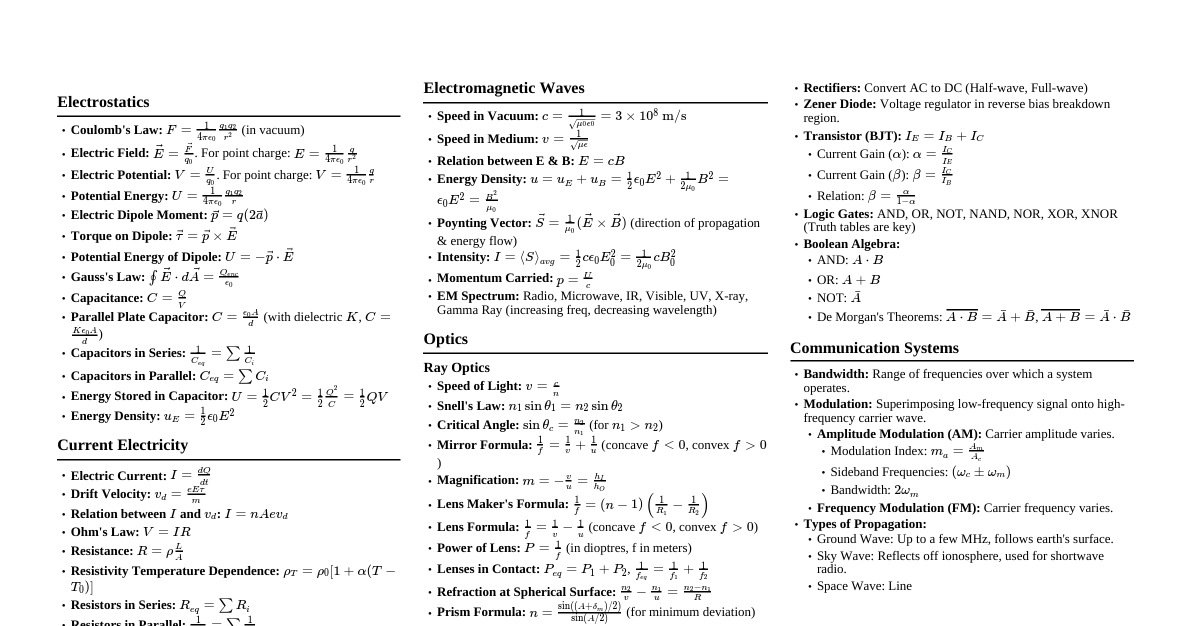
Physics Cheatsheet
Cheatsheet Content
1. Physical Quantities and Measurement 1.1. Basic Definitions Physical Quantity: A quantifiable property of a phenomenon or body (e.g., length, mass). Measurement: The act of comparing a physical quantity with a standard unit. Unit: A known fixed quantity used as a standard of measurement. Basic Physical Quantities: Fundamental quantities from which all others can be derived (e.g., length, mass, time). Derived Physical Quantities: Quantities expressed in terms of fundamental quantities (e.g., area, volume, density). 1.2. SI Units International System of Units (SI) is built upon 7 basic quantities: Property Symbol Unit Dimension Length $L$ meter (m) $L$ Mass $m$ kilogram (kg) $M$ Time $t$ second (s) $T$ Temperature $T$ kelvin (K) $\theta$ Electric Current $I$ ampere (A) $I$ Amount of Substance $N$ mole (N) $1$ Luminous Intensity $F$ candela (cd) $J$ Derived units examples: Property Symbol Unit Dimension Force $F$ newton (N) kg$\cdot$m$\cdot$s$^{-2}$ Speed $v$ meter per second (m/s) m$\cdot$s$^{-1}$ Pressure $P$ pascal (Pa) kg$\cdot$m$^{-1}\cdot$s$^{-2}$ Energy $E$ joule (J) kg$\cdot$m$^2\cdot$s$^{-2}$ Power $W$ watt (W) kg$\cdot$m$^2\cdot$s$^{-3}$ 1.3. Unit Conversion To convert units, multiply by conversion factors to cancel unwanted units. Common conversions: Quantity From To Operation Length inch (in) m (inch) $\times$ 0.0254 foot (ft) m (foot) $\times$ 0.3048 mile (mi) m (mile) $\times$ 1609.34 Mass pound (lb) kg (pound) $\times$ 0.4536 metric ton (t) kg (ton) $\times$ 1000 ounce kg (ounce) $\times$ 0.02835 Volume liter (l) m$^3$ (liter) $\times$ 0.001 gallon (ga) m$^3$ (gallon) $\times$ 0.00379 Temperature fahrenheit (F) K $\{(fahrenheit) - 32\} \times \frac{5}{9} + 273.15$ celcius (C) K $(celcius) + 273.15$ 1.4. Uncertainty and Significant Digits Uncertainty: Range of possible values for a measurement, indicating the spread of results. Systematic Error: Consistent errors due to faulty equipment or methods (e.g., uncalibrated scale). Random Error: Fluctuations in measurements, equally probable to be too high or too low, due to limitations of measuring device. Uncertainty in scale device: $\sigma_x = \frac{\text{Smallest increment}}{2}$ Uncertainty in digital device: $\sigma_x = \text{Smallest increment}$ Measurement form: $X_{\text{best}} \pm \sigma_x$ Significant Digits Rules: Non-zero numbers are always significant. Zeros between non-zero digits are significant. Leading zeros (e.g., $0.0062$) are not significant. Trailing zeros are significant if the number contains a decimal point (e.g., $4.0500$). For multiplication/division, the result has the same number of significant digits as the least precise factor. For addition/subtraction, the result has the same number of decimal places as the least precise term. 2. Vectors 2.1. Definitions Scalar: A quantity with magnitude only (e.g., mass, time, volume, speed). Obeys ordinary algebra. Vector: A quantity with both magnitude and direction (e.g., displacement, velocity, acceleration, momentum). Obeys vector algebra. Vector Representation: Algebraic: A letter with an arrow ($\vec{v}$). Magnitude is a positive scalar ($|\vec{A}|$ or $A$). Geometric: An arrow, where length is magnitude and arrowhead indicates direction. Resultant Vector: A single vector obtained by adding two or more vectors. 2.2. Vector Addition Graphical Method (Head-to-Tail): Join vectors head-to-tail. The resultant is drawn from the tail of the first to the head of the last vector. Parallelogram Law: For two vectors $\vec{A}$ and $\vec{B}$ originating from the same point, the resultant $\vec{R}$ is the diagonal of the parallelogram formed by $\vec{A}$ and $\vec{B}$ as adjacent sides. Cosine Law (Magnitude): $R = \sqrt{A^2 + B^2 - 2AB\cos\theta}$ (where $\theta$ is the angle between $\vec{A}$ and $\vec{B}$ when placed tail-to-tail) Sine Law (Direction): $\frac{\sin\alpha}{B} = \frac{\sin\beta}{A} = \frac{\sin\theta}{R}$ (angles within the triangle formed by vectors) 2.3. Vector Components For a vector $\vec{A}$ in 2D with angle $\theta$ from the x-axis: x-component: $A_x = A\cos\theta$ y-component: $A_y = A\sin\theta$ Magnitude: $A = \sqrt{A_x^2 + A_y^2}$ For a vector $\vec{A}$ in 3D with components $A_x, A_y, A_z$: Vector: $\vec{A} = A_x\hat{i} + A_y\hat{j} + A_z\hat{k}$ Magnitude: $A = \sqrt{A_x^2 + A_y^2 + A_z^2}$ Direction Cosines: $\cos\theta_x = \frac{A_x}{A}$, $\cos\theta_y = \frac{A_y}{A}$, $\cos\theta_z = \frac{A_z}{A}$ 2.4. Unit Vectors Definition: A dimensionless vector with magnitude one, used to specify direction. Denoted with a "hat" ($\hat{u}$). $\hat{A} = \frac{\vec{A}}{|\vec{A}|}$ Cartesian Unit Vectors: $\hat{i}$ (x-direction), $\hat{j}$ (y-direction), $\hat{k}$ (z-direction). Vector in Unit Vector Notation: $\vec{A} = A_x\hat{i} + A_y\hat{j} + A_z\hat{k}$ Addition in Unit Vector Notation: If $\vec{A} = A_x\hat{i} + A_y\hat{j} + A_z\hat{k}$ and $\vec{B} = B_x\hat{i} + B_y\hat{j} + B_z\hat{k}$, then $\vec{A} + \vec{B} = (A_x + B_x)\hat{i} + (A_y + B_y)\hat{j} + (A_z + B_z)\hat{k}$ Finding a Unit Vector: For $\vec{r} = x\hat{i} + y\hat{j} + z\hat{k}$, the unit vector in its direction is $\hat{r} = \frac{x}{r}\hat{i} + \frac{y}{r}\hat{j} + \frac{z}{r}\hat{k}$, where $r = \sqrt{x^2+y^2+z^2}$. 3. Kinematics 3.1. Kinematical Quantities Position: Location of an object relative to a reference point. Displacement ($\Delta\vec{r}$): Change in position ($\Delta\vec{r} = \vec{r}_f - \vec{r}_i$). It's a vector. Distance ($S$): Total length of the path followed. It's a scalar. Average Velocity ($\vec{v}_{\text{av}}$): Total displacement divided by total time ($\vec{v}_{\text{av}} = \frac{\Delta\vec{r}}{\Delta t}$). It's a vector. Average Speed: Total distance traveled divided by total elapsed time ($\text{Speed}_{\text{av}} = \frac{S}{\Delta t}$). It's a scalar. Instantaneous Velocity ($\vec{v}$): Limiting value of average velocity as $\Delta t \to 0$ ($\vec{v} = \lim_{\Delta t \to 0} \frac{\Delta\vec{r}}{\Delta t}$). It's a vector, tangent to path. Instantaneous Speed: Magnitude of instantaneous velocity. Average Acceleration ($\vec{a}_{\text{av}}$): Change in velocity divided by time interval ($\vec{a}_{\text{av}} = \frac{\Delta\vec{v}}{\Delta t}$). It's a vector. Instantaneous Acceleration ($\vec{a}$): Limiting value of average acceleration as $\Delta t \to 0$ ($\vec{a} = \lim_{\Delta t \to 0} \frac{\Delta\vec{v}}{\Delta t}$). 3.2. Motion with Constant Acceleration Velocity changes at a constant rate. $\vec{v}_f = \vec{v}_i + \vec{a}t$ $\vec{r}_f - \vec{r}_i = \vec{v}_i t + \frac{1}{2}\vec{a}t^2$ $\vec{r}_f - \vec{r}_i = \frac{1}{2}(\vec{v}_i + \vec{v}_f)t$ $v_f^2 = v_i^2 + 2a(\Delta r)$ (for 1D) For 2D motion, components are independent: $v_{xf} = v_{xi} + a_xt$ $v_{yf} = v_{yi} + a_yt$ $\Delta x = v_{xi}t + \frac{1}{2}a_xt^2$ $\Delta y = v_{yi}t + \frac{1}{2}a_yt^2$ 3.3. Free Fall Motion Motion under gravity's sole influence, neglecting air resistance. Constant acceleration $g = 9.8 \text{ m/s}^2$ downwards. 3.4. Projectile Motion Motion of an object thrown obliquely into space, following a path determined by gravity. Assumptions: $g$ is constant and downward, air resistance is negligible. Path is a parabola. Initial velocity $\vec{u}$ at angle $\theta$ to horizontal. Components: $u_x = u\cos\theta$, $u_y = u\sin\theta$. Horizontal motion: $a_x = 0$, $v_x = u_x = u\cos\theta$, $x_f = u_xt = (u\cos\theta)t$. Vertical motion: $a_y = -g$, $v_y = u_y - gt = (u\sin\theta) - gt$, $y_f = u_yt - \frac{1}{2}gt^2 = (u\sin\theta)t - \frac{1}{2}gt^2$. Maximum Height ($H$): Occurs when $v_y = 0$. $t_H = \frac{u\sin\theta}{g}$. $H = \frac{u^2\sin^2\theta}{2g}$. Time of Flight ($t_{\text{tot}}$): $t_{\text{tot}} = 2t_H = \frac{2u\sin\theta}{g}$. Horizontal Range ($R$): $R = u_x t_{\text{tot}} = (u\cos\theta)\left(\frac{2u\sin\theta}{g}\right) = \frac{u^2\sin(2\theta)}{g}$. Maximum range occurs at $\theta = 45^\circ$, $R_{\text{max}} = \frac{u^2}{g}$. 4. Dynamics (Forces) 4.1. Force Definitions Force: An interaction that changes an object's motion (magnitude or direction). Net Force ($\vec{F}_{\text{net}}$): Vector sum of all forces acting on an object. An object accelerates only if $\vec{F}_{\text{net}} \neq 0$. Contact Forces: Require physical contact (e.g., muscular, frictional, normal, applied, tension, spring, air resistance). Non-Contact Forces (Field Forces): Act without physical contact (e.g., gravitational, magnetic, electrostatic). 4.2. Types of Contact Forces Muscular Force: Force exerted by muscles (e.g., lifting, pushing). Frictional Force ($f$): Resisting force when objects move or try to move on a surface. Acts parallel to surface, opposite to motion/impending motion. Static Friction ($f_s$): Exists between stationary objects. $f_s \le \mu_s N$. Kinetic Friction ($f_k$): Exists when objects are in motion. $f_k = \mu_k N$. $\mu_s$: Coefficient of static friction. $\mu_k$: Coefficient of kinetic friction ($\mu_k Normal Force ($N$): Force exerted by a surface perpendicular to the surface. Prevents objects from passing through. Applied Force: A direct push or pull on an object. Tension Force: Force transmitted through a stretched cable or rope. Spring Force: Force exerted by a compressed or stretched spring. Air Resistance: Frictional force experienced by objects moving through air. 4.3. Types of Non-Contact Forces Gravitational Force: Attractive force between any two objects with mass. Magnetic Force: Force exerted by magnets on magnetic objects. Electrostatic Force: Force between electrically charged bodies (attractive or repulsive). 4.4. Newton's Laws of Motion First Law (Law of Inertia): An object at rest stays at rest, and an object in motion stays in motion with the same speed and in the same direction unless acted upon by an unbalanced force. ($\vec{F}_{\text{net}} = 0 \implies \vec{a} = 0$). Second Law: The acceleration of an object is directly proportional to the net force acting on it, and inversely proportional to its mass. The direction of the acceleration is in the direction of the net force. ($\sum \vec{F} = m\vec{a}$). Third Law: For every action, there is an equal and opposite reaction. If object A exerts a force $\vec{F}_{AB}$ on object B, then object B exerts a force $\vec{F}_{BA}$ on object A such that $\vec{F}_{AB} = -\vec{F}_{BA}$. Applying Newton's Laws: Draw a sketch of the situation. Draw a free-body diagram for each object, showing all external forces. Choose a coordinate system that simplifies calculations. Apply Newton's Second Law ($\sum F_x = ma_x$, $\sum F_y = ma_y$) for each object and component. Solve the resulting equations. 4.5. Uniform Circular Motion Motion in a circular path at constant speed. Object has acceleration because direction of velocity changes. Centripetal Acceleration ($a_c$): Always perpendicular to velocity, points towards the center of the circle. $a_c = \frac{v^2}{r}$. Period ($T$): Time for one complete revolution. $T = \frac{2\pi r}{v}$. 4.6. Newton's Law of Universal Gravitation Every particle in the universe attracts every other particle with a force directly proportional to the product of their masses and inversely proportional to the square of the distance between them. $F_g = G\frac{m_1 m_2}{r^2}$, where $G = 6.674 \times 10^{-11} \text{ Nm}^2/\text{kg}^2$ (gravitational constant). Acceleration due to gravity ($g$): $g = G\frac{M_E}{R_E^2} \approx 9.8 \text{ m/s}^2$ near Earth's surface. 4.7. Kepler's Laws of Planetary Motion First Law (Law of Orbits): The orbit of each planet around the Sun is an ellipse with the Sun at one focus. Second Law (Law of Areas): A line segment joining a planet and the Sun sweeps out equal areas during equal intervals of time. (Planet moves faster when closer to Sun). Third Law (Law of Harmony): The square of the orbital period ($T$) of a planet is proportional to the cube of its average distance ($R$) from the Sun. $\frac{T^2}{R^3} = \text{constant}$ for all planets in a system. 4.8. Weightlessness Sensation experienced when there are no external objects exerting contact forces (push/pull) on the body. Occurs in free fall, where only gravity (a non-contact force) acts. Gravity cannot be "felt" without opposing forces. 5. Work, Energy, and Momentum 5.1. Work Work ($W$): Transfer of energy to an object due to an applied force causing displacement. Conditions for work: Force exerted, displacement occurs, force has a component along displacement. Questions & Problems Section 1: Physical Quantities & Measurement MCQ 1.1 Which of the following is a basic physical quantity? Force Volume Time Density MCQ 1.2 If a measurement is recorded as $0.00450 \text{ m}$, how many significant figures does it have? 2 3 4 5 Workout 1.1 Convert a speed limit of $30 \text{ km/hr}$ to miles per hour. (Use the conversion factor from the table). Workout 1.2 A student measures the length of a rod as $12.35 \text{ cm}$ using a ruler with the smallest increment of $1 \text{ mm}$. What is the uncertainty in this measurement? Section 2: Vectors MCQ 2.1 Which statement is true for a scalar quantity? It has both magnitude and direction. It only has magnitude. It always points in the positive x-direction. It obeys vector algebra. MCQ 2.2 Two vectors, $\vec{A}$ and $\vec{B}$, are perpendicular. What is the magnitude of their resultant $\vec{R} = \vec{A} + \vec{B}$? $|\vec{A}| + |\vec{B}|$ $\sqrt{|\vec{A}|^2 + |\vec{B}|^2}$ $|\vec{A}| - |\vec{B}|$ $\sqrt{|\vec{A}|^2 - |\vec{B}|^2}$ Workout 2.1 Given displacement vectors $\vec{A} = (3\hat{i} - 4\hat{j} + 4\hat{k})\text{ m}$ and $\vec{B} = (2\hat{i} + 3\hat{j} - 7\hat{k})\text{ m}$. Find the magnitude of $\vec{A} + \vec{B}$. Find the magnitude of $2\vec{A} - \vec{B}$. Workout 2.2 Find a unit vector in the direction of the resultant of vectors $\vec{A} = (2\hat{i} - 3\hat{j} + \hat{k})$ and $\vec{B} = (\hat{i} + \hat{j} + 2\hat{k})$. Section 3: Kinematics MCQ 3.1 An object moves in a straight line. If its velocity changes from $10 \text{ m/s}$ to $20 \text{ m/s}$ in $5 \text{ s}$, what is its average acceleration? $1 \text{ m/s}^2$ $2 \text{ m/s}^2$ $3 \text{ m/s}^2$ $4 \text{ m/s}^2$ MCQ 3.2 Which of the following is true for projectile motion (neglecting air resistance)? Horizontal velocity changes due to gravity. Vertical acceleration is zero. The path is a parabola. Maximum range occurs at $60^\circ$ launch angle. Workout 3.1 (Free Body Diagram Required) A jet plane lands with a speed of $100 \text{ m/s}$ and slows down at a rate of $5 \text{ m/s}^2$ as it comes to rest. What is the time interval needed by the jet to come to rest? What distance does the jet travel before coming to rest? If the runway is $0.8 \text{ km}$ long, can the jet land safely? Workout 3.2 A rocket is fired with an initial velocity of $100 \text{ m/s}$ at an angle of $55^\circ$ above the horizontal. It explodes $12 \text{ s}$ after its firing. What are the x- and y-coordinates of the rocket relative to its firing point at the moment of explosion? Section 4: Dynamics (Forces) MCQ 4.1 According to Newton's First Law, an object in motion will not change its velocity unless: Its mass changes. It experiences a net force. It is in a vacuum. It is at rest. MCQ 4.2 The force exerted by a surface perpendicular to an object resting on it is called: Frictional force Tension force Normal force Gravitational force Workout 4.1 (Free Body Diagram Required) A $40 \text{ kg}$ box sits at rest on a frictionless tile floor. A $20 \text{ N}$ horizontal force is applied to it. Draw the free-body diagram for the box and calculate its acceleration. Workout 4.2 (Free Body Diagram Required) A bag of cement of weight $300 \text{ N}$ hangs from three ropes. Two ropes make angles of $53.0^\circ$ and $37.0^\circ$ with the horizontal, and the third rope is vertical. If the system is in equilibrium, draw the free-body diagram for the knot where the ropes meet and find the tension in each rope. Section 5: Uniform Circular Motion & Gravitation MCQ 5.1 An object moving in a circle at a constant speed has acceleration because: Its speed is changing. Its direction is changing. Its mass is changing. It is acted upon by gravity only. MCQ 5.2 Kepler's Third Law states that for planets orbiting the Sun, the ratio $\frac{T^2}{R^3}$ is: Different for each planet. Constant for all planets. Dependent on the planet's mass. Dependent on the planet's velocity. Workout 5.1 An athlete rotates a discus along a circular path of radius $1.06 \text{ m}$. If the maximum speed of the discus is $20 \text{ m/s}$, determine the magnitude of the maximum centripetal acceleration. Workout 5.2 Calculate the gravitational force between two $1 \text{ kg}$ masses placed $1 \text{ m}$ apart. (Use $G = 6.674 \times 10^{-11} \text{ Nm}^2/\text{kg}^2$). Section 6: Work, Energy & Momentum (Conceptual) MCQ 6.1 Work is done on an object when: A force is applied, but no displacement occurs. An object is lifted against gravity. An object moves at constant velocity. A force is applied perpendicular to the direction of motion. MCQ 6.2 Which situation describes weightlessness? Sitting in a stationary chair. An astronaut in orbit around Earth. An object falling through a dense fluid. Pushing a heavy box across the floor. Answers Section 1: Physical Quantities & Measurement MCQ 1.1 Answer c) Time Step-by-step: Force, Volume, and Density are derived quantities, as they can be expressed in terms of basic quantities like mass, length, and time. Time is a fundamental, basic physical quantity. MCQ 1.2 Answer b) 3 Step-by-step: Leading zeros ($0.00$) are not significant. The digits $4$, $5$, and the trailing zero after the decimal point ($0$) are significant. Thus, there are 3 significant figures. Workout 1.1 Solution Given speed: $30 \text{ km/hr}$ To convert to miles per hour, we need the conversion factor from km to miles. From the table, $1 \text{ mile} = 1609.34 \text{ m} = 1.60934 \text{ km}$. So, $1 \text{ km} = \frac{1}{1.60934} \text{ miles} \approx 0.62137 \text{ miles}$. Speed in miles per hour: $30 \text{ km/hr} \times \frac{0.62137 \text{ miles}}{1 \text{ km}} = 18.64 \text{ miles/hr}$. Workout 1.2 Solution The smallest increment of the ruler is $1 \text{ mm} = 0.1 \text{ cm}$. For a scale measuring device, the uncertainty is half of the smallest increment. Uncertainty $\sigma_x = \frac{\text{Smallest increment}}{2} = \frac{0.1 \text{ cm}}{2} = 0.05 \text{ cm}$. Section 2: Vectors MCQ 2.1 Answer b) It only has magnitude. Step-by-step: A scalar quantity is fully described by its magnitude alone and does not have a direction. It follows the rules of ordinary algebra. MCQ 2.2 Answer b) $\sqrt{|\vec{A}|^2 + |\vec{B}|^2}$ Step-by-step: If two vectors $\vec{A}$ and $\vec{B}$ are perpendicular, the angle between them is $90^\circ$. Using the cosine law for vector addition, $R = \sqrt{A^2 + B^2 - 2AB\cos(90^\circ)}$. Since $\cos(90^\circ) = 0$, the formula simplifies to $R = \sqrt{A^2 + B^2}$. Workout 2.1 Solution Given $\vec{A} = (3\hat{i} - 4\hat{j} + 4\hat{k})\text{ m}$ and $\vec{B} = (2\hat{i} + 3\hat{j} - 7\hat{k})\text{ m}$. Find the magnitude of $\vec{A} + \vec{B}$. First, find $\vec{A} + \vec{B}$: $\vec{A} + \vec{B} = (3+2)\hat{i} + (-4+3)\hat{j} + (4-7)\hat{k} = (5\hat{i} - \hat{j} - 3\hat{k})\text{ m}$ Magnitude: $|\vec{A} + \vec{B}| = \sqrt{5^2 + (-1)^2 + (-3)^2} = \sqrt{25 + 1 + 9} = \sqrt{35} \approx 5.92 \text{ m}$ Find the magnitude of $2\vec{A} - \vec{B}$. First, find $2\vec{A}$: $2\vec{A} = 2(3\hat{i} - 4\hat{j} + 4\hat{k}) = (6\hat{i} - 8\hat{j} + 8\hat{k})\text{ m}$ Next, find $2\vec{A} - \vec{B}$: $2\vec{A} - \vec{B} = (6-2)\hat{i} + (-8-3)\hat{j} + (8-(-7))\hat{k} = (4\hat{i} - 11\hat{j} + 15\hat{k})\text{ m}$ Magnitude: $|2\vec{A} - \vec{B}| = \sqrt{4^2 + (-11)^2 + 15^2} = \sqrt{16 + 121 + 225} = \sqrt{362} \approx 19.03 \text{ m}$ Workout 2.2 Solution Given vectors $\vec{A} = (2\hat{i} - 3\hat{j} + \hat{k})$ and $\vec{B} = (\hat{i} + \hat{j} + 2\hat{k})$. First, find the resultant vector $\vec{R} = \vec{A} + \vec{B}$: $\vec{R} = (2+1)\hat{i} + (-3+1)\hat{j} + (1+2)\hat{k} = (3\hat{i} - 2\hat{j} + 3\hat{k})$ Next, find the magnitude of $\vec{R}$: $|\vec{R}| = \sqrt{3^2 + (-2)^2 + 3^2} = \sqrt{9 + 4 + 9} = \sqrt{22}$ The unit vector in the direction of $\vec{R}$ is $\hat{r} = \frac{\vec{R}}{|\vec{R}|}$: $\hat{r} = \frac{3\hat{i} - 2\hat{j} + 3\hat{k}}{\sqrt{22}} = \frac{3}{\sqrt{22}}\hat{i} - \frac{2}{\sqrt{22}}\hat{j} + \frac{3}{\sqrt{22}}\hat{k}$ $\hat{r} \approx 0.64\hat{i} - 0.43\hat{j} + 0.64\hat{k}$ Section 3: Kinematics MCQ 3.1 Answer b) $2 \text{ m/s}^2$ Step-by-step: Average acceleration $\vec{a}_{\text{av}} = \frac{\Delta\vec{v}}{\Delta t} = \frac{v_f - v_i}{t}$. $a_{\text{av}} = \frac{20 \text{ m/s} - 10 \text{ m/s}}{5 \text{ s}} = \frac{10 \text{ m/s}}{5 \text{ s}} = 2 \text{ m/s}^2$. MCQ 3.2 Answer c) The path is a parabola. Step-by-step: In projectile motion (neglecting air resistance), horizontal velocity is constant (a), vertical acceleration is due to gravity ($g$, not zero) (b), and maximum range is at $45^\circ$ (d). The path is always a parabola. Workout 3.1 Solution Given: Initial speed $v_i = 100 \text{ m/s}$, acceleration $a = -5 \text{ m/s}^2$ (deceleration), final speed $v_f = 0 \text{ m/s}$. Time interval needed to come to rest: Using $v_f = v_i + at$: $0 = 100 \text{ m/s} + (-5 \text{ m/s}^2)t$ $5t = 100 \text{ s}$ $t = 20 \text{ s}$ Distance traveled before coming to rest: Using $\Delta x = v_i t + \frac{1}{2}at^2$: $\Delta x = (100 \text{ m/s})(20 \text{ s}) + \frac{1}{2}(-5 \text{ m/s}^2)(20 \text{ s})^2$ $\Delta x = 2000 \text{ m} - \frac{1}{2}(5 \text{ m/s}^2)(400 \text{ s}^2)$ $\Delta x = 2000 \text{ m} - 1000 \text{ m} = 1000 \text{ m} = 1 \text{ km}$ Alternatively, using $v_f^2 = v_i^2 + 2a\Delta x$: $0^2 = (100 \text{ m/s})^2 + 2(-5 \text{ m/s}^2)\Delta x$ $0 = 10000 \text{ m}^2/\text{s}^2 - 10 \text{ m/s}^2 \Delta x$ $10 \text{ m/s}^2 \Delta x = 10000 \text{ m}^2/\text{s}^2$ $\Delta x = 1000 \text{ m} = 1 \text{ km}$ Can the jet land safely if the runway is $0.8 \text{ km}$ long? No. The jet needs $1 \text{ km}$ to stop, but the runway is only $0.8 \text{ km}$ ($800 \text{ m}$) long. It cannot land safely. Free Body Diagram: For horizontal motion: Assume the jet is moving in the positive x-direction. The only horizontal force is the braking force (friction/thrust reversal), acting in the negative x-direction. Let $F_B$ be the braking force. Then $\sum F_x = -F_B = ma_x$. (Since this problem gives acceleration directly, the FBD is conceptual for understanding forces.) Workout 3.2 Solution Given: Initial velocity $u = 100 \text{ m/s}$, launch angle $\theta = 55^\circ$, time $t = 12 \text{ s}$. Initial velocity components: $u_x = u\cos\theta = 100 \text{ m/s} \times \cos(55^\circ) = 100 \text{ m/s} \times 0.5736 = 57.36 \text{ m/s}$ $u_y = u\sin\theta = 100 \text{ m/s} \times \sin(55^\circ) = 100 \text{ m/s} \times 0.8192 = 81.92 \text{ m/s}$ Horizontal coordinate ($x$): $x = u_x t = (57.36 \text{ m/s})(12 \text{ s}) = 688.32 \text{ m}$ Vertical coordinate ($y$): Using $y = u_y t + \frac{1}{2}a_yt^2$, with $a_y = -g = -9.8 \text{ m/s}^2$: $y = (81.92 \text{ m/s})(12 \text{ s}) + \frac{1}{2}(-9.8 \text{ m/s}^2)(12 \text{ s})^2$ $y = 983.04 \text{ m} - (4.9 \text{ m/s}^2)(144 \text{ s}^2)$ $y = 983.04 \text{ m} - 705.6 \text{ m} = 277.44 \text{ m}$ At the moment of explosion, the coordinates are approximately $(688 \text{ m}, 277 \text{ m})$. Section 4: Dynamics (Forces) MCQ 4.1 Answer b) It experiences a net force. Step-by-step: Newton's First Law states that an object's state of motion (velocity) changes only if a net external force acts upon it. Without a net force, it maintains constant velocity (which includes zero velocity if at rest). MCQ 4.2 Answer c) Normal force Step-by-step: The normal force is specifically defined as the contact force exerted by a surface on an object, acting perpendicular to the surface. Workout 4.1 Solution Given: mass $m = 40 \text{ kg}$, applied force $F_A = 20 \text{ N}$ (horizontal), frictionless floor. Free Body Diagram: A dot or small box representing the $40 \text{ kg}$ box. A downward arrow labeled $mg$ (weight). An upward arrow labeled $N$ (normal force). A horizontal arrow to the right labeled $F_A = 20 \text{ N}$. Since the floor is frictionless, there is no frictional force. Apply Newton's Second Law in the horizontal direction: $\sum F_x = ma_x$ $F_A = ma_x$ $20 \text{ N} = (40 \text{ kg})a_x$ $a_x = \frac{20 \text{ N}}{40 \text{ kg}} = 0.5 \text{ m/s}^2$ The acceleration of the box is $0.5 \text{ m/s}^2$ in the direction of the applied force. Workout 4.2 Solution Given: Weight of cement bag $W = 300 \text{ N}$. Angles of upper ropes: $\theta_1 = 53.0^\circ$ and $\theta_2 = 37.0^\circ$ with the horizontal. System is in equilibrium. Free Body Diagram for the knot (point where ropes meet): A dot representing the knot. Three arrows originating from the dot: $T_1$: Tension in the rope at $53.0^\circ$ above the negative x-axis (or $180-53 = 127^\circ$ from positive x-axis). $T_2$: Tension in the rope at $37.0^\circ$ above the positive x-axis. $T_3$: Tension in the vertical rope, pointing downwards. This tension is equal to the weight of the bag, so $T_3 = W = 300 \text{ N}$. Since the system is in equilibrium, the net force in both x and y directions is zero. Equations from FBD: Sum of forces in x-direction ($\sum F_x = 0$): $T_2 \cos(37^\circ) - T_1 \cos(53^\circ) = 0$ $T_2 (0.7986) - T_1 (0.6018) = 0$ $T_2 \approx 0.7536 T_1$ (Equation 1) Sum of forces in y-direction ($\sum F_y = 0$): $T_1 \sin(53^\circ) + T_2 \sin(37^\circ) - T_3 = 0$ $T_1 (0.7986) + T_2 (0.6018) - 300 \text{ N} = 0$ (Equation 2) Substitute Equation 1 into Equation 2: $T_1 (0.7986) + (0.7536 T_1) (0.6018) - 300 = 0$ $0.7986 T_1 + 0.4536 T_1 - 300 = 0$ $1.2522 T_1 = 300$ $T_1 = \frac{300}{1.2522} \approx 239.58 \text{ N}$ Now find $T_2$ using Equation 1: $T_2 = 0.7536 \times 239.58 \text{ N} \approx 180.59 \text{ N}$ The tensions are: $T_1 \approx 240 \text{ N}$, $T_2 \approx 181 \text{ N}$, and $T_3 = 300 \text{ N}$. Section 5: Uniform Circular Motion & Gravitation MCQ 5.1 Answer b) Its direction is changing. Step-by-step: Acceleration is the rate of change of velocity. Velocity is a vector with both magnitude (speed) and direction. Even if the speed is constant, a change in direction means a change in velocity, hence there is acceleration (centripetal acceleration). MCQ 5.2 Answer b) Constant for all planets. Step-by-step: Kepler's Third Law states that the ratio of the square of a planet's orbital period to the cube of its average distance from the Sun is a constant value for all planets orbiting that same Sun. Workout 5.1 Solution Given: Radius $r = 1.06 \text{ m}$, maximum speed $v = 20 \text{ m/s}$. Maximum centripetal acceleration $a_c = \frac{v^2}{r}$: $a_c = \frac{(20 \text{ m/s})^2}{1.06 \text{ m}} = \frac{400 \text{ m}^2/\text{s}^2}{1.06 \text{ m}} \approx 377.36 \text{ m/s}^2$ Workout 5.2 Solution Given: $m_1 = 1 \text{ kg}$, $m_2 = 1 \text{ kg}$, distance $r = 1 \text{ m}$, $G = 6.674 \times 10^{-11} \text{ Nm}^2/\text{kg}^2$. Using Newton's Law of Universal Gravitation $F_g = G\frac{m_1 m_2}{r^2}$: $F_g = (6.674 \times 10^{-11} \text{ Nm}^2/\text{kg}^2) \frac{(1 \text{ kg})(1 \text{ kg})}{(1 \text{ m})^2}$ $F_g = 6.674 \times 10^{-11} \text{ N}$ Section 6: Work, Energy & Momentum (Conceptual) MCQ 6.1 Answer b) An object is lifted against gravity. Step-by-step: For work to be done, a force must be applied and cause a displacement in the direction of the force (or a component of it). Lifting an object against gravity involves an upward force and an upward displacement. If no displacement occurs (a), or force is perpendicular to motion (d), no work is done. Constant velocity (c) implies zero net force, so no net work is done by external forces, though individual forces might do work. MCQ 6.2 Answer b) An astronaut in orbit around Earth. Step-by-step: Weightlessness is the sensation of lacking contact forces. An astronaut in orbit is constantly in free fall around Earth, experiencing only the force of gravity, thus feeling weightless. The other options involve contact forces or are not in a state of free fall.