NEET Physics Master Cheatsheet
Cheatsheet Content
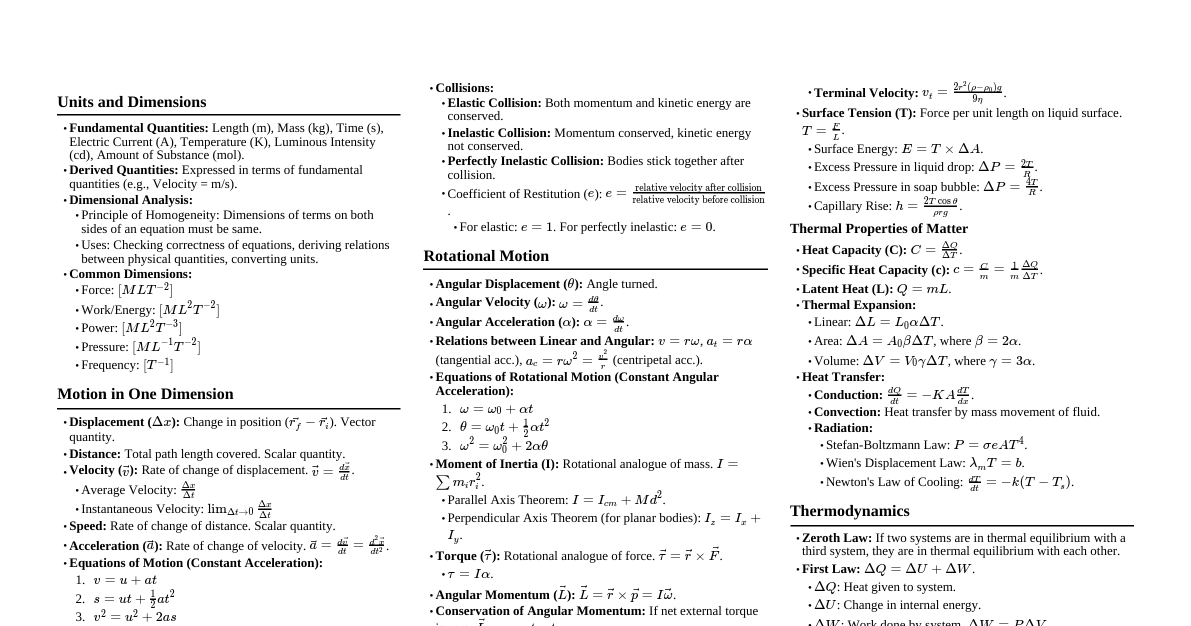
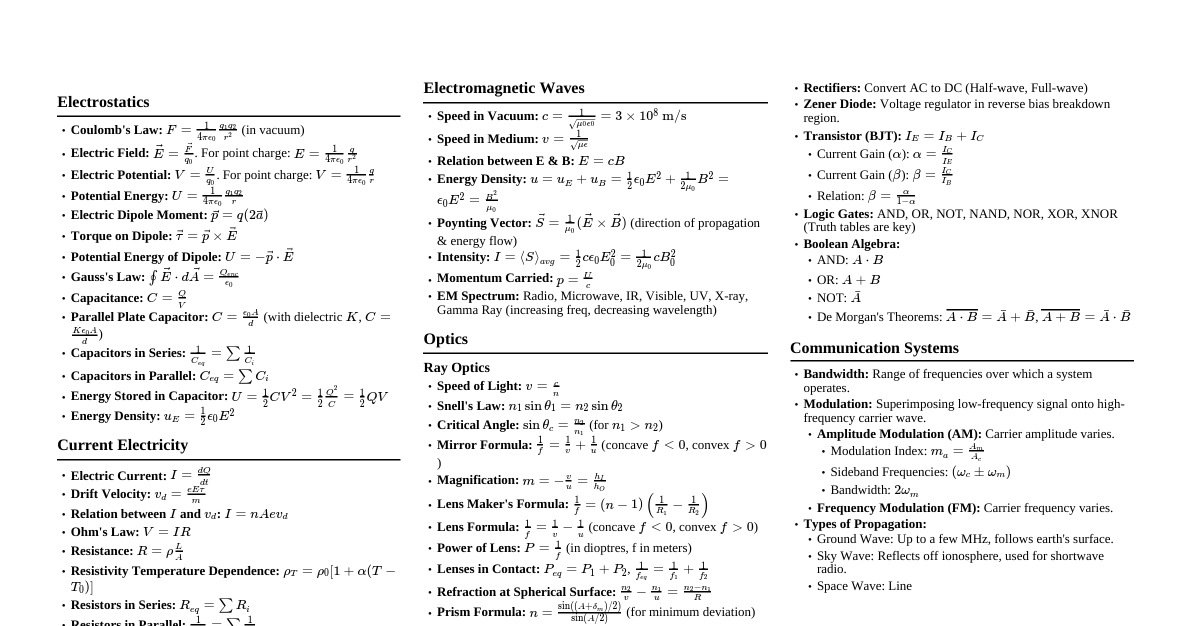
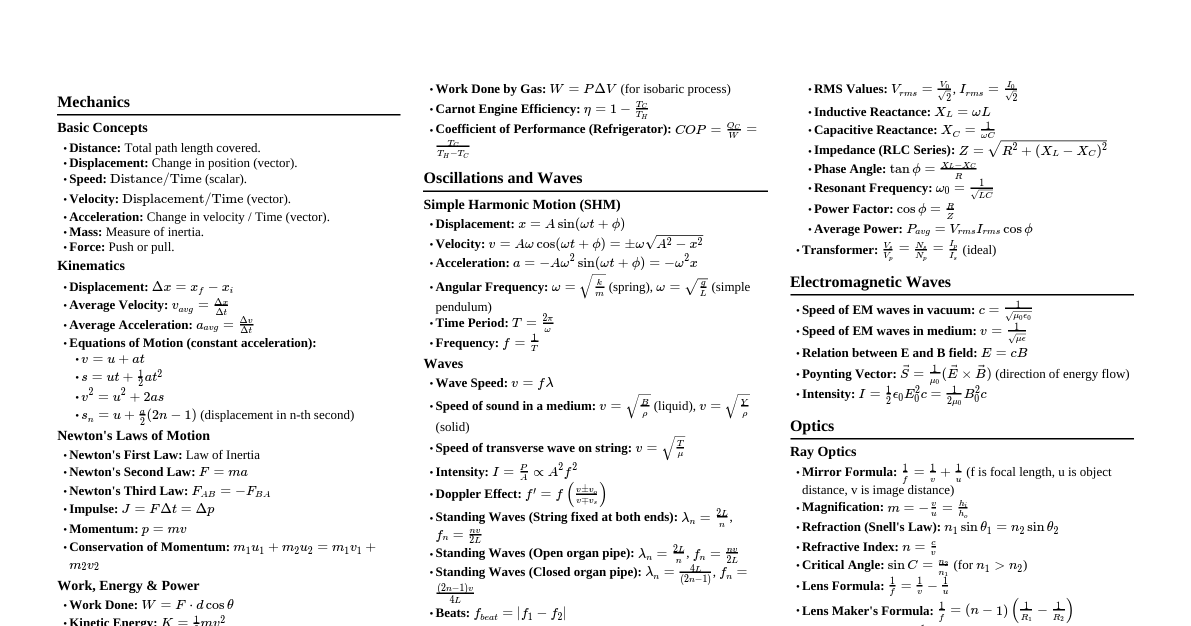
### Page 1 — Mechanics-I (Kinematics, Laws of Motion, Work-Energy-Power) #### 1️⃣ FORMULA MAP - **Kinematics:** - $$\vec{v} = \vec{u} + \vec{a}t$$ (Vector form, constant $\vec{a}$) - $\vec{v}$: final velocity, $\vec{u}$: initial velocity, $\vec{a}$: acceleration, $t$: time - Units: m/s, m/s², s - Validity: Constant acceleration only. - $$\Delta \vec{x} = \vec{u}t + \frac{1}{2}\vec{a}t^2$$ (Vector form, constant $\vec{a}$) - $\Delta \vec{x}$: displacement - Units: m - Validity: Constant acceleration only. - $$v^2 = u^2 + 2a\Delta x$$ (Scalar form, constant $a$, 1D) - Validity: Constant acceleration, 1D motion. - $$v_{avg} = \frac{\Delta x}{\Delta t}$$ (Average velocity) - $$a_{avg} = \frac{\Delta v}{\Delta t}$$ (Average acceleration) - $$x_n = u + \frac{a}{2}(2n-1)$$ (Displacement in $n^{th}$ second) - Validity: Constant acceleration, 1D. - **Projectile Motion:** - $$H = \frac{u^2\sin^2\theta}{2g}$$ (Max height) - $$R = \frac{u^2\sin(2\theta)}{g}$$ (Range) - $$T = \frac{2u\sin\theta}{g}$$ (Time of flight) - Validity: Projectile launched from ground, lands on ground. No air resistance. - **Relative Motion:** - $$\vec{v}_{AB} = \vec{v}_A - \vec{v}_B$$ (Velocity of A w.r.t. B) - $$\vec{a}_{AB} = \vec{a}_A - \vec{a}_B$$ (Acceleration of A w.r.t. B) - **Laws of Motion:** - $$\vec{F}_{net} = m\vec{a}$$ (Newton's 2nd Law) - Units: N, kg, m/s² - Validity: Constant mass system, inertial frame. - $$F_{friction, max} = \mu_s N$$ (Static friction) - $$F_{friction, k} = \mu_k N$$ (Kinetic friction) - $\mu_s$: coefficient of static friction, $\mu_k$: coefficient of kinetic friction, $N$: normal force. - Validity: For surfaces in contact. $\mu_s \ge \mu_k$. - $$Impulse = \vec{J} = \vec{F}_{avg}\Delta t = \Delta \vec{p}$$ (Impulse-momentum theorem) - $\vec{p} = m\vec{v}$: momentum - Units: N·s or kg·m/s - $$F_{centripetal} = \frac{mv^2}{r} = m\omega^2 r$$ (Centripetal force) - Validity: Uniform circular motion. Direction towards center. - **Work, Energy, Power:** - $$W = \vec{F} \cdot \vec{d} = Fd\cos\theta$$ (Work done by constant force) - Units: Joule (J) - $$W = \int \vec{F} \cdot d\vec{r}$$ (Work done by variable force) - $$KE = \frac{1}{2}mv^2$$ (Kinetic Energy) - $$PE_{gravity} = mgh$$ (Gravitational Potential Energy near Earth's surface) - $h$: height from reference level. - $$PE_{spring} = \frac{1}{2}kx^2$$ (Elastic Potential Energy) - $k$: spring constant, $x$: compression/extension from natural length. - $$W_{net} = \Delta KE$$ (Work-Energy Theorem) - $$P = \frac{dW}{dt} = \vec{F} \cdot \vec{v}$$ (Instantaneous Power) - Units: Watt (W) - $$P_{avg} = \frac{W}{\Delta t}$$ (Average Power) #### 2️⃣ “QUESTION DEKHTE HI” TRIGGER ZONE - "constant acceleration" $\rightarrow$ use kinematic equations ($\vec{v} = \vec{u} + \vec{a}t$, etc.). - "body dropped" or "starts from rest" $\rightarrow u=0$. - "comes to rest" $\rightarrow v=0$. - "maximum height" in projectile $\rightarrow v_y = 0$. - "relative velocity" $\rightarrow$ always $\vec{v}_{AB} = \vec{v}_A - \vec{v}_B$. - "force given, find acceleration" $\rightarrow$ always $\vec{F}_{net} = m\vec{a}$. - "friction present" $\rightarrow$ draw FBD, find N, then $F_{friction}$. - "collision / impulse" $\rightarrow$ use Impulse-Momentum Theorem ($\vec{J} = \Delta \vec{p}$). - "circular motion" $\rightarrow$ Centripetal force $F_c = mv^2/r$ must be provided by some real force (tension, friction, gravity). - "work done by friction / air resistance" $\rightarrow$ Non-conservative force, mechanical energy is NOT conserved. Use $W_{nc} = \Delta E_{mech}$. - "work done by gravity / spring" $\rightarrow$ Conservative force, can use potential energy. - "power delivery" $\rightarrow$ $P = \vec{F} \cdot \vec{v}$ for instantaneous, $P = W/t$ for average. - "smooth surface" $\rightarrow$ Friction is zero. #### 3️⃣ ⚠️ EXAM TRAP ZONE - **Sign Conventions:** For 1D motion, define a positive direction and stick to it for displacement, velocity, and acceleration. Up/Right usually positive. - **Vector vs. Scalar:** Kinematic equations are vector equations. $v^2 = u^2 + 2a\Delta x$ is scalar for 1D. Don't mix. - **Relative Velocity:** $\vec{v}_{AB}$ is velocity of A as seen by B. It's NOT $\vec{v}_B - \vec{v}_A$. - **Friction:** Static friction is a variable force, up to $\mu_s N$. Kinetic friction is constant $\mu_k N$. Don't use $\mu_s N$ if the body is already moving. - **Normal Force:** Normal force $N$ is NOT always $mg$. It depends on external forces and inclination. Draw FBD! - **Centripetal Force:** It's a NET force towards center, not an extra force. It's provided by other forces like tension, friction, etc. - **Work Done:** Work is $Fd\cos\theta$. If $F$ is perpendicular to $d$, work is zero (e.g., centripetal force). - **Conservation of Energy:** Only for conservative forces. If friction/air drag is present, mechanical energy is NOT conserved. - **Power:** $P = Fv$ is for instantaneous power when force and velocity are parallel. Use $\vec{F} \cdot \vec{v}$ for general case. #### 4️⃣ 🧠 MEMORY & VISUAL TRICKS - **Kinematics:** "SUVAT" equations (S=displacement, U=initial, V=final, A=accel, T=time). Jo missing ho, uski equation choose karo. - **Projectile:** Max Height ($H$) has $\sin^2\theta$, Range ($R$) has $\sin(2\theta)$, Time ($T$) has $\sin\theta$. (Height is vertical, so $\sin^2$ makes sense, $2\theta$ for range covers both directions). - **Friction:** Static friction is self-adjusting, "jitni zaroorat, utni milegi". Kinetic friction is constant once moving. - **Impulse:** "Force-time graph ka area Impulse dega." (Area under F-t graph is Impulse). - **Work-Energy Theorem:** "All forces ka work = change in KE." $W_{all} = \Delta KE$. - **Power:** "Power is force times velocity, when parallel." $P = Fv$. Imagine pushing a car, faster you push, more power. #### 5️⃣ 🎯 PYQ HOTSPOTS - **Kinematics:** Relative motion (river-boat, rain-man), displacement in $n^{th}$ second, projectile motion (range, height, time, path equation). - **Laws of Motion:** FBDs, connected bodies (pulleys, blocks on inclines), friction problems (static vs kinetic), pseudo force (non-inertial frames). - **Work-Energy-Power:** Work-Energy Theorem applications, conservation of mechanical energy (especially with springs or varying heights), power calculations ($\vec{F} \cdot \vec{v}$). ### Page 2 — Mechanics-II (Centre of Mass, Rotation, Gravitation) #### 1️⃣ FORMULA MAP - **Centre of Mass (COM):** - $$X_{COM} = \frac{\sum m_i x_i}{\sum m_i}$$ (Discrete particles) - $$X_{COM} = \frac{\int x \, dm}{\int dm}$$ (Continuous body) - $$\vec{v}_{COM} = \frac{\sum m_i \vec{v}_i}{\sum m_i}$$ (Velocity of COM) - $$\vec{a}_{COM} = \frac{\sum m_i \vec{a}_i}{\sum m_i} = \frac{\vec{F}_{ext, net}}{M_{total}}$$ (Acceleration of COM) - Validity: For a system of particles/body. $\vec{F}_{ext, net}$ is net external force. - **Rotational Motion:** - $$\vec{\tau} = \vec{r} \times \vec{F}$$ (Torque) - Units: N·m - $$\vec{L} = \vec{r} \times \vec{p} = I\vec{\omega}$$ (Angular momentum) - Units: kg·m²/s or J·s - $I$: Moment of Inertia, $\vec{\omega}$: angular velocity. - $$I = \sum m_i r_i^2$$ (Discrete particles) - $$I = \int r^2 \, dm$$ (Continuous body) - $$I_{parallel} = I_{COM} + Md^2$$ (Parallel Axis Theorem) - $$I_{perpendicular} = I_x + I_y$$ (Perpendicular Axis Theorem, for planar bodies) - $$\vec{\tau}_{net} = I\vec{\alpha}$$ (Rotational equivalent of $F=ma$) - $\vec{\alpha}$: angular acceleration. - $$KE_{rotational} = \frac{1}{2}I\omega^2$$ - $$W_{rotational} = \tau \theta$$ (Work done by constant torque) - **Rolling Motion:** - $$v_{COM} = R\omega$$ (Condition for pure rolling) - $$KE_{total} = KE_{translational} + KE_{rotational} = \frac{1}{2}Mv_{COM}^2 + \frac{1}{2}I_{COM}\omega^2$$ - **Gravitation:** - $$F = G\frac{m_1 m_2}{r^2}$$ (Gravitational force between two point masses) - $G = 6.67 \times 10^{-11} \, N m^2/kg^2$: Universal Gravitational Constant - Units: N - Validity: Point masses or spherically symmetric objects. - $$g = G\frac{M}{R^2}$$ (Acceleration due to gravity on Earth's surface) - $$g_h = g\left(1 - \frac{2h}{R}\right)$$ (Variation of $g$ with height, $h \ll R$) - $$g_d = g\left(1 - \frac{d}{R}\right)$$ (Variation of $g$ with depth) - $$PE_{gravity} = -\frac{GMm}{r}$$ (Gravitational Potential Energy of two masses $M, m$ at distance $r$) - Reference: $PE=0$ at $r=\infty$. - $$V_{gravity} = -\frac{GM}{r}$$ (Gravitational Potential due to mass $M$ at distance $r$) - $$v_{escape} = \sqrt{\frac{2GM}{R}}$$ (Escape velocity from Earth's surface) - $$v_{orbital} = \sqrt{\frac{GM}{r}}$$ (Orbital velocity for circular orbit at radius $r$) - $$T^2 \propto r^3$$ (Kepler's 3rd Law, for circular orbits) - $$T^2 = \left(\frac{4\pi^2}{GM}\right)r^3$$ #### 2️⃣ “QUESTION DEKHTE HI” TRIGGER ZONE - "system of particles" or "body with holes removed" $\rightarrow$ Think Centre of Mass. - "no external force" $\rightarrow$ COM velocity is constant ($\vec{v}_{COM} = constant$). - "force applied, causing rotation" $\rightarrow$ Torque ($\tau = r F \sin\theta$). - "angular momentum conserved" $\rightarrow$ If $\tau_{ext, net} = 0$. - "rolling without slipping" $\rightarrow v_{COM} = R\omega$ and $a_{COM} = R\alpha$. - "object rolling down incline" $\rightarrow$ Use energy conservation: $Mgh = \frac{1}{2}Mv_{COM}^2 + \frac{1}{2}I_{COM}\omega^2$. - "gravitational force between two bodies" $\rightarrow$ $F = GMm/r^2$. - "variation in $g$" $\rightarrow$ Use $g_h$ or $g_d$ formulas. Remember $g_h$ for height, $g_d$ for depth. - "escape velocity" $\rightarrow$ Energy conservation: $KE + PE = 0$ at infinity. - "satellite in orbit" $\rightarrow$ Gravitational force provides centripetal force: $GMm/r^2 = mv_{orbital}^2/r$. - "Kepler's Laws" $\rightarrow$ For planetary motion, especially $T^2 \propto r^3$. #### 3️⃣ ⚠️ EXAM TRAP ZONE - **COM:** If mass is removed, treat it as negative mass at that location for COM calculation. - **Torque:** Always $\vec{r}$ from pivot to force application point. Check direction using right-hand rule or common sense (clockwise/anticlockwise). - **Moment of Inertia (I):** $I$ depends on mass distribution AND axis of rotation. Use Parallel/Perpendicular axis theorems correctly. $I_{COM}$ is minimum. - **Angular Momentum Conservation:** Only if NET external torque is zero. Internal torques don't change total angular momentum. - **Rolling:** For pure rolling, friction acts but does NO work. If slipping, friction does work. - **Gravitational Potential Energy:** It's always negative (attractive force). The maximum value is 0 (at infinity). - **$g$ variation:** $g_h$ formula is approximation for $h \ll R$. For large $h$, use $g_h = G M / (R+h)^2$. $g_d$ is linear with depth. - **Kepler's 3rd Law:** $r$ is semi-major axis (for elliptical) or radius (for circular). #### 4️⃣ 🧠 MEMORY & VISUAL TRICKS - **COM:** "COM wahan, jahan mass zyada." (COM is closer to heavier masses). - **Torque:** "Force ka ghoomane wala effect." (The turning effect of a force). $\tau = rF\sin\theta$. - **Moment of Inertia:** "Mass ka resistance to rotation." (Mass's resistance to angular acceleration). $I = MR^2$ for ring, $I = \frac{1}{2}MR^2$ for disk. "Disk half hai, ring pura." - **Angular Momentum:** "Ice skater experiment yaad karo." (Remember the ice skater extending/retracting arms). $I_1\omega_1 = I_2\omega_2$. - **Rolling:** "Pure rolling matlab, contact point rest par." (Pure rolling means contact point is at rest relative to surface). - **Gravitation:** "Potential energy negative, because attraction." (Potential energy is negative because gravity is attractive). - **Escape Velocity:** "Escape velocity, jab total energy zero." (Escape velocity is when total energy is zero). - **Kepler's 3rd Law:** "Square of Time period is proportional to Cube of Radius." $T^2 \propto R^3$. #### 5️⃣ 🎯 PYQ HOTSPOTS - **Centre of Mass:** COM of system, COM for removed parts, velocity/acceleration of COM. - **Rotational Dynamics:** Moment of inertia calculations (using theorems), torque problems, angular momentum conservation, rolling motion (especially down inclines, energy method). - **Gravitation:** Variation of $g$ (height, depth), gravitational potential/potential energy, escape velocity, orbital velocity, Kepler's laws. ### Page 3 — Properties of Matter (Elasticity & Fluids) #### 1️⃣ FORMULA MAP - **Elasticity:** - $$Stress = \frac{F_{restoring}}{A}$$ (Force per unit area) - Units: N/m² or Pascal (Pa) - $$Strain = \frac{\Delta L}{L_0}$$ (Longitudinal strain) - $$Strain = \frac{\Delta V}{V_0}$$ (Volumetric strain) - $$Strain = \phi$$ (Shear strain, angle of twist) - $$Y = \frac{Stress}{Longitudinal\, Strain} = \frac{F/A}{\Delta L/L_0}$$ (Young's Modulus) - Units: N/m² - Validity: Within elastic limit. - $$B = \frac{Stress}{Volumetric\, Strain} = \frac{-P}{\Delta V/V_0}$$ (Bulk Modulus) - $P$: pressure. - $$G = \frac{Shear\, Stress}{Shear\, Strain} = \frac{F/A}{\phi}$$ (Shear Modulus or Modulus of Rigidity) - $$U = \frac{1}{2} \times Stress \times Strain \times Volume$$ (Elastic Potential Energy stored) - $$U_{per\, unit\, volume} = \frac{1}{2} \times Stress \times Strain$$ - $$Poisson's\, Ratio (\sigma) = -\frac{Lateral\, Strain}{Longitudinal\, Strain}$$ (Typically $0 90^\circ$, so $\cos\theta$ is negative (capillary fall). #### 4️⃣ 🧠 MEMORY & VISUAL TRICKS - **Stress/Strain:** "Stress is force by area, Strain is change by original." (Force/Area, $\Delta L/L$). - **Young's Modulus:** "Y for Young, for wire खींचना." (Y for stretching a wire). - **Pascal's Law:** "Pressure is transmitted equally in a static fluid." (Hydraulic lift yaad karo). - **Archimedes:** "Buoyant force is weight of displaced fluid." (Boat floats, submarine sinks/floats). - **Continuity:** "Jahan area kam, wahan speed zyada." (Narrow pipe, fast flow). "Water hose pipe." - **Bernoulli:** "Pressure + KE + PE is constant." (Energy conservation for fluids). "Fast moving fluid ka pressure kam." (Venturi effect). - **Stokes' Law:** "Viscous drag force, sphere par." (Imagine honey, very thick fluid). - **Surface Tension:** "Water drops gol kyun hote hain?" (Why are water drops spherical? Because of surface tension trying to minimize surface area). - **Capillary Rise:** "Water rises in thin tube, mercury falls." (Cohesive vs Adhesive forces). #### 5️⃣ 🎯 PYQ HOTSPOTS - **Elasticity:** Young's modulus (wire stretching, energy stored), stress-strain graph interpretation. - **Fluid Statics:** Pascal's Law, hydrostatic pressure ($\rho gh$), Archimedes' principle (floating/sinking, apparent weight). - **Fluid Dynamics:** Equation of Continuity, Bernoulli's equation (Venturi meter, airplane lift, Torricelli's law), Stokes' law (terminal velocity). - **Surface Tension:** Capillary rise/fall, excess pressure in drops/bubbles, work done in forming bubbles. ### Page 4 — Thermodynamics & KTG #### 1️⃣ FORMULA MAP - **Thermodynamics:** - $$Q = mc\Delta T$$ (Heat absorbed/released by substance without phase change) - $m$: mass, $c$: specific heat capacity. - Units: Joule (J) - $$Q = mL$$ (Heat absorbed/released during phase change) - $L$: latent heat (fusion or vaporization). - **First Law of Thermodynamics:** $\Delta U = Q - W$ - $\Delta U$: change in internal energy, $Q$: heat added to system, $W$: work done BY system. - Units: J - Sign convention: $Q_{added} > 0$, $W_{by\,system} > 0$. - $$W = \int P \, dV$$ (Work done by gas) - For isobaric (constant P): $W = P\Delta V$ - For isothermal (constant T): $W = nRT \ln\left(\frac{V_f}{V_i}\right)$ - For adiabatic ($PV^\gamma = const$): $W = \frac{P_iV_i - P_fV_f}{\gamma - 1} = \frac{nR(T_i - T_f)}{\gamma - 1}$ - **Specific Heats:** - $C_P - C_V = R$ (Mayer's Formula, for ideal gas) - $\gamma = C_P/C_V$ (Adiabatic index) - $C_V = \frac{f}{2}R$ ($f$: degrees of freedom) - Monatomic: $f=3 \Rightarrow C_V = \frac{3}{2}R, C_P = \frac{5}{2}R, \gamma = 5/3$ - Diatomic: $f=5 \Rightarrow C_V = \frac{5}{2}R, C_P = \frac{7}{2}R, \gamma = 7/5$ (at moderate T) - **Heat Engines:** - Efficiency $\eta = \frac{W}{Q_H} = 1 - \frac{Q_C}{Q_H}$ - Carnot engine efficiency: $\eta_{Carnot} = 1 - \frac{T_C}{T_H}$ - $T_H$: hot reservoir temp, $T_C$: cold reservoir temp (in Kelvin). - **Refrigerators/Heat Pumps:** - Coefficient of Performance (COP): $\text{COP}_{Ref} = \frac{Q_C}{W} = \frac{Q_C}{Q_H - Q_C}$ - $\text{COP}_{HP} = \frac{Q_H}{W} = \frac{Q_H}{Q_H - Q_C}$ - $\text{COP}_{Carnot, Ref} = \frac{T_C}{T_H - T_C}$ - **Kinetic Theory of Gases (KTG):** - $$PV = nRT = NkT$$ (Ideal Gas Equation) - $n$: moles, $R$: universal gas constant, $N$: number of molecules, $k$: Boltzmann constant ($R=N_A k$). - $$P = \frac{1}{3} \frac{mN}{V} v_{rms}^2 = \frac{1}{3} \rho v_{rms}^2$$ (Pressure of ideal gas) - $$KE_{avg\, per\, molecule} = \frac{3}{2}kT$$ (For ideal gas) - $$KE_{total} = \frac{3}{2}nRT$$ (For $n$ moles of ideal gas) - $$v_{rms} = \sqrt{\frac{3RT}{M_m}} = \sqrt{\frac{3kT}{m}}$$ (Root Mean Square speed) - $M_m$: molar mass in kg/mol, $m$: mass of one molecule. - $$v_{avg} = \sqrt{\frac{8RT}{\pi M_m}}$$ (Average speed) - $$v_{mp} = \sqrt{\frac{2RT}{M_m}}$$ (Most probable speed) - Order: $v_{mp} ### Page 5 — Oscillations & Waves #### 1️⃣ FORMULA MAP - **Simple Harmonic Motion (SHM):** - $$y(t) = A\sin(\omega t + \phi)$$ (Displacement) - $A$: amplitude, $\omega$: angular frequency, $\phi$: initial phase. - $$v(t) = A\omega\cos(\omega t + \phi) = \omega\sqrt{A^2 - y^2}$$ (Velocity) - $$a(t) = -A\omega^2\sin(\omega t + \phi) = -\omega^2 y$$ (Acceleration) - $$\omega = \sqrt{\frac{k}{m}}$$ (Angular frequency for spring-mass system) - $$T = 2\pi\sqrt{\frac{m}{k}}$$ (Time period for spring-mass system) - $$T = 2\pi\sqrt{\frac{L}{g}}$$ (Time period for simple pendulum, small angles) - $$KE = \frac{1}{2}m\omega^2(A^2 - y^2)$$ - $$PE = \frac{1}{2}m\omega^2 y^2$$ - $$E_{total} = KE + PE = \frac{1}{2}m\omega^2 A^2 = \frac{1}{2}kA^2$$ (Total Energy in SHM) - **Damped & Forced Oscillations:** - $$x(t) = A_0 e^{-bt/2m} \cos(\omega' t + \phi)$$ (Damped oscillation, $\omega' = \sqrt{\omega_0^2 - (b/2m)^2}$) - Resonance: Max amplitude when driving frequency equals natural frequency. - **Waves:** - $$v = f\lambda$$ (Wave speed) - $f$: frequency, $\lambda$: wavelength. - $$v_{string} = \sqrt{\frac{T}{\mu}}$$ (Speed of transverse wave on string) - $T$: tension, $\mu$: linear mass density. - $$v_{sound} = \sqrt{\frac{B}{\rho}}$$ (Speed of sound in medium) - $B$: bulk modulus, $\rho$: density. - $$v_{sound, gas} = \sqrt{\frac{\gamma P}{\rho}} = \sqrt{\frac{\gamma RT}{M_m}}$$ (Speed of sound in gas) - $$I = 2\pi^2 f^2 A^2 \rho v$$ (Intensity of wave) - $I \propto A^2$ - **Standing Waves:** - **String fixed at both ends:** - $\lambda_n = \frac{2L}{n}$, $f_n = \frac{nv}{2L}$ ($n=1, 2, 3, ...$) - Fundamental frequency $f_1 = v/2L$. All harmonics present. - **Open organ pipe:** - $\lambda_n = \frac{2L}{n}$, $f_n = \frac{nv}{2L}$ ($n=1, 2, 3, ...$) - All harmonics present. - **Closed organ pipe:** - $\lambda_n = \frac{4L}{n}$, $f_n = \frac{nv}{4L}$ ($n=1, 3, 5, ...$) - Only odd harmonics present. - **Beats:** $f_{beat} = |f_1 - f_2|$ - **Doppler Effect (Sound):** - $$f' = f \left(\frac{v \pm v_O}{v \mp v_S}\right)$$ - $v$: speed of sound, $v_O$: speed of observer, $v_S$: speed of source. - Use '+' for approaching, '-' for receding in numerator. - Use '-' for approaching, '+' for receding in denominator. #### 2️⃣ “QUESTION DEKHTE HI” TRIGGER ZONE - "oscillates back and forth", "restoring force proportional to displacement" $\rightarrow$ SHM. - "spring-mass system" $\rightarrow T = 2\pi\sqrt{m/k}$. - "simple pendulum" $\rightarrow T = 2\pi\sqrt{L/g}$. - "total energy in SHM" $\rightarrow$ Constant, $E = \frac{1}{2}kA^2$. - "wave speed on string" $\rightarrow v = \sqrt{T/\mu}$. - "speed of sound in gas" $\rightarrow v = \sqrt{\gamma RT/M_m}$. - "standing waves", "nodes/antinodes" $\rightarrow$ Fixed ends are nodes, free ends are antinodes. Use appropriate formulas for string/pipe. - "two sound sources, slightly different frequencies" $\rightarrow$ Beats. - "relative motion between source and observer of sound" $\rightarrow$ Doppler Effect. #### 3️⃣ ⚠️ EXAM TRAP ZONE - **SHM:** Maximum velocity at mean position ($y=0$), maximum acceleration at extreme positions ($y=\pm A$). - **Pendulum:** $T = 2\pi\sqrt{L/g}$ is for small angles only. For large angles, period increases. - **Energy in SHM:** Total energy is conserved. KE is max at mean, PE is max at extremes. - **Wave Speed:** Speed depends on medium properties, not on source or amplitude. - **Transverse vs. Longitudinal:** Transverse (string, EM waves), Longitudinal (sound). - **Intensity:** $I \propto A^2$ and $I \propto f^2$. - **Standing Waves:** - String fixed at both ends and open pipe have all harmonics. - Closed pipe has only odd harmonics. $L = \lambda/4, 3\lambda/4, 5\lambda/4, ...$ - **Beats:** The beat frequency is the difference in frequencies, not sum. - **Doppler Effect (Sound):** - Always use source and observer speeds relative to the medium. - The sign convention is critical. "Approaching" means higher frequency ($f'$ increases), "receding" means lower frequency ($f'$ decreases). - Numerator for Observer, Denominator for Source. #### 4️⃣ 🧠 MEMORY & VISUAL TRICKS - **SHM:** "Spring-mass system: $m$ upar, $k$ neeche." ($T = 2\pi\sqrt{m/k}$). "Pendulum: $L$ upar, $g$ neeche." ($T = 2\pi\sqrt{L/g}$). - **Energy in SHM:** "Mean position pe KE max, extreme pe PE max." (Like a swing: fastest at bottom, highest at top). - **Wave Speed:** "String ka speed tension by mass-per-length." ($v = \sqrt{T/\mu}$). "Sound ka speed elasticity by density." ($v = \sqrt{B/\rho}$). - **Standing Waves:** "Fixed end node, free end antinode." (Node zero displacement, Antinode max displacement). - **Open Pipe:** "Both ends open, both antinodes." (Like a flute). - **Closed Pipe:** "One end closed (node), other open (antinode)." (Like a clarinet). - **Beats:** "Jab do close frequencies bajti hain, toh beats sunai dete hain." (When two close frequencies play, you hear beats). "Tuning fork example." - **Doppler Effect:** "Source paas aayega toh pitch badhegi, door jayega toh ghategi." (Approaching source, higher pitch; receding source, lower pitch). "Ambulance siren sound." #### 5️⃣ 🎯 PYQ HOTSPOTS - **SHM:** Displacement, velocity, acceleration equations; time period for spring-mass and simple pendulum; total energy. - **Wave Properties:** Wave speed calculations (string, gas), intensity relations ($I \propto A^2, I \propto f^2$). - **Standing Waves:** Fundamental frequency and harmonics in strings and organ pipes (open/closed). - **Beats:** Beat frequency calculations. - **Doppler Effect:** Change in frequency due to relative motion of source and observer. ### Page 6 — Electrostatics #### 1️⃣ FORMULA MAP - **Electric Charge:** Quantized ($q = ne$), Conserved. - **Coulomb's Law:** $$F = k\frac{q_1 q_2}{r^2}$$ - $k = \frac{1}{4\pi\epsilon_0} = 9 \times 10^9 \, Nm^2/C^2$ - Units: N - Validity: Point charges at rest. - **Electric Field (E):** - $$\vec{E} = \frac{\vec{F}}{q_0}$$ (Force per unit test charge) - $$E = k\frac{q}{r^2}$$ (Due to a point charge) - $$E_{dipole, axial} = \frac{2kp}{r^3}$$ (On axis, $r \gg L$) - $$E_{dipole, equatorial} = \frac{kp}{r^3}$$ (On perpendicular bisector, $r \gg L$) - $p = q(2L)$: electric dipole moment. - **Electric Flux:** $\Phi_E = \int \vec{E} \cdot d\vec{A}$ - **Gauss's Law:** $$\Phi_E = \frac{q_{enclosed}}{\epsilon_0}$$ - Validity: Any closed surface. - **Applications of Gauss's Law:** - Infinite line charge: $E = \frac{\lambda}{2\pi\epsilon_0 r}$ - Infinite plane sheet: $E = \frac{\sigma}{2\epsilon_0}$ - Charged conducting sphere (outside): $E = \frac{kQ}{r^2}$ - Charged conducting sphere (inside): $E = 0$ - **Electric Potential (V):** - $$V = \frac{W}{q_0}$$ (Work done per unit test charge to bring from $\infty$) - $$V = k\frac{q}{r}$$ (Due to a point charge) - $$V_{dipole, axial} = \frac{kp}{r^2}$$ - $$V_{dipole, equatorial} = 0$$ - $$E = -\frac{dV}{dr}$$ (Relation between E and V, for 1D) - $$V_{sphere, outside} = \frac{kQ}{r}$$ - $$V_{sphere, surface} = \frac{kQ}{R}$$ - $$V_{sphere, inside} = \frac{kQ}{R}$$ (Constant inside conductor) - **Electric Potential Energy (U):** - $$U = k\frac{q_1 q_2}{r}$$ (For two point charges) - $$U = qV$$ (Potential energy of charge $q$ in potential $V$) - $$W_{ext} = \Delta U$$ (Work done by external force) - **Electric Dipole in Uniform Field:** - $$\vec{\tau} = \vec{p} \times \vec{E}$$ (Torque) - $$U = -\vec{p} \cdot \vec{E}$$ (Potential Energy) #### 2️⃣ “QUESTION DEKHTE HI” TRIGGER ZONE - "force between charges" $\rightarrow$ Coulomb's Law. - "E-field due to multiple charges" $\rightarrow$ Vector sum of fields. - "flux through a closed surface" $\rightarrow$ Gauss's Law ($\Phi_E = q_{enclosed}/\epsilon_0$). - "E-field for symmetric charge distributions (line, plane, sphere)" $\rightarrow$ Gauss's Law applications. - "potential due to point charge" $\rightarrow V = kq/r$. - "work done moving a charge in E-field" $\rightarrow W = -\Delta U = -q\Delta V$. - "potential energy of a system of charges" $\rightarrow$ Sum of pairwise interaction energies. - "dipole in uniform E-field" $\rightarrow$ Torque and potential energy formulas. - "conductor" $\rightarrow$ E-field inside is zero, potential is constant, charge resides on surface. #### 3️⃣ ⚠️ EXAM TRAP ZONE - **Coulomb's Law:** Always use magnitudes of charges. Direction depends on attraction/repulsion. It's a vector quantity. - **Electric Field:** E-field lines originate from positive, terminate on negative. They never cross. - **Gauss's Law:** $q_{enclosed}$ is the net charge *inside* the Gaussian surface. - **Conductors:** E-field *inside* a conductor is zero in electrostatic equilibrium. Potential is constant throughout the volume and surface. - **Potential vs. Potential Energy:** Potential ($V$) is per unit charge. Potential Energy ($U$) is for a specific charge or system of charges. - **Potential Energy:** The formula $U = kq_1q_2/r$ assumes $U=0$ at infinity. - **Dipole Torque:** Torque tries to align dipole with E-field. Stable equilibrium at $\theta=0^\circ$, unstable at $\theta=180^\circ$. - **Relating E and V:** $\vec{E} = -\nabla V$. For 1D, $E = -dV/dx$. E points in direction of decreasing potential. - **Units:** Check units carefully. $k$ has $N m^2/C^2$. $\epsilon_0$ has $C^2/N m^2$. #### 4️⃣ 🧠 MEMORY & VISUAL TRICKS - **Coulomb's Law:** "Like charges repel, unlike attract." "Force inversely proportional to distance squared." (Imagine magnets). - **Electric Field:** "Positive charge se field lines bahar, negative pe andar." (Positive charge pushes, negative pulls). - **Gauss's Law:** "Flux is just total charge inside divided by epsilon naught." (Closed surface, kitna charge pakda hai). - **Potential:** "High potential se low potential ki taraf flow." (Positive charge moves from high to low potential, like water downhill). - **Conductor:** "Andar sab smooth, E field zero, V constant." (Inside a conductor, everything is calm). - **Dipole:** "Dipole ko E-field align karna chahta hai." (E-field wants to straighten the dipole). "Torque = pE sin$\theta$." #### 5️⃣ 🎯 PYQ HOTSPOTS - **Coulomb's Law & Electric Field:** Force/field due to point charges, superposition principle for multiple charges. - **Gauss's Law:** Applications for symmetric charge distributions (line, plane, sphere). - **Electric Potential & Potential Energy:** Potential due to point charges and systems, work done by/against E-field, potential energy of systems. - **Electric Dipole:** Torque and potential energy in uniform electric field. ### Page 7 — Current Electricity & Capacitors #### 1️⃣ FORMULA MAP - **Current Electricity:** - $$I = \frac{dQ}{dt}$$ (Current) - Units: Ampere (A) - $$I = nAve_d$$ (Relation between current and drift velocity) - $n$: electron density, $A$: cross-sectional area, $v_d$: drift velocity, $e$: charge of electron. - $$V = IR$$ (Ohm's Law) - Units: Volt (V), Ohm ($\Omega$) - Validity: Ohmic materials, constant temperature. - $$R = \rho \frac{L}{A}$$ (Resistance) - $\rho$: resistivity. - $$P = VI = I^2R = \frac{V^2}{R}$$ (Electric Power) - Units: Watt (W) - **Resistors in Series:** $R_{eq} = R_1 + R_2 + ...$ - **Resistors in Parallel:** $\frac{1}{R_{eq}} = \frac{1}{R_1} + \frac{1}{R_2} + ...$ - **Kirchhoff's Laws:** - Junction Rule (KCL): $\sum I_{in} = \sum I_{out}$ (Conservation of charge) - Loop Rule (KVL): $\sum \Delta V = 0$ (Conservation of energy) - **Cells:** - $V = E - Ir$ (Terminal voltage of a cell) - $E$: EMF, $r$: internal resistance. - Cells in Series: $E_{eq} = E_1 + E_2 + ...$, $r_{eq} = r_1 + r_2 + ...$ - Cells in Parallel (identical): $E_{eq} = E$, $r_{eq} = r/n$ - Cells in Parallel (non-identical): $\frac{E_{eq}}{r_{eq}} = \frac{E_1}{r_1} + \frac{E_2}{r_2} + ...$, $\frac{1}{r_{eq}} = \frac{1}{r_1} + \frac{1}{r_2} + ...$ - **Wheatstone Bridge:** Balanced when $R_1/R_2 = R_3/R_4$. - **Meter Bridge:** Balanced when $R/S = l_1/(100-l_1)$. - **Potentiometer:** - Comparison of EMFs: $E_1/E_2 = l_1/l_2$ - Internal Resistance: $r = R\left(\frac{L}{l} - 1\right)$ (where $L$ is balance length for $E$, $l$ for $V$) - **Capacitors:** - $$Q = CV$$ (Charge stored) - $C$: capacitance. - Units: Farad (F) - $$C_{parallel\, plate} = \frac{\epsilon_0 A}{d}$$ (Parallel plate capacitor) - $$C_{dielectric} = \frac{K\epsilon_0 A}{d} = KC_0$$ (With dielectric) - $K$: dielectric constant. - **Capacitors in Series:** $\frac{1}{C_{eq}} = \frac{1}{C_1} + \frac{1}{C_2} + ...$ - Charge is same across each capacitor. - **Capacitors in Parallel:** $C_{eq} = C_1 + C_2 + ...$ - Voltage is same across each capacitor. - $$U = \frac{1}{2}CV^2 = \frac{1}{2}\frac{Q^2}{C} = \frac{1}{2}QV$$ (Energy stored) - $$u = \frac{1}{2}\epsilon_0 E^2$$ (Energy density in electric field) - **Charging/Discharging RC Circuit:** - $$Q(t) = Q_0(1 - e^{-t/\tau})$$ (Charging) - $$V(t) = V_0(1 - e^{-t/\tau})$$ (Charging) - $$I(t) = I_0 e^{-t/\tau}$$ (Charging/Discharging) - $$Q(t) = Q_0 e^{-t/\tau}$$ (Discharging) - $$\tau = RC$$ (Time constant) #### 2️⃣ “QUESTION DEKHTE HI” TRIGGER ZONE - "charge flow", "current" $\rightarrow I = dQ/dt$ or $I=nAve_d$. - "voltage, current, resistance" $\rightarrow$ Ohm's Law $V=IR$. - "heating effect of current" $\rightarrow$ Power $P = I^2R$. - "complex circuit with multiple loops/junctions" $\rightarrow$ Kirchhoff's Laws. - "comparing EMFs or finding internal resistance of cell" $\rightarrow$ Potentiometer. - "unknown resistance" $\rightarrow$ Wheatstone Bridge or Meter Bridge. - "charge storage", "electric field storage" $\rightarrow$ Capacitor. - "dielectric inserted" $\rightarrow$ Capacitance increases by factor $K$. - "capacitors in series/parallel" $\rightarrow$ Use equivalent capacitance formulas. - "energy stored in capacitor" $\rightarrow U = \frac{1}{2}CV^2$. - "capacitor charging/discharging with resistor" $\rightarrow$ RC circuit exponential behavior, time constant $\tau = RC$. #### 3️⃣ ⚠️ EXAM TRAP ZONE - **Ohm's Law:** $V=IR$ applies to ohmic devices at constant temperature. Resistors' resistance changes with temperature. - **Resistivity:** $\rho$ is a material property, depends on temperature. Resistance $R$ depends on geometry. - **Power:** $P = I^2R$ is heat generated. $P = VI$ is total power delivered. - **Kirchhoff's Laws:** - Current direction: Assume a direction. If answer is negative, actual direction is opposite. - Voltage drop/rise: Across resistor $IR$, across EMF $E$. Be consistent with loop direction. - **Cells:** Terminal voltage $V=E-Ir$ when current is drawn. If charging, $V=E+Ir$. If open circuit, $V=E$. - **Potentiometer:** It draws no current from the source under test, thus measures true EMF. - **Capacitor Series/Parallel:** Formulas are opposite to resistors. - Series: Same charge, voltage divides. - Parallel: Same voltage, charge divides. - **Dielectric:** When dielectric is inserted, if battery is connected, $V$ is constant, $Q$ increases. If battery disconnected, $Q$ is constant, $V$ decreases. - **RC Circuit:** At $t=0$, capacitor acts as short circuit. At $t=\infty$, capacitor acts as open circuit. - **Units:** Be careful with prefixes (mF, $\mu$F, nF, pF). #### 4️⃣ 🧠 MEMORY & VISUAL TRICKS - **Ohm's Law:** "VIR - Very Important Rule." (V=IR). - **Resistors:** "Series mein add, parallel mein reciprocal add." (Like a chain for series, multiple paths for parallel). - **Kirchhoff's Current Law:** "Junction pe jitna current aaya, utna hi jayega." (No charge accumulation). "Conservation of Charge." - **Kirchhoff's Voltage Law:** "Loop mein voltage drop/rise cancel out." (Start from one point, come back to same point, potential change is zero). "Conservation of Energy." - **Cells:** "Battery ka andar ka resistance $r$ voltage drop karta hai." ($V = E - Ir$). - **Capacitors:** "Charge store karta hai." (Stores charge). "Like a small battery, but stores charge, not energy like a true battery). - **Capacitors Series/Parallel:** "Resistor ka ulta." (Opposite of resistors). "Parallel mein area badhta hai, so C badhta hai." - **Energy in Capacitor:** "Half CV square." ($\frac{1}{2}CV^2$). "Like spring energy $\frac{1}{2}kx^2$." - **RC Circuit:** "Exponential rise/fall." "Time constant $\tau = RC$, it's the 'speed' of charging/discharging." #### 5️⃣ 🎯 PYQ HOTSPOTS - **Ohm's Law & Resistance:** Calculations involving $V, I, R, \rho$, power dissipation. - **Circuit Analysis:** Kirchhoff's laws for complex circuits, series/parallel combinations of resistors and cells. - **Measuring Instruments:** Potentiometer (comparison of EMFs, internal resistance), Meter bridge. - **Capacitance:** Parallel plate capacitor, effect of dielectric, series/parallel combinations. - **Energy Stored:** Energy in a capacitor, energy density. - **RC Circuits:** Charging/discharging behavior, time constant. ### Page 8 — Magnetism & EMI #### 1️⃣ FORMULA MAP - **Magnetism:** - $$\vec{F} = q(\vec{v} \times \vec{B})$$ (Lorentz force on moving charge) - Units: N - Validity: Charge $q$ moving with velocity $\vec{v}$ in magnetic field $\vec{B}$. - $$\vec{F} = I(\vec{L} \times \vec{B})$$ (Force on current-carrying wire) - $L$: length vector in direction of current. - $$\vec{\tau} = \vec{M} \times \vec{B}$$ (Torque on current loop/magnetic dipole) - $\vec{M} = NI\vec{A}$: magnetic dipole moment. - $$U = -\vec{M} \cdot \vec{B}$$ (Potential energy of magnetic dipole) - **Biot-Savart Law:** $$d\vec{B} = \frac{\mu_0}{4\pi} \frac{I d\vec{l} \times \vec{r}}{r^3}$$ - $\mu_0 = 4\pi \times 10^{-7} \, T m/A$: permeability of free space. - **Magnetic Field (B) applications:** - Long straight wire: $B = \frac{\mu_0 I}{2\pi r}$ - Circular loop (center): $B = \frac{\mu_0 I}{2R}$ - Solenoid: $B = \mu_0 n I$ (inside, $n$: turns per unit length) - Toroid: $B = \frac{\mu_0 N I}{2\pi r}$ (inside) - **Ampere's Circuital Law:** $\oint \vec{B} \cdot d\vec{l} = \mu_0 I_{enclosed}$ - **Force between parallel current-carrying wires:** $F/L = \frac{\mu_0 I_1 I_2}{2\pi d}$ (attractive if currents parallel, repulsive if anti-parallel) - **Moving Coil Galvanometer:** $\tau = NIAB = k\phi$ (deflection $\phi$) - Current sensitivity: $I_s = \phi/I = NAB/k$ - Voltage sensitivity: $V_s = \phi/V = NAB/(kR)$ - **Conversion to Ammeter:** Shunt resistance $S = \frac{I_g R_g}{I - I_g}$ - **Conversion to Voltmeter:** Series resistance $R_s = \frac{V}{I_g} - R_g$ - **Electromagnetic Induction (EMI):** - **Magnetic Flux:** $\Phi_B = \int \vec{B} \cdot d\vec{A}$ - Units: Weber (Wb) - **Faraday's Law:** $\mathcal{E} = -\frac{d\Phi_B}{dt}$ (Induced EMF) - Units: Volt (V) - **Lenz's Law:** Direction of induced current opposes the change in magnetic flux. - **Motional EMF:** $\mathcal{E} = B L v \sin\theta$ (Conductor moving in B-field) - **Self-Inductance (L):** - $\Phi_B = LI$ - $\mathcal{E} = -L\frac{dI}{dt}$ - Energy stored in inductor: $U = \frac{1}{2}LI^2$ - Energy density: $u = \frac{B^2}{2\mu_0}$ - **Mutual Inductance (M):** - $\Phi_2 = M I_1$ - $\mathcal{E}_2 = -M\frac{dI_1}{dt}$ - **RL Circuit:** - Current growth: $I(t) = I_0(1 - e^{-t/\tau})$ - Current decay: $I(t) = I_0 e^{-t/\tau}$ - Time constant: $\tau = L/R$ #### 2️⃣ “QUESTION DEKHTE HI” TRIGGER ZONE - "charge moving in magnetic field" $\rightarrow$ Lorentz force $F = q(\vec{v} \times \vec{B})$. - "current-carrying wire in magnetic field" $\rightarrow$ Force $F = I(\vec{L} \times \vec{B})$. - "torque on current loop" $\rightarrow \vec{\tau} = \vec{M} \times \vec{B}$. - "magnetic field due to current" $\rightarrow$ Biot-Savart Law or Ampere's Law for symmetric cases (wire, loop, solenoid). - "galvanometer conversion" $\rightarrow$ Ammeter (shunt in parallel), Voltmeter (resistance in series). - "change in magnetic flux" $\rightarrow$ Faraday's Law, induced EMF ($\mathcal{E} = -d\Phi_B/dt$). - "conductor moving in B-field" $\rightarrow$ Motional EMF ($\mathcal{E} = BLv$). - "current changing in a coil" $\rightarrow$ Self-inductance, induced EMF $\mathcal{E} = -L dI/dt$. - "energy stored in inductor" $\rightarrow U = \frac{1}{2}LI^2$. - "current changing in one coil, inducing EMF in another" $\rightarrow$ Mutual inductance. - "RL circuit" $\rightarrow$ Exponential current growth/decay, time constant $\tau = L/R$. #### 3️⃣ ⚠️ EXAM TRAP ZONE - **Lorentz Force:** Magnetic force is always perpendicular to both $\vec{v}$ and $\vec{B}$. It does NO work. - **Direction of Force:** Use Right-Hand Rule (for positive charge) or Fleming's Left-Hand Rule. For negative charge, reverse direction. - **Biot-Savart vs. Ampere's Law:** Biot-Savart is general. Ampere's Law is for highly symmetric situations. - **Solenoid/Toroid:** Magnetic field is largely confined to the interior. Outside, it's approximately zero. - **Galvanometer Conversion:** Shunt for ammeter, series for voltmeter. Remember the formulas carefully. - **Faraday's Law:** The negative sign in $\mathcal{E} = -d\Phi_B/dt$ is for Lenz's Law, indicating opposition. Magnitude is $|d\Phi_B/dt|$. - **Lenz's Law:** The induced current's magnetic field will try to counteract the change in flux. If flux increases, induced B is opposite to external B. If flux decreases, induced B is in same direction as external B. - **Motional EMF:** $\mathcal{E} = BLv$ is valid when $\vec{B}$, $\vec{L}$, and $\vec{v}$ are mutually perpendicular. If not, use $\sin\theta$. - **Inductors:** Inductors oppose change in current. At $t=0$, inductor acts as open circuit (infinite resistance). At $t=\infty$, inductor acts as short circuit (zero resistance). - **Energy in Inductor:** Energy is stored in the magnetic field. #### 4️⃣ 🧠 MEMORY & VISUAL TRICKS - **Lorentz Force:** "Fingers in B, thumb in V, palm in F." (Right-hand rule for $q(\vec{v} \times \vec{B})$). "Magnetic force does no work, no change in speed." - **Current-carrying wire force:** "FBI - Force = BIL sin$\theta$." (Force on a wire). - **Magnetic Field Lines:** "North se nikle, South mein enter." (Like electric field lines). - **Solenoid:** "Solenoid: current loop ka train." (Many loops together, strong uniform field inside). - **Ampere's Law:** "B.dl integral = mu naught I enclosed." (Closed loop, current kitna cross kiya). - **Faraday's Law:** "Badalta flux, induced EMF." (Changing magnetic flux creates voltage). - **Lenz's Law:** "Oppose the change." (Nature always opposes change). "Agar flux badh raha hai, toh induced current usko kam karega." - **Motional EMF:** "BLV - B L V." (Remember the letters). - **Inductor:** "Current ka inertia." (Inductor opposes sudden changes in current). "Energy half LI square." #### 5️⃣ 🎯 PYQ HOTSPOTS - **Lorentz Force:** Force on charged particles (circular motion in B-field), force on current-carrying wires. - **Magnetic Field Due to Currents:** Biot-Savart and Ampere's Law applications (wire, loop, solenoid). - **Torque on Current Loop:** Magnetic dipole moment, torque, potential energy. - **Galvanometer Conversion:** Ammeter and Voltmeter conversions. - **Faraday's Law & Lenz's Law:** Calculation of induced EMF and current, direction using Lenz's Law. - **Motional EMF:** EMF induced in moving conductors. - **Self/Mutual Inductance:** Calculation of inductance, energy stored in inductor, RL circuits. ### Page 9 — AC & EM Waves #### 1️⃣ FORMULA MAP - **Alternating Current (AC):** - $$V = V_0 \sin(\omega t)$$ (Instantaneous voltage) - $$I = I_0 \sin(\omega t + \phi)$$ (Instantaneous current) - $V_0, I_0$: Peak values. - $\omega = 2\pi f$: angular frequency. - $\phi$: phase difference between V and I. - $$V_{rms} = \frac{V_0}{\sqrt{2}}$$ (RMS voltage) - $$I_{rms} = \frac{I_0}{\sqrt{2}}$$ (RMS current) - **Reactance:** - Inductive Reactance: $X_L = \omega L = 2\pi f L$ - Capacitive Reactance: $X_C = \frac{1}{\omega C} = \frac{1}{2\pi f C}$ - **Impedance (Z) for RLC series circuit:** $$Z = \sqrt{R^2 + (X_L - X_C)^2}$$ - **Phase Angle:** $\tan\phi = \frac{X_L - X_C}{R}$ - **Resonance:** Occurs when $X_L = X_C \Rightarrow \omega_0 = \frac{1}{\sqrt{LC}}$ - At resonance, $Z=R$, $\phi=0$, current is maximum. - **Power in AC circuit:** - $$P_{avg} = V_{rms} I_{rms} \cos\phi$$ (Average Power) - $\cos\phi$: Power factor. - Only resistor consumes power. - **LC Oscillations:** $$\omega = \frac{1}{\sqrt{LC}}$$ (Natural frequency) - **Transformer:** - $$\frac{V_S}{V_P} = \frac{N_S}{N_P} = \frac{I_P}{I_S}$$ (Ideal transformer) - $P$: primary, $S$: secondary. - **Electromagnetic (EM) Waves:** - Speed of EM waves in vacuum: $$c = \frac{1}{\sqrt{\mu_0 \epsilon_0}} = 3 \times 10^8 \, m/s$$ - Speed in medium: $$v = \frac{1}{\sqrt{\mu \epsilon}}$$ - $$c = f\lambda$$ (Relation between speed, frequency, wavelength) - $$E = cB$$ (Relation between E and B field magnitudes) - **Energy Density:** - Electric field: $u_E = \frac{1}{2}\epsilon_0 E^2$ - Magnetic field: $u_B = \frac{1}{2\mu_0} B^2$ - Total energy density: $u = u_E + u_B = \epsilon_0 E^2 = \frac{B^2}{\mu_0}$ - **Intensity (I):** $$I = \frac{P_{avg}}{A} = \frac{1}{2}\epsilon_0 E_0^2 c = \frac{1}{2}\frac{B_0^2}{\mu_0} c$$ - $I = u_{avg} c$ - **Momentum of EM wave:** $p = E/c$ (for absorbing surface) - **Radiation Pressure:** $P_{rad} = I/c$ (absorbing surface), $P_{rad} = 2I/c$ (reflecting surface) #### 2️⃣ “QUESTION DEKHTE HI” TRIGGER ZONE - "AC source", "sinusoidal voltage/current" $\rightarrow$ Use RMS values for power calculations. - "inductor in AC circuit" $\rightarrow$ Inductive reactance $X_L$. Current lags voltage by $90^\circ$. - "capacitor in AC circuit" $\rightarrow$ Capacitive reactance $X_C$. Current leads voltage by $90^\circ$. - "resistor, inductor, capacitor in series" $\rightarrow$ RLC series circuit, use impedance $Z$. - "maximum current in RLC circuit" $\rightarrow$ Resonance, $X_L = X_C$. - "power consumed in AC circuit" $\rightarrow$ Average power $P_{avg} = V_{rms} I_{rms} \cos\phi$. - "step-up/step-down voltage" $\rightarrow$ Transformer. - "speed of light", "EM spectrum" $\rightarrow$ EM waves. - "E and B fields oscillating perpendicular to each other and direction of propagation" $\rightarrow$ EM wave properties. - "energy of EM wave" $\rightarrow$ Energy density formulas. - "force/pressure exerted by light" $\rightarrow$ Radiation pressure. #### 3️⃣ ⚠️ EXAM TRAP ZONE - **AC Values:** Distinguish between peak ($V_0, I_0$) and RMS ($V_{rms}, I_{rms}$) values. Power formulas use RMS. - **Phase Differences:** - Resistor: V and I in phase ($\phi=0$). - Inductor: V leads I by $90^\circ$ (ELI the ICE man: EMF Leads I in L, I Leads EMF in C). - Capacitor: I leads V by $90^\circ$. - **Resonance:** At resonance, $X_L = X_C$, but they are not zero. The net reactance $(X_L - X_C)$ is zero. - **Power Factor:** $\cos\phi$ is 1 for purely resistive, 0 for purely inductive/capacitive. - **Pure Inductor/Capacitor:** Do not consume average power. - **Transformer:** Ideal transformer has 100% efficiency, $P_P = P_S$. Real transformers have losses. - **EM Wave Speed:** $c$ is speed in vacuum. In medium, speed is less. - **E and B relation:** $E = cB$ is for magnitudes. $\vec{E}$ and $\vec{B}$ are perpendicular to each other and to direction of propagation. - **Energy Density:** Total energy density is sum of $u_E$ and $u_B$, which are equal at any instant for EM waves. - **Radiation Pressure:** Differs for absorbing vs. reflecting surfaces. #### 4️⃣ 🧠 MEMORY & VISUAL TRICKS - **AC:** "RMS value is effective value." (Root Mean Square value gives the effective heating power). - **Reactance:** "Inductor opposes AC current (high freq), Capacitor passes AC current (low freq)." ($X_L$ increases with $f$, $X_C$ decreases with $f$). - **ELI the ICE man:** "ELI: EMF leads Current in Inductor. ICE: Current leads EMF in Capacitor." (Phase relation). - **Resonance:** "Jab $X_L = X_C$, circuit pure R jaisa." (When $X_L=X_C$, circuit behaves like pure resistor). "Max current." - **Power Factor:** "Power factor, it tells you how much power is actually used." (Only resistive part uses power). - **Transformer:** "Voltage up, Current down." (Step-up transformer increases voltage, decreases current to conserve power). - **EM Waves:** "Light is an EM wave." "E and B perpendicular, and to direction of travel." (Imagine sine waves crossing each other). - **Speed of Light:** "One upon under root mu naught epsilon naught." ($\frac{1}{\sqrt{\mu_0 \epsilon_0}}$). - **Radiation Pressure:** "Light has momentum, so it can push things." (Solar sails concept). #### 5️⃣ 🎯 PYQ HOTSPOTS - **AC Circuits:** RMS values, calculation of $X_L, X_C, Z$, phase angle $\phi$. - **Resonance:** Resonant frequency, current at resonance, Q-factor (sometimes asked). - **Power in AC Circuits:** Average power, power factor. - **Transformers:** Turns ratio, voltage/current relation. - **EM Wave Properties:** Speed, relation between E and B, energy density, intensity. - **EM Spectrum:** Order of different EM waves (gamma to radio). ### Page 10 — Optics (Ray & Wave) #### 1️⃣ FORMULA MAP - **Ray Optics:** - **Reflection:** Angle of incidence $i$ = Angle of reflection $r$. - **Mirror Formula:** $\frac{1}{f} = \frac{1}{v} + \frac{1}{u}$ - $f$: focal length, $v$: image distance, $u$: object distance. - Concave mirror $f 0$. - **Magnification (Mirror):** $m = -\frac{v}{u}$ - $|m| > 1$: magnified, $|m| 0$: erect. - **Refraction (Snell's Law):** $n_1 \sin i = n_2 \sin r$ - $n$: refractive index. - **Critical Angle:** $\sin C = \frac{n_2}{n_1}$ (for $n_1 > n_2$, light going from denser to rarer) - **Apparent Depth:** $h_{apparent} = \frac{h_{real}}{n_{relative}}$ (viewed normally) - **Lens Maker's Formula:** $\frac{1}{f} = (n-1)\left(\frac{1}{R_1} - \frac{1}{R_2}\right)$ - $n$: refractive index of lens material w.r.t. surrounding medium. - **Lens Formula:** $\frac{1}{f} = \frac{1}{v} - \frac{1}{u}$ - Converging lens $f > 0$. Diverging lens $f critical angle. - "lens forming image" $\rightarrow$ Lens formula, sign convention. - "multiple lenses" $\rightarrow$ Equivalent power/focal length, or step-by-step image formation. - "prism deviation" $\rightarrow$ Prism formulas, minimum deviation condition. - "magnifying small objects" $\rightarrow$ Microscope. - "viewing distant objects" $\rightarrow$ Telescope. - "two coherent sources", "fringes" $\rightarrow$ Interference (YDSE). - "bending of light around obstacle", "central maximum, minima" $\rightarrow$ Diffraction (single slit). - "light intensity changes when passed through polarizer" $\rightarrow$ Polarization, Malus's Law. - "reflected light is polarized" $\rightarrow$ Brewster's Law. #### 3️⃣ ⚠️ EXAM TRAP ZONE - **Sign Conventions:** New Cartesian Sign Convention is critical for mirrors and lenses. - Distances measured from pole/optical center. - Distances in direction of incident light are positive, opposite are negative. - Height above principal axis positive, below negative. - **Concave/Convex:** Remember $f$ for concave mirror is negative, convex mirror positive. For converging lens $f$ is positive, diverging lens negative. - **Real/Virtual Image:** Real images are formed by actual intersection of rays (can be caught on screen), virtual images are not. - **Magnification:** For mirrors, $m=-v/u$. For lenses, $m=v/u$. - **Snell's Law:** Always $n_1 \sin i = n_2 \sin r$. $n$ is absolute refractive index. - **TIR:** Only occurs when light travels from denser to rarer medium. - **Lens Maker's Formula:** $n$ is relative refractive index of lens material *w.r.t. surrounding medium*. If lens is placed in water, $n_{lens}/n_{water}$. - **Power of lens:** $f$ must be in meters for power in diopters. - **YDSE:** Coherent sources are essential for sustained interference. Path difference. - **Diffraction Minima:** $a\sin\theta = n\lambda$ for minima, not maxima. Central maximum is twice as wide as other maxima. - **Polarization:** Unpolarized light has intensity $I_0$. After passing through first polarizer, intensity becomes $I_0/2$. Then Malus's Law applies. - **Brewster's Angle:** Reflected light is completely polarized, refracted light is partially polarized. Reflected and refracted rays are perpendicular at this angle. #### 4️⃣ 🧠 MEMORY & VISUAL TRICKS - **Sign Convention:** "Light comes from left, distances to right positive, to left negative." "Up is positive, down is negative." - **Mirror/Lens Formulas:** "Mirror mein plus, Lens mein minus." (1/f = 1/v + 1/u for mirror, 1/f = 1/v - 1/u for lens). - **Magnification:** "Mirror mein negative v/u, Lens mein positive v/u." - **Snell's Law:** "N-sin-i is constant." ($n_1 \sin i = n_2 \sin r$). "Denser to Rarer, bends away from normal." - **TIR:** "From Denser to Rarer, if angle too big, light reflects back." (Diamond shines due to TIR). - **Lenses in Contact:** "Powers add up." ($P_{eq} = P_1 + P_2$). "Like spectacles." - **YDSE:** "Bright fringe means path diff = nlambda." "Dark fringe means odd half lambda." "Fringe width is lambda D by d." (Imagine two slits, waves combining). - **Diffraction:** "Single slit, central bright, side mein fainter." (Light spreading out). - **Polarization:** "Light ko ek direction mein oscillate karana." (Making light vibrate in one plane). "Malus's Law: cos square theta." #### 5️⃣ 🎯 PYQ HOTSPOTS - **Mirrors & Lenses:** Image formation, focal length, magnification, power of lenses (especially combinations). - **Refraction:** Snell's Law, apparent depth, TIR, prism deviation. - **Optical Instruments:** Magnifying power of simple/compound microscopes and telescopes. - **Interference:** YDSE (fringe width, conditions for bright/dark fringes, effect of changing medium). - **Diffraction:** Single slit diffraction (minima positions, width of central maximum). - **Polarization:** Malus's Law, Brewster's Law. ### Page 11 — Modern Physics & Semiconductors #### 1️⃣ FORMULA MAP - **Dual Nature of Radiation and Matter:** - $$E = hf = \frac{hc}{\lambda}$$ (Energy of photon) - $h = 6.626 \times 10^{-34} \, J s$: Planck's constant. - $$p = \frac{h}{\lambda} = \frac{E}{c}$$ (Momentum of photon) - **Photoelectric Effect:** $KE_{max} = hf - \phi_0 = hf - hf_0$ - $\phi_0$: work function, $f_0$: threshold frequency. - $V_0$: stopping potential, $KE_{max} = eV_0$. - **De Broglie Wavelength:** $\lambda = \frac{h}{p} = \frac{h}{mv}$ - For electron accelerated by voltage V: $\lambda = \frac{1.227}{\sqrt{V}} \, nm$ - **Atomic Physics:** - **Bohr Model:** - Radius of $n^{th}$ orbit: $r_n = 0.529 \frac{n^2}{Z} \, \text{Å}$ - Velocity of electron: $v_n = 2.18 \times 10^6 \frac{Z}{n} \, m/s$ - Energy of $n^{th}$ orbit: $E_n = -13.6 \frac{Z^2}{n^2} \, eV$ - Energy difference for transition: $\Delta E = E_f - E_i = hf = \frac{hc}{\lambda}$ - Rydberg formula for spectral series: $\frac{1}{\lambda} = R_H Z^2 \left(\frac{1}{n_1^2} - \frac{1}{n_2^2}\right)$ - $R_H = 1.097 \times 10^7 \, m^{-1}$: Rydberg constant. - **X-rays:** - Minimum wavelength (cutoff): $\lambda_{min} = \frac{hc}{eV_{accel}}$ - Moseley's Law: $\sqrt{f} = a(Z-b)$ - **Nuclear Physics:** - Mass Defect: $\Delta m = (Z m_p + (A-Z)m_n) - M_{nucleus}$ - Binding Energy: $BE = \Delta m c^2$ - Radioactive Decay Law: $N(t) = N_0 e^{-\lambda t}$ - $\lambda$: decay constant. - Half-life: $T_{1/2} = \frac{\ln 2}{\lambda} = \frac{0.693}{\lambda}$ - Mean life: $\tau = \frac{1}{\lambda}$ - Activity: $A = -\frac{dN}{dt} = \lambda N$ - Units: Becquerel (Bq) or Curie (Ci). $1 \, Ci = 3.7 \times 10^{10} \, Bq$. - Nuclear Fission & Fusion: Energy released per reaction. - **Semiconductors:** - **Conduction in Semiconductors:** - $I = I_e + I_h = (n_e e A v_e) + (n_h e A v_h)$ - Intrinsic semiconductor: $n_e = n_h = n_i$ - Mass Action Law: $n_e n_h = n_i^2$ (for extrinsic semiconductors) - **Diode:** - Forward bias: low resistance, current flows. - Reverse bias: high resistance, almost no current (except breakdown). - Zener Diode: operates in reverse breakdown region for voltage regulation. - **Rectifiers:** - Half-wave rectifier: Output frequency = Input frequency. - Full-wave rectifier: Output frequency = $2 \times$ Input frequency. - **Transistor (BJT):** - $\alpha = \frac{I_C}{I_E}$ (Current gain in common base) - $\beta = \frac{I_C}{I_B}$ (Current gain in common emitter) - Relation: $\beta = \frac{\alpha}{1-\alpha}$ and $\alpha = \frac{\beta}{1+\beta}$ - $I_E = I_B + I_C$ #### 2️⃣ “QUESTION DEKHTE HI” TRIGGER ZONE - "light as particle", "energy in packets" $\rightarrow$ Photon energy $E = hf$. - "electron emission from metal surface" $\rightarrow$ Photoelectric effect, $KE_{max} = hf - \phi_0$. - "wave nature of particles" $\rightarrow$ De Broglie wavelength $\lambda = h/p$. - "electron in hydrogen atom" $\rightarrow$ Bohr model formulas ($r_n, v_n, E_n$). - "spectral lines", "transition between energy levels" $\rightarrow$ Rydberg formula. - "X-ray production", "minimum wavelength" $\rightarrow \lambda_{min} = hc/eV_{accel}$. - "mass difference, energy released" $\rightarrow$ Mass defect, binding energy ($E = \Delta m c^2$). - "radioactive decay", "half-life" $\rightarrow$ Exponential decay law, $N(t) = N_0 e^{-\lambda t}$. - "semiconductor doping", "electron/hole concentration" $\rightarrow$ Mass Action Law. - "diode characteristics", "rectification" $\rightarrow$ Diode forward/reverse bias. - "voltage regulation" $\rightarrow$ Zener diode. - "amplification", "switching" $\rightarrow$ Transistor, current gains $\alpha, \beta$. #### 3️⃣ ⚠️ EXAM TRAP ZONE - **Photoelectric Effect:** - Intensity affects number of photons, thus number of electrons, thus saturation current. Not KE. - Frequency affects KE of electrons. Below threshold frequency, no emission, no matter how high the intensity. - **De Broglie Wavelength:** Applies to all particles, not just electrons. - **Bohr Model:** Valid only for single-electron atoms/ions (e.g., H, He+, Li++). - **Energy Levels:** Energy is negative, $E_n = -13.6 Z^2/n^2$. Ground state $n=1$, highest energy is $0$ at $\infty$. - **Rydberg Formula:** $n_1$ is final orbit, $n_2$ is initial orbit ($n_2 > n_1$). - **Mass Defect:** Use unified atomic mass unit (u) and its energy equivalent (1 u = 931.5 MeV). - **Radioactivity:** Decay is statistical. $T_{1/2}$ is time for half the *initial* nuclei to decay, not half of remaining. - **Activity:** $A = \lambda N$, not $\lambda N_0$. Activity decreases with time. - **Semiconductors:** - Intrinsic: $n_e=n_h$. - N-type: $n_e \gg n_h$. P-type: $n_h \gg n_e$. - Mass Action Law $n_e n_h = n_i^2$ holds for both intrinsic and extrinsic. - **Diode:** Ideal diode: 0 resistance in forward bias, infinite in reverse bias. Real diode has knee voltage ($\approx 0.7V$ for Si). - **Transistor:** Common-emitter configuration is most common for amplification. Remember $I_E = I_B + I_C$. #### 4️⃣ 🧠 MEMORY & VISUAL TRICKS - **Photon Energy:** "Energy equals hf." ($E=hf$). "Light packets." - **Photoelectric Effect:** "Light hits metal, electrons pop out." "Work function is minimum energy needed." "Frequency decides energy, intensity decides numbers." - **De Broglie:** "Har particle ka wave nature." ($\lambda = h/p$). "Electron ka bhi wavelength hota hai." - **Bohr Model:** "Hydrogen atom, fixed orbits, fixed energy." "Ground state lowest energy." ($E_n = -13.6 Z^2/n^2$). - **Radioactivity:** "Exponential decay, half-life." "Jitna hai, uska aadha." (Whatever amount is present, half of it decays in one half-life). - **Binding Energy:** "Mass defect se energy release." ($E=mc^2$). "Nucleus ko pakad ke rakhne wali energy." - **Semiconductors:** "Conductors ke beech mein." "Holes are like positive charge carriers." - **Diode:** "One-way gate for current." (Allows current in one direction only). "Forward bias ON, Reverse bias OFF." - **Transistor:** "Small current in base controls large current in collector." (Amplifier action). "Like a tap: small turn, large flow." #### 5️⃣ 🎯 PYQ HOTSPOTS - **Photoelectric Effect:** Work function, threshold frequency, stopping potential, effect of intensity/frequency. - **De Broglie Wavelength:** Calculation for electrons, protons, alpha particles. - **Bohr Model:** Energy levels, radii, velocities for hydrogen-like atoms, spectral series. - **Nuclear Physics:** Mass defect, binding energy, radioactive decay law, half-life, mean life, activity. - **Semiconductors:** Intrinsic/extrinsic semiconductors, mass action law, diode characteristics, rectifiers (half-wave, full-wave), Zener diode, transistor current gains ($\alpha, \beta$).