Physics Essentials Cheatsheet
Cheatsheet Content
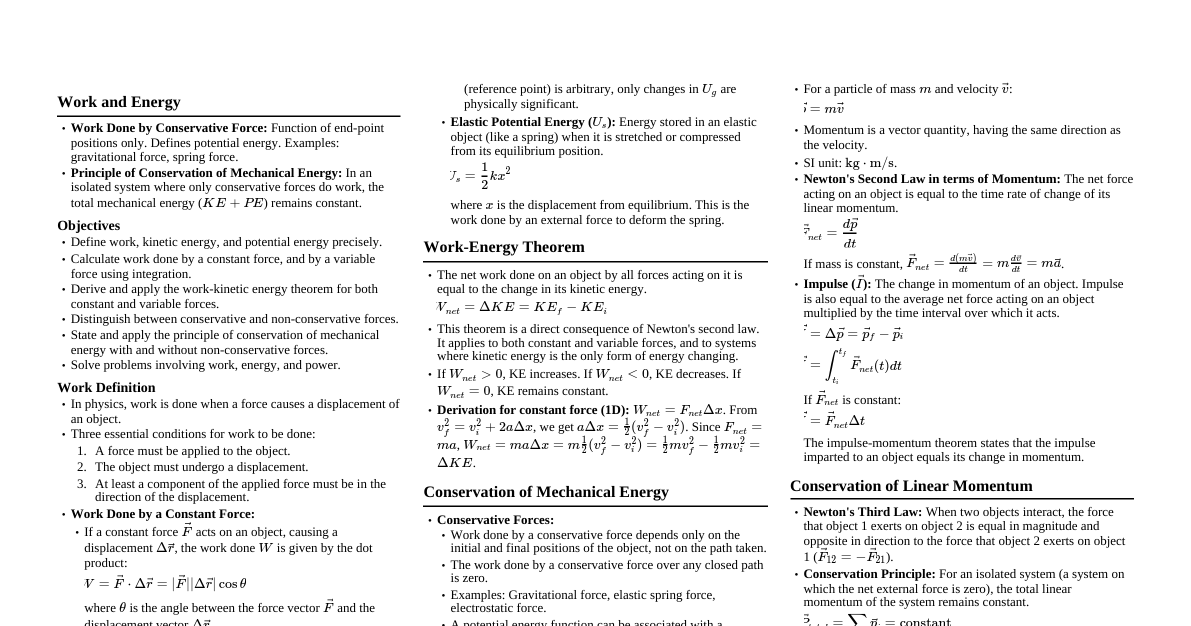
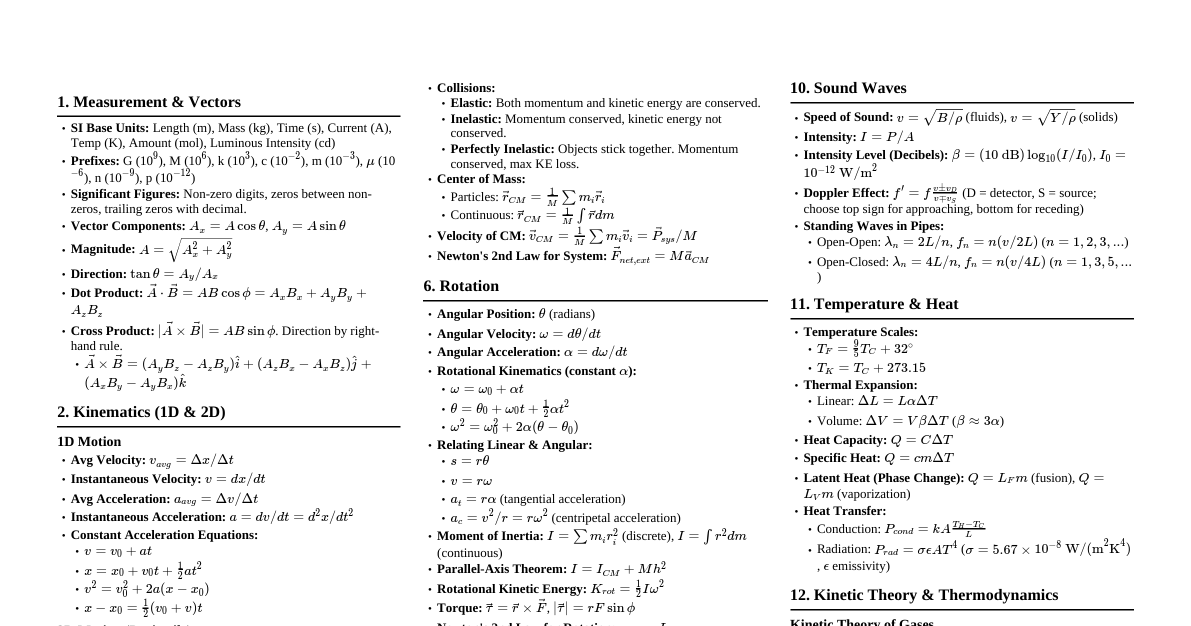
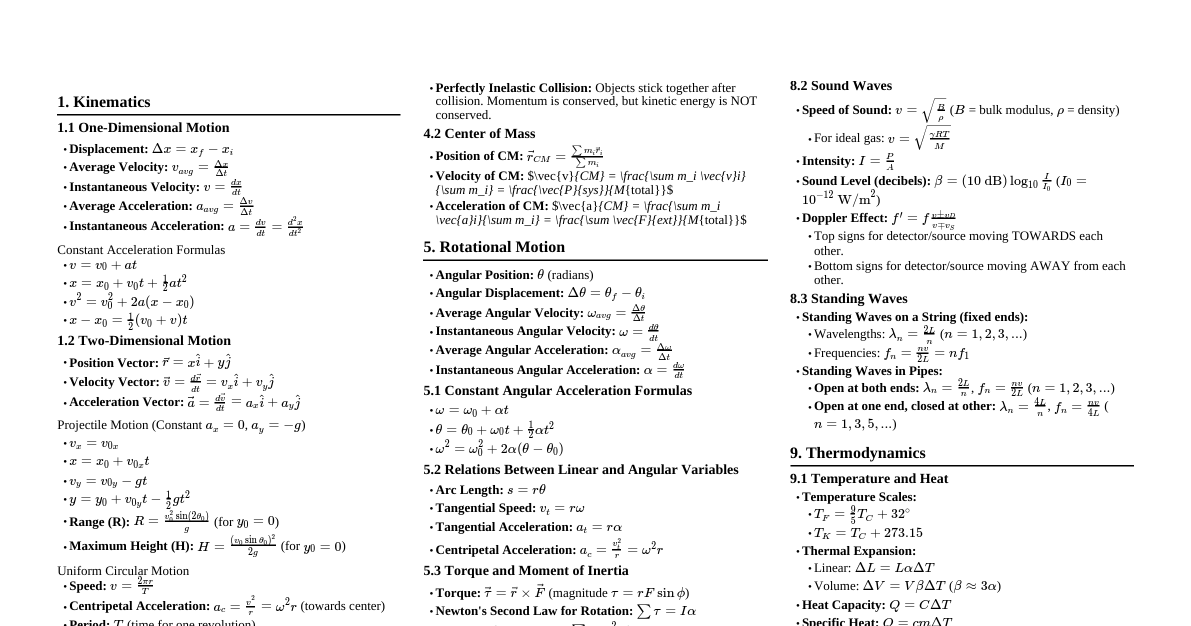
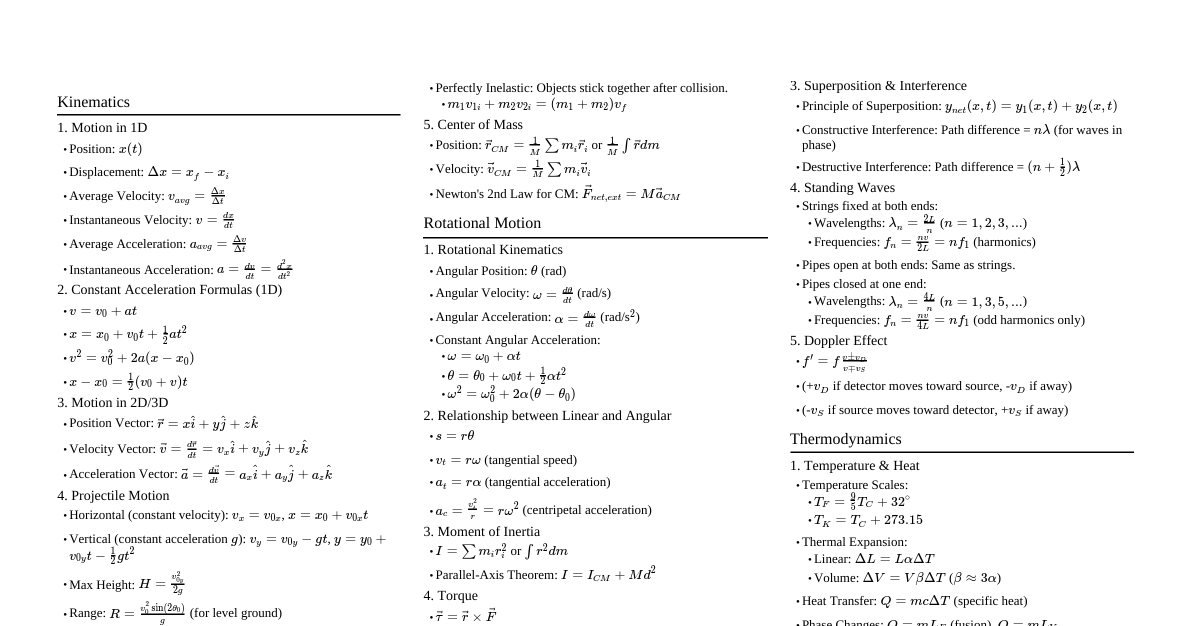
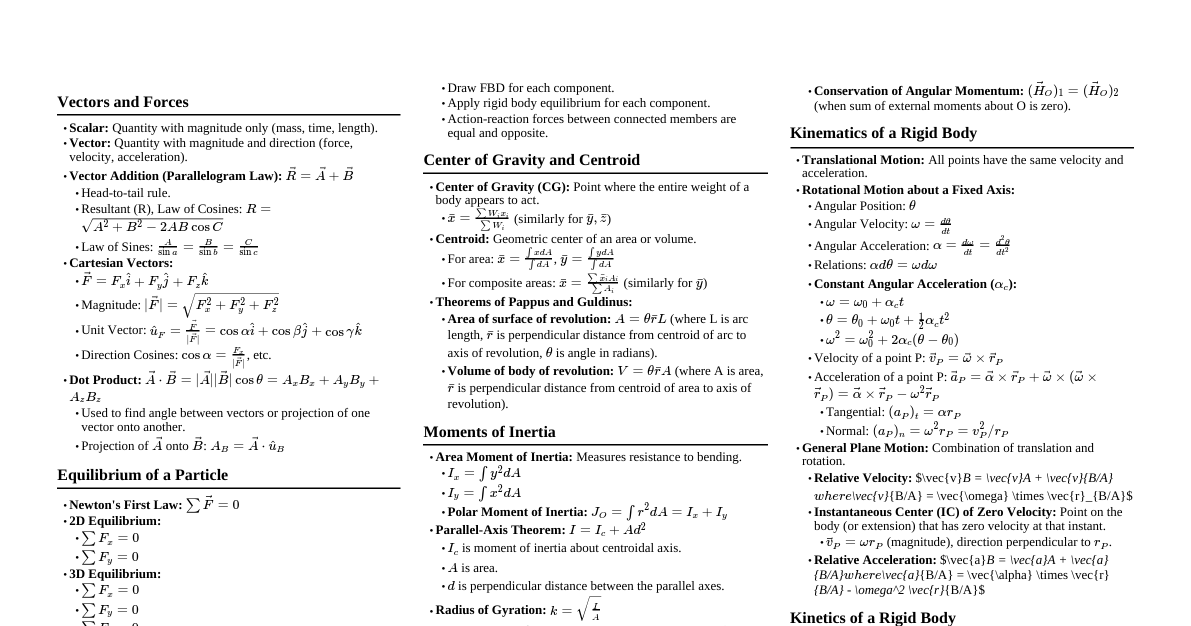
Mechanics Uniform Circular Motion Angular Velocity: $\omega = \frac{\Delta \theta}{\Delta t}$ Sample Problem: A wheel rotates $360^\circ$ in $2 \, \text{s}$. What is its angular velocity in rad/s? Solution: $\Delta \theta = 360^\circ = 2\pi \, \text{rad}$. $\omega = \frac{2\pi \, \text{rad}}{2 \, \text{s}} = \pi \, \text{rad/s} \approx 3.14 \, \text{rad/s}$ Tangential Speed: $v = r\omega$ Sample Problem: A point on a rotating disk is $0.1 \, \text{m}$ from the center. If the disk's angular velocity is $5 \, \text{rad/s}$, what is the tangential speed of the point? Solution: $v = (0.1 \, \text{m})(5 \, \text{rad/s}) = 0.5 \, \text{m/s}$ Centripetal Acceleration: $a_c = \frac{v^2}{r} = r\omega^2$ Sample Problem: A car travels around a circular track of radius $50 \, \text{m}$ at a constant speed of $10 \, \text{m/s}$. What is its centripetal acceleration? Solution: $a_c = \frac{(10 \, \text{m/s})^2}{50 \, \text{m}} = \frac{100 \, \text{m}^2/\text{s}^2}{50 \, \text{m}} = 2 \, \text{m/s}^2$ Centripetal Force: $F_c = ma_c = \frac{mv^2}{r} = mr\omega^2$ Sample Problem: A $1.5 \, \text{kg}$ ball is swung in a horizontal circle of radius $0.8 \, \text{m}$ at a speed of $3 \, \text{m/s}$. What is the centripetal force acting on the ball? Solution: $F_c = \frac{(1.5 \, \text{kg})(3 \, \text{m/s})^2}{0.8 \, \text{m}} = \frac{(1.5)(9)}{0.8} = \frac{13.5}{0.8} = 16.875 \, \text{N}$ Period: $T = \frac{2\pi r}{v} = \frac{2\pi}{\omega}$ Sample Problem: What is the period of a satellite orbiting Earth with an angular velocity of $7.27 \times 10^{-5} \, \text{rad/s}$? Solution: $T = \frac{2\pi}{\omega} = \frac{2\pi}{7.27 \times 10^{-5} \, \text{rad/s}} \approx 86400 \, \text{s}$ (approx. 24 hours) Conservation of Mechanical Energy Kinetic Energy: $K = \frac{1}{2}mv^2$ Sample Problem: What is the kinetic energy of a $0.5 \, \text{kg}$ object moving at $4 \, \text{m/s}$? Solution: $K = \frac{1}{2}(0.5 \, \text{kg})(4 \, \text{m/s})^2 = \frac{1}{2}(0.5)(16) = 4 \, \text{J}$ Gravitational Potential Energy: $U_g = mgh$ Sample Problem: A $10 \, \text{kg}$ mass is $3 \, \text{m}$ above the ground. What is its gravitational potential energy? (Assume $g = 9.8 \, \text{m/s}^2$) Solution: $U_g = (10 \, \text{kg})(9.8 \, \text{m/s}^2)(3 \, \text{m}) = 294 \, \text{J}$ Elastic Potential Energy: $U_s = \frac{1}{2}kx^2$ Sample Problem: A spring with a constant $k = 100 \, \text{N/m}$ is stretched by $0.1 \, \text{m}$. How much elastic potential energy is stored? Solution: $U_s = \frac{1}{2}(100 \, \text{N/m})(0.1 \, \text{m})^2 = \frac{1}{2}(100)(0.01) = 0.5 \, \text{J}$ Conservation Principle: If only conservative forces do work, $K_i + U_i = K_f + U_f$ Sample Problem: A $2 \, \text{kg}$ ball is dropped from a height of $5 \, \text{m}$. What is its speed just before it hits the ground? (Assume $g = 9.8 \, \text{m/s}^2$) Solution: $0 + mgh = \frac{1}{2}mv^2 + 0 \Rightarrow v = \sqrt{2gh} = \sqrt{2 \times 9.8 \, \text{m/s}^2 \times 5 \, \text{m}} = \sqrt{98} \approx 9.9 \, \text{m/s}$ Conservation of Linear Momentum Linear Momentum: $\vec{p} = m\vec{v}$ Sample Problem: What is the momentum of a $1500 \, \text{kg}$ car moving at $20 \, \text{m/s}$? Solution: $p = (1500 \, \text{kg})(20 \, \text{m/s}) = 30000 \, \text{kg} \cdot \text{m/s}$ Impulse: $\vec{J} = \Delta \vec{p} = \vec{F}_{avg}\Delta t$ Sample Problem: A $0.1 \, \text{kg}$ ball hits a wall at $5 \, \text{m/s}$ and bounces back at $3 \, \text{m/s}$. What is the magnitude of the impulse on the ball? Solution: $\Delta p = m(v_f - v_i) = (0.1 \, \text{kg})(-3 \, \text{m/s} - 5 \, \text{m/s}) = (0.1)(-8) = -0.8 \, \text{kg} \cdot \text{m/s}$. Magnitude is $0.8 \, \text{kg} \cdot \text{m/s}$. Conservation Principle (Perfectly Inelastic Collision): $m_1v_{1i} + m_2v_{2i} = (m_1+m_2)v_f$ Sample Problem: A $2 \, \text{kg}$ cart moving at $3 \, \text{m/s}$ collides with and sticks to a stationary $1 \, \text{kg}$ cart. What is their final velocity? Solution: $(2 \, \text{kg})(3 \, \text{m/s}) + (1 \, \text{kg})(0 \, \text{m/s}) = (2 \, \text{kg} + 1 \, \text{kg})v_f \Rightarrow 6 = 3v_f \Rightarrow v_f = 2 \, \text{m/s}$ Torque and Rotational Motion Torque: $\tau = rF\sin\theta$ Sample Problem: A force of $20 \, \text{N}$ is applied perpendicularly to the end of a $0.5 \, \text{m}$ wrench. What is the torque produced? Solution: $\tau = (0.5 \, \text{m})(20 \, \text{N})\sin(90^\circ) = 10 \, \text{N} \cdot \text{m}$ Net Torque and Angular Acceleration: $\sum \tau = I\alpha$ Sample Problem: A disk with moment of inertia $I = 0.5 \, \text{kg} \cdot \text{m}^2$ experiences a net torque of $2 \, \text{N} \cdot \text{m}$. What is its angular acceleration? Solution: $\alpha = \frac{\sum \tau}{I} = \frac{2 \, \text{N} \cdot \text{m}}{0.5 \, \text{kg} \cdot \text{m}^2} = 4 \, \text{rad/s}^2$ Angular Momentum: $L = I\omega$ Sample Problem: A merry-go-round with a moment of inertia $I = 100 \, \text{kg} \cdot \text{m}^2$ is rotating at $2 \, \text{rad/s}$. What is its angular momentum? Solution: $L = (100 \, \text{kg} \cdot \text{m}^2)(2 \, \text{rad/s}) = 200 \, \text{kg} \cdot \text{m}^2/\text{s}$ Conservation of Angular Momentum: $I_i\omega_i = I_f\omega_f$ Sample Problem: A figure skater with $I_i = 5 \, \text{kg} \cdot \text{m}^2$ is spinning at $\omega_i = 10 \, \text{rad/s}$. When she pulls her arms in, her moment of inertia decreases to $I_f = 2 \, \text{kg} \cdot \text{m}^2$. What is her new angular velocity? Solution: $\omega_f = \frac{I_i\omega_i}{I_f} = \frac{(5 \, \text{kg} \cdot \text{m}^2)(10 \, \text{rad/s})}{2 \, \text{kg} \cdot \text{m}^2} = 25 \, \text{rad/s}$ Thermodynamics Calorimetry Heat Transfer (Temperature Change): $Q = mc\Delta T$ Sample Problem: How much heat is required to raise the temperature of $0.5 \, \text{kg}$ of water from $20^\circ\text{C}$ to $100^\circ\text{C}$? (Specific heat of water $c = 4186 \, \text{J/kg}^\circ\text{C}$) Solution: $Q = (0.5 \, \text{kg})(4186 \, \text{J/kg}^\circ\text{C})(100^\circ\text{C} - 20^\circ\text{C}) = 167440 \, \text{J}$ Heat Transfer (Phase Change): $Q = mL_f$ (fusion) or $Q = mL_v$ (vaporization) Sample Problem: How much heat is needed to melt $0.1 \, \text{kg}$ of ice at $0^\circ\text{C}$? (Latent heat of fusion for ice $L_f = 3.34 \times 10^5 \, \text{J/kg}$) Solution: $Q = (0.1 \, \text{kg})(3.34 \times 10^5 \, \text{J/kg}) = 33400 \, \text{J}$ Electricity Ohm's Law Ohm's Law: $V = IR$ Sample Problem: A $12 \, \text{V}$ battery is connected to a $4 \, \Omega$ resistor. What is the current flowing through the resistor? Solution: $I = \frac{V}{R} = \frac{12 \, \text{V}}{4 \, \Omega} = 3 \, \text{A}$ Power Dissipated: $P = IV = I^2R = \frac{V^2}{R}$ Sample Problem: A $10 \, \Omega$ resistor has $2 \, \text{A}$ of current flowing through it. How much power is dissipated? Solution: $P = I^2R = (2 \, \text{A})^2 (10 \, \Omega) = (4)(10) = 40 \, \text{W}$ Resistors in Series and Parallel Resistors in Series: $R_{eq} = R_1 + R_2 + ...$ Sample Problem: Two resistors, $R_1 = 5 \, \Omega$ and $R_2 = 10 \, \Omega$, are connected in series. What is their equivalent resistance? Solution: $R_{eq} = 5 \, \Omega + 10 \, \Omega = 15 \, \Omega$ Resistors in Parallel: $\frac{1}{R_{eq}} = \frac{1}{R_1} + \frac{1}{R_2} + ...$ Sample Problem: Two resistors, $R_1 = 6 \, \Omega$ and $R_2 = 3 \, \Omega$, are connected in parallel. What is their equivalent resistance? Solution: $\frac{1}{R_{eq}} = \frac{1}{6 \, \Omega} + \frac{1}{3 \, \Omega} = \frac{1}{6 \, \Omega} + \frac{2}{6 \, \Omega} = \frac{3}{6 \, \Omega} = \frac{1}{2 \, \Omega}$. So, $R_{eq} = 2 \, \Omega$.