Oscillations and Waves
Cheatsheet Content
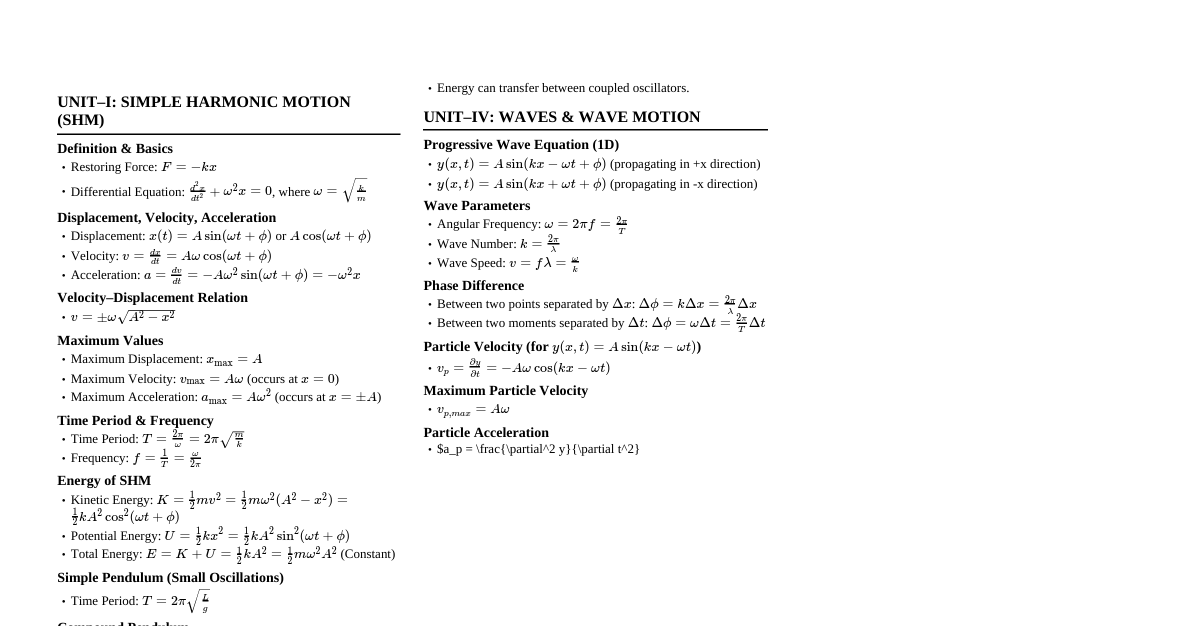
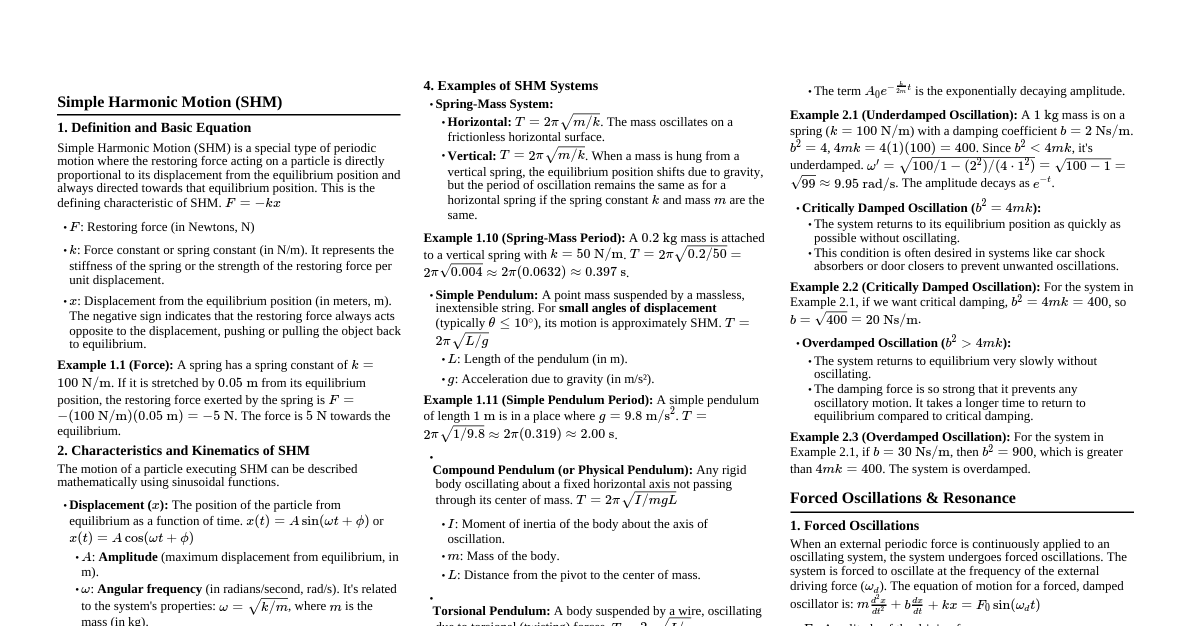
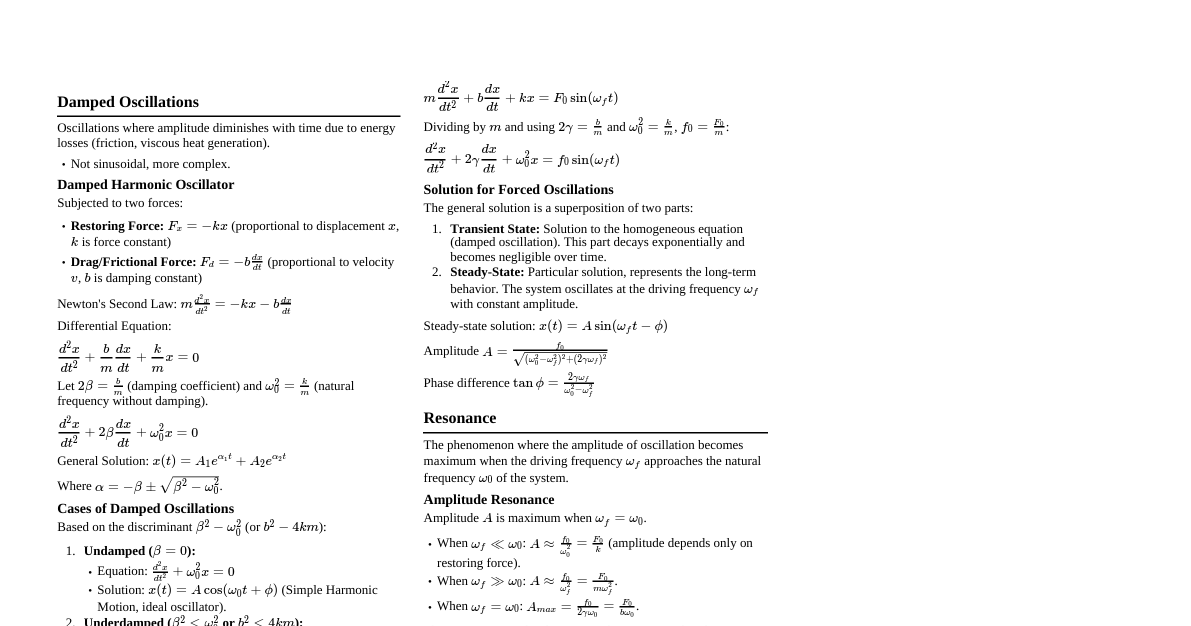
### Simple Harmonic Motion (SHM) #### Types of Motion - **Periodic Motion:** Motion that repeats itself over a fixed interval ($T$, time period). E.g., Earth's rotation. - **Oscillatory Motion:** Motion that repeats itself about a mean position between two extreme positions. E.g., simple pendulum. - All oscillatory motions are periodic, but not all periodic motions are oscillatory. #### Key Terms in SHM - **Time Period ($T$):** Smallest interval for periodic motion to repeat. Time to complete one vibration. - **Frequency ($f$ or $\nu$):** Number of vibrations per unit time. $f = 1/T$. Measured in Hz (s⁻¹ or cps). - **Displacement ($x$ or $y$):** Distance of oscillating particle from mean position at any instant. - **Amplitude ($r$):** Maximum displacement from the mean position. #### Characteristics of SHM 1. **Displacement:** - $x = r \cos(\omega t)$ - $y = r \sin(\omega t)$ 2. **Velocity:** - $v_x = \frac{dx}{dt} = -r\omega \sin(\omega t) = -\omega y$ - $v_y = \frac{dy}{dt} = r\omega \cos(\omega t) = \omega x$ - Using Pythagoras theorem: $v_x = \omega\sqrt{r^2 - y^2}$ and $v_y = \omega\sqrt{r^2 - x^2}$ 3. **Acceleration:** - $a_x = \frac{dv_x}{dt} = -\omega^2 r \cos(\omega t) = -\omega^2 x$ - $a_y = \frac{dv_y}{dt} = -\omega^2 r \sin(\omega t) = -\omega^2 y$ - In general, $a = -\omega^2 r$ or $a \propto -r$. - **Equation of SHM:** Acceleration is directly proportional to displacement and directed opposite to it. 4. **Vibration:** To-and-fro motion of a particle between two consecutive passages in the same direction. 5. **Time Period (from acceleration):** - From $a = \omega^2 x$, we get $\omega = \sqrt{\frac{a}{x}}$. - Since $\omega = \frac{2\pi}{T}$, then $T = 2\pi \sqrt{\frac{x}{a}} = 2\pi \sqrt{\frac{\text{displacement}}{\text{acceleration}}}$. 6. **Frequency (from acceleration):** - $f = \frac{1}{T} = \frac{1}{2\pi} \sqrt{\frac{\text{acceleration}}{\text{displacement}}}$. #### Motion of a Loaded Spring - For a spring with mass $m$ attached, restoring force $F = -kl$ (Hooke's Law). - Weight of body $F = mg$. So $kl = mg$. - If displaced by $y$, net restoring force $F' - F = -k(l+y) - (-kl) = -ky$. - Acceleration $a = \frac{-ky}{m}$. - Time Period: $T = 2\pi \sqrt{\frac{m}{k}}$. - Also, from $kl=mg$, $k = \frac{mg}{l}$. Substituting this: $T = 2\pi \sqrt{\frac{m}{mg/l}} = 2\pi \sqrt{\frac{l}{g}}$. #### Simple Pendulum - For a bob of mass $m$ on a string of length $L$, with displacement angle $\theta = y/L$. - Restoring force $F = -mg \sin\theta$. - For small $\theta$, $\sin\theta \approx \theta$, so $F = -mg\theta = -mg(y/L)$. - Acceleration $a = F/m = -gy/L$. - Time Period: $T = 2\pi \sqrt{\frac{L}{g}}$. - This is independent of mass and amplitude (for small angles). - **Second's Pendulum:** A pendulum with a time period of 2 seconds. Its length $L = \frac{T^2 g}{4\pi^2}$. - **Drawbacks:** Difficult to realize ideal conditions (point mass, weightless string), motion is not strictly linear, string slackens at extremes, formula only for small $\theta$, air resistance affects motion. #### Energy of a Particle Executing SHM Total energy is the sum of kinetic and potential energy. - **Potential Energy (U):** Work done against restoring force. - $F = -m\omega^2 y$. - $dW = (-F)dy = m\omega^2 y dy$. - $U = \int_0^y m\omega^2 y dy = \frac{1}{2} m\omega^2 y^2$. - **Kinetic Energy (T):** - $T = \frac{1}{2}mv^2$. - Since $v = \omega\sqrt{r^2 - y^2}$, $T = \frac{1}{2}m\omega^2(r^2 - y^2)$. - **Total Energy (E):** - $E = U + T = \frac{1}{2}m\omega^2 y^2 + \frac{1}{2}m\omega^2(r^2 - y^2) = \frac{1}{2}m\omega^2 r^2$. - Since $\omega = 2\pi f$, $E = \frac{1}{2}m(2\pi f)^2 r^2 = 2\pi^2 m f^2 r^2$. - Total energy is directly proportional to: - Mass ($m$) - Square of frequency ($f^2$) - Square of amplitude ($r^2$) - **Graphical Representation:** - At mean position ($y=0$): $T = \frac{1}{2}m\omega^2 r^2$, $U=0$. - At extreme position ($y=r$): $T=0$, $U = \frac{1}{2}m\omega^2 r^2$. ### Wave Motion #### Wave Motion Definition - A disturbance that travels through a medium due to the repeated periodic motion of particles about their mean positions. #### Types of Waves 1. **Elastic Waves (Mechanical Waves):** Require a material medium for propagation. E.g., water waves, sound waves. 2. **Electromagnetic Waves (Non-Mechanical Waves):** Do not require a material medium. E.g., light waves, X-rays, gamma rays. #### Types of Wave Motion 1. **Transverse Wave Motion:** Particles vibrate perpendicular to the direction of wave propagation. E.g., waves on a string, electromagnetic waves. - Travels as crests (highest points) and troughs (lowest points). - Wavelength ($\lambda$): Distance traveled when a particle completes one vibration, or distance between two consecutive crests/troughs. - Velocity ($v$): $v = \lambda/T = \lambda f$. 2. **Longitudinal Wave Motion:** Particles vibrate parallel to the direction of wave propagation. E.g., sound waves. - Travels as compressions (particles closer) and rarefactions (particles farther apart). - Wavelength ($\lambda$): Distance traveled when a particle completes one vibration, or distance between two consecutive compressions/rarefactions. - Velocity ($v$): $v = \lambda f$. #### Characteristics of Wave Motion 1. A disturbance traveling through a medium. 2. No bodily motion of particles; they vibrate about mean positions. 3. Disturbance propagates from one particle to the next. 4. Particle velocity varies, but wave velocity is constant. 5. Displacement of vibrating particle is zero over one vibration cycle. 6. Requires a material medium with elasticity and inertia. 7. Energy is propagated without net transport of the material medium. #### Speed of Transverse Waves 1. **In a solid:** $V = \sqrt{\frac{\eta}{\rho}}$, where $\eta$ is modulus of rigidity, $\rho$ is density. 2. **In a stretched string:** $V = \sqrt{\frac{T}{m}}$, where $T$ is tension, $m$ is linear density (mass per unit length). #### Speed of Longitudinal Waves 1. **In a solid:** $V = \sqrt{\frac{K + \frac{4}{3}\eta}{\rho}}$, where $K$ is bulk modulus, $\eta$ is modulus of rigidity, $\rho$ is density. - For a long rod: $V = \sqrt{\frac{Y}{\rho}}$, where $Y$ is Young's modulus. 2. **In a liquid or gas:** $V = \sqrt{\frac{K}{\rho}}$, where $K$ is bulk modulus, $\rho$ is density. (This is the speed of sound in gas). ### Equation of a Progressive Wave A wave traveling continuously in the same direction without change in amplitude. - For a plane harmonic wave traveling along +X-axis: - $y = r \sin(\omega t - \phi)$ - Since $\phi = \frac{2\pi}{\lambda}x$, then $y = r \sin(\omega t - \frac{2\pi}{\lambda}x)$. - Using $\omega = \frac{2\pi}{T}$ and $v = \lambda/T$: - $y = r \sin(2\pi(\frac{t}{T} - \frac{x}{\lambda}))$ - $y = r \sin(\frac{2\pi}{\lambda}(vt - x))$ - For a wave traveling along -X-axis: - $y = r \sin(\frac{2\pi}{\lambda}(vt + x))$ ### Superposition Principle When two or more waves travel in a medium, the resultant displacement of a particle at any time is the vector sum of individual displacements: $y = y_1 + y_2 + y_3 + ... + y_n$. ### Reflection of Waves - **Transverse Waves:** - Rigid boundary: $180^\circ$ phase reversal. - Free boundary: No phase reversal. - **Longitudinal Waves:** - Rigid boundary: $180^\circ$ phase reversal (compression reflects as compression, rarefaction as rarefaction, but with phase shift). - Free boundary: No phase reversal. ### Stationary Waves Formed when two progressive waves of the same wavelength and amplitude travel with the same speed in opposite directions and superpose. - **Nodes:** Points of zero amplitude. - **Anti-nodes:** Points of maximum amplitude. #### Standing Waves in a String Fixed at Both Ends - Equation: $y = -2r \sin(\frac{2\pi}{\lambda}x) \cos(\frac{2\pi}{T}t)$. - Amplitude $A = |-2r \sin(\frac{2\pi}{\lambda}x)|$. - Boundary conditions ($y=0$ at $x=0$ and $x=L$): - $\sin(\frac{2\pi}{\lambda}L) = 0 \implies \frac{2\pi}{\lambda}L = n\pi \implies L = n\frac{\lambda}{2}$, where $n = 1, 2, 3, ...$ - **Modes of Vibration:** - **First mode ($n=1$):** $L = \lambda_1/2 \implies \lambda_1 = 2L$. Frequency $f_1 = \frac{v}{\lambda_1} = \frac{v}{2L}$. - **Second mode ($n=2$):** $L = 2\lambda_2/2 = \lambda_2$. Frequency $f_2 = \frac{v}{\lambda_2} = \frac{2v}{2L} = 2f_1$. - In general, $\lambda_n = \frac{2L}{n}$, and $f_n = n f_1$. #### Standing Waves in a Pipe Closed at One End - Boundary conditions ($y=0$ at $x=0$ (closed end), $y=$ max at $x=L$ (open end)): - $\frac{2\pi}{\lambda}L = (2n-1)\frac{\pi}{2} \implies L = (2n-1)\frac{\lambda}{4}$, where $n = 1, 2, 3, ...$ - **Modes of Vibration:** - **First mode ($n=1$):** $L = \lambda_1/4 \implies \lambda_1 = 4L$. Frequency $f_1 = \frac{v}{\lambda_1} = \frac{v}{4L}$. - **Second mode ($n=2$):** $L = 3\lambda_2/4 \implies \lambda_2 = \frac{4L}{3}$. Frequency $f_2 = \frac{3v}{4L} = 3f_1$. - In general, $\lambda_n = \frac{4L}{2n-1}$, and $f_n = (2n-1)f_1$. Only odd harmonics are present. #### Standing Waves in a Pipe Open at Both Ends - Boundary conditions ($y=$ max at $x=0$ and $x=L$): - $\frac{2\pi}{\lambda}L = n\pi \implies L = n\frac{\lambda}{2}$, where $n = 1, 2, 3, ...$ - **Modes of Vibration:** - **First mode ($n=1$):** $L = \lambda_1/2 \implies \lambda_1 = 2L$. Frequency $f_1 = \frac{v}{\lambda_1} = \frac{v}{2L}$. - **Second mode ($n=2$):** $L = 2\lambda_2/2 = \lambda_2$. Frequency $f_2 = \frac{2v}{2L} = 2f_1$. - In general, $\lambda_n = \frac{2L}{n}$, and $f_n = n f_1$. All harmonics are present. #### Characteristics of Stationary Waves 1. Disturbance does not move forward or backward; no energy transfer. 2. Time period of periodic motion is same for all particles (except at nodes). 3. Amplitude of vibration varies; maximum at anti-nodes, minimum at nodes. 4. Nodes are permanently at rest (zero velocity). 5. Nodes and anti-nodes occur alternately; separation between consecutive nodes/anti-nodes is $\lambda/2$. 6. Direction of particle motion reverses after half a vibration. ### Beats - **Definition:** Periodic variations in sound intensity due to superposition of two sound waves with slightly different frequencies. - **Beat Period:** Time interval between two beats. - **Beat Frequency:** Number of beats per second ($|f_1 - f_2|$).