Oscillations & Waves Formulae
Cheatsheet Content
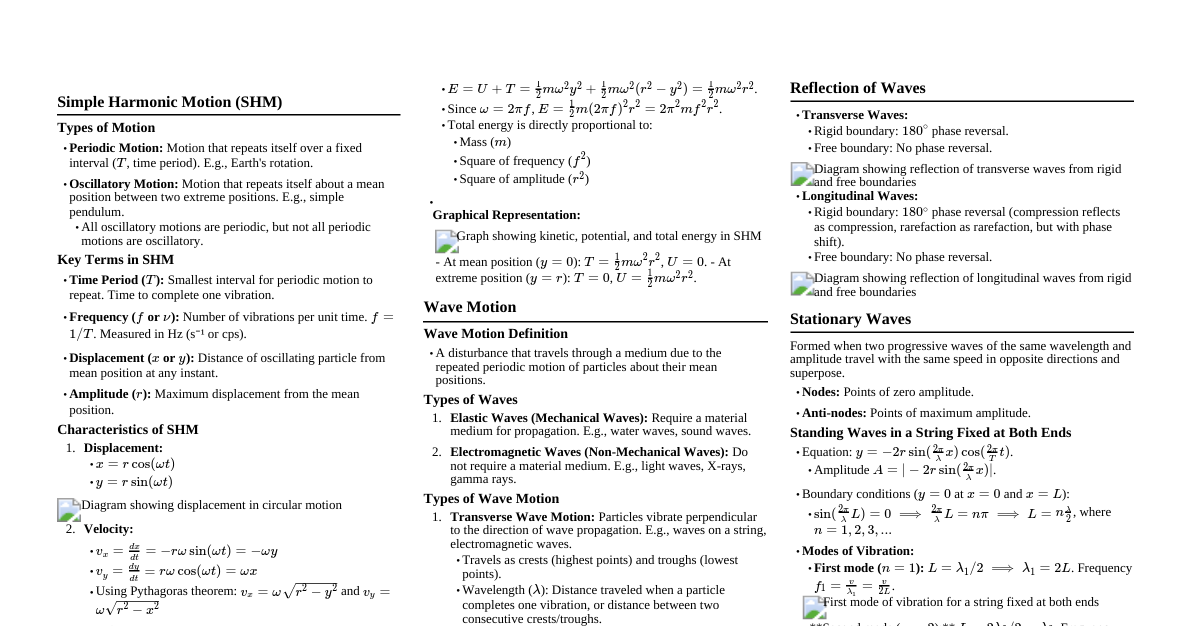
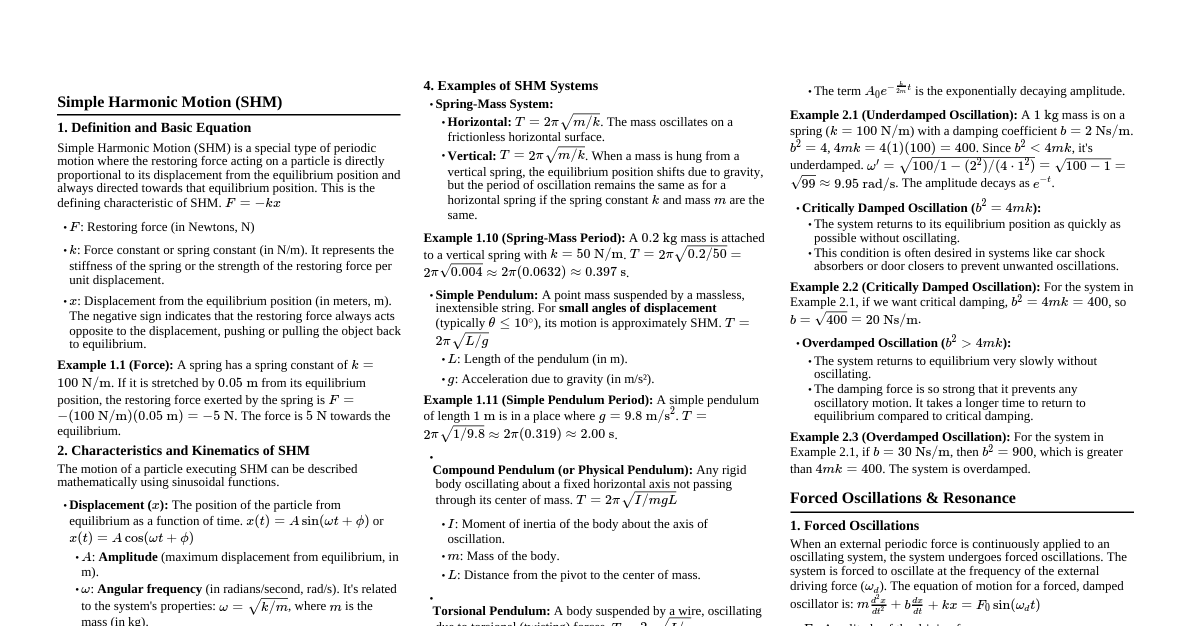
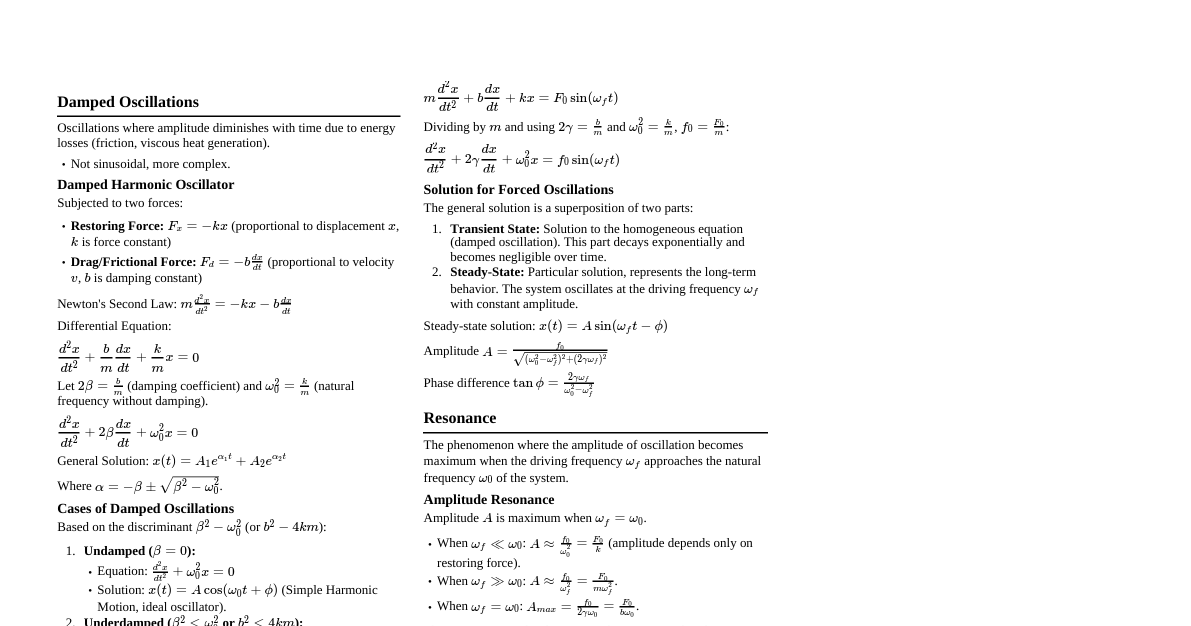
UNIT–I: SIMPLE HARMONIC MOTION (SHM) Definition & Basics Restoring Force: $F = -kx$ Differential Equation: $\frac{d^2x}{dt^2} + \omega^2 x = 0$, where $\omega = \sqrt{\frac{k}{m}}$ Displacement, Velocity, Acceleration Displacement: $x(t) = A\sin(\omega t + \phi)$ or $A\cos(\omega t + \phi)$ Velocity: $v = \frac{dx}{dt} = A\omega\cos(\omega t + \phi)$ Acceleration: $a = \frac{dv}{dt} = -A\omega^2\sin(\omega t + \phi) = -\omega^2 x$ Velocity–Displacement Relation $v = \pm \omega \sqrt{A^2 - x^2}$ Maximum Values Maximum Displacement: $x_{\max} = A$ Maximum Velocity: $v_{\max} = A\omega$ (occurs at $x=0$) Maximum Acceleration: $a_{\max} = A\omega^2$ (occurs at $x=\pm A$) Time Period & Frequency Time Period: $T = \frac{2\pi}{\omega} = 2\pi\sqrt{\frac{m}{k}}$ Frequency: $f = \frac{1}{T} = \frac{\omega}{2\pi}$ Energy of SHM Kinetic Energy: $K = \frac{1}{2}mv^2 = \frac{1}{2}m\omega^2(A^2 - x^2) = \frac{1}{2}kA^2\cos^2(\omega t + \phi)$ Potential Energy: $U = \frac{1}{2}kx^2 = \frac{1}{2}kA^2\sin^2(\omega t + \phi)$ Total Energy: $E = K + U = \frac{1}{2}kA^2 = \frac{1}{2}m\omega^2 A^2$ (Constant) Simple Pendulum (Small Oscillations) Time Period: $T = 2\pi\sqrt{\frac{L}{g}}$ Compound Pendulum Time Period: $T = 2\pi\sqrt{\frac{I}{mgL}}$, where $I$ is moment of inertia about pivot, $L$ is distance from pivot to center of mass. UNIT–II: DAMPED & FORCED OSCILLATIONS Damped Harmonic Oscillator Equation: $m\frac{d^2x}{dt^2} + b\frac{dx}{dt} + kx = 0$ Damping Coefficient: $\beta = \frac{b}{2m}$ Natural Frequency: $\omega_0 = \sqrt{\frac{k}{m}}$ Types of Damping Underdamped: $\beta Critically Damped: $\beta = \omega_0$ Overdamped: $\beta > \omega_0$ Displacement (Underdamped) $x(t) = Ae^{-\beta t}\cos(\omega t + \phi)$, where $\omega = \sqrt{\omega_0^2 - \beta^2}$ (angular frequency of damped oscillations) Energy Decay (Underdamped) $E(t) = E_0 e^{-2\beta t}$ Logarithmic Decrement ($\Lambda$) $\Lambda = \ln\left(\frac{x_n}{x_{n+1}}\right) = \beta T_d = \frac{2\pi\beta}{\sqrt{\omega_0^2 - \beta^2}}$, where $T_d = \frac{2\pi}{\omega}$ is the damped period. Forced Oscillator Equation $m\frac{d^2x}{dt^2} + b\frac{dx}{dt} + kx = F_0\cos(\omega_f t)$ Amplitude of Forced Oscillation (Steady State) $A = \frac{F_0/m}{\sqrt{(\omega_0^2 - \omega_f^2)^2 + (2\beta\omega_f)^2}}$ Resonance Amplitude Resonance Frequency: $\omega_r = \sqrt{\omega_0^2 - 2\beta^2}$ (for small damping, $\omega_r \approx \omega_0$) Quality Factor (Q-factor) $Q = \frac{\omega_0}{2\beta} = \frac{\omega_0 m}{b}$ $Q = 2\pi \times \frac{\text{Energy stored}}{\text{Energy dissipated per cycle}}$ UNIT–III: COUPLED OSCILLATIONS & BEATS Two Coupled Oscillators – Normal Frequencies In-phase mode (symmetric): $\omega_1 = \sqrt{\frac{k}{m}}$ Out-of-phase mode (antisymmetric): $\omega_2 = \sqrt{\frac{k+2k'}{m}}$, where $k'$ is the coupling constant. General solution is a superposition of these normal modes. Beats Occur when two waves of slightly different frequencies interfere. Resultant displacement: $y(t) = [2A\cos(2\pi \frac{f_1-f_2}{2}t)] \cos(2\pi \frac{f_1+f_2}{2}t)$ Beat Frequency $f_{beat} = |f_1 - f_2|$ N-Coupled Oscillators (General Concept) System has N normal modes, each with a distinct normal frequency. Energy can transfer between coupled oscillators. UNIT–IV: WAVES & WAVE MOTION Progressive Wave Equation (1D) $y(x,t) = A\sin(kx - \omega t + \phi)$ (propagating in +x direction) $y(x,t) = A\sin(kx + \omega t + \phi)$ (propagating in -x direction) Wave Parameters Angular Frequency: $\omega = 2\pi f = \frac{2\pi}{T}$ Wave Number: $k = \frac{2\pi}{\lambda}$ Wave Speed: $v = f\lambda = \frac{\omega}{k}$ Phase Difference Between two points separated by $\Delta x$: $\Delta\phi = k\Delta x = \frac{2\pi}{\lambda}\Delta x$ Between two moments separated by $\Delta t$: $\Delta\phi = \omega\Delta t = \frac{2\pi}{T}\Delta t$ Particle Velocity (for $y(x,t) = A\sin(kx - \omega t)$) $v_p = \frac{\partial y}{\partial t} = -A\omega\cos(kx - \omega t)$ Maximum Particle Velocity $v_{p,max} = A\omega$ Particle Acceleration $a_p = \frac{\partial^2 y}{\partial t^2} = -A\omega^2\sin(kx - \omega t) = -\omega^2 y$