Electromagnetic Waves
Cheatsheet Content
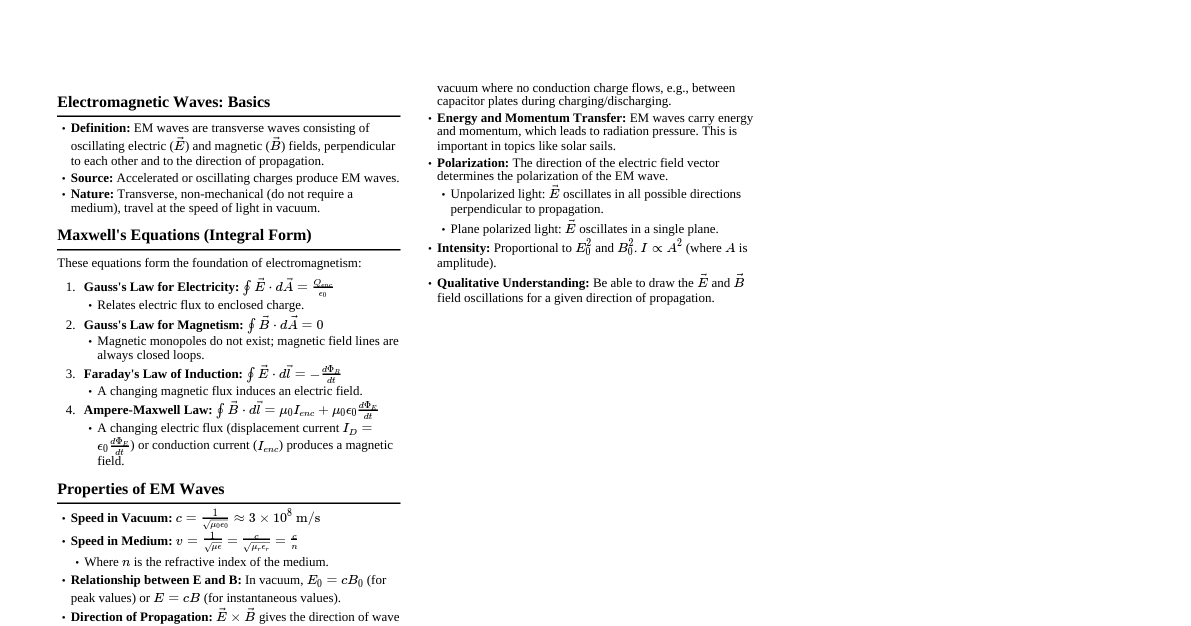
### Introduction to EM Waves - Electromagnetic waves are coupled time-varying electric and magnetic fields that propagate in space. - They are a direct consequence of Maxwell's equations. - **Key Idea:** A changing electric field produces a magnetic field (Maxwell's insight), and vice-versa (Faraday's Law). ### Maxwell's Equations in Vacuum These four equations are fundamental to electromagnetism: 1. **Gauss's Law for Electricity:** $\oint \vec{E} \cdot d\vec{A} = \frac{Q}{\epsilon_0}$ - Relates electric field to charge distribution. 2. **Gauss's Law for Magnetism:** $\oint \vec{B} \cdot d\vec{A} = 0$ - States that magnetic monopoles do not exist. 3. **Faraday's Law of Induction:** $\oint \vec{E} \cdot d\vec{l} = -\frac{d\Phi_B}{dt}$ - A changing magnetic flux induces an electric field. 4. **Ampere-Maxwell Law:** $\oint \vec{B} \cdot d\vec{l} = \mu_0 I_c + \mu_0 \epsilon_0 \frac{d\Phi_E}{dt}$ - A magnetic field is produced by conduction current ($I_c$) and a changing electric flux ($\Phi_E$). The term $\mu_0 \epsilon_0 \frac{d\Phi_E}{dt}$ is the **displacement current**. **Trick:** Remember the symmetry: changing E generates B, and changing B generates E. This self-sustaining nature allows EM waves to propagate. ### Displacement Current ($I_d$) - **Definition:** $I_d = \epsilon_0 \frac{d\Phi_E}{dt}$ - **Significance:** Maxwell introduced this term to resolve an inconsistency in Ampere's Law for time-varying fields (e.g., in a charging capacitor). - It acts as a source of magnetic field just like conduction current. - **Total Current:** $I_{total} = I_c + I_d$ - **Application:** Explains how magnetic fields exist between capacitor plates during charging, even though no conduction current flows there. ### Properties of EM Waves - **Source:** Accelerated charges produce EM waves. - **Nature:** Transverse waves (electric field $\vec{E}$, magnetic field $\vec{B}$, and direction of propagation are mutually perpendicular). - **Direction:** If the wave propagates along z-axis, $\vec{E}$ is along x-axis, and $\vec{B}$ is along y-axis (or vice-versa). The direction of propagation is given by $\vec{E} \times \vec{B}$. - **Speed in vacuum:** $c = \frac{1}{\sqrt{\mu_0 \epsilon_0}} \approx 3 \times 10^8 \text{ m/s}$. This is the speed of light. - **Speed in medium:** $v = \frac{1}{\sqrt{\mu \epsilon}}$, where $\mu$ and $\epsilon$ are permeability and permittivity of the medium. - **Relationship between E and B magnitudes:** $E_0 = B_0 c$ (or $E = Bc$) - **Wave Equations:** For a plane EM wave propagating in z-direction: - $\vec{E} = E_0 \sin(kz - \omega t) \hat{i}$ - $\vec{B} = B_0 \sin(kz - \omega t) \hat{j}$ - Where $\omega = 2\pi\nu$ (angular frequency), $k = \frac{2\pi}{\lambda}$ (wave number). - **Relation:** $\omega = ck$ or $\nu\lambda = c$. - **Energy Transfer:** EM waves carry energy from one place to another. - **No Medium Required:** They do not require a material medium for propagation. ### Electromagnetic Spectrum - The entire range of electromagnetic waves arranged by frequency or wavelength. - **Order (decreasing wavelength, increasing frequency/energy):** - Gamma rays ($\gamma$) - X-rays - Ultraviolet (UV) - Visible Light (VIBGYOR) - Infrared (IR) - Microwaves - Radio waves #### Key Characteristics & Uses: #### Gamma Rays - **Production:** Radioactive decay of atomic nuclei. - **Wavelength:** $ #### X-rays - **Production:** Bombardment of metal target by high-energy electrons. - **Wavelength:** $10^{-8}$ m to $10^{-13}$ m. - **Uses:** Medical imaging (diagnostics), security scanning. #### Ultraviolet (UV) Rays - **Production:** Special lamps, very hot bodies (Sun). - **Wavelength:** $10^{-7}$ m to $10^{-8}$ m. - **Uses:** Sterilization, water purifiers, LASIK eye surgery. - **Harmful effects:** Skin tanning, damage. Ozone layer protects from most harmful UV. #### Visible Light - **Production:** Electron transitions in atoms. - **Wavelength:** 400 nm (violet) to 700 nm (red). - **Uses:** Sight, illumination, photography. #### Infrared (IR) Waves - **Production:** Hot bodies and molecules (vibration of atoms/molecules). - **Wavelength:** $10^{-3}$ m to $10^{-7}$ m. - **Uses:** Remote controls, thermal imaging, night vision, physical therapy, greenhouse effect. Often called "heat waves". #### Microwaves - **Production:** Klystron valves, magnetrons, Gunn diodes. - **Wavelength:** $0.1$ m to $1$ mm. - **Uses:** Radar systems (aircraft navigation, speed guns), microwave ovens (heating food by resonant absorption by water molecules). #### Radio Waves - **Production:** Rapid acceleration and deceleration of electrons in aerials. - **Wavelength:** $> 0.1$ m. - **Uses:** Radio and TV communication, cellular phones. **Trick:** Remember the order and a key application for each part of the spectrum. The boundaries are not sharp, and there can be overlaps. ### Important Formulas & Relations - **Speed of EM Wave:** $c = \frac{1}{\sqrt{\mu_0 \epsilon_0}}$ - **Relation between E & B:** $E_0 = B_0 c$ - **Displacement Current:** $I_d = \epsilon_0 \frac{d\Phi_E}{dt}$ - **Ampere-Maxwell Law:** $\oint \vec{B} \cdot d\vec{l} = \mu_0 (I_c + I_d)$ - **Electromagnetic Wave Equation:** - For E-field: $\frac{\partial^2 E}{\partial z^2} = \mu_0 \epsilon_0 \frac{\partial^2 E}{\partial t^2}$ - For B-field: $\frac{\partial^2 B}{\partial z^2} = \mu_0 \epsilon_0 \frac{\partial^2 B}{\partial t^2}$ - **Wave velocity:** $v = \nu\lambda = \frac{\omega}{k}$ ### Common Mistakes to Avoid - Confusing conduction current with displacement current. - Forgetting that EM waves are transverse. - Incorrectly applying Maxwell's equations (especially signs and vector directions). - Not knowing the order or key uses of the EM spectrum. - Forgetting the relationship $E_0 = B_0 c$.