Coupled Oscillators
Cheatsheet Content
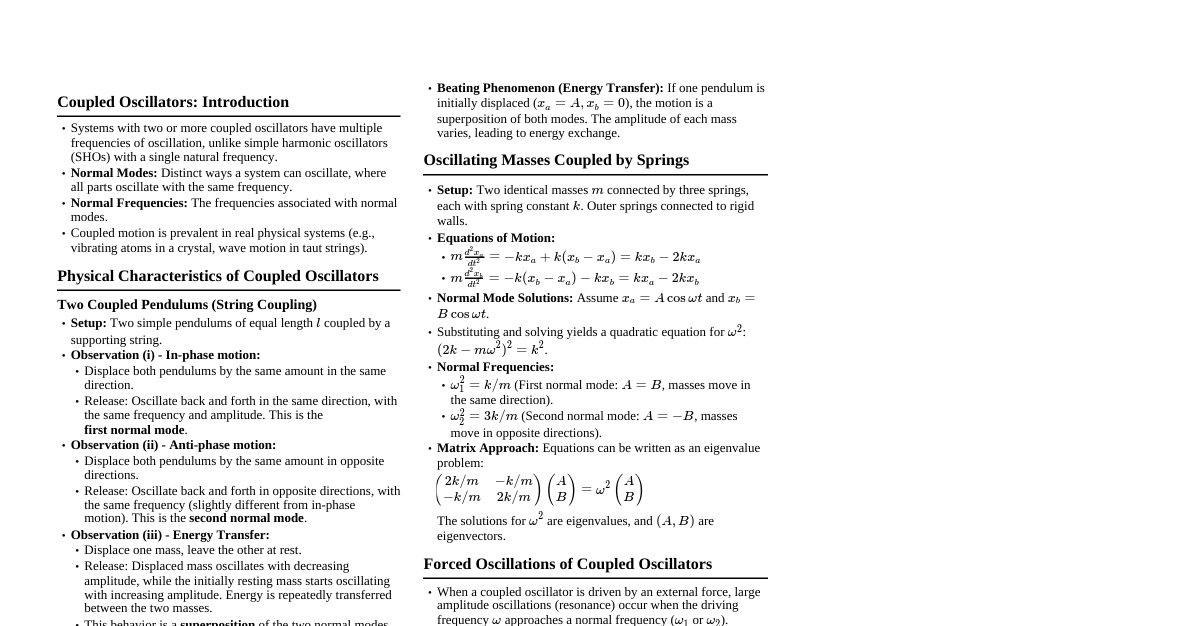
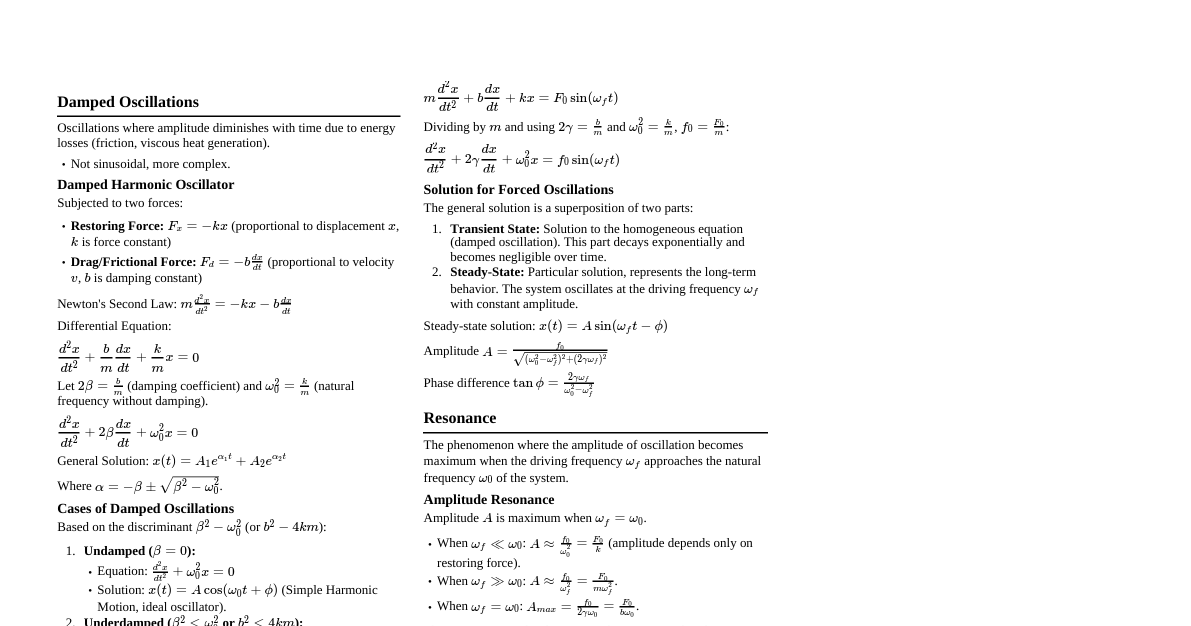
Coupled Oscillators Overview Systems with two or more oscillators coupled together. Characterized by multiple frequencies of oscillation (normal frequencies). Each normal mode means all parts oscillate with the same frequency. Coupled motion is essential for understanding waves in continuous media. Physical Characteristics of Coupled Oscillators Coupled Pendulums Example (Figure 4.1) Two pendulums of length $l$ coupled by a supporting string. Displacements perpendicular to the plane of the page. Case (i): In-phase motion Displace both masses equally in same direction. Oscillate with same frequency and amplitude. Frequency: $\omega_1 = \sqrt{g/l}$ (like uncoupled simple pendulum). Displacements: $x_a = A \cos(\omega_1 t)$, $x_b = A \cos(\omega_1 t)$ Case (ii): Anti-phase motion Displace both masses equally in opposite directions. Oscillate with same frequency but $180^\circ$ out of phase. Frequency: $\omega_2 = \sqrt{g/l + 2k/m}$ (higher due to spring's additional restoring force). Displacements: $x_a = B \cos(\omega_2 t)$, $x_b = -B \cos(\omega_2 t)$ Case (iii): Energy Transfer (Superposition) Displace one mass, leave other at rest. Energy transfers back and forth between masses. This behavior is a superposition of the two normal modes. a b supporting string l l Figure 4.1: Two simple pendulums coupled together by a supporting string. Normal Modes of Oscillation (Spring Coupled) Two simple pendulums (mass $m$, length $l$) coupled by a horizontal spring (constant $k$). Oscillations are in the plane of the page. a b k l l $x_a$ $x_b$ Figure 4.2: Two simple pendulums coupled together by a light horizontal spring. Equations of Motion Restoring force on mass $a$: $F_a = -\frac{mgx_a}{l} - k(x_a - x_b)$ Restoring force on mass $b$: $F_b = -\frac{mgx_b}{l} - k(x_b - x_a)$ Resultant equations: $$ \frac{d^2x_a}{dt^2} + \frac{g}{l}x_a + \frac{k}{m}(x_a - x_b) = 0 $$ $$ \frac{d^2x_b}{dt^2} + \frac{g}{l}x_b + \frac{k}{m}(x_b - x_a) = 0 $$ Normal Modes and Frequencies First Normal Mode (In-Phase): $x_a = x_b$ $$ \frac{d^2x_a}{dt^2} + \frac{g}{l}x_a = 0 $$ Frequency: $\omega_1 = \sqrt{g/l}$ Displacements: $x_a = A \cos(\omega_1 t)$, $x_b = A \cos(\omega_1 t)$ Second Normal Mode (Anti-Phase): $x_a = -x_b$ $$ \frac{d^2x_a}{dt^2} + \left(\frac{g}{l} + \frac{2k}{m}\right)x_a = 0 $$ Frequency: $\omega_2 = \sqrt{g/l + 2k/m}$ Displacements: $x_a = B \cos(\omega_2 t)$, $x_b = -B \cos(\omega_2 t)$ Superposition of Normal Modes General motion is a superposition of normal modes. Introduce normal coordinates: $q_1 = x_a + x_b$ $q_2 = x_a - x_b$ Equations of motion for normal coordinates: $$ \frac{d^2q_1}{dt^2} + \omega_1^2 q_1 = 0 $$ $$ \frac{d^2q_2}{dt^2} + \omega_2^2 q_2 = 0 $$ Solutions for normal coordinates: $q_1 = C_1 \cos(\omega_1 t + \phi_1)$ $q_2 = C_2 \cos(\omega_2 t + \phi_2)$ Displacements in terms of normal coordinates: $x_a = \frac{1}{2}(q_1 + q_2) = \frac{1}{2}[C_1 \cos(\omega_1 t + \phi_1) + C_2 \cos(\omega_2 t + \phi_2)]$ $x_b = \frac{1}{2}(q_1 - q_2) = \frac{1}{2}[C_1 \cos(\omega_1 t + \phi_1) - C_2 \cos(\omega_2 t + \phi_2)]$ Total Energy $E$: $$E = \frac{1}{2}m\left(\frac{dq_1}{dt}\right)^2 + \frac{1}{2}m\omega_1^2 q_1^2 + \frac{1}{2}m\left(\frac{dq_2}{dt}\right)^2 + \frac{1}{2}m\omega_2^2 q_2^2$$ This shows that the energy of two independent simple harmonic oscillators. No "cross terms" between $q_1$ and $q_2$ means no energy transfer between normal modes. Oscillating Masses Coupled by Springs (Horizontal) Two identical masses $m$ connected by three springs with constant $k$. a b k k k $x_a$ $x_b$ Figure 4.11: Two mass-spring oscillators coupled together by a third spring. Equations of Motion Force on mass $a$: $m\frac{d^2x_a}{dt^2} = -kx_a + k(x_b - x_a) = kx_b - 2kx_a$ Force on mass $b$: $m\frac{d^2x_b}{dt^2} = -k(x_b - x_a) - kx_b = kx_a - 2kx_b$ Assuming solutions $x_a = A \cos(\omega t)$ and $x_b = B \cos(\omega t)$: $A(2k - m\omega^2) = Bk$ $B(2k - m\omega^2) = Ak$ This leads to a quadratic equation for $\omega^2$: $(2k - m\omega^2)^2 = k^2$ Normal Frequencies $(2k - m\omega^2) = \pm k$ $\omega_1^2 = k/m$ (First normal mode: $A=B$, in-phase) $\omega_2^2 = 3k/m$ (Second normal mode: $A=-B$, anti-phase) Forced Oscillations of Coupled Oscillators When a coupled oscillator is driven by an external force, it will oscillate with large amplitude when the driving frequency is close to one of its normal frequencies. Consider the arrangement from Figure 4.11, but the leftmost wall is now replaced by a driving mechanism that moves as $\xi = a \cos(\omega t)$. a b k k k $x_a$ $x_b$ $\xi$ Figure 4.15: Forced oscillations of a coupled oscillator. Equations of Motion with Forcing Mass $a$: $m\frac{d^2x_a}{dt^2} = -k(x_a - \xi) + k(x_b - x_a)$ Mass $b$: $m\frac{d^2x_b}{dt^2} = -k(x_b - x_a) - kx_b$ In terms of normal coordinates $q_1 = x_a + x_b$ and $q_2 = x_a - x_b$: $$ \frac{d^2q_1}{dt^2} + \omega_1^2 q_1 = \frac{F_0}{m} \cos(\omega t) $$ $$ \frac{d^2q_2}{dt^2} + \omega_2^2 q_2 = \frac{F_0}{m} \cos(\omega t) $$ where $F_0 = ka$. Steady-state solutions for amplitudes $C_1, C_2$: $C_1 = \frac{F_0/m}{(\omega_1^2 - \omega^2)}$ $C_2 = \frac{F_0/m}{(\omega_2^2 - \omega^2)}$ Resonance occurs when $\omega = \omega_1$ or $\omega = \omega_2$. Transverse Oscillations Periodic displacements perpendicular to the line connecting masses. Single Mass Transverse Oscillation Mass $m$ connected by two springs (constant $k$, length $l$, tension $T$). m k k $y$ $\theta$ $\theta$ $l$ $l$ Figure 4.17: Transverse displacement of a single mass m coupled by two springs. Equation of motion (small angle approximation): $m\frac{d^2y}{dt^2} = -2T \sin\theta \approx -2T\theta \approx -2T\frac{y}{l}$ $$ \frac{d^2y}{dt^2} = -\frac{2T}{ml}y $$ Frequency: $\omega = \sqrt{2T/ml}$ Two Masses Transverse Oscillation Two identical masses $m$ connected by three identical springs (length $l$, tension $T$). a b $y_a$ $y_b$ Figure 4.18: Transverse displacements of two masses connected by springs. Equations of Motion Mass $a$: $m\frac{d^2y_a}{dt^2} = -T\frac{y_a}{l} + T\frac{(y_b - y_a)}{l} = \frac{T}{l}(y_b - 2y_a)$ Mass $b$: $m\frac{d^2y_b}{dt^2} = -T\frac{(y_b - y_a)}{l} - T\frac{y_b}{l} = \frac{T}{l}(y_a - 2y_b)$ Normal frequencies: $\omega_1 = \sqrt{T/ml}$ (in-phase, $y_a = y_b$) $\omega_2 = \sqrt{3T/ml}$ (anti-phase, $y_a = -y_b$) CO$_2$ Molecule Vibration Modes A CO$_2$ molecule can be modeled as three masses (C in middle, O on sides) connected by two springs. (a) (b) (c) Figure 4.16: Normal modes of vibration of the CO$_2$ molecule. Symmetric Stretch Mode (a): Outer masses move symmetrically away/towards central mass, which stays fixed. Frequency: $4.0 \times 10^{13} \text{ s}^{-1}$ Asymmetric Stretch Mode (b): Outer masses move in the same direction, central mass moves in opposite direction to keep center of mass stationary. Frequency: $7.0 \times 10^{13} \text{ s}^{-1}$ Bending Mode (c): Masses move perpendicular to the molecular axis. This mode is degenerate (can occur in two orthogonal planes with the same frequency). Frequency: $2.0 \times 10^{13} \text{ s}^{-1}$ These frequencies are determined experimentally using absorption spectroscopy.