ISC Class 12: Solutions
Cheatsheet Content
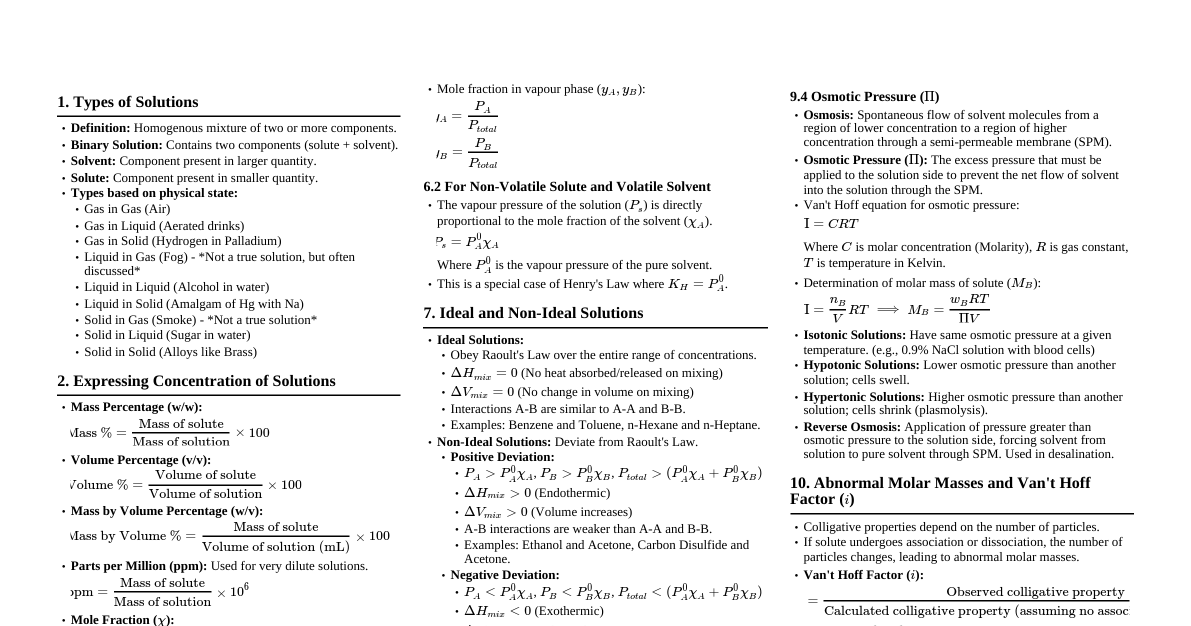
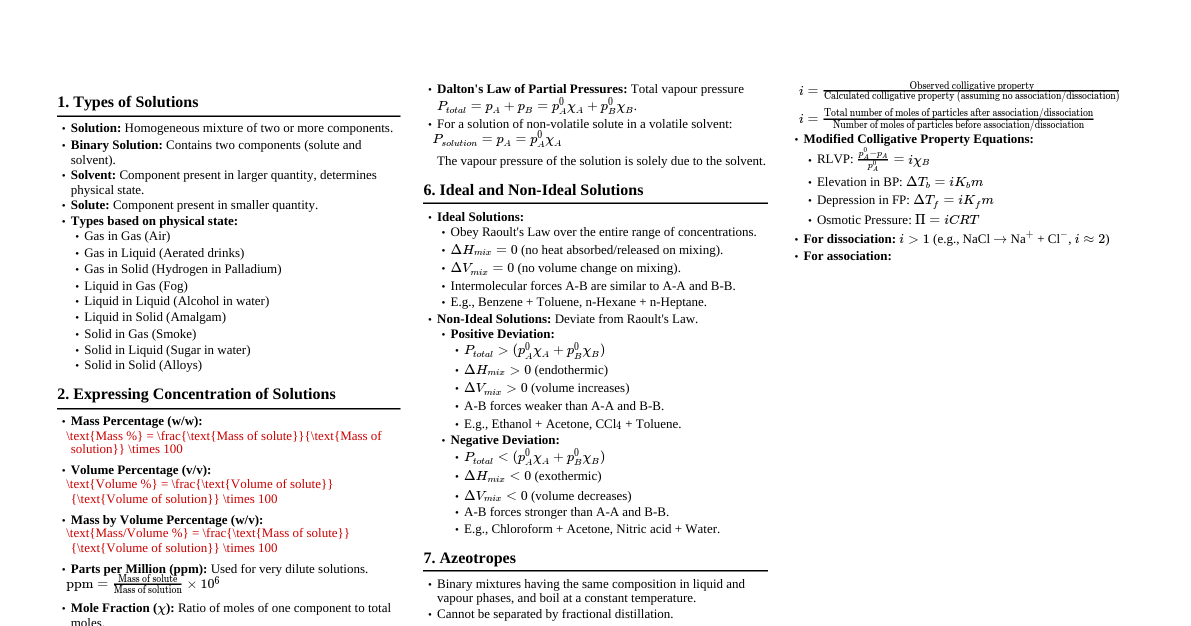
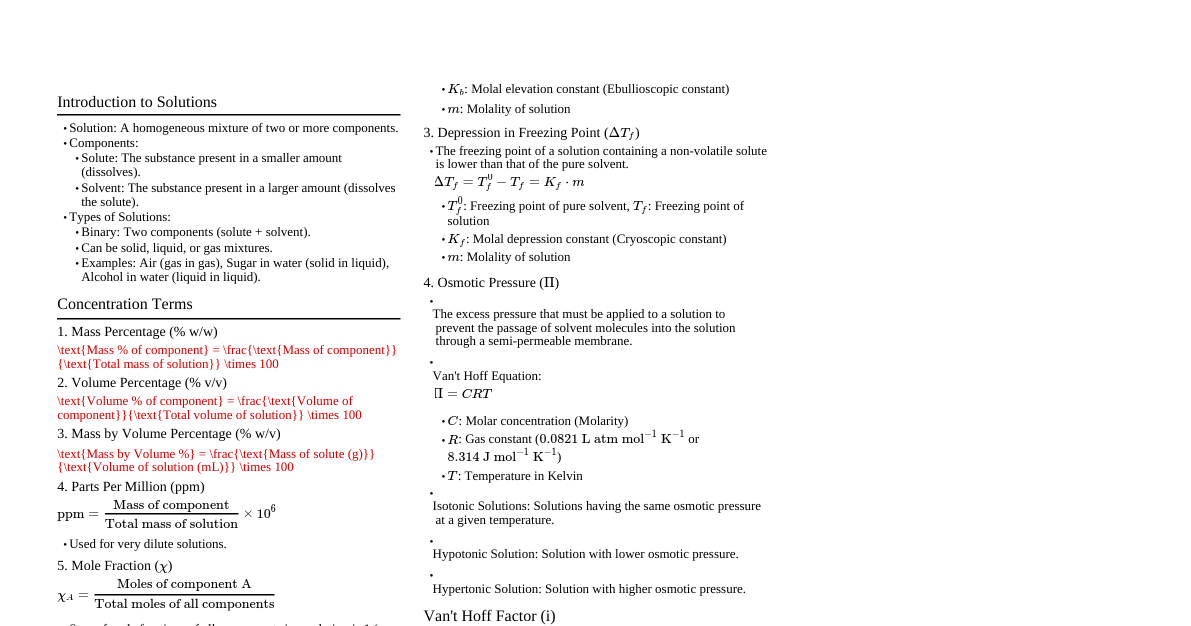
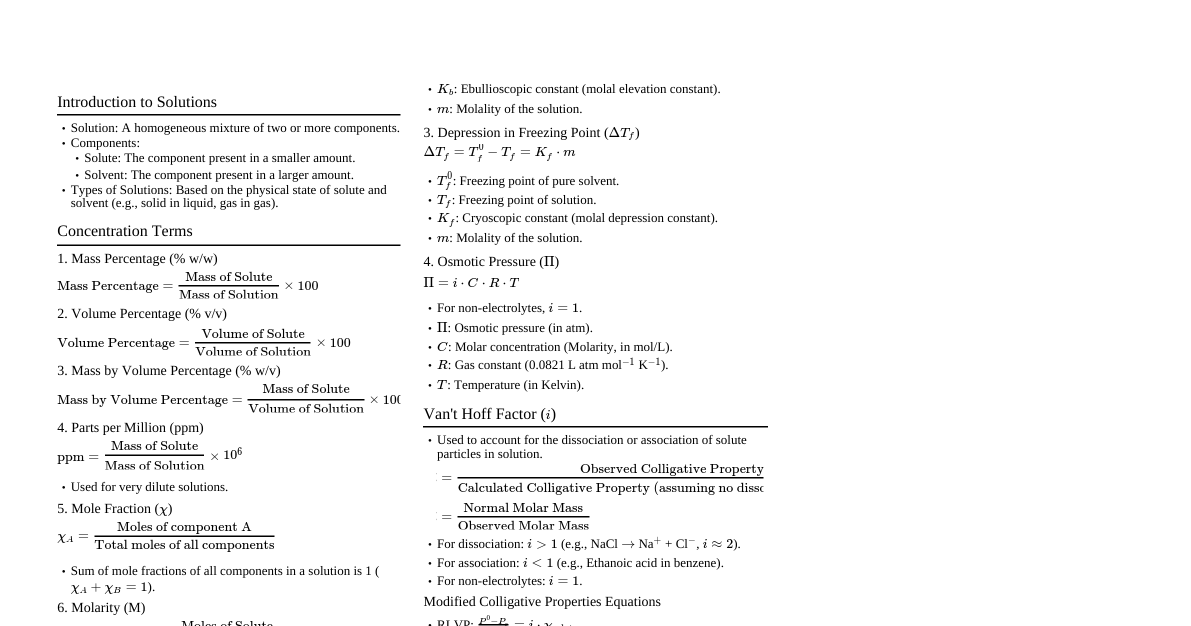
### Introduction & Types of Solutions #### 1. Definition - **Solution:** A homogeneous mixture of two or more chemically non-reacting substances. - **Solute:** Component present in smaller quantity. - **Solvent:** Component present in larger quantity, determines the physical state of the solution. #### 2. Types of Solutions Based on the physical state of solute and solvent: | Solute | Solvent | Example | |:-------|:--------|:-----------------------------| | Gas | Gas | Air (O$_2$ in N$_2$) | | Gas | Liquid | Soda water (CO$_2$ in H$_2$O)| | Gas | Solid | H$_2$ in Palladium | | Liquid | Gas | Fog (H$_2$O in air) | | Liquid | Liquid | Alcohol in water | | Liquid | Solid | Amalgam (Hg in Na) | | Solid | Gas | Smoke (carbon in air) | | Solid | Liquid | Sugar in water | | Solid | Solid | Alloys (e.g., Brass) | ### Concentration Terms #### 1. Mass Percentage (w/w) $$ \text{Mass \%} = \frac{\text{Mass of solute}}{\text{Mass of solution}} \times 100 $$ #### 2. Volume Percentage (v/v) $$ \text{Volume \%} = \frac{\text{Volume of solute}}{\text{Volume of solution}} \times 100 $$ #### 3. Mass by Volume Percentage (w/v) $$ \text{Mass by Volume \%} = \frac{\text{Mass of solute (g)}}{\text{Volume of solution (mL)}} \times 100 $$ #### 4. Parts per Million (ppm) / Parts per Billion (ppb) - Used for very dilute solutions. $$ \text{ppm} = \frac{\text{Mass of solute}}{\text{Mass of solution}} \times 10^6 $$ $$ \text{ppb} = \frac{\text{Mass of solute}}{\text{Mass of solution}} \times 10^9 $$ #### 5. Mole Fraction ($X$) - Ratio of moles of one component to the total moles of all components. - For a binary solution of A and B: $$ X_A = \frac{n_A}{n_A + n_B} $$ $$ X_B = \frac{n_B}{n_A + n_B} $$ $$ X_A + X_B = 1 $$ #### 6. Molarity ($M$) - Moles of solute per liter of solution. (Temperature dependent) $$ M = \frac{\text{Moles of solute}}{\text{Volume of solution (L)}} $$ #### 7. Molality ($m$) - Moles of solute per kilogram of solvent. (Temperature independent) $$ m = \frac{\text{Moles of solute}}{\text{Mass of solvent (kg)}} $$ #### 8. Normality ($N$) - Gram equivalents of solute per liter of solution. (Temperature dependent) $$ N = \frac{\text{Gram equivalents of solute}}{\text{Volume of solution (L)}} $$ $$ \text{Gram equivalents} = \frac{\text{Mass of solute}}{\text{Equivalent mass of solute}} $$ $$ \text{Equivalent mass} = \frac{\text{Molar mass}}{n\text{-factor}} $$ - Relationship between Molarity and Normality: $N = M \times n\text{-factor}$ ### Solubility #### 1. Definition - Maximum amount of solute that can be dissolved in a given amount of solvent at a specific temperature to form a saturated solution. #### 2. Solubility of a Solid in a Liquid - **Effect of Temperature:** - Endothermic dissolution (e.g., $NH_4Cl$): Solubility increases with temperature. - Exothermic dissolution (e.g., $NaOH$, $CaCl_2$): Solubility decreases with temperature. - **Effect of Pressure:** Negligible for solids. #### 3. Solubility of a Gas in a Liquid - **Effect of Temperature:** Solubility generally decreases with increasing temperature (exothermic process). - **Effect of Pressure: Henry's Law** - The partial pressure of the gas in vapor phase ($p$) is proportional to the mole fraction of the gas ($X$) in the solution. $$ p = K_H X $$ Where $K_H$ is Henry's Law constant (depends on gas, solvent, and temperature). - Higher $K_H$ at a given temperature implies lower solubility of the gas. - **Applications:** Carbonated drinks, deep-sea diving (Decompression Sickness or "bends"). ### Vapour Pressure & Raoult's Law #### 1. Vapour Pressure - The pressure exerted by the vapors in equilibrium with the liquid at a given temperature. #### 2. Raoult's Law - For a solution of volatile liquids, the partial vapor pressure of each component in the solution is directly proportional to its mole fraction in the solution. - For component A: $p_A = p_A^0 X_A$ - For component B: $p_B = p_B^0 X_B$ Where $p_A^0$ and $p_B^0$ are vapor pressures of pure components A and B, respectively. - **Dalton's Law of Partial Pressures:** Total vapor pressure $P_{total} = p_A + p_B = p_A^0 X_A + p_B^0 X_B$. - **Vapor Phase Composition:** Mole fraction of component A in vapor phase ($Y_A$): $$ Y_A = \frac{p_A}{P_{total}} $$ $$ Y_B = \frac{p_B}{P_{total}} $$ #### 3. Raoult's Law for Non-volatile Solute - When a non-volatile solute is added to a solvent, the vapor pressure of the solution is solely due to the solvent. - The vapor pressure of the solution is directly proportional to the mole fraction of the solvent. $$ P_{solution} = p_A = p_A^0 X_A $$ Where $p_A^0$ is the vapor pressure of the pure solvent. #### 4. Graphs *Figure: Vapor pressure vs. mole fraction for an ideal binary solution. The total vapor pressure and partial pressures ($p_A, p_B$) are linear functions of mole fraction.* ### Ideal & Non-Ideal Solutions #### 1. Ideal Solutions - **Definition:** Solutions that obey Raoult's Law over the entire range of concentrations and temperatures. - **Characteristics:** - $\Delta H_{mix} = 0$ (no heat absorbed or released on mixing) - $\Delta V_{mix} = 0$ (no change in volume on mixing) - A-B intermolecular forces are similar to A-A and B-B forces. - **Examples:** Benzene + Toluene, n-Hexane + n-Heptane. #### 2. Non-Ideal Solutions - **Definition:** Solutions that do not obey Raoult's Law. - **Characteristics:** - $\Delta H_{mix} \neq 0$ - $\Delta V_{mix} \neq 0$ - A-B intermolecular forces are different from A-A and B-B forces. #### 3. Positive Deviation from Raoult's Law - **Cause:** A-B interactions are weaker than A-A and B-B interactions. - **Characteristics:** - $p_A > p_A^0 X_A$ and $p_B > p_B^0 X_B$ (higher vapor pressure) - $\Delta H_{mix} > 0$ (endothermic, cooling upon mixing) - $\Delta V_{mix} > 0$ (expansion upon mixing) - Minimum boiling azeotropes. - **Examples:** Ethanol + Water, Acetone + Carbon Disulphide. #### 4. Negative Deviation from Raoult's Law - **Cause:** A-B interactions are stronger than A-A and B-B interactions. - **Characteristics:** - $p_A ### Colligative Properties - Properties of solutions that depend only on the number of solute particles, not on their nature. - Applicable to dilute solutions of non-volatile, non-electrolyte solutes. #### 1. Relative Lowering of Vapour Pressure (RLVP) - When a non-volatile solute is added, the vapor pressure of the solvent decreases. $$ \frac{P^0 - P_s}{P^0} = X_{solute} = \frac{n_{solute}}{n_{solute} + n_{solvent}} $$ - For dilute solutions, $n_{solute} \ll n_{solvent}$, so $n_{solute} + n_{solvent} \approx n_{solvent}$. $$ \frac{P^0 - P_s}{P^0} \approx \frac{n_{solute}}{n_{solvent}} = \frac{w_B/M_B}{w_A/M_A} $$ Where $P^0$ = vapor pressure of pure solvent, $P_s$ = vapor pressure of solution, $X_{solute}$ = mole fraction of solute, $w_B$ = mass of solute, $M_B$ = molar mass of solute, $w_A$ = mass of solvent, $M_A$ = molar mass of solvent. #### 2. Elevation in Boiling Point ($\Delta T_b$) - Boiling point of a solution containing a non-volatile solute is higher than that of the pure solvent. $$ \Delta T_b = T_b - T_b^0 = K_b m $$ - Where $\Delta T_b$ = elevation in boiling point, $T_b$ = boiling point of solution, $T_b^0$ = boiling point of pure solvent, $m$ = molality of solution. - $K_b$ = Ebullioscopic constant or Molal elevation constant (solvent specific). $$ K_b = \frac{R M_A (T_b^0)^2}{1000 \Delta_{vap}H} $$ - To find molar mass of solute ($M_B$): $$ \Delta T_b = K_b \frac{w_B}{M_B} \times \frac{1000}{w_A (\text{in g})} $$ $$ M_B = \frac{K_b \times w_B \times 1000}{\Delta T_b \times w_A (\text{in g})} $$ #### 3. Depression in Freezing Point ($\Delta T_f$) - Freezing point of a solution containing a non-volatile solute is lower than that of the pure solvent. $$ \Delta T_f = T_f^0 - T_f = K_f m $$ - Where $\Delta T_f$ = depression in freezing point, $T_f^0$ = freezing point of pure solvent, $T_f$ = freezing point of solution, $m$ = molality of solution. - $K_f$ = Cryoscopic constant or Molal depression constant (solvent specific). $$ K_f = \frac{R M_A (T_f^0)^2}{1000 \Delta_{fus}H} $$ - To find molar mass of solute ($M_B$): $$ \Delta T_f = K_f \frac{w_B}{M_B} \times \frac{1000}{w_A (\text{in g})} $$ $$ M_B = \frac{K_f \times w_B \times 1000}{\Delta T_f \times w_A (\text{in g})} $$ #### 4. Osmotic Pressure ($\Pi$) - The excess pressure that must be applied to a solution to prevent the passage of solvent molecules into it through a semi-permeable membrane (SPM). - **Van't Hoff Equation for Osmotic Pressure:** $$ \Pi = CRT $$ - Where $\Pi$ = osmotic pressure (in atm or Pa), $C$ = molar concentration (mol/L), $R$ = gas constant ($0.0821 \text{ L atm mol}^{-1} \text{ K}^{-1}$ or $8.314 \text{ J mol}^{-1} \text{ K}^{-1}$), $T$ = temperature (in Kelvin). - To find molar mass of solute ($M_B$): $$ \Pi = \frac{n_B}{V} RT = \frac{w_B}{M_B V} RT $$ $$ M_B = \frac{w_B RT}{\Pi V} $$ #### 5. Isotonic, Hypotonic, and Hypertonic Solutions - **Isotonic Solutions:** Have the same osmotic pressure at a given temperature. (No net flow of solvent). - **Hypotonic Solutions:** Have lower osmotic pressure. (Cells swell when placed in hypotonic solution). - **Hypertonic Solutions:** Have higher osmotic pressure. (Cells shrink/crenate when placed in hypertonic solution). #### 6. Reverse Osmosis - If pressure greater than osmotic pressure is applied to the solution side, solvent flows from solution to pure solvent through SPM. Used in desalination. ### Van't Hoff Factor ($i$) & Abnormal Molar Masses #### 1. Van't Hoff Factor ($i$) - Introduced to account for the extent of association or dissociation of solute particles in solution. $$ i = \frac{\text{Observed Colligative Property}}{\text{Calculated Colligative Property (assuming no association/dissociation)}} $$ $$ i = \frac{\text{Normal Molar Mass}}{\text{Observed Molar Mass (experimental)}} $$ $$ i = \frac{\text{Total number of moles of particles after association/dissociation}}{\text{Number of moles of particles before association/dissociation}} $$ #### 2. Modified Colligative Property Equations - **RLVP:** $ \frac{P^0 - P_s}{P^0} = i X_{solute} $ - **Elevation in Boiling Point:** $ \Delta T_b = i K_b m $ - **Depression in Freezing Point:** $ \Delta T_f = i K_f m $ - **Osmotic Pressure:** $ \Pi = i CRT $ #### 3. Dissociation of Solute - For a solute that dissociates into $n$ ions (e.g., $NaCl \rightarrow Na^+ + Cl^-$, $n=2$): $$ i = 1 + (n-1)\alpha $$ Where $\alpha$ is the degree of dissociation. - If dissociation is complete ($\alpha=1$), then $i=n$. - For $NaCl$, $i \approx 2$ - For $K_2SO_4$, $i \approx 3$ #### 4. Association of Solute - For a solute that associates to form $n$ particles (e.g., ethanoic acid in benzene forms a dimer, $n=2$): $$ i = 1 + \left(\frac{1}{n}-1\right)\alpha $$ Where $\alpha$ is the degree of association. - If association is complete ($\alpha=1$): - For dimerization ($n=2$), $i = 1/2$. - For trimerization ($n=3$), $i = 1/3$. #### 5. Abnormal Molar Masses - When $i > 1$ (dissociation), the observed molar mass is less than the normal molar mass. - When $i