Class 12 Chemistry Formulae (CBSE)
Cheatsheet Content
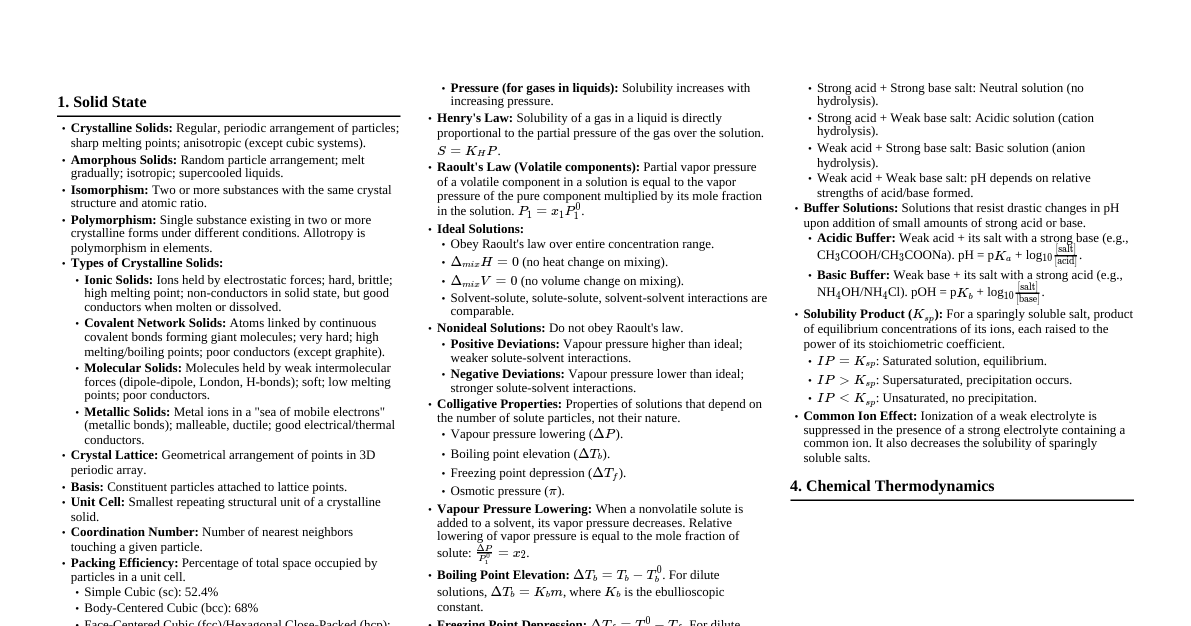
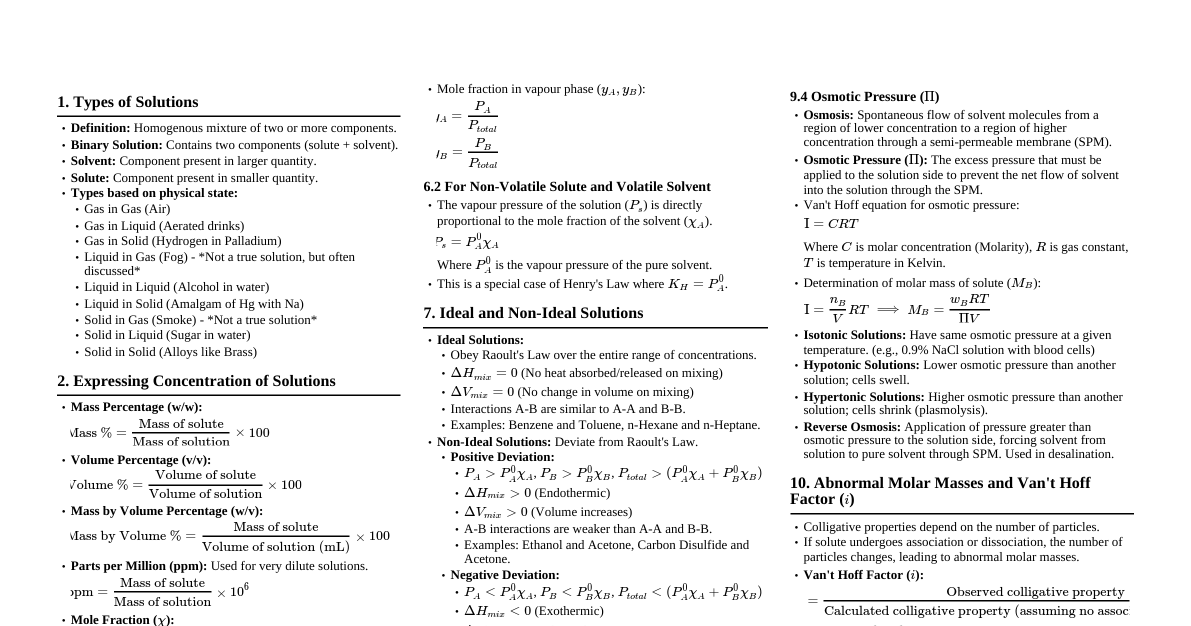
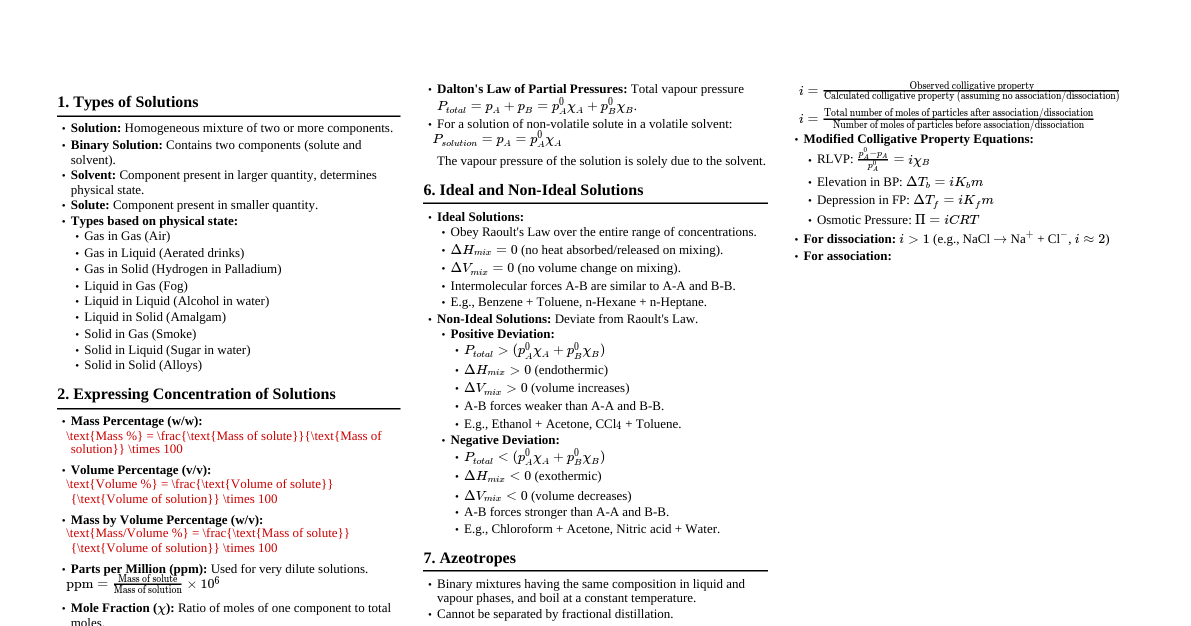
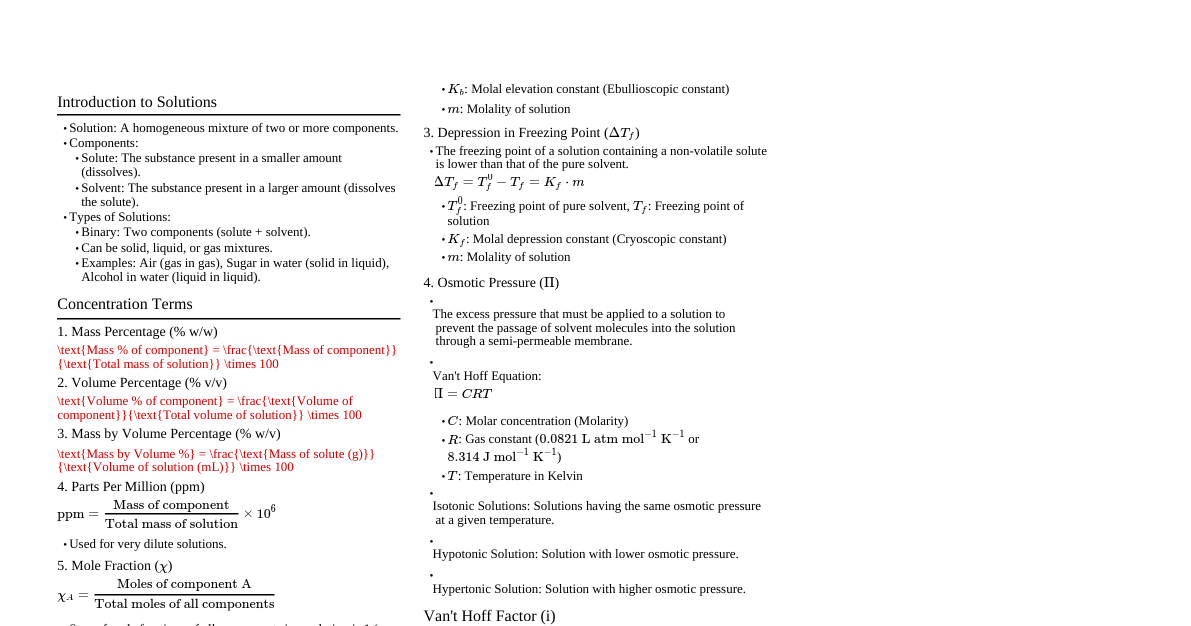
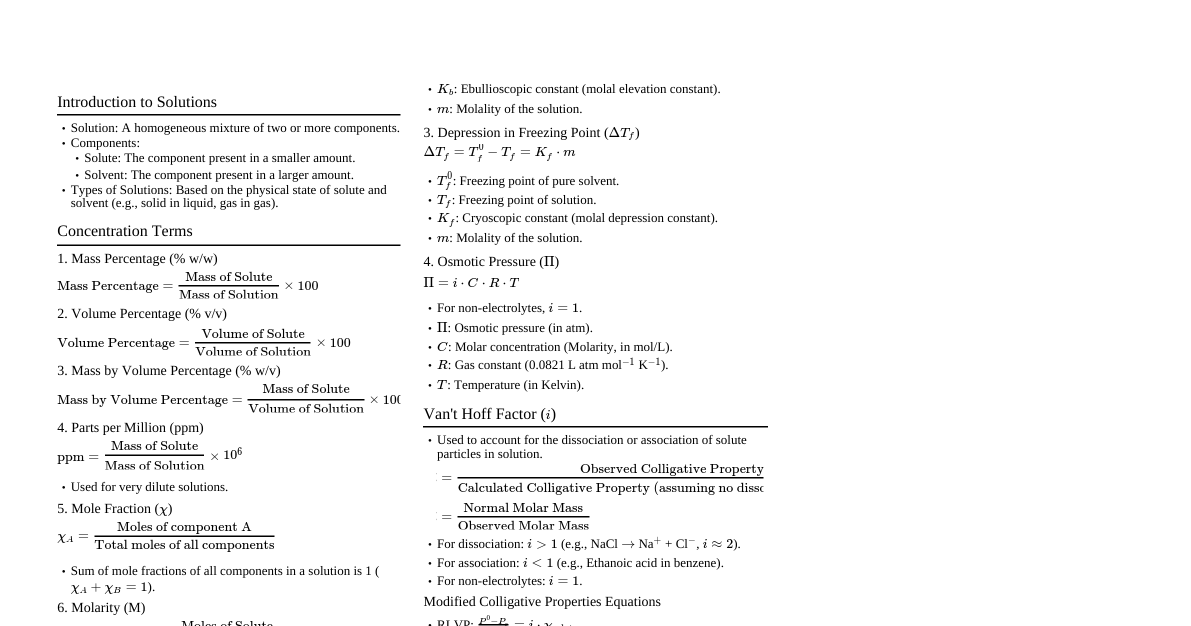
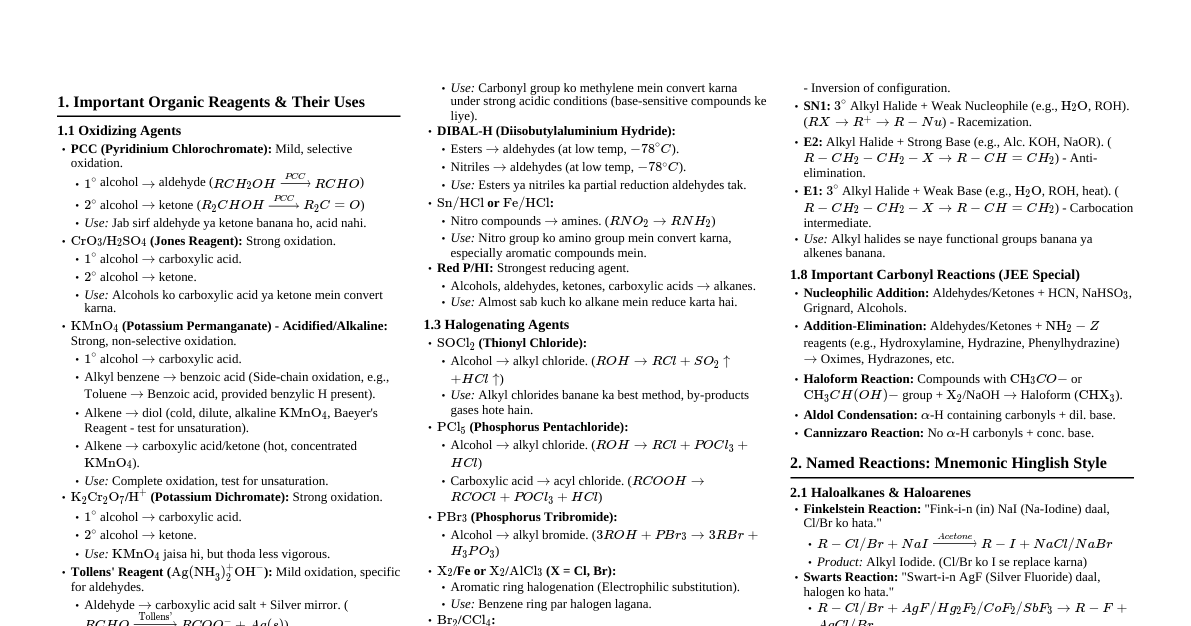
1. Solid State Density of unit cell: $\rho = \frac{Z \cdot M}{a^3 \cdot N_A}$ $Z$: number of atoms per unit cell $M$: molar mass $a$: edge length $N_A$: Avogadro's number ($6.022 \times 10^{23} \text{ mol}^{-1}$) Packing Efficiency: Simple Cubic: $52.4\%$ BCC (Body Centered Cubic): $68\%$ FCC (Face Centered Cubic) / HCP (Hexagonal Close Packing): $74\%$ Radius Ratio Rules: $0.155 - 0.225$: Trigonal, CN 3 $0.225 - 0.414$: Tetrahedral, CN 4 $0.414 - 0.732$: Octahedral, CN 6 $0.732 - 1.000$: Cubic, CN 8 2. Solutions Mole fraction: $x_A = \frac{n_A}{n_A + n_B}$ Molality (m): $m = \frac{\text{moles of solute}}{\text{mass of solvent (in kg)}}$ Molarity (M): $M = \frac{\text{moles of solute}}{\text{volume of solution (in L)}}$ Henry's Law: $p = K_H \cdot x$ $p$: partial pressure of gas $K_H$: Henry's Law constant $x$: mole fraction of gas in solution Raoult's Law: For volatile solute: $P_A = P_A^0 \cdot x_A$ For non-volatile solute: $P_{total} = P_A^0 \cdot x_A$ Colligative Properties: Relative lowering of vapor pressure: $\frac{P_A^0 - P_A}{P_A^0} = x_B = \frac{n_B}{n_A + n_B}$ Elevation in boiling point: $\Delta T_b = K_b \cdot m$ Depression in freezing point: $\Delta T_f = K_f \cdot m$ Osmotic pressure: $\pi = i \cdot C \cdot R \cdot T$ $i$: van't Hoff factor $C$: molar concentration $R$: gas constant ($0.0821 \text{ L atm mol}^{-1} \text{ K}^{-1}$) $T$: temperature in Kelvin Van't Hoff factor ($i$): $i = \frac{\text{Normal molar mass}}{\text{Observed molar mass}} = \frac{\text{Observed colligative property}}{\text{Calculated colligative property}}$ 3. Electrochemistry Conductance: $G = \frac{1}{R}$ (Siemens, S) Conductivity ($\kappa$): $\kappa = G \cdot \frac{l}{A} = \frac{1}{R} \cdot \frac{l}{A}$ (S cm$^{-1}$ or S m$^{-1}$) Molar conductivity ($\Lambda_m$): $\Lambda_m = \frac{\kappa \times 1000}{M}$ (S cm$^2$ mol$^{-1}$) Kohlrausch's Law: $\Lambda_m^0 = \nu_A \lambda_A^0 + \nu_B \lambda_B^0$ Nernst Equation: $E_{cell} = E_{cell}^0 - \frac{RT}{nF} \ln Q$ At $298 \text{ K}$: $E_{cell} = E_{cell}^0 - \frac{0.0591}{n} \log Q$ $n$: number of electrons transferred $F$: Faraday constant ($96487 \text{ C mol}^{-1}$) $Q$: reaction quotient Gibbs Free Energy: $\Delta G^0 = -nFE_{cell}^0$ Relationship with Equilibrium Constant: $\Delta G^0 = -RT \ln K_c = -nFE_{cell}^0$ $\log K_c = \frac{nE_{cell}^0}{0.0591}$ (at $298 \text{ K}$) Faraday's Laws of Electrolysis: $1^{st}$ Law: $m \propto Q$ or $m = Z \cdot Q = Z \cdot I \cdot t$ $2^{nd}$ Law: $\frac{m_1}{m_2} = \frac{E_1}{E_2}$ (where $E$ is equivalent mass) $Z = \frac{\text{Equivalent mass}}{F}$ 4. Chemical Kinetics Rate of reaction: Rate $= -\frac{1}{\nu_R} \frac{d[R]}{dt} = +\frac{1}{\nu_P} \frac{d[P]}{dt}$ Rate Law: Rate $= k[A]^x[B]^y$ Integrated Rate Laws: Zero Order: $[A]_t = -kt + [A]_0$ Half-life: $t_{1/2} = \frac{[A]_0}{2k}$ First Order: $\ln[A]_t = -kt + \ln[A]_0$ or $k = \frac{2.303}{t} \log \frac{[A]_0}{[A]_t}$ Half-life: $t_{1/2} = \frac{0.693}{k}$ Arrhenius Equation: $k = A e^{-E_a/RT}$ $\ln k = -\frac{E_a}{RT} + \ln A$ $\log \frac{k_2}{k_1} = \frac{E_a}{2.303R} \left( \frac{1}{T_1} - \frac{1}{T_2} \right)$ $A$: Arrhenius factor / pre-exponential factor $E_a$: activation energy 5. Surface Chemistry Freundlich Adsorption Isotherm: $\frac{x}{m} = k \cdot p^{1/n}$ (for gases) $\log \frac{x}{m} = \log k + \frac{1}{n} \log p$ $x$: mass of adsorbate $m$: mass of adsorbent $p$: pressure Hardy-Schulze Rule: Coagulating power of an electrolyte is directly proportional to the fourth power of the valency of the effective ion. 6. General Principles and Processes of Isolation of Elements (Metallurgy) Ellingham Diagram: Plots $\Delta G^0$ vs $T$ for formation of metal oxides. 7. p-Block Elements No specific formulas, primarily descriptive chemistry. 8. d- and f-Block Elements Magnetic Moment: $\mu = \sqrt{n(n+2)}$ B.M. (Bohr Magnetons) $n$: number of unpaired electrons 9. Coordination Compounds EAN (Effective Atomic Number) Rule: EAN = Z - Oxidation State + 2 $\times$ Coordination Number Crystal Field Stabilization Energy (CFSE): Octahedral: $\Delta_o = (-0.4 n_{t_{2g}} + 0.6 n_{e_g}) \Delta_o + n_P \cdot P$ (where $n_P$ is number of paired electrons) Tetrahedral: $\Delta_t = (-0.6 n_e + 0.4 n_{t_2}) \Delta_t + n_P \cdot P$ Usually $\Delta_t = \frac{4}{9} \Delta_o$ Isomerism: Structural (linkage, coordination, ionization, hydrate) and Stereoisomerism (geometrical, optical). 10. Haloalkanes and Haloarenes SN1, SN2, E1, E2 reaction mechanisms. 11. Alcohols, Phenols and Ethers Acidity of alcohols/phenols, reactivity towards various reagents. 12. Aldehydes, Ketones and Carboxylic Acids Reactions: Aldol condensation, Cannizzaro, Clemmensen, Wolff-Kishner, Hell-Volhard-Zelinsky (HVZ). 13. Amines Basicity of amines, Carbylamine reaction, Hoffmann bromamide degradation. 14. Biomolecules Structures and classifications of carbohydrates, proteins, nucleic acids, vitamins. 15. Polymers Classification, types of polymerization (addition, condensation), examples of polymers. 16. Chemistry in Everyday Life Drugs, food additives, cleansing agents.