Class 11 Chemistry: Solutions
Cheatsheet Content
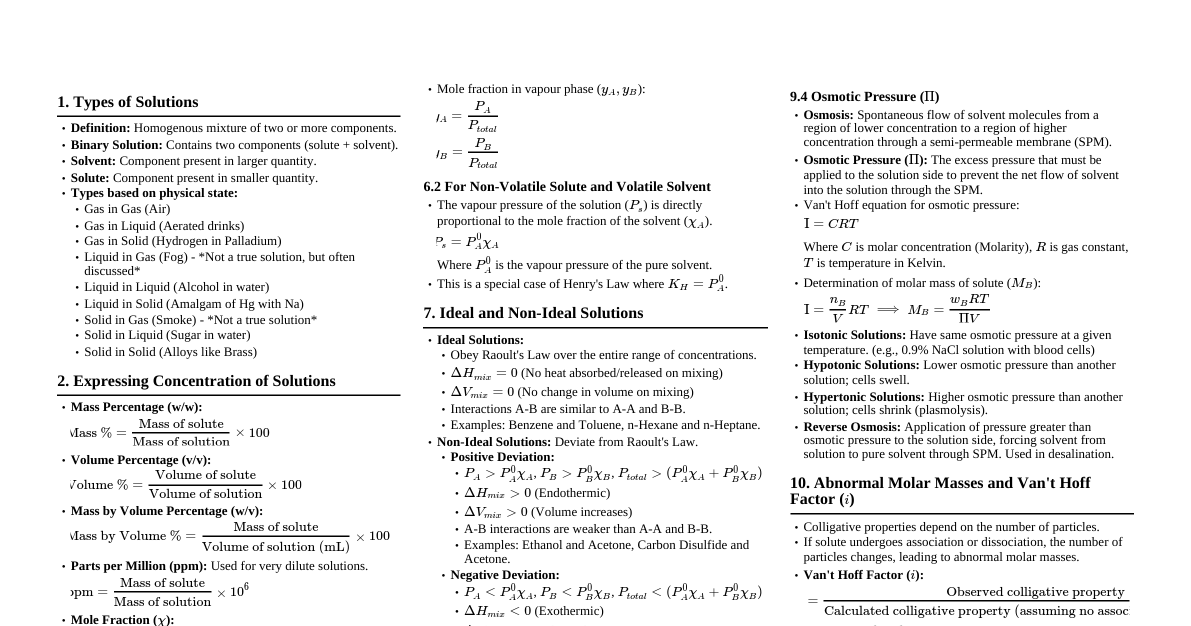
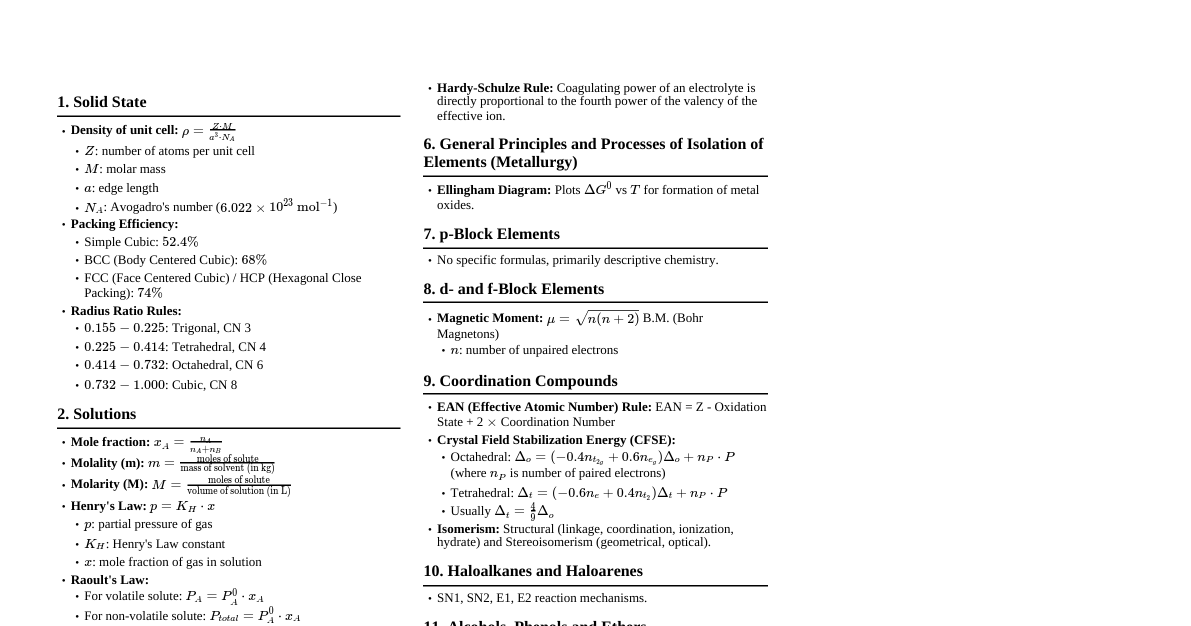
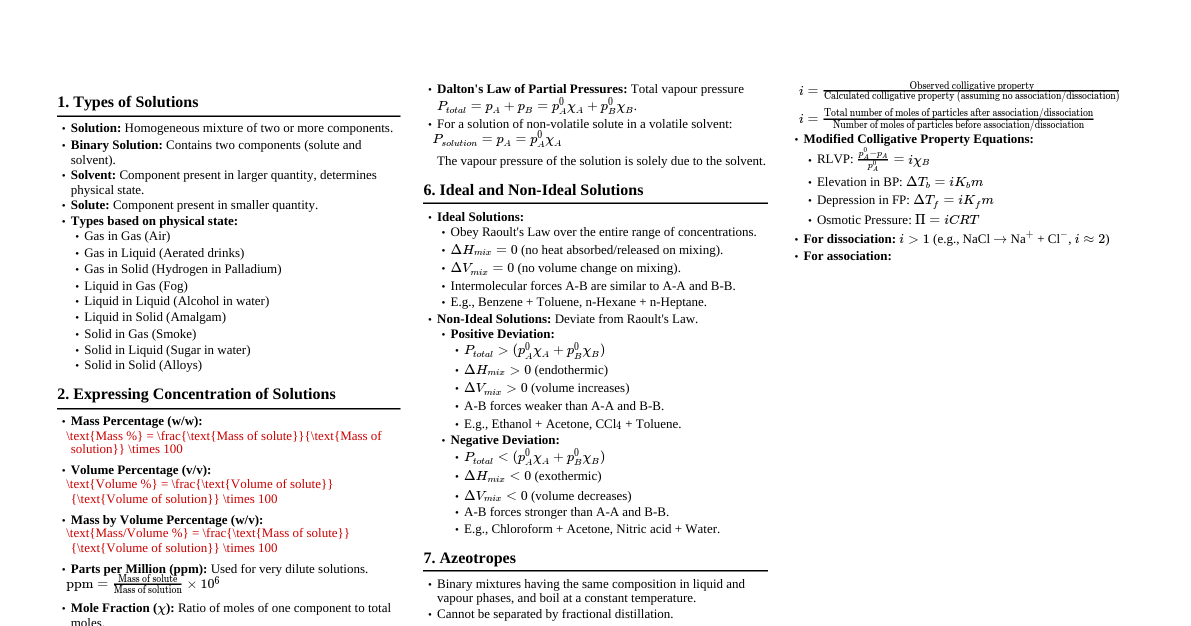
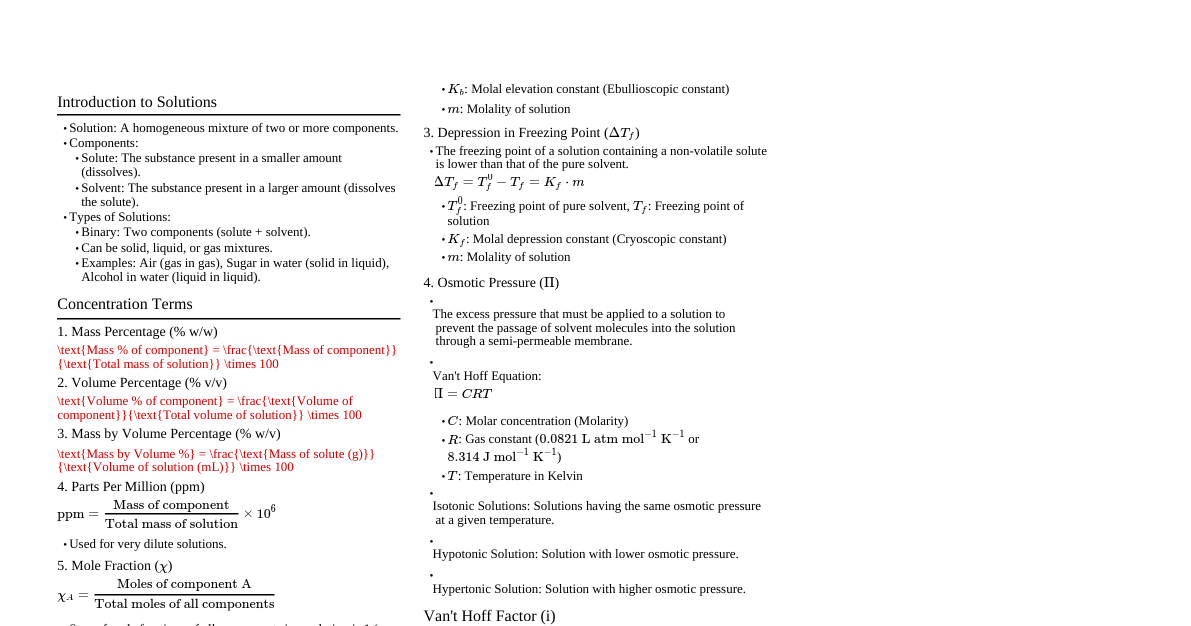
### Introduction to Solutions - **Solution:** A homogeneous mixture of two or more components. - **Components:** - **Solute:** The component present in a smaller amount. - **Solvent:** The component present in a larger amount. - **Types of Solutions:** Based on the physical state of solute and solvent (e.g., solid in liquid, gas in gas). ### Concentration Terms #### 1. Mass Percentage (% w/w) $$ \text{Mass Percentage} = \frac{\text{Mass of Solute}}{\text{Mass of Solution}} \times 100 $$ #### 2. Volume Percentage (% v/v) $$ \text{Volume Percentage} = \frac{\text{Volume of Solute}}{\text{Volume of Solution}} \times 100 $$ #### 3. Mass by Volume Percentage (% w/v) $$ \text{Mass by Volume Percentage} = \frac{\text{Mass of Solute}}{\text{Volume of Solution}} \times 100 $$ #### 4. Parts per Million (ppm) $$ \text{ppm} = \frac{\text{Mass of Solute}}{\text{Mass of Solution}} \times 10^6 $$ - Used for very dilute solutions. #### 5. Mole Fraction ($\chi$) $$ \chi_A = \frac{\text{Moles of component A}}{\text{Total moles of all components}} $$ - Sum of mole fractions of all components in a solution is 1 ($\chi_A + \chi_B = 1$). #### 6. Molarity (M) $$ \text{Molarity (M)} = \frac{\text{Moles of Solute}}{\text{Volume of Solution (L)}} $$ - Temperature dependent (as volume changes with temperature). #### 7. Molality (m) $$ \text{Molality (m)} = \frac{\text{Moles of Solute}}{\text{Mass of Solvent (kg)}} $$ - Temperature independent (as mass does not change with temperature). #### 8. Normality (N) $$ \text{Normality (N)} = \frac{\text{Number of Gram Equivalents of Solute}}{\text{Volume of Solution (L)}} $$ - **Gram equivalent:** Molar mass / n-factor (acidity/basicity, change in oxidation state). ### Solubility - **Definition:** Maximum amount of solute that can dissolve in a given amount of solvent at a specific temperature. - **Factors Affecting Solubility:** - **Nature of Solute and Solvent:** "Like dissolves like" (polar solutes dissolve in polar solvents, non-polar in non-polar). - **Temperature:** - For solids in liquids: Usually increases with temperature (endothermic dissolution). - For gases in liquids: Decreases with temperature. - **Pressure:** - For solids/liquids in liquids: No significant effect. - For gases in liquids: Increases with pressure (Henry's Law). #### Henry's Law $$ P = K_H \cdot \chi $$ - $P$: Partial pressure of the gas above the solution. - $K_H$: Henry's Law constant. - $\chi$: Mole fraction of the gas in the solution. - Higher $K_H$ means lower solubility for a given pressure. ### Colligative Properties - Properties of solutions that depend only on the number of solute particles, not on their nature. - Applicable to ideal dilute solutions. #### 1. Relative Lowering of Vapor Pressure (RLVP) - **Raoult's Law:** For a solution of volatile liquids, the partial vapor pressure of each component is proportional to its mole fraction. $$ P_A = P_A^0 \chi_A $$ - $P_A$: Partial vapor pressure of component A in solution. - $P_A^0$: Vapor pressure of pure component A. - $\chi_A$: Mole fraction of component A in solution. - For a solution with a non-volatile solute: $$ \frac{P^0 - P_s}{P^0} = \chi_{\text{solute}} = \frac{n_{\text{solute}}}{n_{\text{solute}} + n_{\text{solvent}}} $$ - $P^0$: Vapor pressure of pure solvent. - $P_s$: Vapor pressure of solution. #### 2. Elevation in Boiling Point ($\Delta T_b$) $$ \Delta T_b = T_b - T_b^0 = K_b \cdot m $$ - $T_b$: Boiling point of solution. - $T_b^0$: Boiling point of pure solvent. - $K_b$: Ebullioscopic constant (molal elevation constant). - $m$: Molality of the solution. #### 3. Depression in Freezing Point ($\Delta T_f$) $$ \Delta T_f = T_f^0 - T_f = K_f \cdot m $$ - $T_f^0$: Freezing point of pure solvent. - $T_f$: Freezing point of solution. - $K_f$: Cryoscopic constant (molal depression constant). - $m$: Molality of the solution. #### 4. Osmotic Pressure ($\Pi$) $$ \Pi = i \cdot C \cdot R \cdot T $$ - For non-electrolytes, $i=1$. - $\Pi$: Osmotic pressure (in atm). - $C$: Molar concentration (Molarity, in mol/L). - $R$: Gas constant (0.0821 L atm mol$^{-1}$ K$^{-1}$). - $T$: Temperature (in Kelvin). ### Van't Hoff Factor ($i$) - Used to account for the dissociation or association of solute particles in solution. $$ i = \frac{\text{Observed Colligative Property}}{\text{Calculated Colligative Property (assuming no dissociation/association)}} $$ $$ i = \frac{\text{Normal Molar Mass}}{\text{Observed Molar Mass}} $$ - For dissociation: $i > 1$ (e.g., NaCl $\to$ Na$^+$ + Cl$^-$, $i \approx 2$). - For association: $i ### Ideal and Non-Ideal Solutions - **Ideal Solutions:** - Obeys Raoult's Law over the entire range of concentrations. - $\Delta H_{\text{mix}} = 0$ (no heat absorbed or released on mixing). - $\Delta V_{\text{mix}} = 0$ (no volume change on mixing). - Intermolecular interactions A-B are similar to A-A and B-B. - Example: Benzene + Toluene. - **Non-Ideal Solutions:** - Do not obey Raoult's Law. - $\Delta H_{\text{mix}} \ne 0$, $\Delta V_{\text{mix}} \ne 0$. - **Positive Deviations:** - $P_A > P_A^0 \chi_A$, $P_B > P_B^0 \chi_B$ (higher vapor pressure than ideal). - $\Delta H_{\text{mix}} > 0$ (endothermic). - $\Delta V_{\text{mix}} > 0$ (expansion in volume). - A-B interactions are weaker than A-A and B-B. - Example: Ethanol + Acetone. - **Negative Deviations:** - $P_A ### Azeotropes - Binary mixtures that boil at a constant temperature and distil without change in composition. - Cannot be separated by fractional distillation. - **Minimum Boiling Azeotropes:** Formed by solutions showing large positive deviation from Raoult's Law (e.g., ethanol-water). - **Maximum Boiling Azeotropes:** Formed by solutions showing large negative deviation from Raoult's Law (e.g., nitric acid-water).