Class 12 Chemistry Solutions
Cheatsheet Content
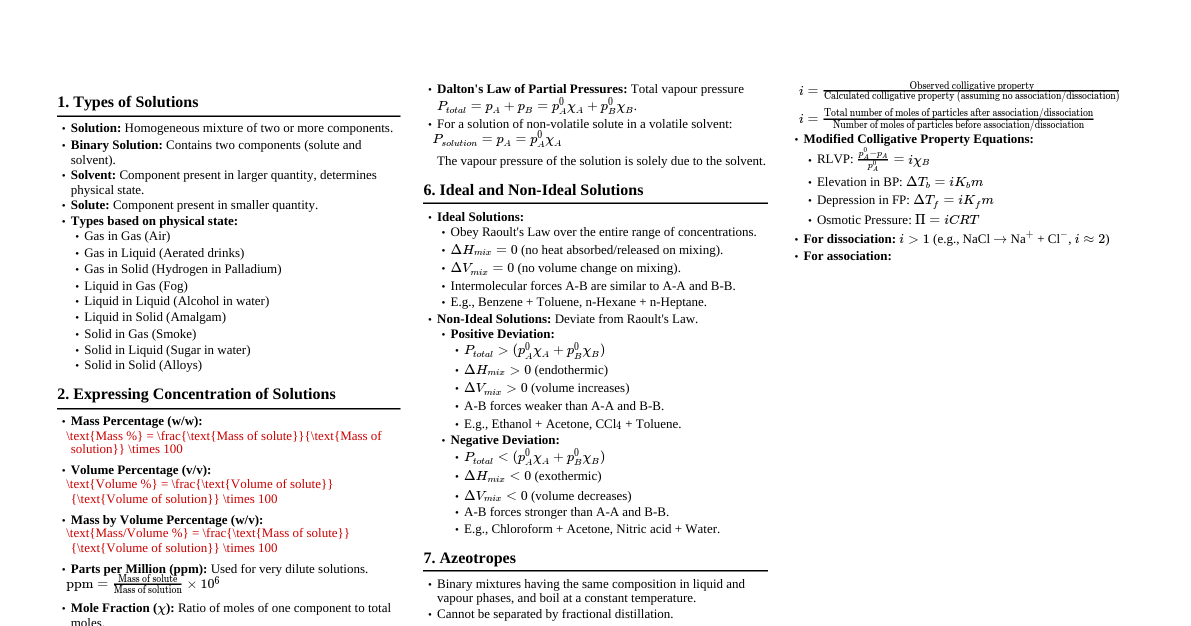
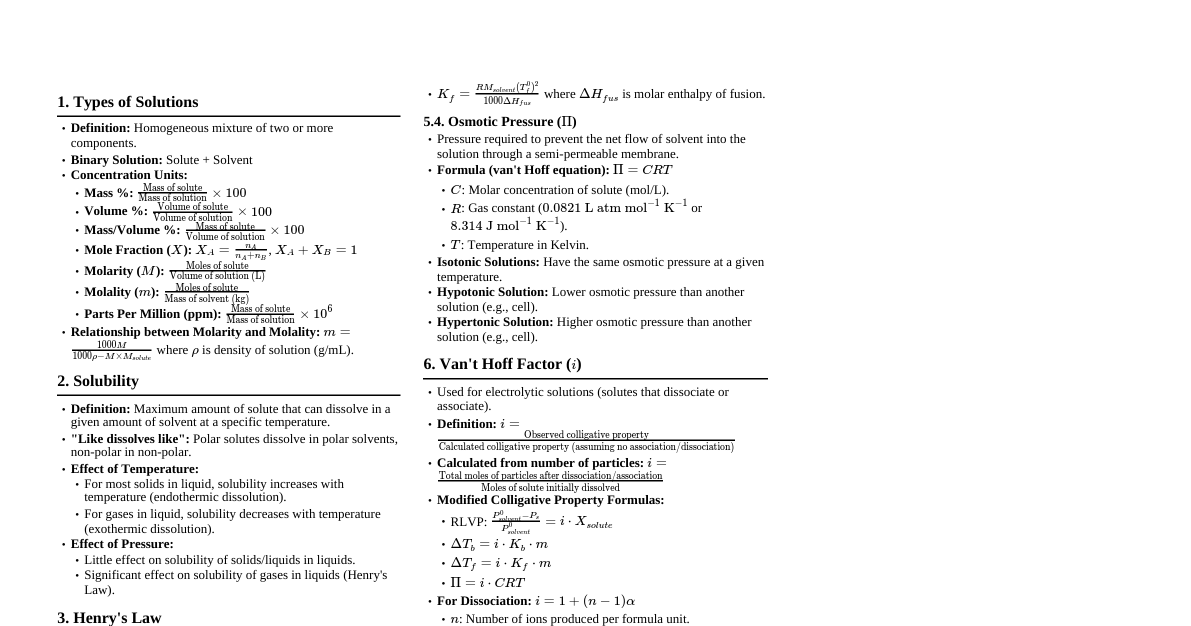
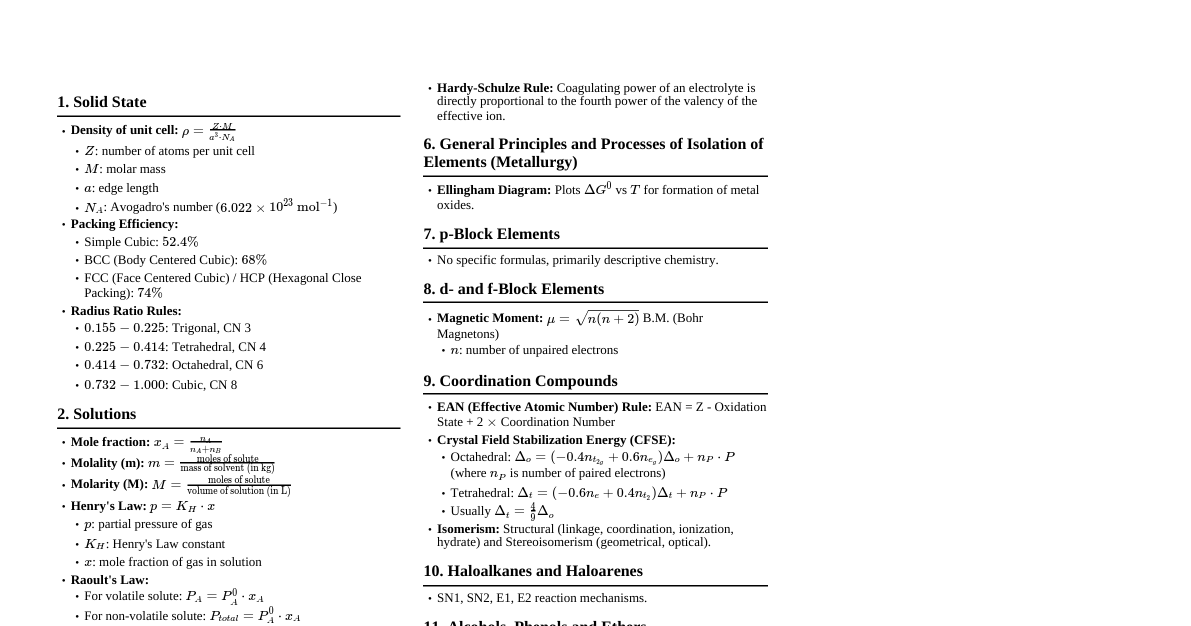
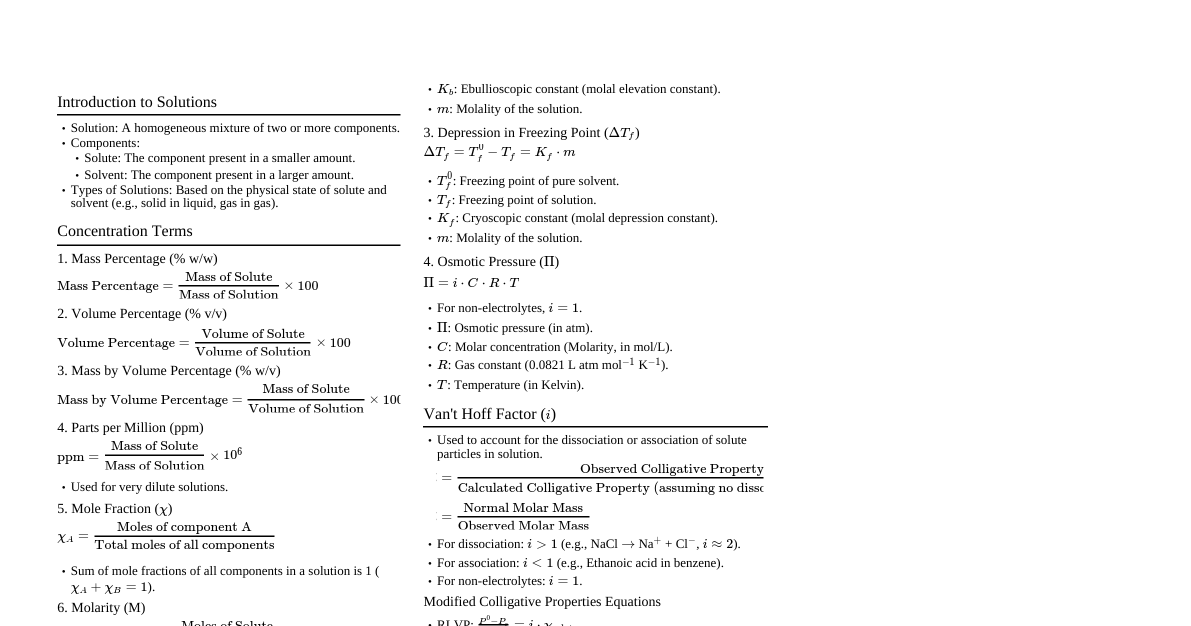
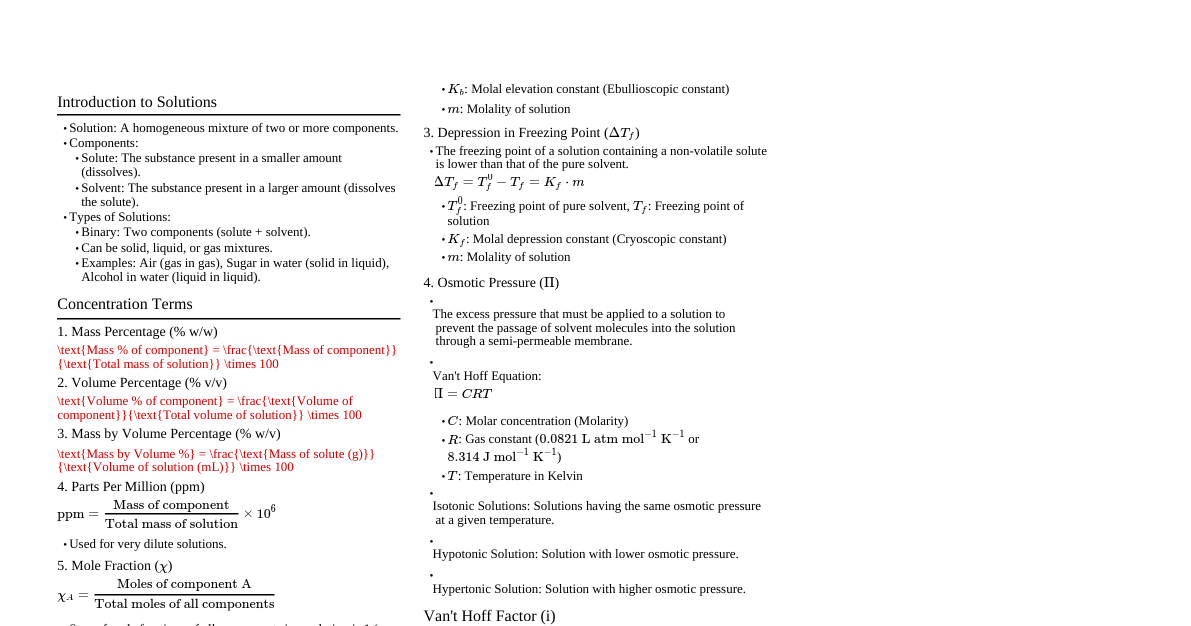
1. Types of Solutions Definition: Homogenous mixture of two or more components. Binary Solution: Contains two components (solute + solvent). Solvent: Component present in larger quantity. Solute: Component present in smaller quantity. Types based on physical state: Gas in Gas (Air) Gas in Liquid (Aerated drinks) Gas in Solid (Hydrogen in Palladium) Liquid in Gas (Fog) - *Not a true solution, but often discussed* Liquid in Liquid (Alcohol in water) Liquid in Solid (Amalgam of Hg with Na) Solid in Gas (Smoke) - *Not a true solution* Solid in Liquid (Sugar in water) Solid in Solid (Alloys like Brass) 2. Expressing Concentration of Solutions Mass Percentage (w/w): $$ \text{Mass \%} = \frac{\text{Mass of solute}}{\text{Mass of solution}} \times 100 $$ Volume Percentage (v/v): $$ \text{Volume \%} = \frac{\text{Volume of solute}}{\text{Volume of solution}} \times 100 $$ Mass by Volume Percentage (w/v): $$ \text{Mass by Volume \%} = \frac{\text{Mass of solute}}{\text{Volume of solution (mL)}} \times 100 $$ Parts per Million (ppm): Used for very dilute solutions. $$ \text{ppm} = \frac{\text{Mass of solute}}{\text{Mass of solution}} \times 10^6 $$ Mole Fraction ($\chi$): $$ \chi_A = \frac{\text{Moles of component A}}{\text{Total moles of all components}} $$ For a binary solution: $\chi_A + \chi_B = 1$ Molarity (M): Moles of solute per litre of solution. (Temperature dependent) $$ M = \frac{\text{Moles of solute}}{\text{Volume of solution (L)}} $$ Molality (m): Moles of solute per kg of solvent. (Temperature independent) $$ m = \frac{\text{Moles of solute}}{\text{Mass of solvent (kg)}} $$ 3. Solubility Definition: Maximum amount of solute that can be dissolved in a specified amount of solvent at a given temperature. Factors affecting solubility of a solid in a liquid: Nature of solute and solvent ("Like dissolves like") Temperature: Endothermic dissolution: Solubility increases with T. Exothermic dissolution: Solubility decreases with T. Factors affecting solubility of a gas in a liquid: Nature of gas and liquid Temperature: Solubility generally decreases with increase in T. Pressure: Governed by Henry's Law. 4. Henry's Law Statement: The partial pressure of the gas in vapor phase ($P$) is proportional to the mole fraction of the gas ($\chi$) in the solution. $$ P = K_H \chi $$ Where $K_H$ is Henry's Law constant. Higher $K_H$ value at a given temperature implies lower solubility of the gas. Applications: Soft drinks, deep-sea diving (decompression sickness/bends), high altitudes (anoxia). 5. Vapour Pressure of Liquid Solutions Vapour Pressure: Pressure exerted by the vapours in equilibrium with the liquid at a given temperature. Factors affecting vapour pressure: Nature of liquid (intermolecular forces) Temperature 6. Raoult's Law 6.1 For Volatile Solute and Volatile Solvent For a binary solution of two volatile liquids A and B: $$ P_A = P_A^0 \chi_A $$ $$ P_B = P_B^0 \chi_B $$ Where $P_A^0$ and $P_B^0$ are vapour pressures of pure components A and B. Dalton's Law of Partial Pressures: Total vapour pressure ($P_{total}$) $$ P_{total} = P_A + P_B = P_A^0 \chi_A + P_B^0 \chi_B $$ Or $$ P_{total} = P_A^0 + (P_B^0 - P_A^0)\chi_B $$ Mole fraction in vapour phase ($y_A, y_B$): $$ y_A = \frac{P_A}{P_{total}} $$ $$ y_B = \frac{P_B}{P_{total}} $$ 6.2 For Non-Volatile Solute and Volatile Solvent The vapour pressure of the solution ($P_s$) is directly proportional to the mole fraction of the solvent ($\chi_A$). $$ P_s = P_A^0 \chi_A $$ Where $P_A^0$ is the vapour pressure of the pure solvent. This is a special case of Henry's Law where $K_H = P_A^0$. 7. Ideal and Non-Ideal Solutions Ideal Solutions: Obey Raoult's Law over the entire range of concentrations. $\Delta H_{mix} = 0$ (No heat absorbed/released on mixing) $\Delta V_{mix} = 0$ (No change in volume on mixing) Interactions A-B are similar to A-A and B-B. Examples: Benzene and Toluene, n-Hexane and n-Heptane. Non-Ideal Solutions: Deviate from Raoult's Law. Positive Deviation: $P_A > P_A^0 \chi_A$, $P_B > P_B^0 \chi_B$, $P_{total} > (P_A^0 \chi_A + P_B^0 \chi_B)$ $\Delta H_{mix} > 0$ (Endothermic) $\Delta V_{mix} > 0$ (Volume increases) A-B interactions are weaker than A-A and B-B. Examples: Ethanol and Acetone, Carbon Disulfide and Acetone. Negative Deviation: $P_A $\Delta H_{mix} $\Delta V_{mix} A-B interactions are stronger than A-A and B-B. Examples: Phenol and Aniline, Acetone and Chloroform, Nitric Acid and Water. 8. Azeotropes Binary mixtures that boil at a constant temperature like a pure liquid and distill without changing composition. Cannot be separated by fractional distillation. Minimum boiling azeotropes: Formed by non-ideal solutions showing positive deviation (e.g., Ethanol-Water, 95.6% ethanol). Maximum boiling azeotropes: Formed by non-ideal solutions showing negative deviation (e.g., Nitric Acid-Water, 68% nitric acid). 9. Colligative Properties Properties of dilute solutions that depend only on the number of solute particles, not on their nature. Applicable for non-volatile solutes in ideal solutions. Four colligative properties: Relative Lowering of Vapour Pressure (RLVP) Elevation in Boiling Point ($\Delta T_b$) Depression in Freezing Point ($\Delta T_f$) Osmotic Pressure ($\Pi$) 9.1 Relative Lowering of Vapour Pressure (RLVP) According to Raoult's Law for non-volatile solute: $$ \frac{P_A^0 - P_s}{P_A^0} = \chi_B $$ Where $\chi_B$ is the mole fraction of the solute. For dilute solutions, $\chi_B \approx \frac{n_B}{n_A}$ $$ \frac{P_A^0 - P_s}{P_A^0} = \frac{n_B}{n_A} = \frac{w_B/M_B}{w_A/M_A} $$ Where $w_A, w_B$ are masses and $M_A, M_B$ are molar masses. 9.2 Elevation in Boiling Point ($\Delta T_b$) Boiling point of solution ($T_b$) is higher than that of pure solvent ($T_b^0$). $$ \Delta T_b = T_b - T_b^0 $$ $\Delta T_b$ is directly proportional to molality ($m$) of the solution: $$ \Delta T_b = K_b m $$ Where $K_b$ is Ebullioscopic constant (molal elevation constant) for the solvent. Determination of molar mass of solute ($M_B$): $$ M_B = \frac{K_b \times w_B \times 1000}{\Delta T_b \times w_A} $$ 9.3 Depression in Freezing Point ($\Delta T_f$) Freezing point of solution ($T_f$) is lower than that of pure solvent ($T_f^0$). $$ \Delta T_f = T_f^0 - T_f $$ $\Delta T_f$ is directly proportional to molality ($m$) of the solution: $$ \Delta T_f = K_f m $$ Where $K_f$ is Cryoscopic constant (molal depression constant) for the solvent. Determination of molar mass of solute ($M_B$): $$ M_B = \frac{K_f \times w_B \times 1000}{\Delta T_f \times w_A} $$ 9.4 Osmotic Pressure ($\Pi$) Osmosis: Spontaneous flow of solvent molecules from a region of lower concentration to a region of higher concentration through a semi-permeable membrane (SPM). Osmotic Pressure ($\Pi$): The excess pressure that must be applied to the solution side to prevent the net flow of solvent into the solution through the SPM. Van't Hoff equation for osmotic pressure: $$ \Pi = CRT $$ Where $C$ is molar concentration (Molarity), $R$ is gas constant, $T$ is temperature in Kelvin. Determination of molar mass of solute ($M_B$): $$ \Pi = \frac{n_B}{V} RT \implies M_B = \frac{w_B RT}{\Pi V} $$ Isotonic Solutions: Have same osmotic pressure at a given temperature. (e.g., 0.9% NaCl solution with blood cells) Hypotonic Solutions: Lower osmotic pressure than another solution; cells swell. Hypertonic Solutions: Higher osmotic pressure than another solution; cells shrink (plasmolysis). Reverse Osmosis: Application of pressure greater than osmotic pressure to the solution side, forcing solvent from solution to pure solvent through SPM. Used in desalination. 10. Abnormal Molar Masses and Van't Hoff Factor ($i$) Colligative properties depend on the number of particles. If solute undergoes association or dissociation, the number of particles changes, leading to abnormal molar masses. Van't Hoff Factor ($i$): $$ i = \frac{\text{Observed colligative property}}{\text{Calculated colligative property (assuming no association/dissociation)}} $$ $$ i = \frac{\text{Normal molar mass}}{\text{Abnormal molar mass}} $$ $$ i = \frac{\text{Total number of moles of particles after association/dissociation}}{\text{Number of moles of particles before association/dissociation}} $$ Modified Colligative Property equations: RLVP: $ \frac{P_A^0 - P_s}{P_A^0} = i \chi_B $ $\Delta T_b = i K_b m $ $\Delta T_f = i K_f m $ $\Pi = i CRT $ For Dissociation: (e.g., NaCl $\rightarrow$ Na$^+$ + Cl$^-$, $i=2$) Let $\alpha$ be degree of dissociation. If 1 mole of solute gives $n$ ions, then $i = 1 + (n-1)\alpha$. For Association: (e.g., acetic acid in benzene, forms dimer, $i=0.5$) Let $\alpha$ be degree of association. If $n$ molecules associate to form 1 particle, then $i = 1 - \alpha + \frac{\alpha}{n}$.