Class 11 Chemistry: Solutions
Cheatsheet Content
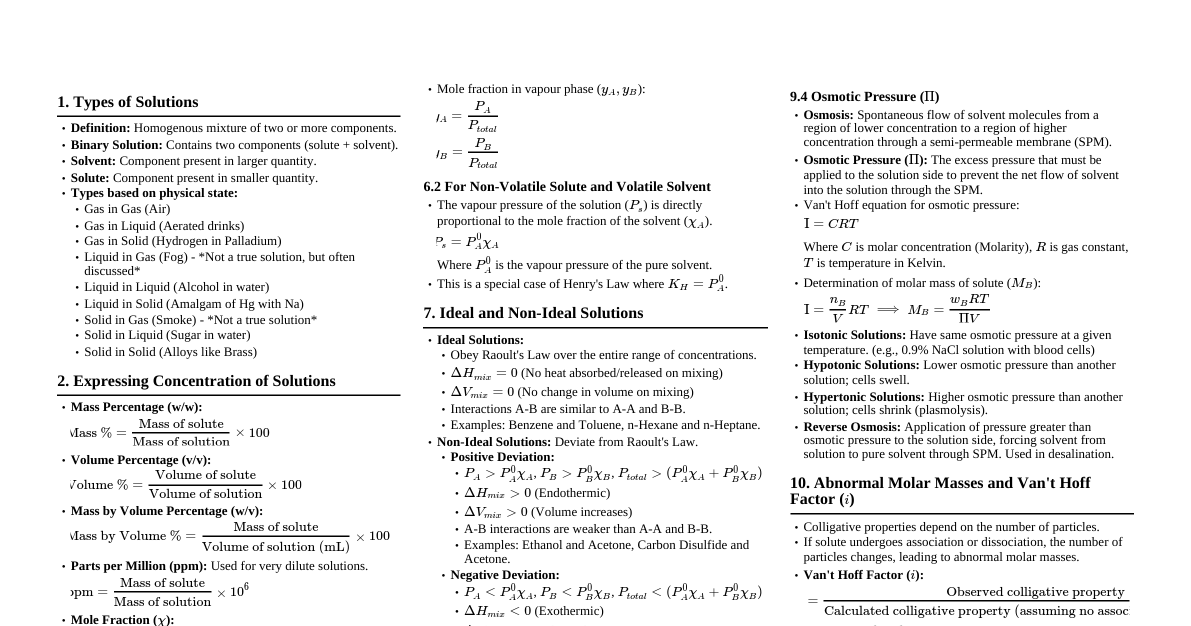
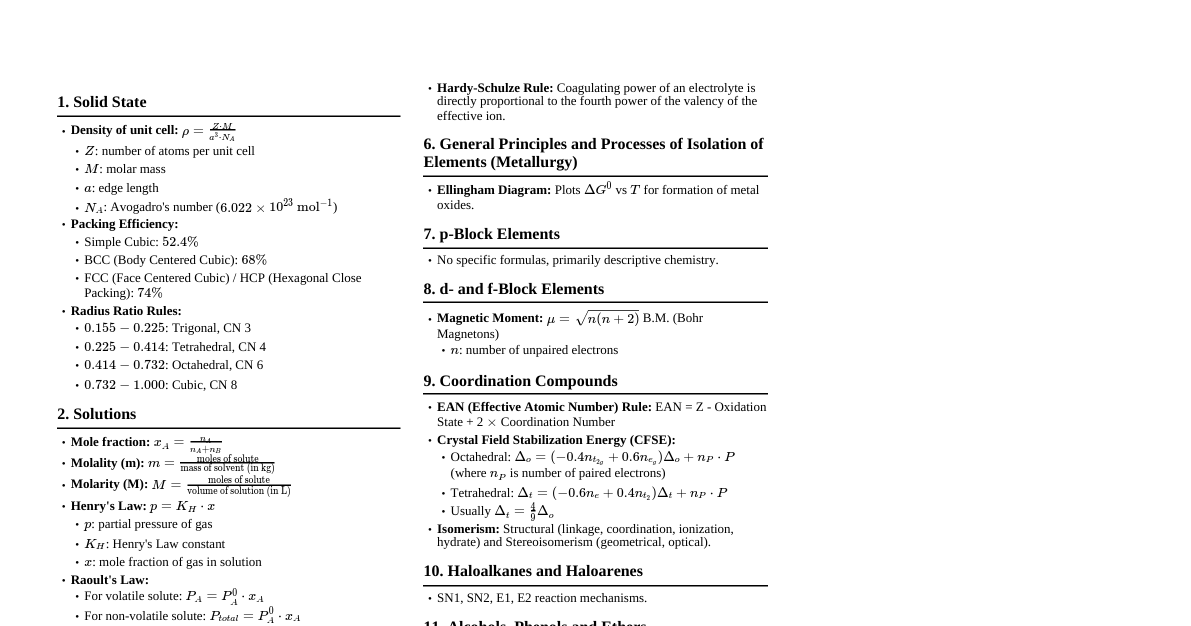
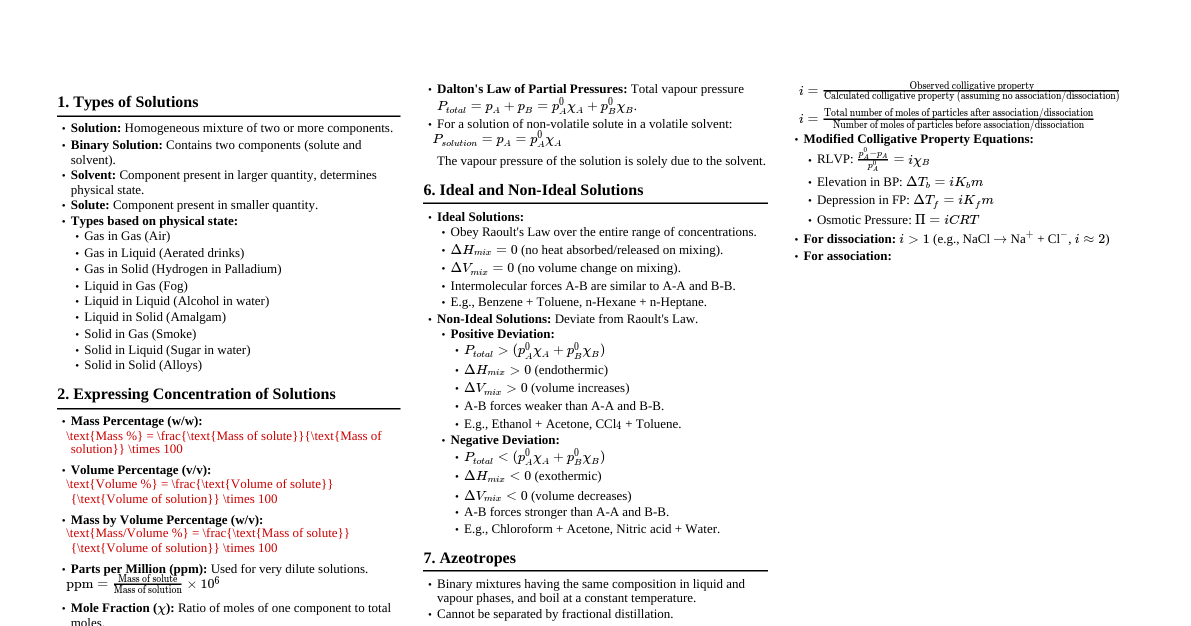
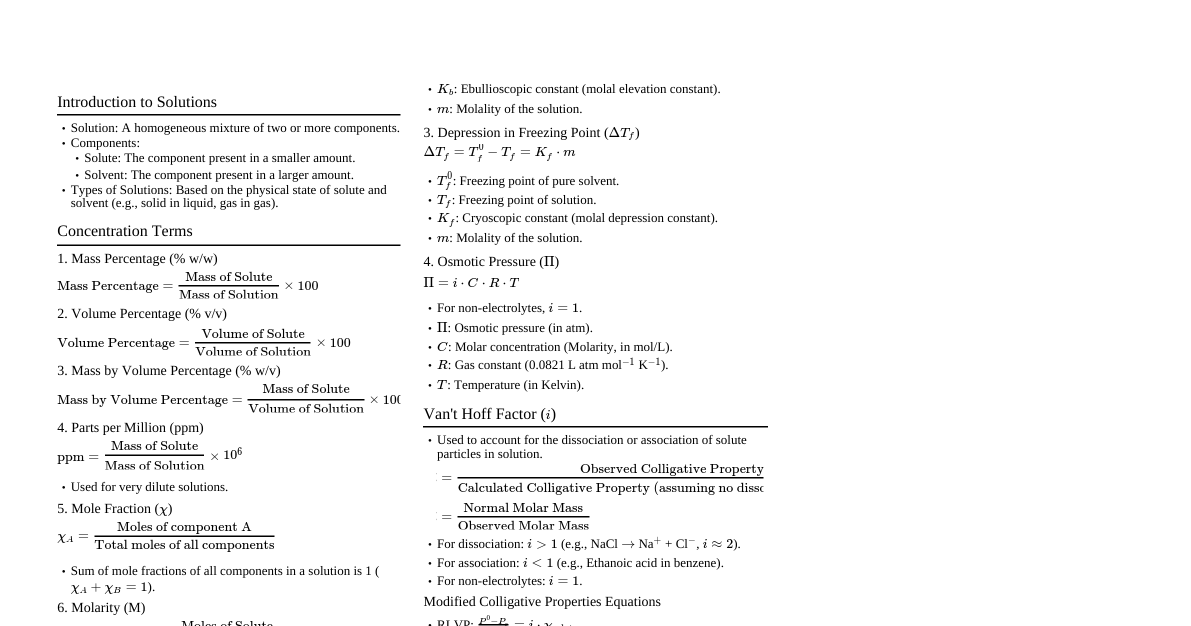
### Introduction to Solutions - **Solution:** A homogeneous mixture of two or more components. - **Components:** - **Solute:** The substance present in a smaller amount (dissolves). - **Solvent:** The substance present in a larger amount (dissolves the solute). - **Types of Solutions:** - **Binary:** Two components (solute + solvent). - Can be solid, liquid, or gas mixtures. - Examples: Air (gas in gas), Sugar in water (solid in liquid), Alcohol in water (liquid in liquid). ### Concentration Terms #### 1. Mass Percentage (% w/w) $$ \text{Mass \% of component} = \frac{\text{Mass of component}}{\text{Total mass of solution}} \times 100 $$ #### 2. Volume Percentage (% v/v) $$ \text{Volume \% of component} = \frac{\text{Volume of component}}{\text{Total volume of solution}} \times 100 $$ #### 3. Mass by Volume Percentage (% w/v) $$ \text{Mass by Volume \%} = \frac{\text{Mass of solute (g)}}{\text{Volume of solution (mL)}} \times 100 $$ #### 4. Parts Per Million (ppm) $$ \text{ppm} = \frac{\text{Mass of component}}{\text{Total mass of solution}} \times 10^6 $$ - Used for very dilute solutions. #### 5. Mole Fraction ($\chi$) $$ \chi_A = \frac{\text{Moles of component A}}{\text{Total moles of all components}} $$ - Sum of mole fractions of all components in a solution is 1 ($\chi_A + \chi_B = 1$). #### 6. Molarity (M) $$ \text{Molarity (M)} = \frac{\text{Moles of solute}}{\text{Volume of solution (L)}} $$ - Temperature dependent (as volume changes with temperature). #### 7. Molality (m) $$ \text{Molality (m)} = \frac{\text{Moles of solute}}{\text{Mass of solvent (kg)}} $$ - Temperature independent (as mass does not change with temperature). ### Solubility - **Definition:** Maximum amount of solute that can dissolve in a specified amount of solvent at a specific temperature. - **Saturated Solution:** A solution in which no more solute can be dissolved at a given temperature. - **Unsaturated Solution:** A solution that contains less solute than the maximum amount that can be dissolved. #### Factors Affecting Solubility of a Solid in a Liquid - **Nature of Solute and Solvent:** "Like dissolves like." Polar solutes dissolve in polar solvents, non-polar in non-polar. - **Temperature:** - For endothermic dissolution ($\Delta H_{sol} > 0$): Solubility increases with temperature. - For exothermic dissolution ($\Delta H_{sol} ### Colligative Properties - Properties of solutions that depend only on the number of solute particles, not on their nature. - Applicable to dilute solutions of non-volatile solutes. #### 1. Relative Lowering of Vapor Pressure (RLVP) - **Raoult's Law (for non-volatile solute):** The relative lowering of vapor pressure is equal to the mole fraction of the solute. $$ \frac{P_0 - P_s}{P_0} = \chi_B = \frac{n_B}{n_A + n_B} $$ - $P_0$: Vapor pressure of pure solvent - $P_s$: Vapor pressure of solution - $\chi_B$: Mole fraction of solute - $n_A$: Moles of solvent, $n_B$: Moles of solute #### 2. Elevation in Boiling Point ($\Delta T_b$) - The boiling point of a solution containing a non-volatile solute is higher than that of the pure solvent. $$ \Delta T_b = T_b - T_b^0 = K_b \cdot m $$ - $T_b$: Boiling point of solution, $T_b^0$: Boiling point of pure solvent - $K_b$: Molal elevation constant (Ebullioscopic constant) - $m$: Molality of solution #### 3. Depression in Freezing Point ($\Delta T_f$) - The freezing point of a solution containing a non-volatile solute is lower than that of the pure solvent. $$ \Delta T_f = T_f^0 - T_f = K_f \cdot m $$ - $T_f^0$: Freezing point of pure solvent, $T_f$: Freezing point of solution - $K_f$: Molal depression constant (Cryoscopic constant) - $m$: Molality of solution #### 4. Osmotic Pressure ($\Pi$) - The excess pressure that must be applied to a solution to prevent the passage of solvent molecules into the solution through a semi-permeable membrane. - **Van't Hoff Equation:** $$ \Pi = CRT $$ - $C$: Molar concentration (Molarity) - $R$: Gas constant ($0.0821 \text{ L atm mol}^{-1} \text{ K}^{-1}$ or $8.314 \text{ J mol}^{-1} \text{ K}^{-1}$) - $T$: Temperature in Kelvin - **Isotonic Solutions:** Solutions having the same osmotic pressure at a given temperature. - **Hypotonic Solution:** Solution with lower osmotic pressure. - **Hypertonic Solution:** Solution with higher osmotic pressure. ### Van't Hoff Factor (i) - Used for electrolyte solutions where solute dissociates or associates. $$ i = \frac{\text{Normal molar mass}}{\text{Observed molar mass}} = \frac{\text{Observed colligative property}}{\text{Calculated colligative property (assuming no dissociation/association)}} $$ $$ i = \frac{\text{Total number of moles of particles after dissociation/association}}{\text{Number of moles of particles before dissociation/association}} $$ - **Modified Colligative Property Equations:** - RLVP: $$ \frac{P_0 - P_s}{P_0} = i \cdot \chi_B $$ - Elevation in Boiling Point: $$ \Delta T_b = i \cdot K_b \cdot m $$ - Depression in Freezing Point: $$ \Delta T_f = i \cdot K_f \cdot m $$ - Osmotic Pressure: $$ \Pi = i \cdot CRT $$ - **Degree of Dissociation ($\alpha$):** $$ \alpha = \frac{i-1}{n-1} $$ - $n$: Number of ions produced per formula unit of solute. - **Degree of Association ($\alpha$):** $$ \alpha = \frac{1-i}{1-1/n} $$ - $n$: Number of molecules that associate.