CBSE Class 12 Chemistry Exam Guide
Cheatsheet Content
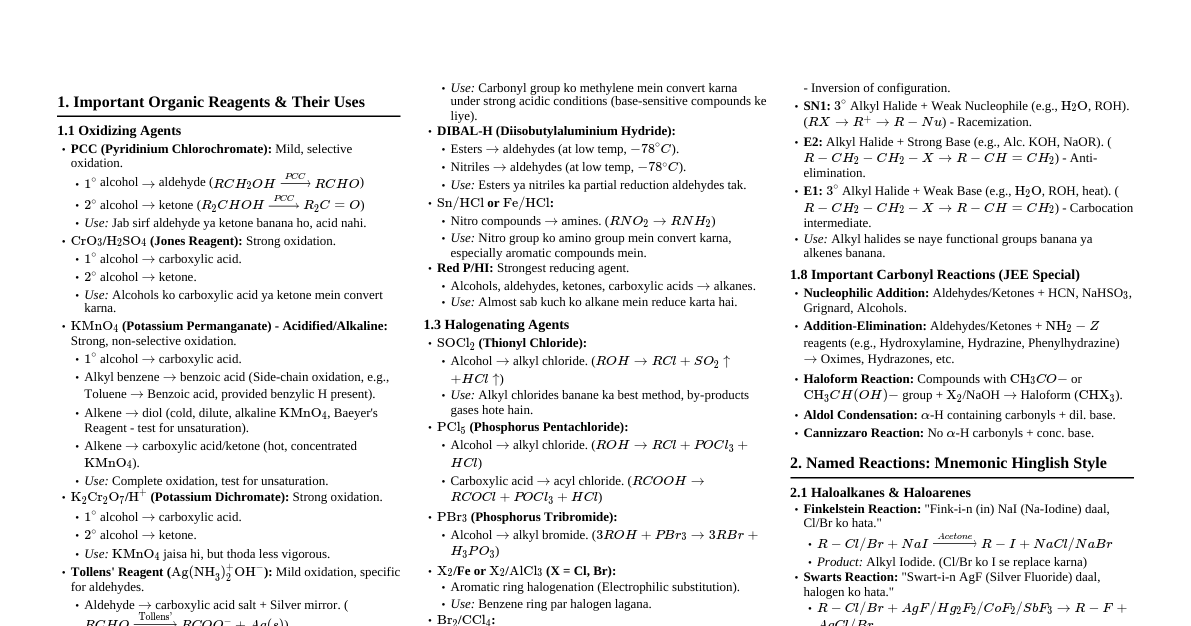
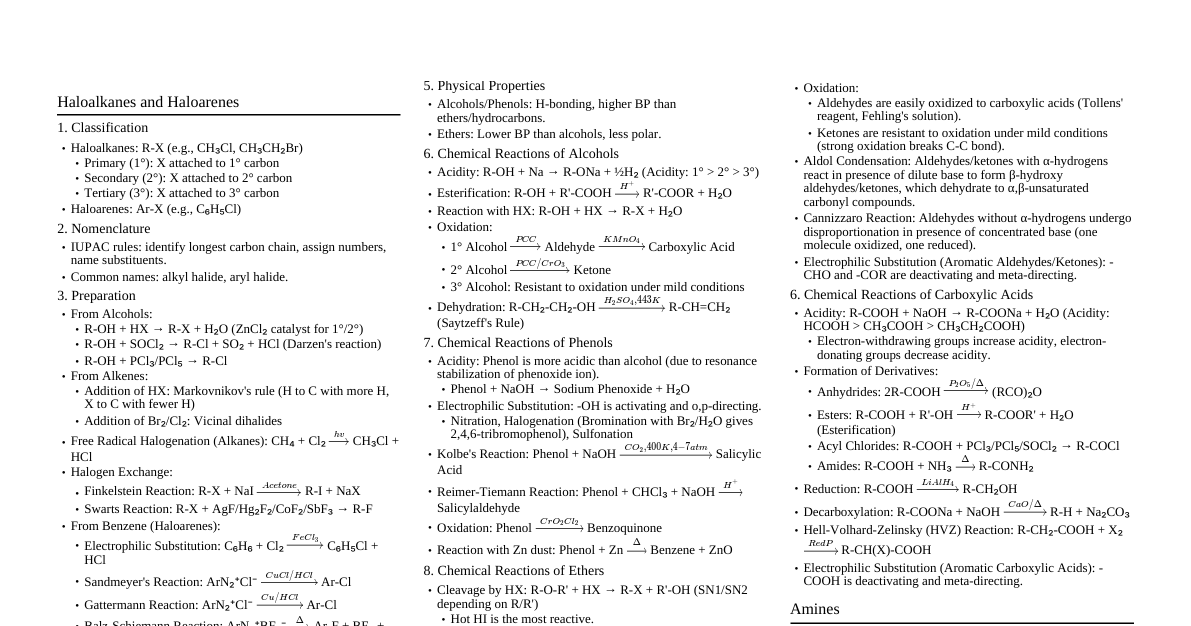
1. Reagents for Oxidation Reactions $\mathrm{KMnO_4}$ (Potassium Permanganate) Alkaline/Acidic/Neutral: Strong oxidising agent. $\mathrm{R-CH_2OH \xrightarrow{KMnO_4} R-COOH}$ (Primary alcohol to carboxylic acid) $\mathrm{R_2CH-OH \xrightarrow{KMnO_4} R_2C=O}$ (Secondary alcohol to ketone) $\mathrm{R-CH=CH-R' \xrightarrow{KMnO_4} R-COOH + R'-COOH}$ (Alkenes to carboxylic acids, with cleavage) Alkylbenzenes to Benzoic acid ($\mathrm{C_6H_5-CH_3 \xrightarrow{KMnO_4} C_6H_5-COOH}$) Cold, dilute, alkaline $\mathrm{KMnO_4}$ (Baeyer's Reagent): Mild oxidising agent. $\mathrm{R-CH=CH-R' \xrightarrow{cold, dil. KMnO_4} R-CH(OH)-CH(OH)-R'}$ (Alkenes to vicinal diols) Test for unsaturation. $\mathrm{K_2Cr_2O_7/H^+}$ (Potassium Dichromate/Acid) Strong oxidising agent. $\mathrm{R-CH_2OH \xrightarrow{K_2Cr_2O_7/H^+} R-COOH}$ (Primary alcohol to carboxylic acid) $\mathrm{R_2CH-OH \xrightarrow{K_2Cr_2O_7/H^+} R_2C=O}$ (Secondary alcohol to ketone) $\mathrm{CrO_3}$ (Chromium Trioxide) Jones Reagent ($\mathrm{CrO_3/H_2SO_4/Acetone}$): Oxidises primary alcohols to carboxylic acids, secondary to ketones. Collins Reagent ($\mathrm{CrO_3 \cdot 2Pyridine}$): Selectively oxidises primary alcohols to aldehydes. PCC (Pyridinium Chlorochromate) ($\mathrm{CrO_3 \cdot Pyridine \cdot HCl}$): Mild oxidising agent. $\mathrm{R-CH_2OH \xrightarrow{PCC} R-CHO}$ (Primary alcohol to aldehyde) $\mathrm{R_2CH-OH \xrightarrow{PCC} R_2C=O}$ (Secondary alcohol to ketone) Tollens' Reagent ($\mathrm{Ag(NH_3)_2OH}$) Mild oxidising agent. $\mathrm{R-CHO \xrightarrow{Tollens'} R-COOH}$ (Aldehyde to carboxylic acid, gives silver mirror) Also oxidises $\alpha$-hydroxy ketones. Fehling's Solution ($\mathrm{Cu^{2+}}$ complex) Mild oxidising agent. $\mathrm{R-CHO \xrightarrow{Fehling's} R-COOH}$ (Aldehyde to carboxylic acid, gives red ppt of $\mathrm{Cu_2O}$) Does not oxidise aromatic aldehydes or ketones. $\mathrm{O_3}$ (Ozone) Ozonolysis: With $\mathrm{Zn/H_2O}$ (reductive workup). $\mathrm{R-CH=CH-R' \xrightarrow{O_3, then Zn/H_2O} R-CHO + R'-CHO}$ (Alkenes to aldehydes/ketones) Used to locate double bonds. 2. Reagents for Reduction Reactions $\mathrm{H_2/Ni, Pd, Pt}$ (Hydrogenation) Reduces alkenes/alkynes to alkanes. Reduces aldehydes/ketones to alcohols. Reduces nitriles to primary amines. $\mathrm{LiAlH_4}$ (Lithium Aluminium Hydride) Strong reducing agent (reduces almost everything). $\mathrm{R-COOH \xrightarrow{LiAlH_4} R-CH_2OH}$ (Carboxylic acid to primary alcohol) $\mathrm{R-COOR' \xrightarrow{LiAlH_4} R-CH_2OH + R'-OH}$ (Esters to alcohols) $\mathrm{R-CHO \xrightarrow{LiAlH_4} R-CH_2OH}$ (Aldehyde to primary alcohol) $\mathrm{R_2C=O \xrightarrow{LiAlH_4} R_2CH-OH}$ (Ketone to secondary alcohol) $\mathrm{R-CN \xrightarrow{LiAlH_4} R-CH_2NH_2}$ (Nitriles to primary amines) $\mathrm{R-NO_2 \xrightarrow{LiAlH_4} R-NH_2}$ (Nitro compounds to amines) $\mathrm{NaBH_4}$ (Sodium Borohydride) Milder reducing agent than $\mathrm{LiAlH_4}$. $\mathrm{R-CHO \xrightarrow{NaBH_4} R-CH_2OH}$ (Aldehyde to primary alcohol) $\mathrm{R_2C=O \xrightarrow{NaBH_4} R_2CH-OH}$ (Ketone to secondary alcohol) Does NOT reduce carboxylic acids, esters, or nitriles. $\mathrm{Sn/HCl}$ or $\mathrm{Fe/HCl}$ or $\mathrm{H_2/Pd}$ Reduces nitro compounds to amines. $\mathrm{R-NO_2 \xrightarrow{Sn/HCl} R-NH_2}$ $\mathrm{Zn/Hg}$ + conc. $\mathrm{HCl}$ (Clemmensen Reduction) Reduces carbonyl group ($\mathrm{C=O}$) of aldehydes/ketones to methylene group ($\mathrm{CH_2}$). $\mathrm{R-CO-R' \xrightarrow{Zn/Hg, conc. HCl} R-CH_2-R'}$ $\mathrm{NH_2NH_2/KOH, \text{Ethylene Glycol, heat}}$ (Wolff-Kishner Reduction) Reduces carbonyl group ($\mathrm{C=O}$) of aldehydes/ketones to methylene group ($\mathrm{CH_2}$). $\mathrm{R-CO-R' \xrightarrow{NH_2NH_2, KOH, heat} R-CH_2-R'}$ Useful when acid-sensitive groups are present. $\mathrm{DIBAL-H}$ (Diisobutylaluminium Hydride) Selective reducing agent. $\mathrm{R-CN \xrightarrow{DIBAL-H, -78^\circ C, then H_3O^+} R-CHO}$ (Nitriles to aldehydes) $\mathrm{R-COOR' \xrightarrow{DIBAL-H, -78^\circ C, then H_3O^+} R-CHO}$ (Esters to aldehydes) $\mathrm{H_2/Pd-BaSO_4}$ (Lindlar's Catalyst) Partially hydrogenates alkynes to cis -alkenes. $\mathrm{R-C \equiv C-R' \xrightarrow{H_2/Pd-BaSO_4} \text{cis-}R-CH=CH-R'}$ $\mathrm{Na/Liquid NH_3}$ (Birch Reduction) Partially hydrogenates alkynes to trans -alkenes. $\mathrm{R-C \equiv C-R' \xrightarrow{Na/Liq. NH_3} \text{trans-}R-CH=CH-R'}$ 3. Reagents for Halogenation Reactions $\mathrm{X_2/FeX_3}$ or $\mathrm{X_2/hv}$ (Halogenation) $\mathrm{Cl_2/FeCl_3}$ or $\mathrm{Br_2/FeBr_3}$: Electrophilic substitution on aromatic rings. $\mathrm{C_6H_6 \xrightarrow{Cl_2/FeCl_3} C_6H_5Cl}$ (Benzene to chlorobenzene) $\mathrm{Cl_2/hv}$ or $\mathrm{Br_2/hv}$: Free radical substitution on alkanes or alkyl side chains. $\mathrm{CH_4 \xrightarrow{Cl_2/hv} CH_3Cl}$ $\mathrm{C_6H_5-CH_3 \xrightarrow{Cl_2/hv} C_6H_5-CH_2Cl}$ $\mathrm{HX}$ ($\mathrm{HCl, HBr, HI}$) Adds across double/triple bonds (Markovnikov's rule). $\mathrm{R-CH=CH_2 \xrightarrow{HBr} R-CH(Br)-CH_3}$ Converts alcohols to alkyl halides. $\mathrm{R-OH \xrightarrow{HCl/ZnCl_2} R-Cl}$ (Lucas Test) $\mathrm{PCl_3, PCl_5, SOCl_2}$ (Thionyl Chloride) Converts alcohols to alkyl chlorides. $\mathrm{SOCl_2}$ is preferred due to gaseous byproducts. $\mathrm{R-OH \xrightarrow{SOCl_2} R-Cl + SO_2 + HCl}$ $\mathrm{NaI/Acetone}$ (Finkelstein Reaction) Alkyl chlorides/bromides to alkyl iodides. $\mathrm{R-Cl \xrightarrow{NaI/Acetone} R-I}$ (S_N2 reaction, drives equilibrium by ppt of NaCl/NaBr) $\mathrm{AgF, Hg_2F_2, CoF_2, SbF_3}$ (Swarts Reaction) Alkyl chlorides/bromides to alkyl fluorides. $\mathrm{R-Cl \xrightarrow{AgF} R-F}$ 4. Reagents for Formation of C-C Bonds / Carbonyl Chemistry Grignard Reagent ($\mathrm{RMgX}$) Forms new C-C bonds. $\mathrm{HCHO \xrightarrow{RMgX, then H_2O} R-CH_2OH}$ (Formaldehyde to primary alcohol) $\mathrm{R'-CHO \xrightarrow{RMgX, then H_2O} R'-CH(OH)-R}$ (Aldehyde to secondary alcohol) $\mathrm{R'_2C=O \xrightarrow{RMgX, then H_2O} R'_2C(OH)-R}$ (Ketone to tertiary alcohol) $\mathrm{CO_2 \xrightarrow{RMgX, then H_2O} R-COOH}$ (Carbon dioxide to carboxylic acid) $\mathrm{NaCN}$ or $\mathrm{KCN}$ Introduces cyano group (precursor to carboxylic acids, amines). $\mathrm{R-X \xrightarrow{NaCN} R-CN}$ (Alkyl halide to nitrile) $\mathrm{R-CHO \xrightarrow{HCN} R-CH(OH)-CN}$ (Aldehyde to cyanohydrin) $\mathrm{AlCl_3}$ (Anhydrous) Friedel-Crafts Alkylation: $\mathrm{C_6H_6 + R-X \xrightarrow{Anhy. AlCl_3} C_6H_5-R}$ Friedel-Crafts Acylation: $\mathrm{C_6H_6 + R-COCl \xrightarrow{Anhy. AlCl_3} C_6H_5-COR}$ $\mathrm{NaOH/Dilute}$ (Aldol Condensation) Aldehydes/ketones with $\alpha$-hydrogens. $\mathrm{2 R-CHO \xrightarrow{Dil. NaOH} R-CH(OH)-CH_2-CHO}$ ($\beta$-hydroxy aldehyde) $\mathrm{NaOH/Conc.}$ (Cannizzaro Reaction) Aldehydes WITHOUT $\alpha$-hydrogens. $\mathrm{2 HCHO \xrightarrow{Conc. NaOH} CH_3OH + HCOONa}$ (Disproportionation) $\mathrm{CHCl_3/KOH}$ (Carbylamine Reaction) Test for primary amines. $\mathrm{R-NH_2 \xrightarrow{CHCl_3/KOH} R-NC}$ (Offensive smell isocyanide) $\mathrm{NaNO_2/HCl}$ (Nitrous Acid) $0-5^\circ C$: Diazotisation of primary aromatic amines. $\mathrm{Ar-NH_2 \xrightarrow{NaNO_2/HCl, 0-5^\circ C} Ar-N_2^+Cl^-}$ (Diazonium salt) Room Temp: Primary aliphatic amines give alcohols (via unstable diazonium salts). 5. Reagents for Elimination Reactions $\mathrm{Alc. KOH}$ (Alcoholic Potassium Hydroxide) Dehydrohalogenation of alkyl halides (Saytzeff's rule for major product). $\mathrm{R-CH_2-CH_2-X \xrightarrow{Alc. KOH} R-CH=CH_2}$ (Forms alkene) $\mathrm{Conc. H_2SO_4}$ (Concentrated Sulfuric Acid) Dehydration of alcohols (Saytzeff's rule for major product). $\mathrm{R-CH_2-CH_2-OH \xrightarrow{Conc. H_2SO_4, 170^\circ C} R-CH=CH_2}$ (Forms alkene) 6. Reagents for Hydrolysis Reactions $\mathrm{H_2O/H^+}$ or $\mathrm{H_2O/OH^-}$ Hydrolysis of nitriles to carboxylic acids. $\mathrm{R-CN \xrightarrow{H_2O/H^+ \text{ or } OH^-} R-COOH}$ Hydrolysis of esters to carboxylic acids and alcohols. $\mathrm{R-COOR' \xrightarrow{H_2O/H^+ \text{ or } OH^-} R-COOH + R'-OH}$ Hydrolysis of amides to carboxylic acids and amines. $\mathrm{R-CONH_2 \xrightarrow{H_2O/H^+ \text{ or } OH^-} R-COOH + NH_3}$ Hydrolysis of alkyl halides (S_N1/S_N2). $\mathrm{R-X \xrightarrow{Aq. KOH \text{ or } H_2O} R-OH}$ 7. Specific Name Reactions & Reagents Rosenmund Reduction: $\mathrm{H_2/Pd-BaSO_4}$ $\mathrm{R-COCl \xrightarrow{H_2/Pd-BaSO_4} R-CHO}$ (Acyl chloride to aldehyde) Stephen Reaction: $\mathrm{SnCl_2/HCl, then H_3O^+}$ $\mathrm{R-CN \xrightarrow{SnCl_2/HCl, then H_3O^+} R-CHO}$ (Nitrile to aldehyde) Gattermann-Koch Reaction: $\mathrm{CO/HCl/Anhy. AlCl_3/CuCl}$ $\mathrm{C_6H_6 \xrightarrow{CO/HCl, Anhy. AlCl_3} C_6H_5-CHO}$ (Benzene to benzaldehyde) Kolbe's Reaction: $\mathrm{CO_2/NaOH/H^+}$ Phenol to Salicylic acid. Reimer-Tiemann Reaction: $\mathrm{CHCl_3/NaOH, then H^+}$ Phenol to Salicylaldehyde. Hoffmann Bromamide Degradation: $\mathrm{Br_2/KOH}$ $\mathrm{R-CONH_2 \xrightarrow{Br_2/KOH} R-NH_2}$ (Amide to primary amine, one carbon less) Gabriel Phthalimide Synthesis: $\mathrm{Phthalimide/KOH/R-X/H_3O^+}$ Synthesis of primary amines. Sandmeyer Reaction: $\mathrm{Cu_2X_2/HX}$ $\mathrm{Ar-N_2^+Cl^- \xrightarrow{Cu_2Cl_2/HCl} Ar-Cl}$ (Diazonium salt to aryl halide) Similar for $\mathrm{Cu_2Br_2/HBr}$. Gattermann Reaction: $\mathrm{Cu/HX}$ $\mathrm{Ar-N_2^+Cl^- \xrightarrow{Cu/HCl} Ar-Cl}$ (Similar to Sandmeyer, but copper powder instead of cuprous salt) Balz-Schiemann Reaction: $\mathrm{HBF_4}$ $\mathrm{Ar-N_2^+Cl^- \xrightarrow{HBF_4, then heat} Ar-F}$ (Diazonium salt to aryl fluoride) Wurtz Reaction: $\mathrm{Na/Dry Ether}$ $\mathrm{2 R-X \xrightarrow{Na/Dry Ether} R-R}$ (Alkyl halides to higher alkanes) Wurtz-Fittig Reaction: $\mathrm{Na/Dry Ether}$ $\mathrm{Ar-X + R-X \xrightarrow{Na/Dry Ether} Ar-R}$ (Aryl halide and alkyl halide to alkylbenzene) Fittig Reaction: $\mathrm{Na/Dry Ether}$ $\mathrm{2 Ar-X \xrightarrow{Na/Dry Ether} Ar-Ar}$ (Aryl halides to diphenyl) 8. Important Functional Group Tests (Reagents) Lucas Reagent ($\mathrm{Conc. HCl + Anhy. ZnCl_2}$): For alcohols. Distinguishes $1^\circ, 2^\circ, 3^\circ$ alcohols based on turbidity. Bromine Water ($\mathrm{Br_2/H_2O}$): Test for unsaturation (alkenes/alkynes), phenols, anilines. Decolorizes bromine water. Ferric Chloride Test ($\mathrm{FeCl_3}$): For phenols. Gives characteristic violet/blue/green coloration. Iodoform Test ($\mathrm{I_2/NaOH}$): For compounds with $\mathrm{CH_3CO-}$ group or $\mathrm{CH_3CH(OH)-}$ group. Gives yellow ppt of iodoform ($\mathrm{CHI_3}$). Hinsberg's Reagent ($\mathrm{C_6H_5SO_2Cl}$ - Benzenesulphonyl chloride): For amines. Distinguishes $1^\circ, 2^\circ, 3^\circ$ amines based on solubility of sulfonamide in $\mathrm{KOH}$. 9. Exhaustive Differentiation Tests (CBSE & JEE Advanced) Distinguishing Alkanes, Alkenes, Alkynes: Bromine Water Test ($\mathrm{Br_2/H_2O}$): Alkenes/Alkynes decolorize (addition), Alkanes do not. Baeyer's Test (Cold, Dilute, Alkaline $\mathrm{KMnO_4}$): Alkenes/Alkynes decolorize pink $\mathrm{KMnO_4}$ (oxidation), Alkanes do not. Ammoniacal Silver Nitrate (Tollens' Reagent): Terminal Alkynes ($\mathrm{R-C \equiv CH}$) form white ppt of silver acetylide. Non-terminal alkynes, alkenes, alkanes do not. Ammoniacal Cuprous Chloride ($\mathrm{Cu_2Cl_2}$): Terminal Alkynes form red ppt of cuprous acetylide. Distinguishing Alcohols (Primary, Secondary, Tertiary): Lucas Test ($\mathrm{Conc. HCl + Anhy. ZnCl_2}$): $3^\circ$ alcohols (immediate turbidity), $2^\circ$ alcohols (turbidity in 5-10 min), $1^\circ$ alcohols (no turbidity at RT). Chromic Acid Test (Jones Reagent, $\mathrm{CrO_3/H_2SO_4/Acetone}$): $1^\circ$ and $2^\circ$ alcohols oxidize (orange color of reagent turns green/blue). $3^\circ$ alcohols do not react. Iodoform Test ($\mathrm{I_2/NaOH}$): Alcohols with $\mathrm{CH_3CH(OH)-}$ group (e.g., Ethanol, Propan-2-ol) give yellow ppt of iodoform. Distinguishing Phenols and Alcohols: Ferric Chloride Test ($\mathrm{FeCl_3}$ solution): Phenols give characteristic coloration. Alcohols do not. Bromine Water Test ($\mathrm{Br_2/H_2O}$): Phenols decolorize bromine water and form white ppt (2,4,6-tribromophenol). Alcohols do not. Litmus Test: Phenols turn blue litmus red (weakly acidic). Alcohols are neutral. $\mathrm{NaHCO_3}$ Test: Phenols do not react (too weakly acidic). (Carboxylic acids react). Distinguishing Aldehydes and Ketones: Tollens' Test (Ammoniacal Silver Nitrate): Aldehydes give silver mirror. Ketones do not. ($\alpha$-hydroxy ketones are an exception, giving positive test). Fehling's Test (Fehling's Solution): Aliphatic Aldehydes give red ppt of $\mathrm{Cu_2O}$. Aromatic aldehydes/ketones do not. Schiff's Test: Aldehydes restore pink/magenta color. Ketones do not. Iodoform Test ($\mathrm{I_2/NaOH}$): Methyl Ketones ($\mathrm{R-CO-CH_3}$) and Ethanal ($\mathrm{CH_3CHO}$) give yellow ppt of iodoform. Propanal ($\mathrm{CH_3CH_2CHO}$) does NOT give iodoform test. Brady's Reagent (2,4-Dinitrophenylhydrazine): Both aldehydes and ketones give yellow/orange/red precipitate (2,4-DNP derivative). This confirms presence of carbonyl group but doesn't differentiate between aldehyde/ketone. Distinguishing Carboxylic Acids and Phenols: $\mathrm{NaHCO_3}$ Test: Carboxylic acids produce brisk effervescence ($\mathrm{CO_2}$). Phenols do not. Ferric Chloride Test ($\mathrm{FeCl_3}$ solution): Phenols give characteristic coloration. Carboxylic acids do not. Litmus Test: Both turn blue litmus red, but carboxylic acids are stronger acids. Distinguishing Amines ($\mathrm{1^\circ, 2^\circ, 3^\circ}$): Hinsberg's Test ($\mathrm{C_6H_5SO_2Cl}$): $1^\circ$ Amines: Forms sulfonamide soluble in $\mathrm{KOH}$ (acidic H on N), precipitates on acidification. $2^\circ$ Amines: Forms sulfonamide insoluble in $\mathrm{KOH}$ (no acidic H on N). $3^\circ$ Amines: No reaction with reagent, but dissolves in $\mathrm{HCl}$ (basic). Nitrous Acid Test ($\mathrm{NaNO_2/HCl}$): $1^\circ$ Aliphatic Amines: $\mathrm{N_2}$ gas evolution (effervescence). $1^\circ$ Aromatic Amines: Stable diazonium salt at $0-5^\circ C$ (gives dye test with $\beta$-naphthol). $2^\circ$ Amines: Yellow oily N-nitrosoamines. $3^\circ$ Amines: No visible reaction (aliphatic), or p-nitroso compound (aromatic, e.g., green color). Carbylamine Test ($\mathrm{CHCl_3/KOH}$): Only $1^\circ$ Amines (aliphatic & aromatic) give offensive smelling isocyanides. Distinguishing Alkyl Halides vs. Aryl Halides: Hydrolysis then $\mathrm{AgNO_3}$ Test: Alkyl Halides: Hydrolyze easily (e.g., with aqueous $\mathrm{KOH}$ or heating with water) to produce halide ions, which give ppt with $\mathrm{AgNO_3}$. Aryl Halides: Do not hydrolyze easily due to resonance stabilization and $\mathrm{sp^2}$ C-X bond, so no ppt with $\mathrm{AgNO_3}$ under these conditions. Distinguishing between specific isomers/compounds: Propan-1-ol vs. Propan-2-ol: Lucas Test (Propan-2-ol reacts faster), Iodoform Test (Propan-2-ol positive, Propan-1-ol negative). Formaldehyde, Acetaldehyde, Acetone: Formaldehyde: Positive Tollens', Negative Iodoform. Acetaldehyde: Positive Tollens', Positive Iodoform. Acetone: Negative Tollens', Positive Iodoform. Formic Acid ($\mathrm{HCOOH}$): Unique as it gives positive Tollens'/Fehling's tests (like an aldehyde) AND reacts with $\mathrm{NaHCO_3}$ (like a carboxylic acid). Other carboxylic acids only react with $\mathrm{NaHCO_3}$. Distinguishing Aromatic vs. Aliphatic Amines: Bromine water test (aniline gives white ppt, ethylamine does not). Dye test with $\mathrm{NaNO_2/HCl}$ and $\beta$-naphthol for aromatic. 10. JEE Practical Organic Chemistry (POC) - Additional Tests & Concepts Elemental Detection (Lassaigne's Test): Principle: Organic compounds are heated with Na metal to convert elements (N, S, Halogens) into ionic forms ($\mathrm{NaCN, Na_2S, NaX}$). Nitrogen: Prussian blue color with $\mathrm{FeSO_4/FeCl_3}$ (formation of ferric ferrocyanide, $\mathrm{Fe_4[Fe(CN)_6]_3}$). Sulfur: Purple color with Sodium Nitroprusside ($\mathrm{Na_2[Fe(CN)_5NO]}$) or black ppt with Lead Acetate ($\mathrm{PbS}$). Halogens (X): Precipitate with $\mathrm{AgNO_3}$ (white $\mathrm{AgCl}$, pale yellow $\mathrm{AgBr}$, yellow $\mathrm{AgI}$). Functional Group Identification (Confirmatory Tests): Unsaturation ($\mathrm{C=C, C \equiv C}$): Bromine water (decolorization), Baeyer's Reagent (decolorization). Alcohols ($\mathrm{-OH}$): Lucas Test (for $1^\circ, 2^\circ, 3^\circ$), Ceric Ammonium Nitrate Test (red color for alcohols). Phenols ($\mathrm{-OH}$ on Benzene): $\mathrm{FeCl_3}$ Test (violet/blue/green color), Bromine Water (white ppt). Carbonyl Compounds ($\mathrm{>C=O}$): Brady's Reagent (2,4-Dinitrophenylhydrazine): Yellow/orange/red ppt with aldehydes/ketones. Tollens' Test: Aldehydes (silver mirror). Fehling's Test: Aliphatic Aldehydes (red ppt). Iodoform Test: Methyl Ketones & Acetaldehyde (yellow ppt). Carboxylic Acids ($\mathrm{-COOH}$): $\mathrm{NaHCO_3}$ Test (effervescence), Esterification (sweet smell). Amines ($\mathrm{-NH_2, -NHR, -NR_2}$): Hinsberg's Test (distinguishes $1^\circ, 2^\circ, 3^\circ$), Carbylamine Test ($1^\circ$ amines). Nitro Group ($\mathrm{-NO_2}$): Reduction to amine, then dye test. Chromatography (Qualitative): Paper Chromatography: Separation based on differential partitioning between stationary phase (paper) and mobile phase (solvent). $\mathrm{R_f}$ values for identification. Thin Layer Chromatography (TLC): Similar to paper, but uses a thin layer of adsorbent (silica gel, alumina) on a plate. $\mathrm{R_f}$ values. Spectroscopy (Basic Understanding): UV-Vis Spectroscopy: Detection of conjugated systems. IR Spectroscopy: Identification of functional groups based on characteristic absorption frequencies (e.g., $\mathrm{O-H}$ stretch, $\mathrm{C=O}$ stretch). NMR Spectroscopy: Provides information about the carbon-hydrogen framework and connectivity (more advanced, but basic principles might be touched upon).