Ray and Wave Optics Essentials
Cheatsheet Content
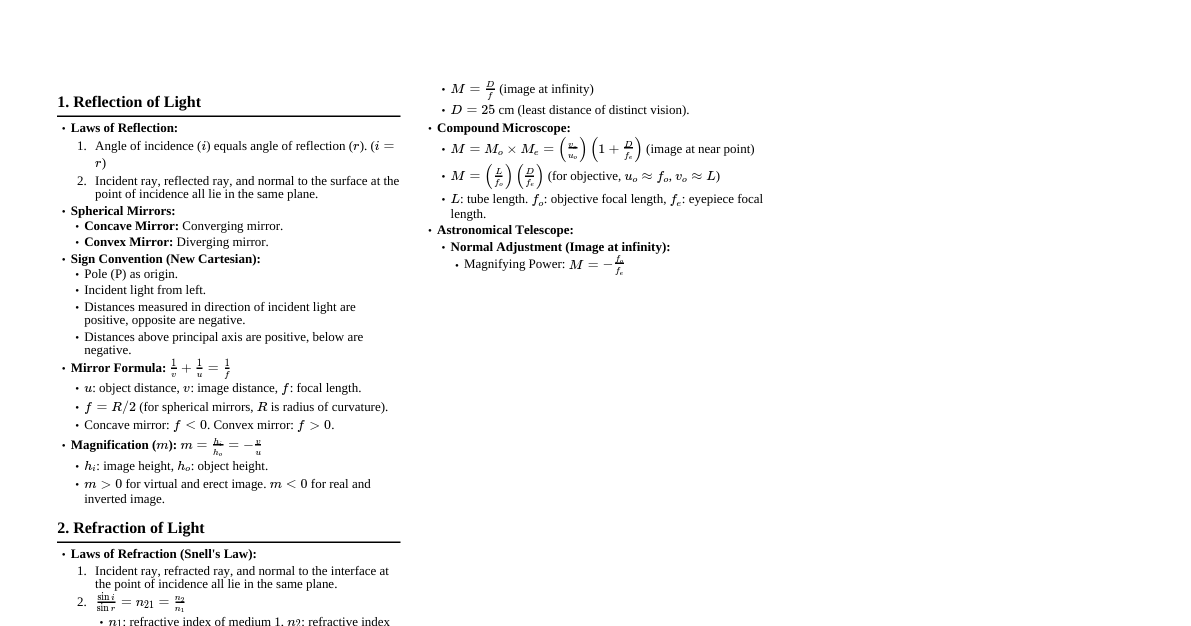
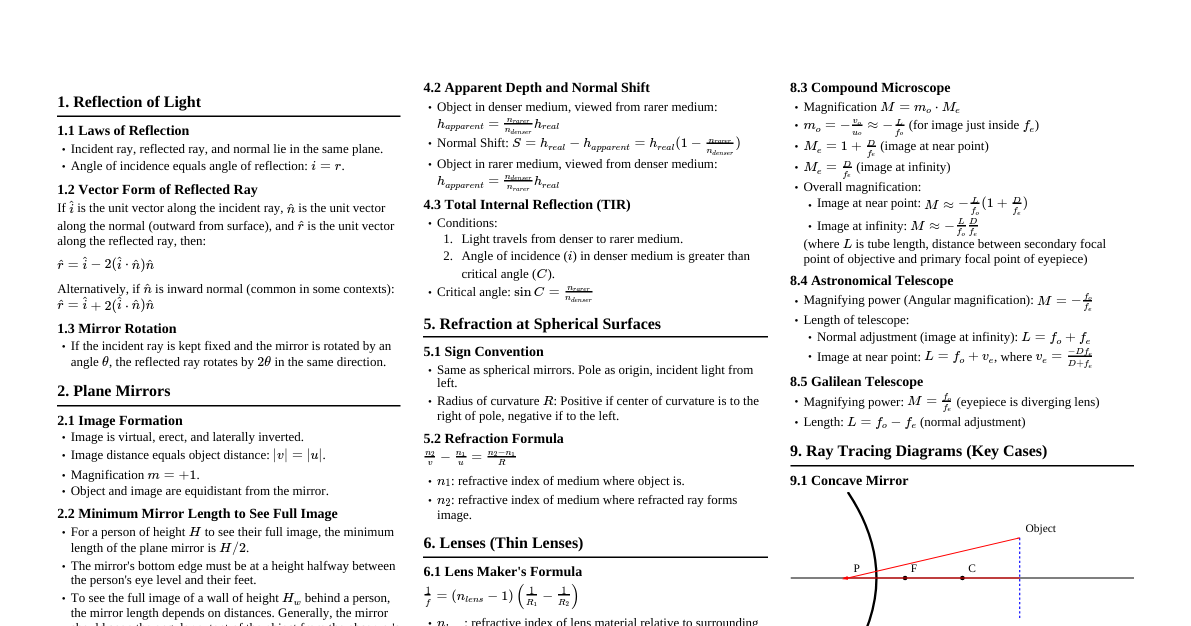
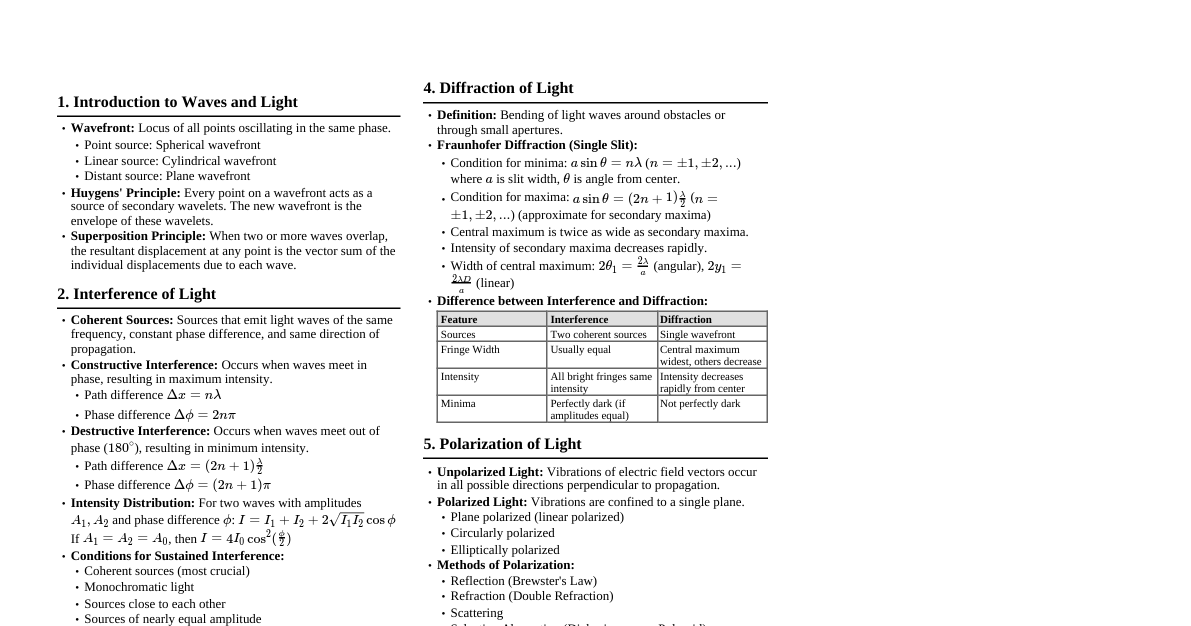
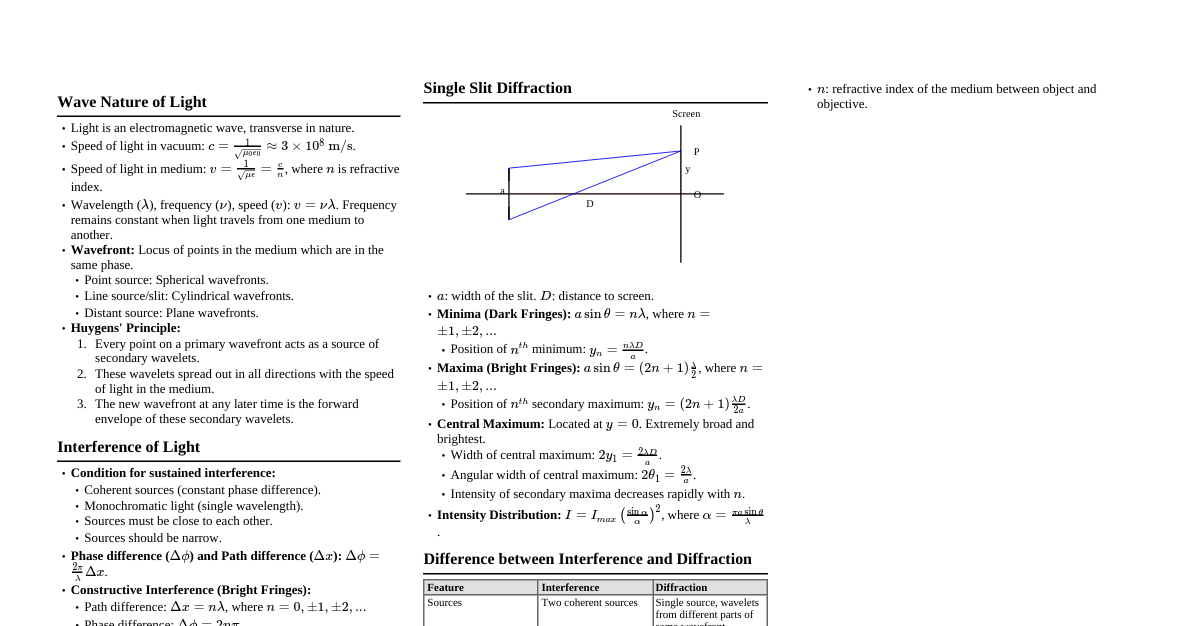
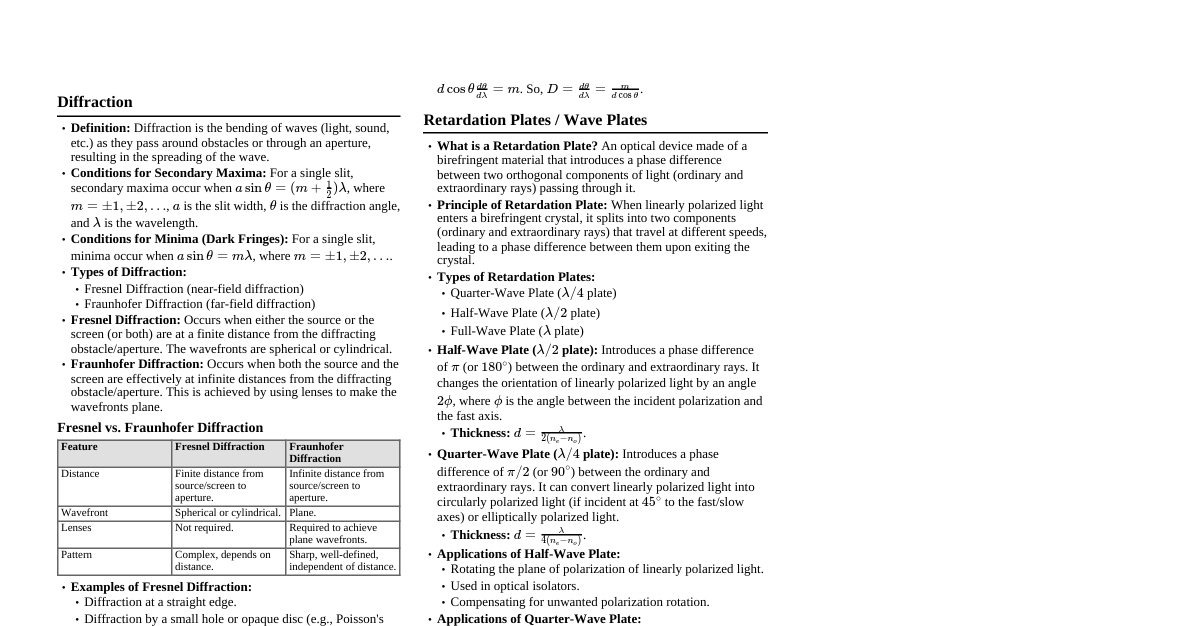
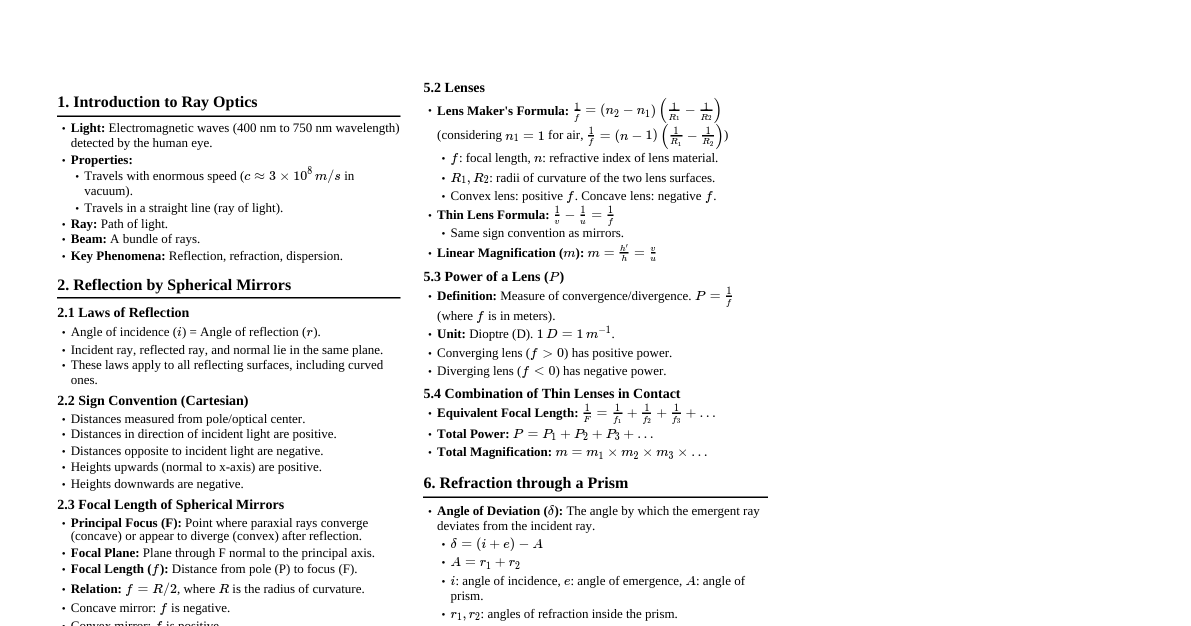
Ray Optics: Reflection by Spherical Mirrors Sign Convention (Cartesian): All distances measured from pole/optical center. Distances in direction of incident light: Positive. Distances opposite to incident light: Negative. Heights upwards (above x-axis): Positive. Heights downwards (below x-axis): Negative. Focal Length ($f$): Distance between focus (F) and pole (P). For paraxial rays, $f = R/2$, where $R$ is radius of curvature. Concave mirror: $f$ is negative. Convex mirror: $f$ is positive. Mirror Equation: $\frac{1}{v} + \frac{1}{u} = \frac{1}{f}$ $u$: object distance $v$: image distance $f$: focal length Linear Magnification ($m$): Ratio of image height ($h'$) to object height ($h$). $m = \frac{h'}{h} = -\frac{v}{u}$ Real, inverted image: $m$ is negative. Virtual, erect image: $m$ is positive. Ray Tracing Rules for Mirrors: Ray parallel to principal axis: Reflects through focus (concave) or appears to diverge from focus (convex). Ray through center of curvature: Reflects back along its path. Ray through focus: Reflects parallel to principal axis. Ray incident at pole: Reflects according to laws of reflection. Ray Optics: Refraction Laws of Refraction: Incident ray, refracted ray, and normal at incidence point all lie in the same plane. Snell's Law: $\frac{\sin i}{\sin r} = n_{21}$ (constant) $i$: angle of incidence $r$: angle of refraction $n_{21}$: refractive index of medium 2 with respect to medium 1. $n_{21} = \frac{n_2}{n_1} = \frac{v_1}{v_2}$ (where $v$ is speed of light in medium) Optical Density vs. Mass Density: Not to be confused. Optically denser medium has lower speed of light. Apparent Depth: For normal viewing, $h_{apparent} = \frac{h_{real}}{n_{medium}}$ Total Internal Reflection (TIR) Conditions for TIR: Light travels from a denser medium to a rarer medium. Angle of incidence ($i$) is greater than the critical angle ($i_c$). Critical Angle ($i_c$): Angle of incidence for which angle of refraction is $90^\circ$. $\sin i_c = \frac{n_{rarer}}{n_{denser}}$ Applications: Optical fibers, prisms (to bend light by $90^\circ$ or $180^\circ$). Refraction at Spherical Surfaces & Lenses Refraction at a Single Spherical Surface: $\frac{n_2}{v} - \frac{n_1}{u} = \frac{n_2 - n_1}{R}$ $n_1$: refractive index of medium 1 (object side) $n_2$: refractive index of medium 2 (image side) $u$: object distance $v$: image distance $R$: radius of curvature (positive for convex, negative for concave surface from incident light side) Lens Maker's Formula: (for a thin lens in air, refractive index $n$) $\frac{1}{f} = (n-1) \left(\frac{1}{R_1} - \frac{1}{R_2}\right)$ $R_1$: radius of curvature of first surface. $R_2$: radius of curvature of second surface. Convex lens: $f$ is positive. Concave lens: $f$ is negative. Thin Lens Formula: $\frac{1}{v} - \frac{1}{u} = \frac{1}{f}$ Linear Magnification ($m$): $m = \frac{h'}{h} = \frac{v}{u}$ Power of a Lens ($P$): Reciprocal of focal length (in meters). Unit: Dioptre (D). $P = \frac{1}{f}$ Converging lens: $P$ is positive. Diverging lens: $P$ is negative. Combination of Thin Lenses in Contact: Effective focal length: $\frac{1}{F} = \frac{1}{f_1} + \frac{1}{f_2} + \frac{1}{f_3} + \dots$ Total power: $P = P_1 + P_2 + P_3 + \dots$ Total magnification: $m = m_1 m_2 m_3 \dots$ Optical Instruments Simple Microscope (Magnifying Glass): Image at near point (D = 25 cm): $m = 1 + \frac{D}{f}$ Image at infinity: $m = \frac{D}{f}$ Compound Microscope: Magnification: $m = m_o m_e = \frac{L}{f_o} (1 + \frac{D}{f_e})$ (Image at near point) Magnification: $m = m_o m_e = \frac{L}{f_o} \frac{D}{f_e}$ (Image at infinity) $f_o$: focal length of objective; $f_e$: focal length of eyepiece. $L$: tube length (distance between second focal point of objective and first focal point of eyepiece). Telescope (Astronomical): Angular magnification: $m = \frac{f_o}{f_e}$ Length of telescope: $L = f_o + f_e$ (Normal adjustment, image at infinity) Reflecting Telescopes (Cassegrain): Use mirrors to avoid chromatic aberration and support large apertures. Wave Optics: Huygens' Principle Wavefront: Locus of points oscillating in same phase. Spherical waves: from point source. Plane waves: far from source. Huygens' Construction: Each point on a wavefront is a source of secondary wavelets. The new wavefront is the envelope of these wavelets. Derivation of Laws of Reflection and Refraction: Explained using Huygens' principle. $\sin i / \sin r = v_1 / v_2 = n_{21}$ Light bends towards normal when entering optically denser medium ($v_2 Interference of Light Waves Coherent Sources: Sources with constant phase difference. Necessary for stable interference pattern. Superposition Principle: Resultant displacement is vector sum of individual displacements. Constructive Interference: Path difference $ = n\lambda$ (where $n = 0, \pm 1, \pm 2, \dots$). Phase difference $ = 2n\pi$. Intensity $ = 4I_0$ (if amplitudes are equal). Destructive Interference: Path difference $ = (n + \frac{1}{2})\lambda$ (where $n = 0, \pm 1, \pm 2, \dots$). Phase difference $ = (2n+1)\pi$. Intensity $ = 0$ (if amplitudes are equal). Young's Double-Slit Experiment: Fringe width: $\beta = \frac{\lambda D}{d}$ Position of bright fringes: $x_n = \frac{n\lambda D}{d}$ Position of dark fringes: $x_n = (n + \frac{1}{2})\frac{\lambda D}{d}$ $\lambda$: wavelength, $D$: distance to screen, $d$: slit separation. Diffraction Definition: Bending of light around obstacles or spreading through apertures. Single Slit Diffraction: Central maximum at $\theta = 0$. Minima (zero intensity) at $\sin\theta = \frac{n\lambda}{a}$ (where $n = \pm 1, \pm 2, \dots$). Secondary maxima at $\sin\theta = \frac{(n + \frac{1}{2})\lambda}{a}$ (where $n = \pm 1, \pm 2, \dots$). $a$: slit width. Interference vs. Diffraction: Both involve superposition, but diffraction usually refers to effects from many points on a single wavefront or aperture. Polarisation Transverse Waves: Vibrations perpendicular to direction of propagation (e.g., light waves). Plane Polarised Light: Electric field oscillates in a single plane. Unpolarised Light: Electric field oscillates randomly in all planes perpendicular to propagation. Polaroid: Material that transmits light oscillating in a specific direction (pass-axis) and absorbs perpendicular components. Malus' Law: If unpolarised light passes through a polariser, then through a second polariser (analyzer) whose pass-axis is at angle $\theta$ to the first, the transmitted intensity is: $I = I_0 \cos^2\theta$ $I_0$: Intensity after first polariser.