d- and f-Block Elements (JEE Mains)
Cheatsheet Content
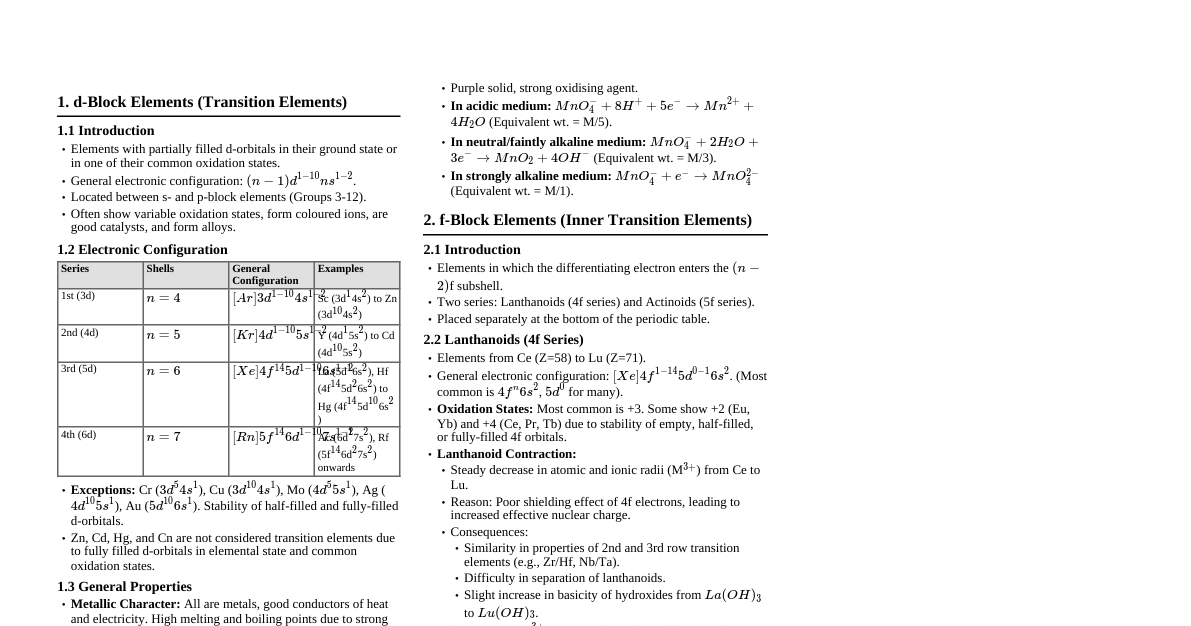
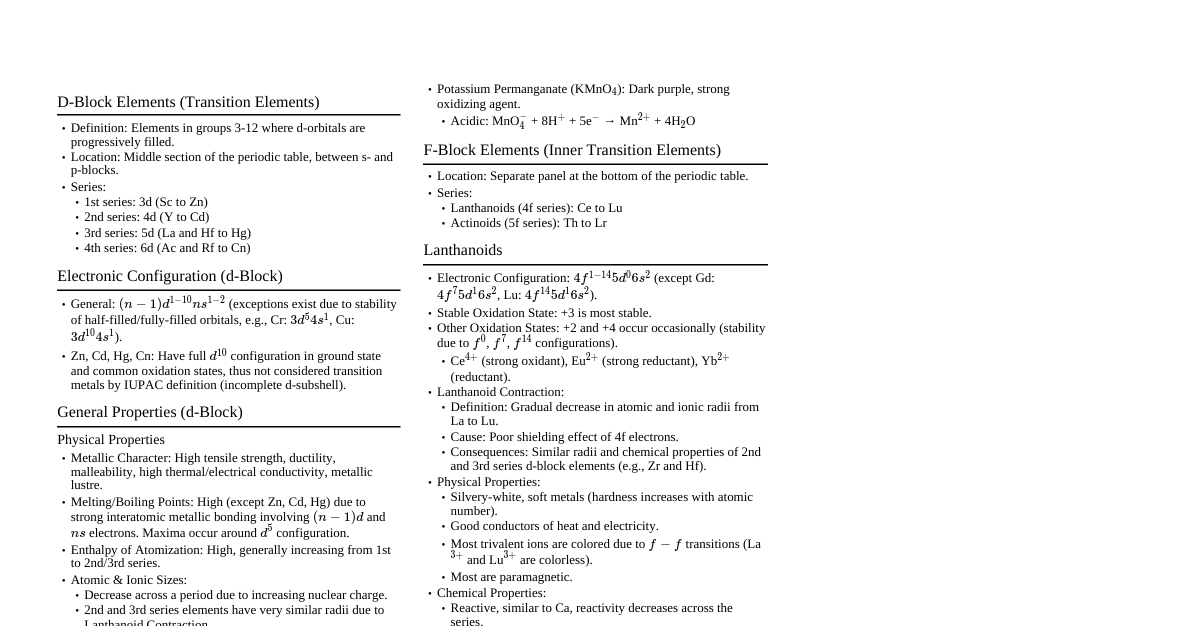
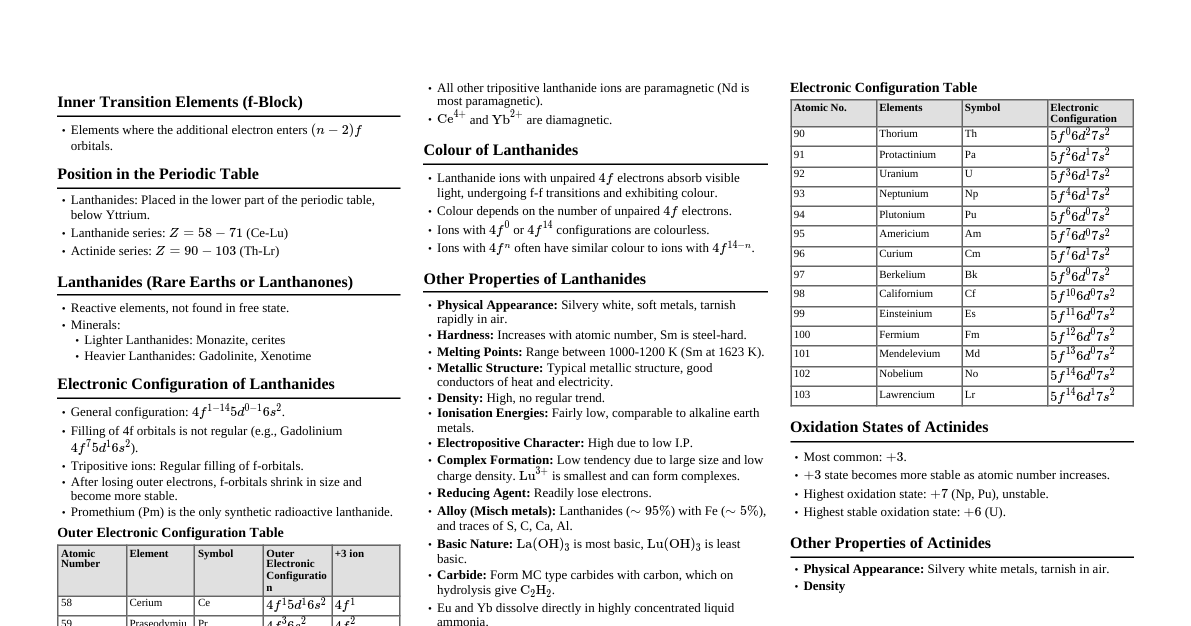
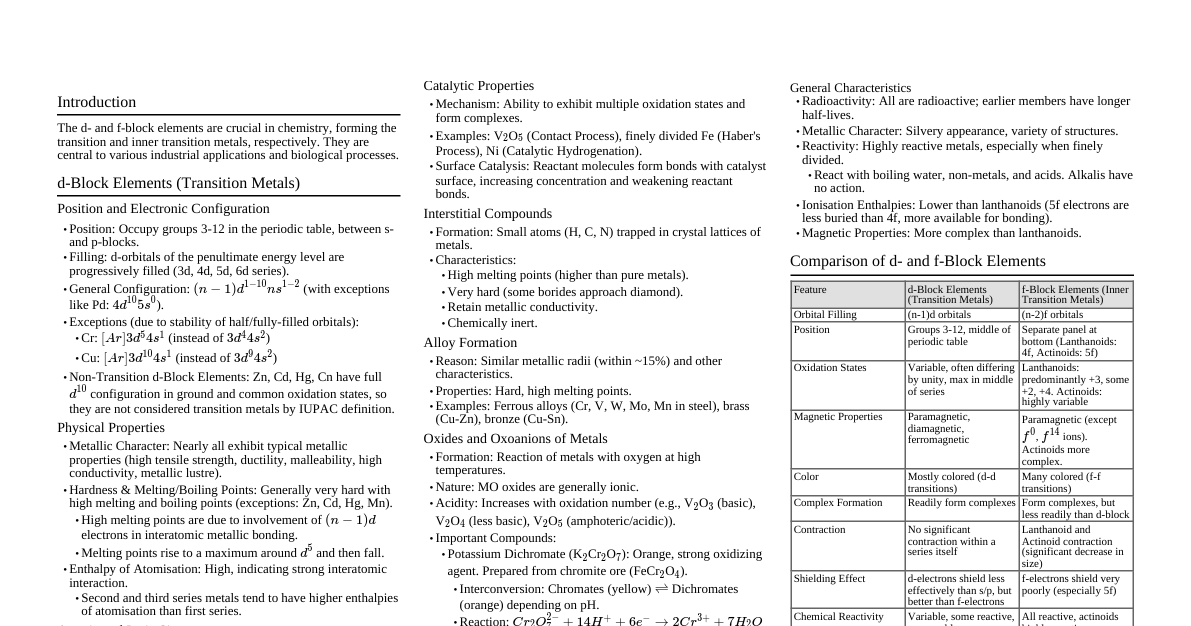
d-Block Elements (Transition Elements) Definition: Elements having partially filled d-orbitals in their atomic or ionic state. Group 3-12. General Electronic Configuration: $(n-1)d^{1-10} ns^{1-2}$ (exceptions: Cr, Cu, etc.) Key Characteristics: High melting/boiling points, high tensile strength, ductility, malleability. Variable oxidation states (due to small energy difference between $(n-1)d$ and $ns$ electrons). Formation of coloured ions (due to d-d transitions). Paramagnetic behaviour (due to unpaired electrons). Good catalysts (due to variable oxidation states and large surface area). Formation of interstitial compounds. Formation of alloys. Trends in Properties Atomic Radii: Decreases across a period initially, then increases slightly towards the end (due to increased electron-electron repulsion). Increases down a group. Lanthanoid Contraction: Poor shielding by 4f electrons causes smaller than expected radii for 5d elements, making 4d and 5d elements in the same group have very similar radii. Ionisation Enthalpy: Generally increases across a period. Irregular trend due to stability of half-filled/fully-filled d-orbitals. Oxidation States: Common: +2 (loss of ns electrons). Highest oxidation state increases to the middle of the series (Mn, +7), then decreases. Stability of higher oxidation states increases with higher electronegativity of combining element (e.g., in oxides, fluorides). Lower oxidation states are more stable for heavier elements. Standard Electrode Potentials ($E^\circ$): Generally negative (reducing agents). $E^\circ_{M^{2+}/M}$ values are generally irregular. Magnetic Properties: Paramagnetic: Presence of unpaired electrons. Calculated by spin-only formula: $\mu = \sqrt{n(n+2)}$ BM (where $n$ = number of unpaired electrons). Diamagnetic: All electrons are paired. E.g., $Sc^{3+}$, $Ti^{4+}$, $Cu^+$, $Zn^{2+}$. Colour: Most transition metal ions are coloured in aqueous solution/solid state due to d-d transitions (absorption of visible light, excitation of electron to higher energy d-orbital). No d-d transition for $d^0$ or $d^{10}$ ions, hence colourless. Catalytic Properties: Due to variable oxidation states, ability to form intermediate compounds, and large surface area. E.g., $V_2O_5$ (contact process), Fe (Haber process), Ni (hydrogenation). Formation of Interstitial Compounds: Small non-metal atoms (H, C, N, B) get trapped in voids of metal lattice. Non-stoichiometric, hard, high melting points, chemically inert. Alloy Formation: Similar atomic radii allow metals to substitute each other in crystal lattice. E.g., brass (Cu-Zn), bronze (Cu-Sn). Important Compounds Potassium Permanganate ($KMnO_4$): Preparation: $2MnO_2 + 4KOH + O_2 \to 2K_2MnO_4 + 2H_2O$ (green) $3K_2MnO_4 + 2H_2O \to 2KMnO_4 + MnO_2 + 4KOH$ (purple; disproportionation) Strong oxidizing agent. Acidic medium: $MnO_4^- + 8H^+ + 5e^- \to Mn^{2+} + 4H_2O$ Neutral medium: $MnO_4^- + 2H_2O + 3e^- \to MnO_2 + 4OH^-$ Alkaline medium: $MnO_4^- + e^- \to MnO_4^{2-}$ Potassium Dichromate ($K_2Cr_2O_7$): Preparation: Chromite ore ($FeCr_2O_4$) $\to Na_2CrO_4 \to Na_2Cr_2O_7 \to K_2Cr_2O_7$. $Cr_2O_7^{2-}$ (orange) $\rightleftharpoons 2CrO_4^{2-}$ (yellow) (pH dependent: acidic $\rightleftharpoons$ basic). Strong oxidizing agent (acidic medium): $Cr_2O_7^{2-} + 14H^+ + 6e^- \to 2Cr^{3+} + 7H_2O$. f-Block Elements (Inner Transition Elements) Definition: Elements where the f-orbitals are being filled. Includes Lanthanoids (4f series) and Actinoids (5f series). Lanthanoids (4f Series) General Electronic Configuration: $[Xe] 4f^{1-14} 5d^{0-1} 6s^2$. Oxidation States: Primarily +3. Some show +2 and +4 (e.g., $Eu^{2+}$, $Yb^{2+}$, $Ce^{4+}$, $Tb^{4+}$) for stable $f^0$, $f^7$, $f^{14}$ configurations. Lanthanoid Contraction: Steady decrease in atomic and ionic radii ($M^{3+}$) with increasing atomic number. Due to poor shielding effect of 4f electrons. Consequences: Similar atomic radii for 4d and 5d elements in the same group; difficulty in separating lanthanoids due to similar chemical properties. Colour: Many $Ln^{3+}$ ions are coloured in solid and aqueous solutions due to f-f transitions. Ions with $f^0$ ($La^{3+}$), $f^7$ ($Gd^{3+}$), $f^{14}$ ($Lu^{3+}$) are colourless. Magnetic Properties: Most $Ln^{3+}$ ions are paramagnetic due to unpaired electrons. $f^0$, $f^7$, $f^{14}$ ions are diamagnetic. Chemical Reactivity: Chemically reactive metals, reactivity increases with atomic number. Actinoids (5f Series) General Electronic Configuration: $[Rn] 5f^{1-14} 6d^{0-1} 7s^2$. Oxidation States: Show a wider range of oxidation states than lanthanoids (e.g., Th (+4), U (+3, +4, +5, +6), Np (+3 to +7), Pu (+3 to +7)), due to smaller energy difference between 5f, 6d, and 7s orbitals. +3 is the most common. Actinoid Contraction: Gradual decrease in atomic and ionic radii ($M^{3+}$) with increasing atomic number. More pronounced than lanthanoid contraction due to even poorer shielding by 5f electrons. Colour: Most actinoid ions are coloured. Magnetic Properties: Paramagnetic. Radioactivity: All actinoids are radioactive. Uranium ($^{238}U$), Thorium ($^{232}Th$) are naturally occurring. Elements after Uranium are transuranic elements, man-made. Chemical Reactivity: More reactive than lanthanoids. React readily with oxygen, acids. Comparison with Lanthanoids: Greater tendency for complex formation. More variable oxidation states. All are radioactive. Actinoids show greater shielding by 5f electrons making 5f-6d-7s energy difference smaller, hence greater range of oxidation states.