JEE Solutions & Colligative Props
Cheatsheet Content
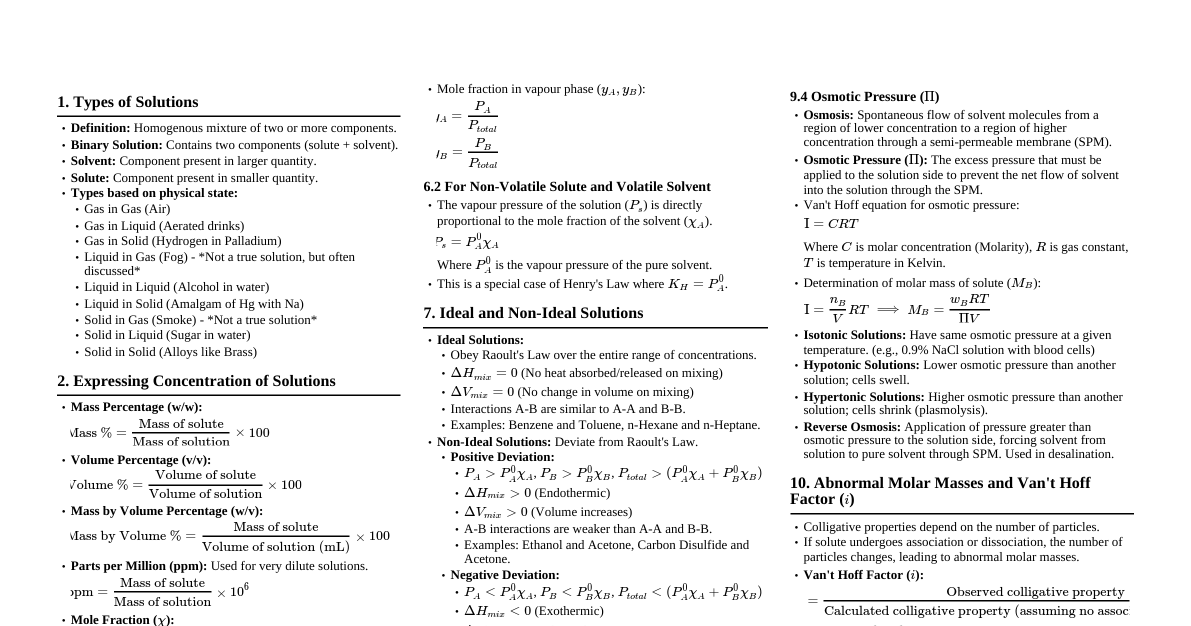
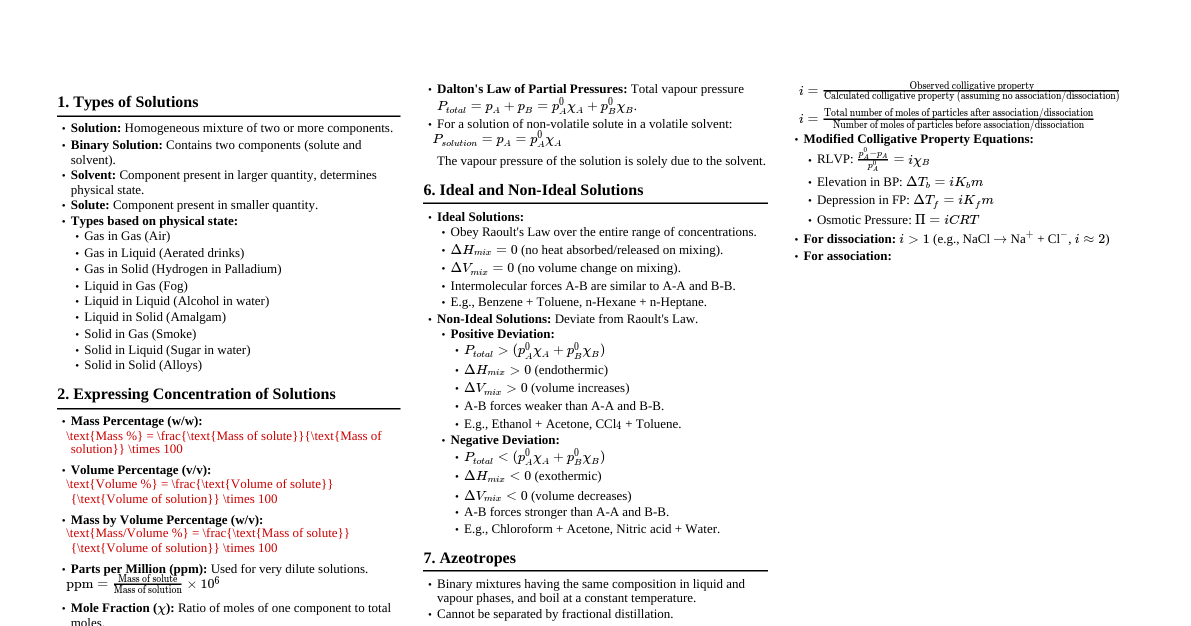
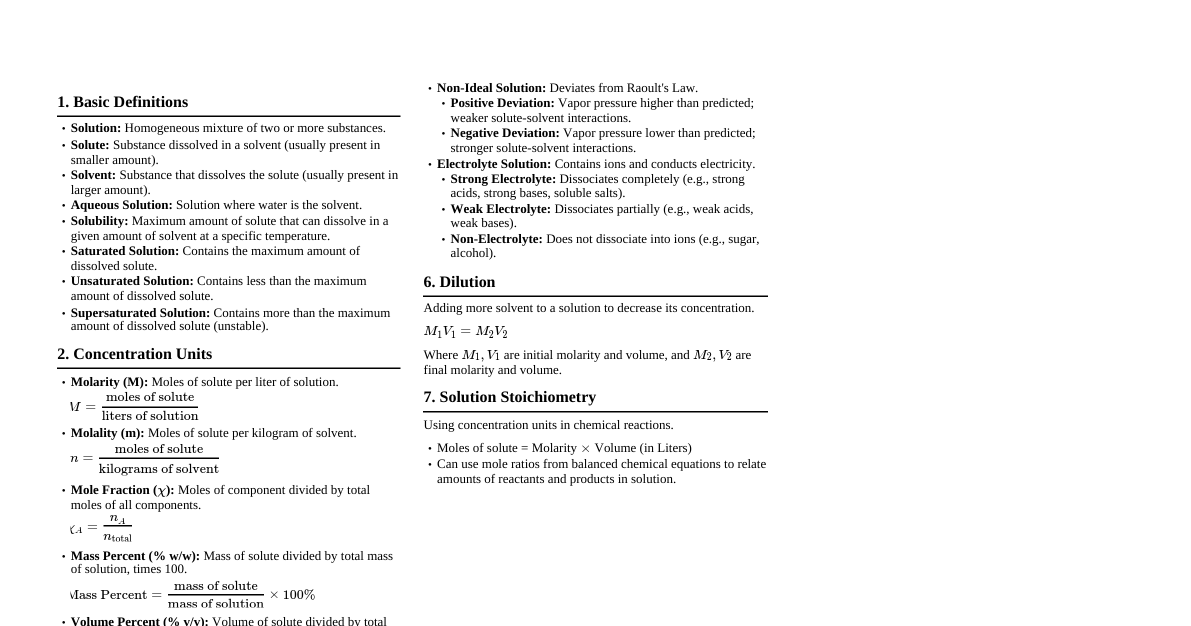
1. Types of Solutions Definition: Homogeneous mixture of two or more components. Binary Solution: Solute + Solvent Concentration Units: Mass %: $\frac{\text{Mass of solute}}{\text{Mass of solution}} \times 100$ Volume %: $\frac{\text{Volume of solute}}{\text{Volume of solution}} \times 100$ Mass/Volume %: $\frac{\text{Mass of solute}}{\text{Volume of solution}} \times 100$ Mole Fraction ($X$): $X_A = \frac{n_A}{n_A + n_B}$, $X_A + X_B = 1$ Molarity ($M$): $\frac{\text{Moles of solute}}{\text{Volume of solution (L)}}$ Molality ($m$): $\frac{\text{Moles of solute}}{\text{Mass of solvent (kg)}}$ Parts Per Million (ppm): $\frac{\text{Mass of solute}}{\text{Mass of solution}} \times 10^6$ Relationship between Molarity and Molality: $m = \frac{1000M}{1000\rho - M \times M_{solute}}$ where $\rho$ is density of solution (g/mL). 2. Solubility Definition: Maximum amount of solute that can dissolve in a given amount of solvent at a specific temperature. "Like dissolves like": Polar solutes dissolve in polar solvents, non-polar in non-polar. Effect of Temperature: For most solids in liquid, solubility increases with temperature (endothermic dissolution). For gases in liquid, solubility decreases with temperature (exothermic dissolution). Effect of Pressure: Little effect on solubility of solids/liquids in liquids. Significant effect on solubility of gases in liquids (Henry's Law). 3. Henry's Law Statement: The partial pressure of the gas in vapor phase ($P_{gas}$) is proportional to the mole fraction of the gas ($X_{gas}$) in the solution. Formula: $P_{gas} = K_H \cdot X_{gas}$ $K_H$: Henry's Law constant (depends on gas, solvent, and temperature). Higher $K_H$ means lower solubility. 4. Raoult's Law For Volatile Liquid-Liquid Solutions: Partial vapor pressure of each component is proportional to its mole fraction in the solution. $P_A = X_A P_A^0$, $P_B = X_B P_B^0$ Total vapor pressure: $P_{total} = P_A + P_B = X_A P_A^0 + X_B P_B^0$ $P_A^0, P_B^0$: Vapor pressures of pure components A and B. For Solutions of Non-Volatile Solute in Volatile Solvent: Vapor pressure of solution ($P_s$) is proportional to the mole fraction of the solvent ($X_{solvent}$). $P_s = X_{solvent} P_{solvent}^0$ Ideal Solutions: Obeys Raoult's Law over the entire range of concentrations. $\Delta H_{mix} = 0$, $\Delta V_{mix} = 0$. Non-Ideal Solutions: Deviate from Raoult's Law. Positive Deviation: $P_{total} > X_A P_A^0 + X_B P_B^0$. Weaker A-B interactions than A-A and B-B. $\Delta H_{mix} > 0$, $\Delta V_{mix} > 0$. (e.g., Ethanol + Acetone) Negative Deviation: $P_{total} Azeotropes: Constant boiling mixtures that distill without change in composition. Minimum boiling azeotropes (from positive deviation). Maximum boiling azeotropes (from negative deviation). 5. Colligative Properties Properties that depend only on the number of solute particles, not on their nature. Applicable for dilute solutions and non-volatile solutes. 5.1. Relative Lowering of Vapor Pressure (RLVP) Formula: $\frac{P_{solvent}^0 - P_s}{P_{solvent}^0} = X_{solute}$ For dilute solutions: $\frac{P_{solvent}^0 - P_s}{P_{solvent}^0} = \frac{n_{solute}}{n_{solvent}} = \frac{w_{solute}/M_{solute}}{w_{solvent}/M_{solvent}}$ Can be used to determine molar mass of non-volatile solute. 5.2. Elevation in Boiling Point ($\Delta T_b$) Boiling point of solution is higher than pure solvent. Formula: $\Delta T_b = T_b - T_b^0 = K_b \cdot m$ $K_b$: Ebullioscopic constant or molar elevation constant (solvent specific). $m$: Molality of solute. $K_b = \frac{R M_{solvent} (T_b^0)^2}{1000 \Delta H_{vap}}$ where $\Delta H_{vap}$ is molar enthalpy of vaporization. 5.3. Depression in Freezing Point ($\Delta T_f$) Freezing point of solution is lower than pure solvent. Formula: $\Delta T_f = T_f^0 - T_f = K_f \cdot m$ $K_f$: Cryoscopic constant or molar depression constant (solvent specific). $m$: Molality of solute. $K_f = \frac{R M_{solvent} (T_f^0)^2}{1000 \Delta H_{fus}}$ where $\Delta H_{fus}$ is molar enthalpy of fusion. 5.4. Osmotic Pressure ($\Pi$) Pressure required to prevent the net flow of solvent into the solution through a semi-permeable membrane. Formula (van't Hoff equation): $\Pi = CRT$ $C$: Molar concentration of solute (mol/L). $R$: Gas constant ($0.0821 \text{ L atm mol}^{-1} \text{ K}^{-1}$ or $8.314 \text{ J mol}^{-1} \text{ K}^{-1}$). $T$: Temperature in Kelvin. Isotonic Solutions: Have the same osmotic pressure at a given temperature. Hypotonic Solution: Lower osmotic pressure than another solution (e.g., cell). Hypertonic Solution: Higher osmotic pressure than another solution (e.g., cell). 6. Van't Hoff Factor ($i$) Used for electrolytic solutions (solutes that dissociate or associate). Definition: $i = \frac{\text{Observed colligative property}}{\text{Calculated colligative property (assuming no association/dissociation)}}$ Calculated from number of particles: $i = \frac{\text{Total moles of particles after dissociation/association}}{\text{Moles of solute initially dissolved}}$ Modified Colligative Property Formulas: RLVP: $\frac{P_{solvent}^0 - P_s}{P_{solvent}^0} = i \cdot X_{solute}$ $\Delta T_b = i \cdot K_b \cdot m$ $\Delta T_f = i \cdot K_f \cdot m$ $\Pi = i \cdot CRT$ For Dissociation: $i = 1 + (n-1)\alpha$ $n$: Number of ions produced per formula unit. $\alpha$: Degree of dissociation. For Association: $i = 1 + (\frac{1}{n}-1)\alpha$ $n$: Number of molecules that associate. $\alpha$: Degree of association. For non-electrolytes, $i=1$. For strong electrolytes, $i \approx n$.