Electric Charges & Fields
Cheatsheet Content
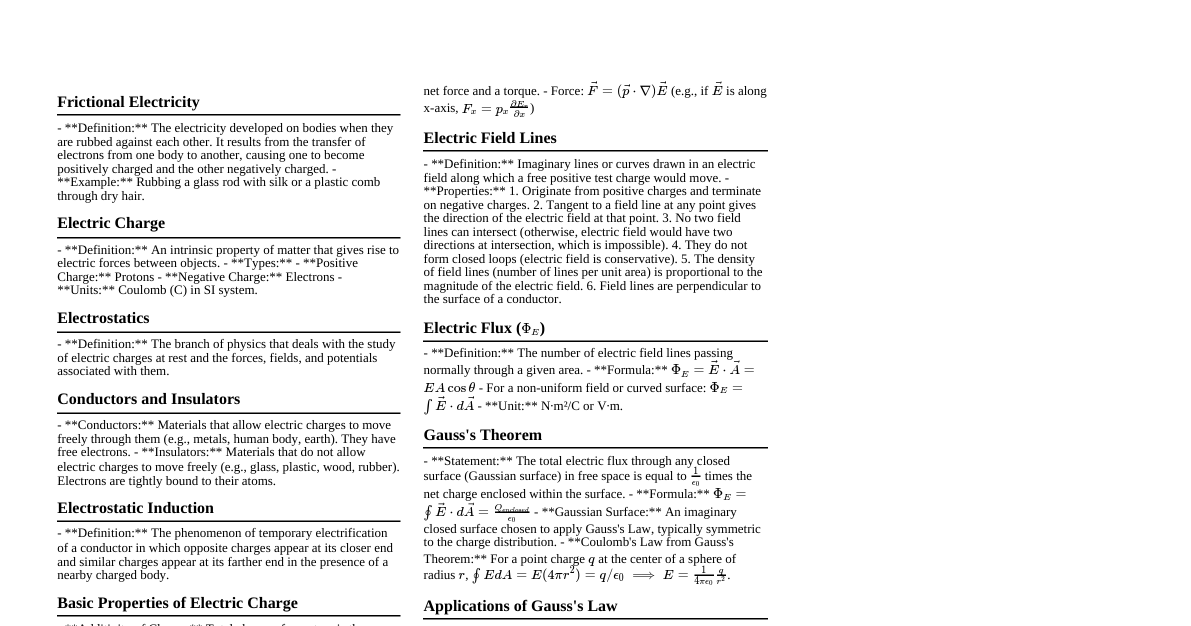
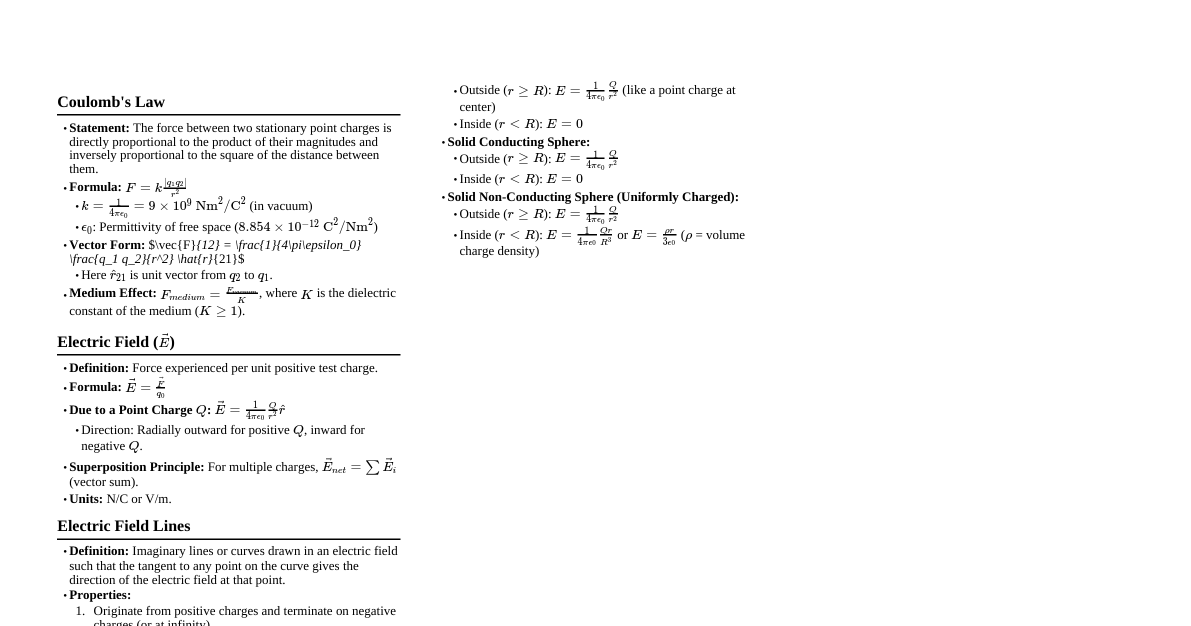
### Electric Charge - **Definition:** Intrinsic property of matter that causes it to experience a force when placed in an electromagnetic field. - **Types:** - **Positive Charge:** Protons carry positive charge. - **Negative Charge:** Electrons carry negative charge. - **Unit:** Coulomb (C) in SI system. - **Quantization of Charge:** Charge exists in discrete packets. $q = \pm ne$, where $n$ is an integer and $e = 1.6 \times 10^{-19}$ C (charge of an electron or proton). - **Conservation of Charge:** Total charge of an isolated system remains constant. - **Properties:** - Like charges repel, unlike charges attract. - Charge is scalar. - Charge is transferable. ### Coulomb's Law - **Statement:** The force between two point charges is directly proportional to the product of the magnitudes of the charges and inversely proportional to the square of the distance between them. - **Formula:** $$F = k \frac{|q_1 q_2|}{r^2}$$ where: - $F$ is the electrostatic force. - $q_1, q_2$ are the magnitudes of the charges. - $r$ is the distance between the charges. - $k$ is Coulomb's constant, $k = \frac{1}{4\pi\epsilon_0} = 9 \times 10^9 \text{ Nm}^2/\text{C}^2$. - $\epsilon_0$ is the permittivity of free space, $\epsilon_0 = 8.85 \times 10^{-12} \text{ C}^2/\text{Nm}^2$. - **Vector Form:** $$\vec{F}_{12} = k \frac{q_1 q_2}{r^3} \vec{r}_{12} = k \frac{q_1 q_2}{|\vec{r}_{12}|^2} \hat{r}_{12}$$ where $\vec{F}_{12}$ is the force on $q_1$ due to $q_2$, and $\hat{r}_{12}$ is the unit vector from $q_2$ to $q_1$. - **Principle of Superposition:** The total force on a given charge due to multiple other charges is the vector sum of the individual forces exerted by each of the other charges. $$\vec{F}_{\text{total}} = \vec{F}_{1} + \vec{F}_{2} + \vec{F}_{3} + ...$$ ### Electric Field - **Definition:** The space around a charge where its influence (force) can be experienced by another charge. - **Electric Field Intensity (E):** Force experienced per unit positive test charge. $$\vec{E} = \frac{\vec{F}}{q_0}$$ where $q_0$ is a small positive test charge. - **Unit:** N/C or V/m. - **Electric Field due to a Point Charge Q:** $$E = k \frac{|Q|}{r^2}$$ Direction is radially outward for positive charge, inward for negative charge. - **Electric Field Lines (Properties):** - Originate from positive charges and end on negative charges. - Never intersect each other. - Tangent to a field line at any point gives the direction of $\vec{E}$ at that point. - Closer lines indicate stronger field. - Do not form closed loops. - **Electric Dipole:** Two equal and opposite charges ($+q$ and $-q$) separated by a small distance $2a$. - **Dipole Moment ($\vec{p}$):** $\vec{p} = q(2\vec{a})$ (vector from $-q$ to $+q$). - **Unit:** C·m. - **Electric Field on Axial Line:** $E_{\text{axial}} = \frac{2kp}{r^3}$ (for $r \gg a$). - **Electric Field on Equatorial Line:** $E_{\text{equatorial}} = \frac{kp}{r^3}$ (for $r \gg a$). - **Torque on a Dipole in Uniform E-field:** $\vec{\tau} = \vec{p} \times \vec{E}$. Magnitude: $\tau = pE \sin\theta$. - **Potential Energy of Dipole in Uniform E-field:** $U = -\vec{p} \cdot \vec{E} = -pE \cos\theta$. ### Electric Flux - **Definition:** Measure of the number of electric field lines passing through a given area. - **Formula:** $$\Phi_E = \vec{E} \cdot \vec{A} = EA \cos\theta$$ where $\vec{A}$ is the area vector (magnitude is area, direction is perpendicular to the surface). - **Unit:** N·m²/C or V·m. ### Gauss's Law - **Statement:** The total electric flux through any closed surface (Gaussian surface) is equal to $1/\epsilon_0$ times the net charge enclosed within the surface. - **Formula:** $$\Phi_E = \oint \vec{E} \cdot d\vec{A} = \frac{q_{\text{enclosed}}}{\epsilon_0}$$ - **Applications:** Used to find electric fields for symmetric charge distributions. - **Infinite Line Charge:** $E = \frac{\lambda}{2\pi\epsilon_0 r}$ ($\lambda$ is linear charge density). - **Infinite Plane Sheet:** $E = \frac{\sigma}{2\epsilon_0}$ ($\sigma$ is surface charge density). - **Spherical Shell (conducting or non-conducting, uniformly charged):** - Outside ($r \ge R$): $E = \frac{Q}{4\pi\epsilon_0 r^2}$ (like point charge at center). - Inside ($r