Electric Current in Conductors
Cheatsheet Content
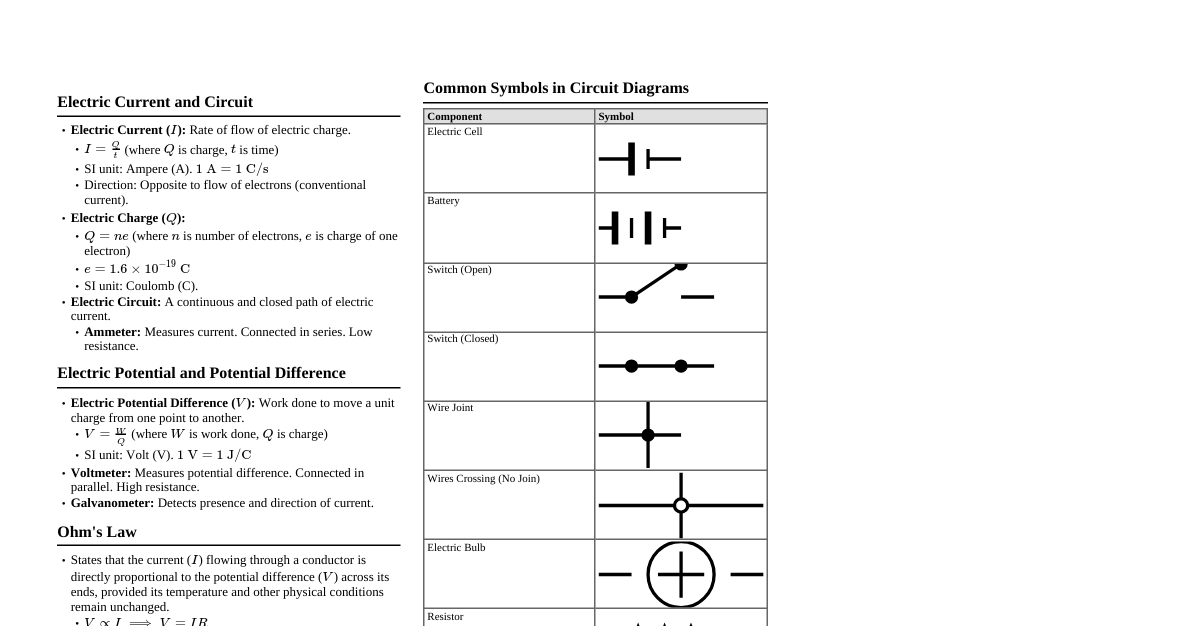
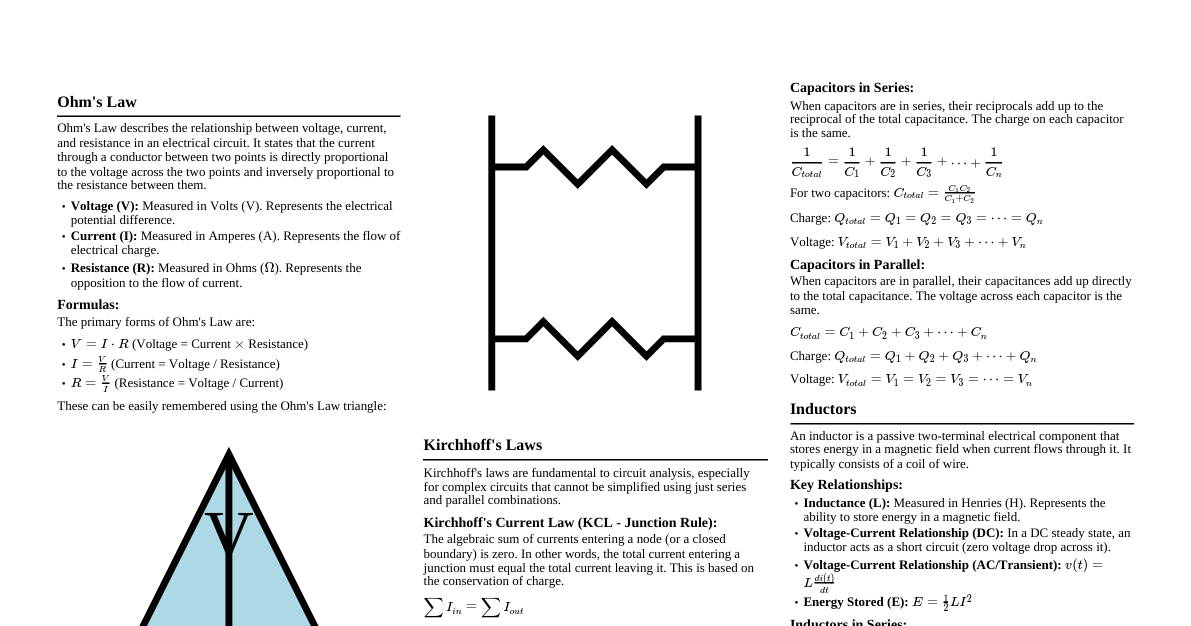
Electric Current Definition: Flow of electric charge through a conductor Formula: $I = \frac{q}{t}$ $I$ = current (Ampere, A) $q$ = charge (Coulomb, C) $t$ = time (seconds, s) Key Point: $1 \text{ Ampere} = 1 \text{ Coulomb/second}$ Drift Velocity ($v_d$) Speed at which free electrons drift through a conductor Formula: $v_d = \frac{I}{nAe}$ $n$ = number of free electrons per unit volume ($\text{m}^{-3}$) $A$ = cross-sectional area ($\text{m}^2$) $e$ = charge of electron ($1.6 \times 10^{-19} \text{ C}$) Connection: Current density $J \propto v_d$ Current Density ($J$) Current per unit area Formula: $J = \frac{I}{A}$ ($\text{A/m}^2$) Also: $J = nev_d$ Resistance ($R$) Definition: Opposition to current flow Formula: $R = \frac{\rho l}{A}$ $\rho$ = resistivity ($\Omega \cdot \text{m}$) $l$ = length ($\text{m}$) $A$ = cross-sectional area ($\text{m}^2$) Unit: Ohm ($\Omega$) Temperature Effect: $\alpha = \frac{R_2 - R_1}{R_1(T_2 - T_1)}$ Ohm's Law Statement: $V \propto I$ (at constant temperature) Formula: $V = IR$ Types of Conductors Ohmic Non-Ohmic Obey Ohm's law Don't obey Ohm's law Linear V-I graph Non-linear V-I graph Examples: Metals (Cu, Ag, Au) Examples: Diodes, transistors Resistor Color Code Format: $(xy \times 10^z \pm T\%) \Omega$ Color Value Tolerance Black 0 - Brown 1 $\pm 1\%$ Red 2 $\pm 2\%$ Orange 3 - Yellow 4 - Green 5 $\pm 0.5\%$ Blue 6 - Violet 7 - Grey 8 - White 9 - Gold - $\pm 5\%$ Silver - $\pm 10\%$ Memory Trick: B lack B rown R ed O range Y ellow G reen B lue V iolet G rey W hite Series & Parallel Circuits Series Connection Current: Same through all ($I = I_1 = I_2 = I_3$) Voltage: $V = V_1 + V_2 + V_3$ Resistance: $R_s = R_1 + R_2 + R_3$ Parallel Connection Voltage: Same across all ($V = V_1 = V_2 = V_3$) Current: $I = I_1 + I_2 + I_3$ Resistance: $\frac{1}{R_p} = \frac{1}{R_1} + \frac{1}{R_2} + \frac{1}{R_3}$ EMF & Internal Resistance EMF ($E$): Maximum potential difference when no current flows Terminal Voltage: $V = E - Ir$ $r$ = internal resistance ($\Omega$) $I$ = current (A) Maximum Current: $I_{max} = \frac{E}{r}$ Power & Energy Power: $P = VI = I^2R = \frac{V^2}{R}$ (Watts, W) Energy: $H = VIt = I^2Rt$ (Joules, J) In calories: $H(\text{cal}) = \frac{H(\text{J})}{4.2}$ Numerical Problems - Quick Solutions Type 1: Basic Resistance Example: Wire of length $20 \text{ km}$, area $25 \text{ cm}^2$, $\rho = 6 \times 10^{-8} \Omega \cdot \text{m}$. Find $R$. Solution: $$R = \frac{\rho l}{A}$$ $$R = \frac{(6 \times 10^{-8} \times 20 \times 10^3)}{(25 \times 10^{-4})} = 0.48 \Omega$$ Type 2: Current & Charge Example: $4 \text{ A}$ current flows for $2 \text{ hours}$. Find number of electrons. Solution: $$N = \frac{It}{e}$$ $$N = \frac{(4 \times 2 \times 3600)}{(1.6 \times 10^{-19})} = 1.8 \times 10^{23} \text{ electrons}$$ Type 3: EMF & Internal Resistance Example: $E = 12 \text{V}$, $r = 3 \Omega$, $I = 0.5 \text{A}$. Find $R$ and $V$. Solution: $$E = I(R + r) \implies 12 = 0.5(R + 3) \implies R = 21 \Omega$$ $$V = IR = 0.5 \times 21 = 10.5 \text{ V}$$ Type 4: Series Circuit Example: $R_1=10\Omega$, $R_2=20\Omega$, $R_3=30\Omega$, $V=12 \text{V}$. Find $I$ and voltage across each. Solution: $$R_s = 10+20+30 = 60\Omega$$ $$I = \frac{V}{R_s} = \frac{12}{60} = 0.2 \text{A}$$ $$V_1 = 0.2 \times 10 = 2 \text{V}$$ $$V_2 = 0.2 \times 20 = 4 \text{V}$$ $$V_3 = 0.2 \times 30 = 6 \text{V}$$ Type 5: Parallel Circuit Example: $R_1=1 \text{k}\Omega$, $R_2=2 \text{k}\Omega$, $V=9 \text{V}$. Find $R_p$ and currents. Solution: $$\frac{1}{R_p} = \frac{1}{1} + \frac{1}{2} = \frac{3}{2} \implies R_p = \frac{2}{3} = 0.67 \text{ k}\Omega$$ $$I_1 = \frac{9}{1} = 9 \text{ mA}$$ $$I_2 = \frac{9}{2} = 4.5 \text{ mA}$$ Type 6: Drift Velocity Example: $J=500 \text{ A/cm}^2$, $n=8.47 \times 10^{22} \text{ /cm}^3$. Find $v_d$. Solution: $$v_d = \frac{J}{ne}$$ $$v_d = \frac{(500 \times 10^4)}{(8.47 \times 10^{28} \times 1.6 \times 10^{-19})} = 3.69 \times 10^{-4} \text{ m/s}$$ Type 7: Temperature Coefficient Example: $R_1=4.2\Omega$ at $27^\circ\text{C}$, $R_2=5.4\Omega$ at $100^\circ\text{C}$. Find $\alpha$. Solution: $$\alpha = \frac{R_2-R_1}{R_1(T_2-T_1)}$$ $$\alpha = \frac{(5.4-4.2)}{[4.2(100-27)]} = 3.91 \times 10^{-3} \text{ /}^\circ\text{C}$$ Type 8: Heat Dissipation Example: $V=230 \text{V}$, $I=5 \text{A}$, $t=1 \text{ hour}$. Find heat. Solution: $$H = VIt$$ $$H = 230 \times 5 \times 3600 = 4.14 \times 10^6 \text{ J}$$ $$H(\text{cal}) = \frac{4.14 \times 10^6}{4.2} = 985.7 \text{ kcal}$$ Quick Memory Tips V-I-R Triangle: V --- I | R Series: "Same Current, Different Voltages" (SCD) Parallel: "Same Voltage, Different Currents" (SVC) Power: $P = I^2R = \frac{V^2}{R} = VI$ (Choose based on given data!) More resistance $\implies$ Less current (Inverse relationship) Common Mistakes to Avoid Forgetting to convert units ($\text{km} \to \text{m}$, $\text{cm} \to \text{m}$, $\text{hours} \to \text{seconds}$) Using wrong formula for series/parallel Neglecting internal resistance in EMF problems Not converting Joules to calories (divide by $4.2$) Pro Tip: Always write given data, required answer, formula, and then calculate step-by-step! 📝