Moving Charges & Magnetism (JEE/NEET)
Cheatsheet Content
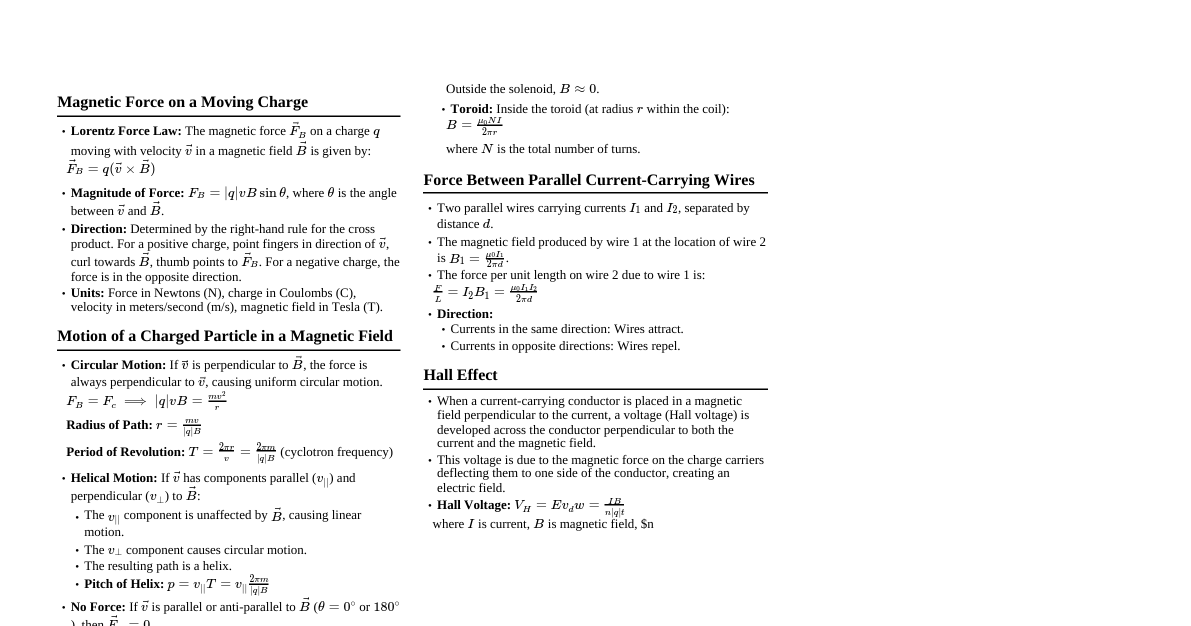
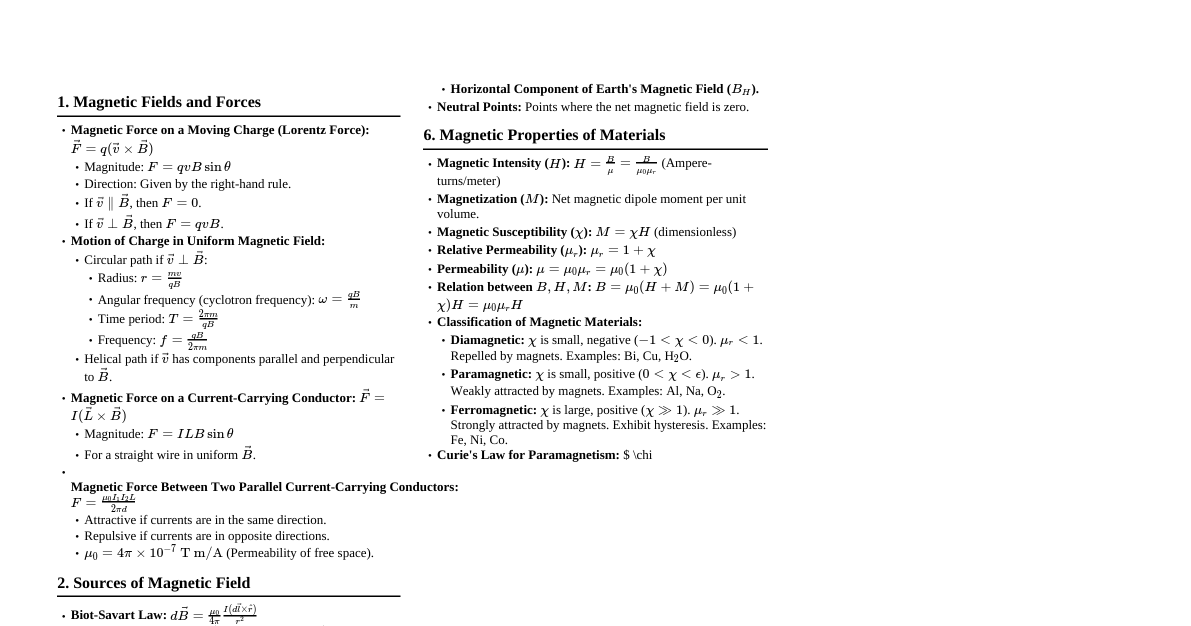
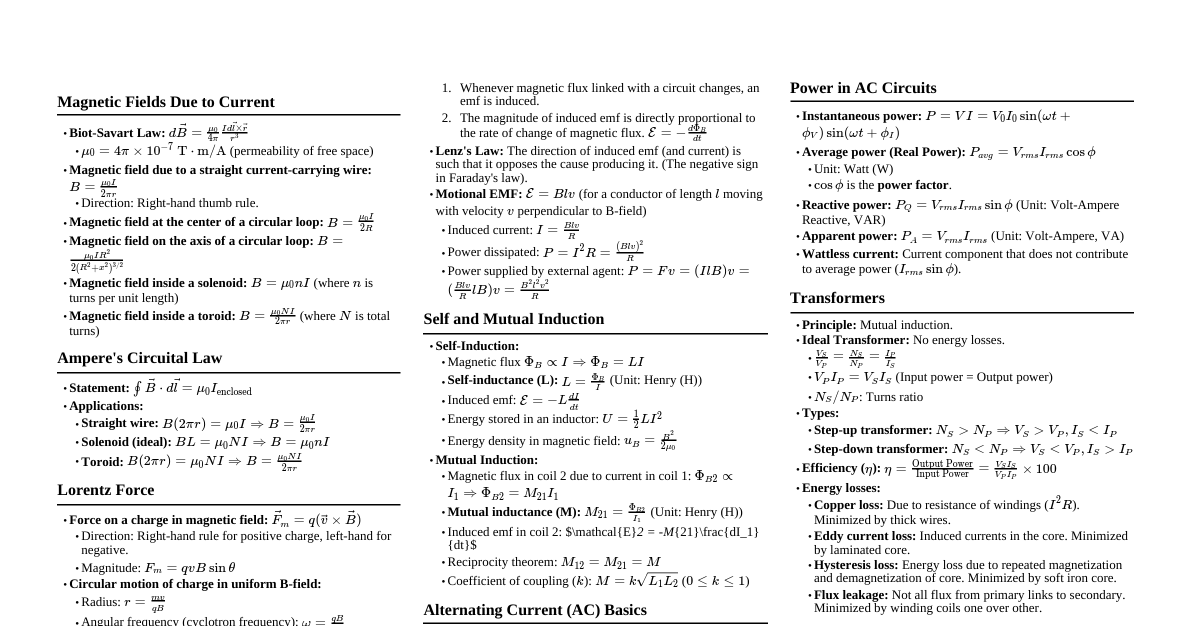
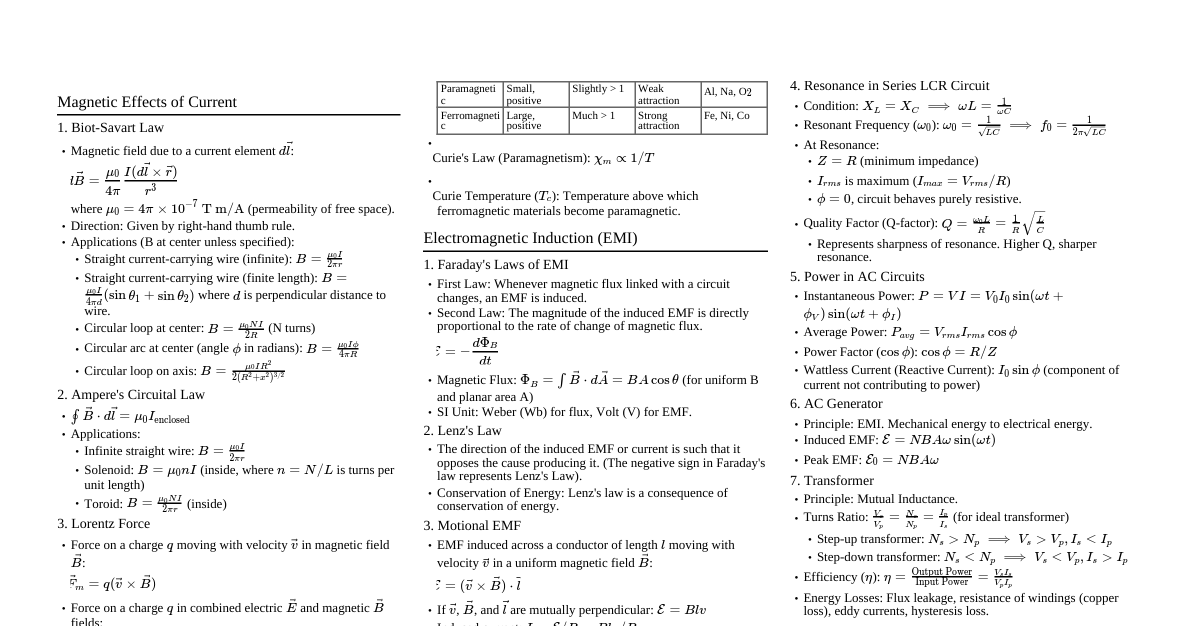
1. Magnetic Force on a Moving Charge Lorentz Force: $\vec{F} = q(\vec{E} + \vec{v} \times \vec{B})$ If only magnetic field: $\vec{F}_m = q(\vec{v} \times \vec{B})$ Magnitude: $F_m = qvB \sin\theta$, where $\theta$ is angle between $\vec{v}$ and $\vec{B}$. Direction: Given by Right-Hand Rule (for positive charge) or Left-Hand Rule (for negative charge). Work Done by Magnetic Force: $W = 0$, as $\vec{F}_m$ is always perpendicular to $\vec{v}$. Kinetic energy remains constant. Motion in Uniform Magnetic Field: If $\vec{v} \parallel \vec{B}$ or $\vec{v} \parallel -\vec{B}$ ($\theta = 0^\circ$ or $180^\circ$): Straight line path. If $\vec{v} \perp \vec{B}$ ($\theta = 90^\circ$): Circular path. Radius: $r = \frac{mv}{qB}$ Angular frequency (cyclotron frequency): $\omega = \frac{qB}{m}$ Time period: $T = \frac{2\pi m}{qB}$ Frequency: $f = \frac{qB}{2\pi m}$ If $\vec{v}$ makes an angle $\theta$ with $\vec{B}$ ($0 Velocity component parallel to $\vec{B}$: $v_\parallel = v \cos\theta$ (causes linear motion) Velocity component perpendicular to $\vec{B}$: $v_\perp = v \sin\theta$ (causes circular motion) Radius of helix: $r = \frac{mv \sin\theta}{qB}$ Pitch of helix: $p = v_\parallel T = (v \cos\theta) \frac{2\pi m}{qB}$ Cyclotron: Device to accelerate charged particles. Condition for resonance: $f_{osc} = f_c = \frac{qB}{2\pi m}$ Maximum kinetic energy: $KE_{max} = \frac{1}{2} m v_{max}^2 = \frac{q^2 B^2 R^2}{2m}$, where $R$ is radius of dees. 2. Magnetic Force on a Current-Carrying Conductor Force on a straight conductor: $\vec{F} = I(\vec{L} \times \vec{B})$ Magnitude: $F = I L B \sin\theta$, where $\theta$ is angle between $\vec{L}$ and $\vec{B}$. Direction: Given by Right-Hand Rule. Force on an arbitrary shaped wire: $\vec{F} = I \int (d\vec{l} \times \vec{B})$ Force between two parallel current-carrying wires: Force per unit length: $\frac{F}{L} = \frac{\mu_0 I_1 I_2}{2\pi d}$ Attractive if currents are in same direction. Repulsive if currents are in opposite directions. Definition of Ampere: 1 Ampere is the current which, when flowing in two infinitely long parallel conductors 1m apart, produces a force of $2 \times 10^{-7}$ N/m between them. 3. Torque on a Current Loop Magnetic Dipole Moment: $\vec{M} = I \vec{A}$ For N turns: $\vec{M} = N I \vec{A}$ Direction of $\vec{A}$ (area vector) is given by Right-Hand Thumb Rule. Torque: $\vec{\tau} = \vec{M} \times \vec{B}$ Magnitude: $\tau = M B \sin\alpha = NIAB \sin\alpha$, where $\alpha$ is angle between $\vec{M}$ (or normal to loop) and $\vec{B}$. Potential Energy: $U = -\vec{M} \cdot \vec{B} = -MB \cos\alpha$ Minimum energy (stable equilibrium): $U_{min} = -MB$ when $\alpha = 0^\circ$ ($\vec{M} \parallel \vec{B}$). Maximum energy (unstable equilibrium): $U_{max} = +MB$ when $\alpha = 180^\circ$ ($\vec{M} \parallel -\vec{B}$). Moving Coil Galvanometer: Principle: Torque on current loop in magnetic field. $\tau = NIAB$. Restoring torque: $\tau_{res} = k\phi$, where $k$ is torsional constant, $\phi$ is deflection. At equilibrium: $NIAB = k\phi \implies \phi = \frac{NIAB}{k}$ Current Sensitivity: $I_S = \frac{\phi}{I} = \frac{NAB}{k}$ Voltage Sensitivity: $V_S = \frac{\phi}{V} = \frac{\phi}{IR_G} = \frac{NAB}{kR_G}$ Conversion to Ammeter: Shunt resistance $R_s = \frac{I_g R_g}{I - I_g}$ (parallel). Conversion to Voltmeter: Series resistance $R_{series} = \frac{V}{I_g} - R_g$ (series). 4. Magnetic Field Due to Current (Biot-Savart Law) Biot-Savart Law: $d\vec{B} = \frac{\mu_0}{4\pi} \frac{I (d\vec{l} \times \hat{r})}{r^2}$ $\mu_0 = 4\pi \times 10^{-7}$ T m/A (permeability of free space). Direction: Right-Hand Thumb Rule. Magnetic Field due to a straight current-carrying wire: At distance $r$ from an infinite wire: $B = \frac{\mu_0 I}{2\pi r}$ At distance $r$ from a finite wire: $B = \frac{\mu_0 I}{4\pi r} (\sin\phi_1 + \sin\phi_2)$ At one end of a semi-infinite wire: $B = \frac{\mu_0 I}{4\pi r}$ Magnetic Field at the center of a circular loop: $B = \frac{\mu_0 I}{2R}$ Magnetic Field on the axis of a circular loop: $B = \frac{\mu_0 I R^2}{2(R^2 + x^2)^{3/2}}$ At center ($x=0$): $B = \frac{\mu_0 I}{2R}$ Magnetic Field at the center of an arc: $B = \frac{\mu_0 I}{2R} \frac{\theta}{2\pi}$ (where $\theta$ is in radians) 5. Ampere's Circuital Law Law: $\oint \vec{B} \cdot d\vec{l} = \mu_0 I_{enc}$ $I_{enc}$ is the net current enclosed by the Amperian loop. Applications: Infinite Straight Wire: $B = \frac{\mu_0 I}{2\pi r}$ (outside) Solenoid: Inside (far from ends): $B = \mu_0 n I$, where $n = N/L$ (turns per unit length). Outside: $B \approx 0$. Toroid: Inside the toroid (in the core): $B = \frac{\mu_0 N I}{2\pi r}$ Outside: $B = 0$. 6. Magnetic Properties of Materials Magnetic Field in Matter: $B = \mu H$ $\mu = \mu_0 \mu_r = \mu_0 (1 + \chi)$ (permeability of medium) $\mu_r$: relative permeability $\chi$: magnetic susceptibility Types of Magnetic Materials: Diamagnetic: $\chi$ is small and negative. $\mu_r Paramagnetic: $\chi$ is small and positive. $\mu_r > 1$. Weakly attracted by magnets. Ex: Aluminum, Sodium, Oxygen. Ferromagnetic: $\chi$ is large and positive. $\mu_r \gg 1$. Strongly attracted by magnets. Form domains. Ex: Iron, Nickel, Cobalt. Show hysteresis. Curie Temperature: Above this, ferromagnetic materials become paramagnetic. 7. Earth's Magnetism Elements of Earth's Magnetic Field: Declination ($\delta$): Angle between geographic and magnetic meridians. Inclination or Dip ($\phi$): Angle between Earth's total magnetic field ($\vec{B}_E$) and the horizontal. At magnetic poles: $\phi = 90^\circ$. At magnetic equator: $\phi = 0^\circ$. Horizontal Component ($B_H$): $B_H = B_E \cos\phi$ Vertical Component ($B_V$): $B_V = B_E \sin\phi$ Relation: $B_V = B_H \tan\phi$