Moving Charges and Magnetism
Cheatsheet Content
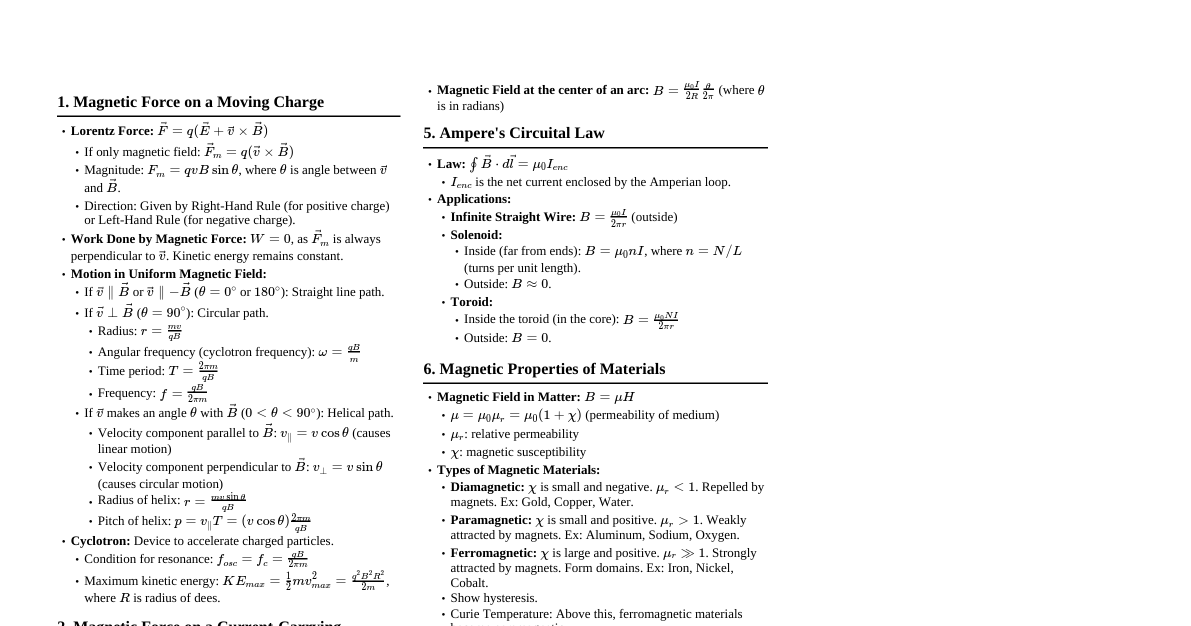
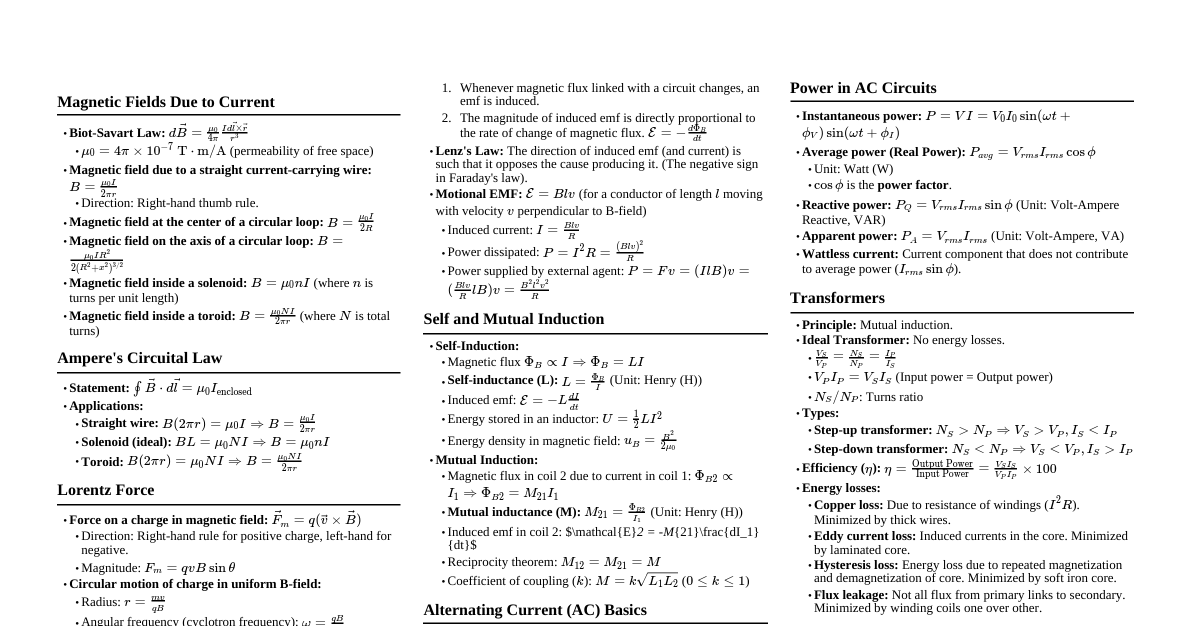
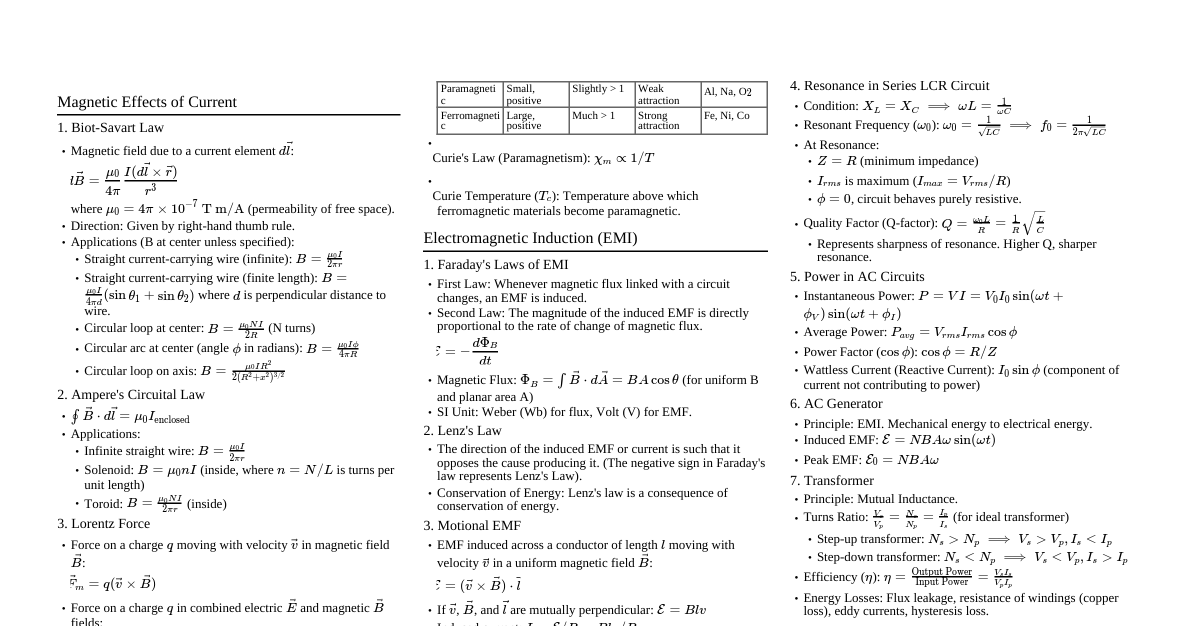
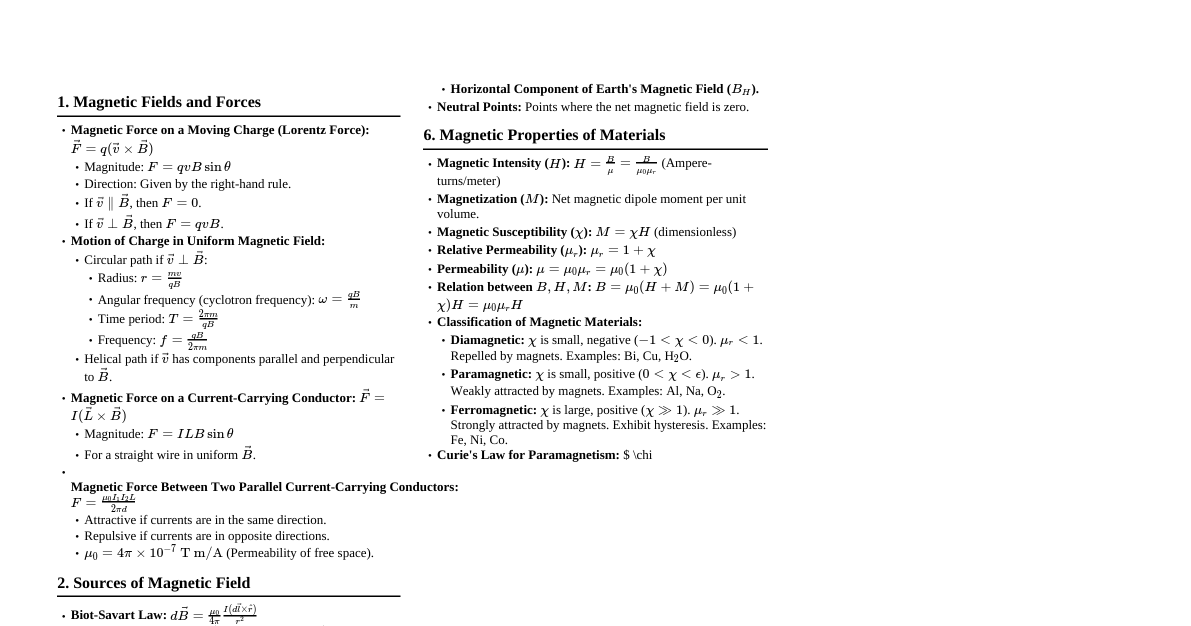
Magnetic Force on a Moving Charge Lorentz Force Law: The magnetic force $\vec{F}_B$ on a charge $q$ moving with velocity $\vec{v}$ in a magnetic field $\vec{B}$ is given by: $\vec{F}_B = q(\vec{v} \times \vec{B})$ Magnitude of Force: $F_B = |q|vB \sin\theta$, where $\theta$ is the angle between $\vec{v}$ and $\vec{B}$. Direction: Determined by the right-hand rule for the cross product. For a positive charge, point fingers in direction of $\vec{v}$, curl towards $\vec{B}$, thumb points to $\vec{F}_B$. For a negative charge, the force is in the opposite direction. Units: Force in Newtons (N), charge in Coulombs (C), velocity in meters/second (m/s), magnetic field in Tesla (T). Motion of a Charged Particle in a Magnetic Field Circular Motion: If $\vec{v}$ is perpendicular to $\vec{B}$, the force is always perpendicular to $\vec{v}$, causing uniform circular motion. $F_B = F_c \implies |q|vB = \frac{mv^2}{r}$ Radius of Path: $r = \frac{mv}{|q|B}$ Period of Revolution: $T = \frac{2\pi r}{v} = \frac{2\pi m}{|q|B}$ (cyclotron frequency) Helical Motion: If $\vec{v}$ has components parallel ($v_{||}$) and perpendicular ($v_{\perp}$) to $\vec{B}$: The $v_{||}$ component is unaffected by $\vec{B}$, causing linear motion. The $v_{\perp}$ component causes circular motion. The resulting path is a helix. Pitch of Helix: $p = v_{||} T = v_{||} \frac{2\pi m}{|q|B}$ No Force: If $\vec{v}$ is parallel or anti-parallel to $\vec{B}$ ($\theta = 0^\circ$ or $180^\circ$), then $\vec{F}_B = 0$. Magnetic Force on a Current-Carrying Wire Force on a segment $L$: For a straight wire segment of length $L$ carrying current $I$ in a uniform magnetic field $\vec{B}$: $\vec{F}_B = I(\vec{L} \times \vec{B})$ Magnitude: $F_B = ILB \sin\theta$, where $\theta$ is the angle between $\vec{L}$ (direction of current) and $\vec{B}$. General Case (non-uniform field or curved wire): $\vec{F}_B = \int I(d\vec{L} \times \vec{B})$ Torque on a Current Loop Magnetic Dipole Moment: For a planar loop with $N$ turns, area $A$, and current $I$: $\vec{\mu} = NIA\hat{n}$ (where $\hat{n}$ is the normal vector to the loop, direction by right-hand rule for current) Torque: In a uniform magnetic field $\vec{B}$: $\vec{\tau} = \vec{\mu} \times \vec{B}$ Magnitude: $\tau = \mu B \sin\theta = NIAB \sin\theta$, where $\theta$ is the angle between $\vec{\mu}$ and $\vec{B}$. Potential Energy: $U = -\vec{\mu} \cdot \vec{B} = -\mu B \cos\theta$ Magnetic Field Due to Currents Biot-Savart Law: The magnetic field $d\vec{B}$ produced by a current element $Id\vec{L}$ at a distance $r$ from the element is: $d\vec{B} = \frac{\mu_0}{4\pi} \frac{I d\vec{L} \times \hat{r}}{r^2}$ where $\mu_0 = 4\pi \times 10^{-7} \text{ T}\cdot\text{m/A}$ is the permeability of free space. Total Field: $\vec{B} = \int d\vec{B}$ Magnetic Field of a Long Straight Wire: At a distance $r$ from the wire: $B = \frac{\mu_0 I}{2\pi r}$ Direction by right-hand rule (thumb in direction of current, fingers curl in direction of $\vec{B}$). Magnetic Field at the Center of a Circular Loop: For a loop of radius $R$ carrying current $I$: $B = \frac{\mu_0 I}{2R}$ For $N$ turns: $B = \frac{\mu_0 NI}{2R}$ Magnetic Field on the Axis of a Circular Loop: At distance $x$ from the center along the axis: $B_x = \frac{\mu_0 I R^2}{2(R^2+x^2)^{3/2}}$ Ampere's Law Statement: The line integral of the magnetic field $\vec{B}$ around any closed loop is proportional to the total current $I_{enc}$ passing through the loop: $\oint \vec{B} \cdot d\vec{s} = \mu_0 I_{enc}$ Applications: Long Straight Wire: (Same as Biot-Savart result) $B = \frac{\mu_0 I}{2\pi r}$ Solenoid: For an ideal solenoid with $n$ turns per unit length, inside the solenoid: $B = \mu_0 n I$ Outside the solenoid, $B \approx 0$. Toroid: Inside the toroid (at radius $r$ within the coil): $B = \frac{\mu_0 N I}{2\pi r}$ where $N$ is the total number of turns. Force Between Parallel Current-Carrying Wires Two parallel wires carrying currents $I_1$ and $I_2$, separated by distance $d$. The magnetic field produced by wire 1 at the location of wire 2 is $B_1 = \frac{\mu_0 I_1}{2\pi d}$. The force per unit length on wire 2 due to wire 1 is: $\frac{F}{L} = I_2 B_1 = \frac{\mu_0 I_1 I_2}{2\pi d}$ Direction: Currents in the same direction: Wires attract. Currents in opposite directions: Wires repel. Hall Effect When a current-carrying conductor is placed in a magnetic field perpendicular to the current, a voltage (Hall voltage) is developed across the conductor perpendicular to both the current and the magnetic field. This voltage is due to the magnetic force on the charge carriers deflecting them to one side of the conductor, creating an electric field. Hall Voltage: $V_H = Ev_d w = \frac{IB}{n|q|t}$ where $I$ is current, $B$ is magnetic field, $n$ is charge carrier density, $|q|$ is charge of carrier, $t$ is thickness of conductor, $w$ is width of conductor. Used to determine the sign of charge carriers and their density.