Electric Fields & Lines
Cheatsheet Content
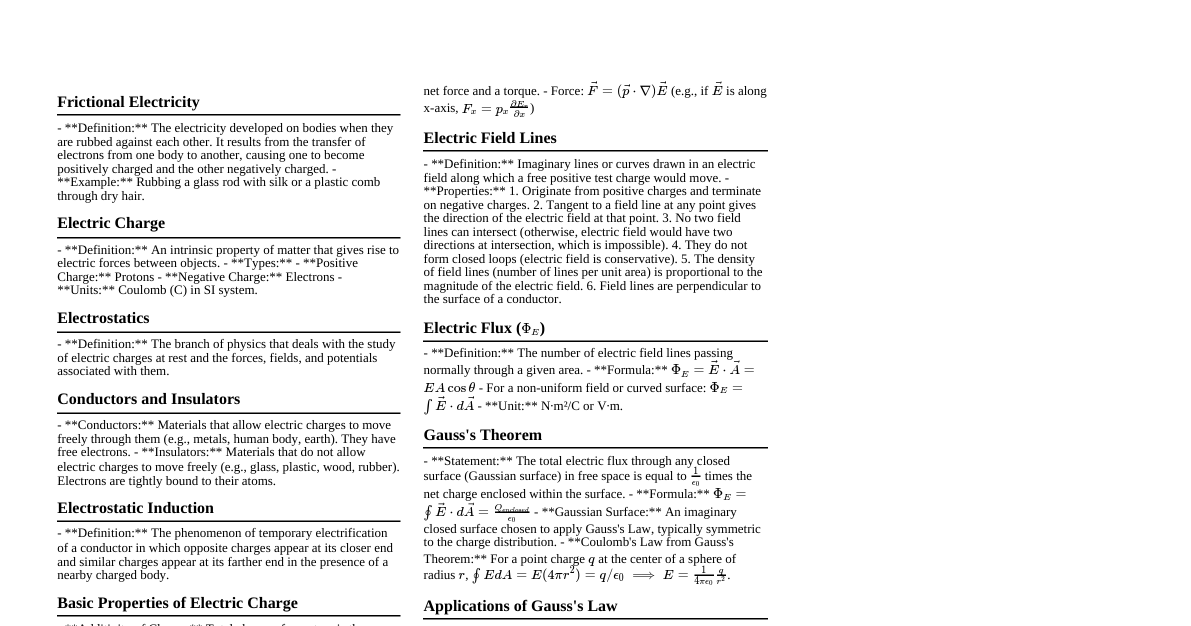
### Coulomb's Law - **Statement:** The force between two stationary point charges is directly proportional to the product of their magnitudes and inversely proportional to the square of the distance between them. - **Formula:** $F = k \frac{|q_1 q_2|}{r^2}$ - $k = \frac{1}{4\pi\epsilon_0} = 9 \times 10^9 \text{ Nm}^2/\text{C}^2$ (in vacuum) - $\epsilon_0$: Permittivity of free space ($8.854 \times 10^{-12} \text{ C}^2/\text{Nm}^2$) - **Vector Form:** $\vec{F}_{12} = \frac{1}{4\pi\epsilon_0} \frac{q_1 q_2}{r^2} \hat{r}_{21}$ - Here $\hat{r}_{21}$ is unit vector from $q_2$ to $q_1$. - **Medium Effect:** $F_{medium} = \frac{F_{vacuum}}{K}$, where $K$ is the dielectric constant of the medium ($K \ge 1$). ### Electric Field ($\vec{E}$) - **Definition:** Force experienced per unit positive test charge. - **Formula:** $\vec{E} = \frac{\vec{F}}{q_0}$ - **Due to a Point Charge $Q$:** $\vec{E} = \frac{1}{4\pi\epsilon_0} \frac{Q}{r^2} \hat{r}$ - Direction: Radially outward for positive $Q$, inward for negative $Q$. - **Superposition Principle:** For multiple charges, $\vec{E}_{net} = \sum \vec{E}_i$ (vector sum). - **Units:** N/C or V/m. ### Electric Field Lines - **Definition:** Imaginary lines or curves drawn in an electric field such that the tangent to any point on the curve gives the direction of the electric field at that point. - **Properties:** 1. Originate from positive charges and terminate on negative charges (or at infinity). 2. Never intersect each other. If they did, $\vec{E}$ would have two directions at the intersection, which is impossible. 3. The density of field lines (number of lines per unit area perpendicular to the lines) is proportional to the magnitude of the electric field. 4. They do not form closed loops (conservative field). 5. They are always perpendicular to the surface of a conductor. 6. They contract lengthwise to represent attraction between opposite charges. 7. They exert lateral pressure on each other to represent repulsion between similar charges. ### Electric Dipole - **Definition:** A system of two equal and opposite point charges ($+q$ and $-q$) separated by a small distance $2a$. - **Dipole Moment ($\vec{p}$):** - **Formula:** $\vec{p} = q(2\vec{a})$ - **Direction:** From negative charge to positive charge. - **Units:** C·m. - **Electric Field Due to a Dipole:** - **Axial Line (on the axis of the dipole):** - $E_{axial} = \frac{1}{4\pi\epsilon_0} \frac{2pr}{(r^2 - a^2)^2}$ - For $r \gg a$, $E_{axial} \approx \frac{1}{4\pi\epsilon_0} \frac{2p}{r^3}$ - **Equatorial Line (perpendicular bisector):** - $E_{equatorial} = \frac{1}{4\pi\epsilon_0} \frac{p}{(r^2 + a^2)^{3/2}}$ - For $r \gg a$, $E_{equatorial} \approx \frac{1}{4\pi\epsilon_0} \frac{p}{r^3}$ - Direction is opposite to $\vec{p}$. - **Torque on a Dipole in Uniform Electric Field:** - **Formula:** $\vec{\tau} = \vec{p} \times \vec{E}$ - **Magnitude:** $\tau = pE \sin\theta$ - Max torque when $\theta = 90^\circ$, Min torque (zero) when $\theta = 0^\circ$ or $180^\circ$. - **Potential Energy of a Dipole in Uniform Electric Field:** - **Formula:** $U = -\vec{p} \cdot \vec{E} = -pE \cos\theta$ - Min energy (stable equilibrium) when $\theta = 0^\circ$. - Max energy (unstable equilibrium) when $\theta = 180^\circ$. ### Electric Flux ($\Phi_E$) - **Definition:** The measure of the number of electric field lines passing through a given area. - **Formula:** $\Phi_E = \int \vec{E} \cdot d\vec{A}$ - For uniform field and planar area: $\Phi_E = EA \cos\theta$ - Where $\theta$ is the angle between $\vec{E}$ and the normal to the area vector $d\vec{A}$. - **Units:** N·m²/C or V·m. ### Gauss's Law - **Statement:** The total electric flux through any closed surface (Gaussian surface) is equal to $1/\epsilon_0$ times the net charge enclosed by that surface. - **Formula:** $\oint \vec{E} \cdot d\vec{A} = \frac{Q_{enclosed}}{\epsilon_0}$ - **Applications (Symmetry required):** - **Infinite Line Charge:** $E = \frac{\lambda}{2\pi\epsilon_0 r}$ ($\lambda$ = linear charge density) - **Infinite Plane Sheet of Charge:** $E = \frac{\sigma}{2\epsilon_0}$ ($\sigma$ = surface charge density) - **Charged Spherical Shell:** - Outside ($r \ge R$): $E = \frac{1}{4\pi\epsilon_0} \frac{Q}{r^2}$ (like a point charge at center) - Inside ($r