Electric Charges & Fields
Shared 5/14/2026•0 views
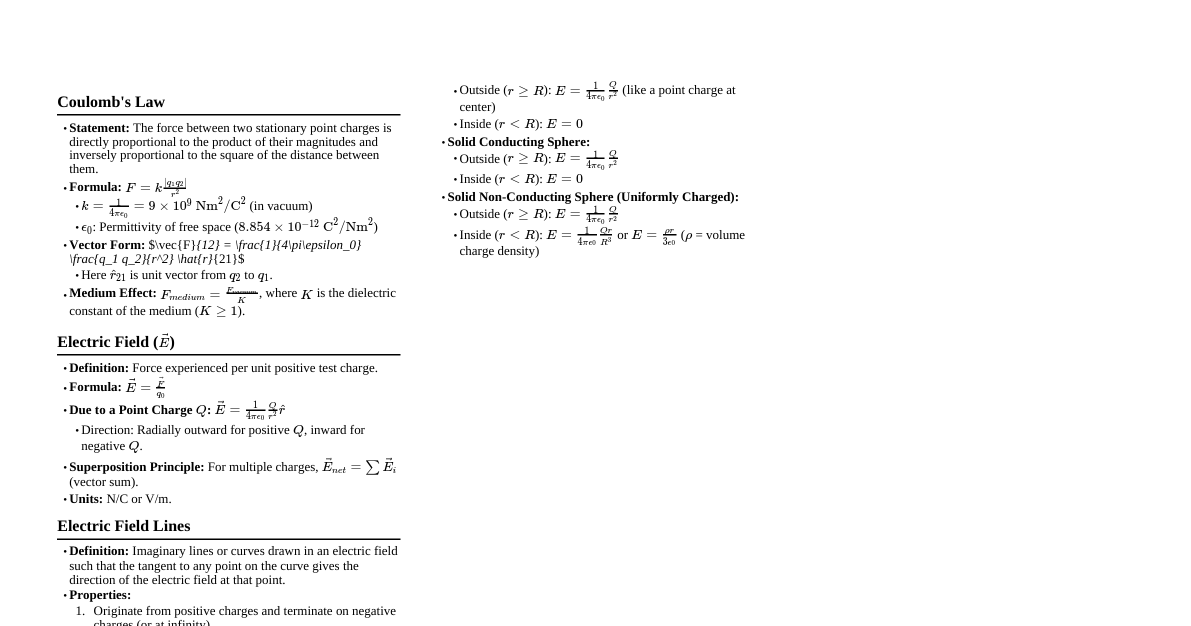
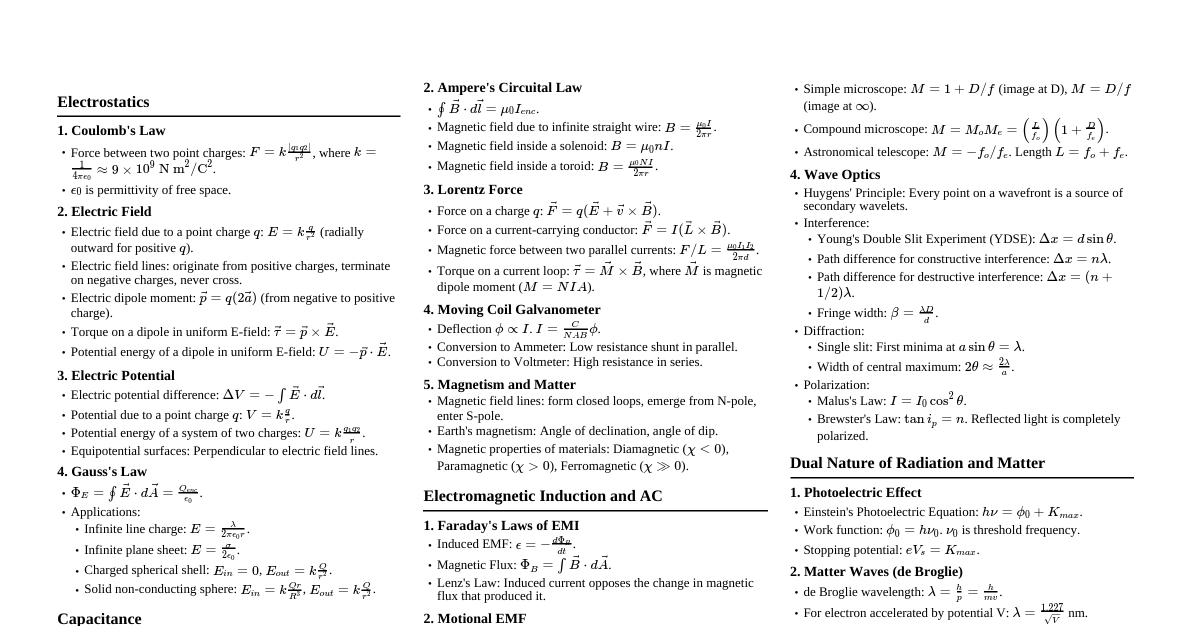
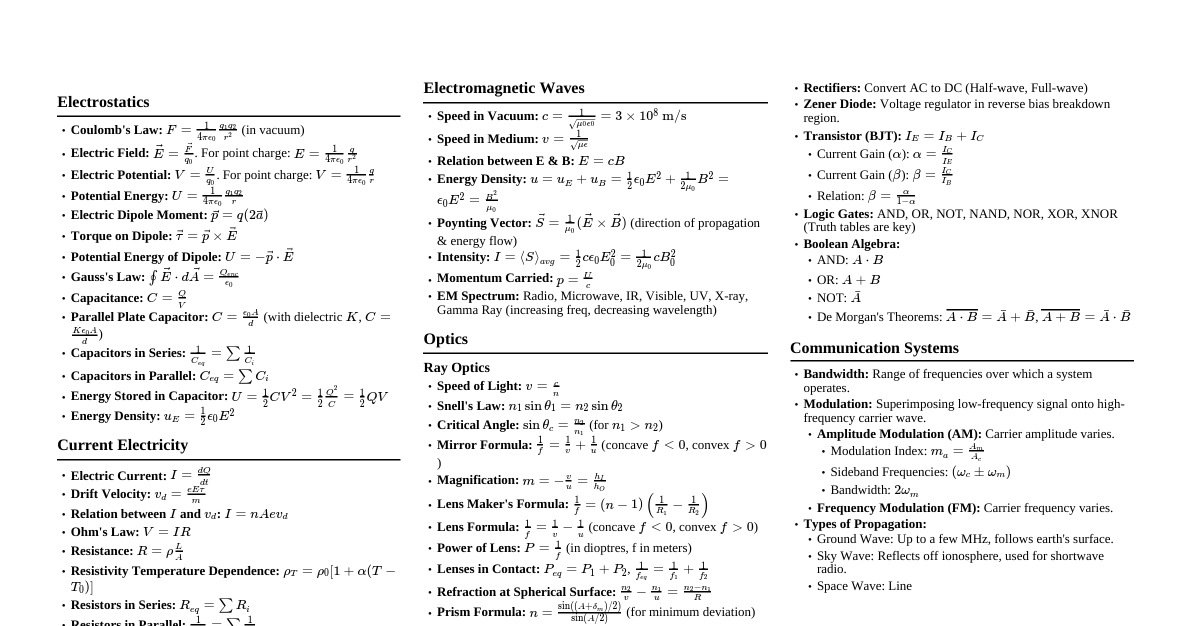
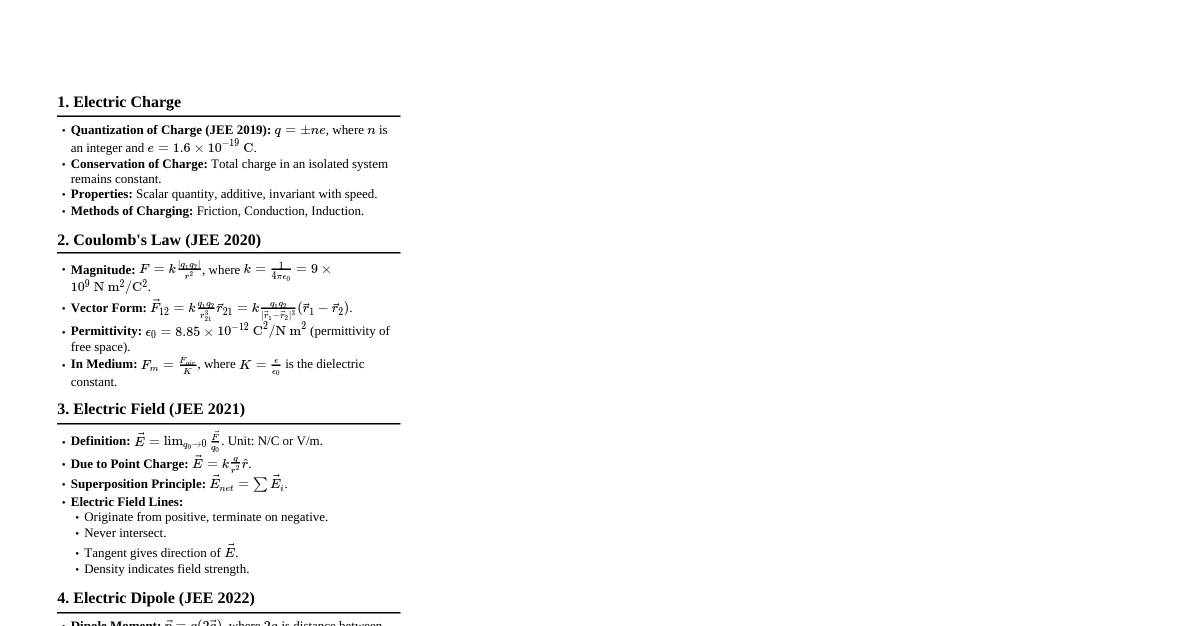
Frictional Electricity - **Definition:** The electricity developed on bodies when they are rubbed against each other. It results from the transfer of electrons from one body to another, causing one to become positively charged and the other negatively charged. - **Example:** Rubbing a glass rod with silk or a plastic comb through dry hair. Electric Charge - **Definition:** An intrinsic property of matter that gives rise to electric forces between objects. - **Types:** - **Positive Charge:** Protons - **Negative Charge:** Electrons - **Units:** Coulomb (C) in SI system. Electrostatics - **Definition:** The branch of physics that deals with the study of electric charges at rest and the forces, fields, and potentials associated with them. Conductors and Insulators - **Conductors:** Materials that allow electric charges to move freely through them (e.g., metals, human body, earth). They have free electrons. - **Insulators:** Materials that do not allow electric charges to move freely (e.g., glass, plastic, wood, rubber). Electrons are tightly bound to their atoms. Electrostatic Induction - **Definition:** The phenomenon of temporary electrification of a conductor in which opposite charges appear at its closer end and similar charges appear at its farther end in the presence of a nearby charged body. Basic Properties of Electric Charge - **Additivity of Charge:** Total charge of a system is the algebraic sum of all individual charges present in the system ($Q = q_1 + q_2 + ... + q_n$). - **Quantization of Charge:** Electric charge is always an integral multiple of the basic unit of charge, $e$. ($q = \pm ne$, where $n$ is an integer and $e = 1.6 \times 10^{-19}$ C). - **Conservation of Charge:** For an isolated system, the total charge remains constant. Charge can neither be created nor destroyed, only transferred. - **Charge vs. Mass:** - Charge can be positive, negative, or zero; Mass is always positive. - Charge is quantized; Mass is not (yet) known to be quantized. - Charge is conserved; Mass is conserved only in non-relativistic reactions. - Charge does not depend on speed; Mass increases with speed ($m = m_0 / \sqrt{1 - v^2/c^2}$). Coulomb's Law of Electric Force - **Statement:** The force of attraction or repulsion between two stationary point charges is directly proportional to the product of their magnitudes and inversely proportional to the square of the distance between them. - **Magnitude:** $F = k \frac{|q_1 q_2|}{r^2}$ - $k = \frac{1}{4\pi\epsilon_0} = 9 \times 10^9 \text{ Nm}^2/\text{C}^2$ in vacuum. - $\epsilon_0$ = permittivity of free space = $8.854 \times 10^{-12} \text{ C}^2/\text{Nm}^2$. - **Vector Form:** $\vec{F}_{12} = \frac{1}{4\pi\epsilon_0} \frac{q_1 q_2}{r_{21}^2} \hat{r}_{21}$ or $\vec{F}_{12} = \frac{1}{4\pi\epsilon_0} \frac{q_1 q_2}{|\vec{r}_1 - \vec{r}_2|^3} (\vec{r}_1 - \vec{r}_2)$ - **Dielectric Constant / Relative Permittivity ($\epsilon_r$ or K):** $\epsilon_r = \frac{\epsilon}{\epsilon_0}$ - Force in a medium: $F_{medium} = \frac{1}{4\pi\epsilon} \frac{|q_1 q_2|}{r^2} = \frac{1}{4\pi\epsilon_0 \epsilon_r} \frac{|q_1 q_2|}{r^2} = \frac{F_{vacuum}}{\epsilon_r}$ Superposition Principle (Forces) - The total electrostatic force on a given charge due to a number of other charges is the vector sum of all the individual forces exerted on that charge by all the other charges. - $\vec{F}_{total} = \vec{F}_1 + \vec{F}_2 + ... + \vec{F}_n$ Electric Field - **Definition:** The region around a charged body where another charged body would experience an electrostatic force. - **Electric Field Intensity ($\vec{E}$):** Force experienced per unit positive test charge. - $\vec{E} = \frac{\vec{F}}{q_0}$ - **Unit:** N/C or V/m. - **Electric Field due to a Point Charge ($Q$):** - Magnitude: $E = \frac{1}{4\pi\epsilon_0} \frac{|Q|}{r^2}$ - Vector form: $\vec{E} = \frac{1}{4\pi\epsilon_0} \frac{Q}{r^2} \hat{r}$ - **Electric Field due to a System of Point Charges:** - $\vec{E}_{total} = \vec{E}_1 + \vec{E}_2 + ... + \vec{E}_n = \sum_{i=1}^{n} \frac{1}{4\pi\epsilon_0} \frac{q_i}{r_i^2} \hat{r}_i$ - **Continuous Charge Distribution:** - **Linear Charge Density ($\lambda$):** Charge per unit length ($dq = \lambda dl$) - **Surface Charge Density ($\sigma$):** Charge per unit area ($dq = \sigma dA$) - **Volume Charge Density ($\rho$):** Charge per unit volume ($dq = \rho dV$) - Field contribution from small element $dq$: $d\vec{E} = \frac{1}{4\pi\epsilon_0} \frac{dq}{r^2} \hat{r}$ - Total field: $\vec{E} = \int d\vec{E}$ Electric Dipole - **Definition:** A pair of equal and opposite point charges ($+q$ and $-q$) separated by a small distance ($2a$). - **Dipole Moment ($\vec{p}$):** A vector quantity that measures the strength of an electric dipole. - $\vec{p} = q (2\vec{a})$, where $2\vec{a}$ is the vector from $-q$ to $+q$. - **Unit:** C·m. - **Electric Field at an Axial Point:** - $\vec{E}_{axial} = \frac{1}{4\pi\epsilon_0} \frac{2\vec{p}r}{(r^2 - a^2)^2}$ - For $r \gg a$: $\vec{E}_{axial} \approx \frac{1}{4\pi\epsilon_0} \frac{2\vec{p}}{r^3}$ (Direction along $\vec{p}$) - **Electric Field at an Equatorial Point:** - $\vec{E}_{equatorial} = \frac{1}{4\pi\epsilon_0} \frac{-\vec{p}}{(r^2 + a^2)^{3/2}}$ - For $r \gg a$: $\vec{E}_{equatorial} \approx \frac{1}{4\pi\epsilon_0} \frac{-\vec{p}}{r^3}$ (Direction opposite to $\vec{p}$) - **Torque on a Dipole in a Uniform Electric Field:** - $\vec{\tau} = \vec{p} \times \vec{E}$ - Magnitude: $\tau = pE \sin\theta$ - **Dipole in a Non-uniform Electric Field:** - Experiences both a net force and a torque. - Force: $\vec{F} = (\vec{p} \cdot \nabla)\vec{E}$ (e.g., if $\vec{E}$ is along x-axis, $F_x = p_x \frac{\partial E_x}{\partial x}$) Electric Field Lines - **Definition:** Imaginary lines or curves drawn in an electric field along which a free positive test charge would move. - **Properties:** 1. Originate from positive charges and terminate on negative charges. 2. Tangent to a field line at any point gives the direction of the electric field at that point. 3. No two field lines can intersect (otherwise, electric field would have two directions at intersection, which is impossible). 4. They do not form closed loops (electric field is conservative). 5. The density of field lines (number of lines per unit area) is proportional to the magnitude of the electric field. 6. Field lines are perpendicular to the surface of a conductor. Electric Flux ($\Phi_E$) - **Definition:** The number of electric field lines passing normally through a given area. - **Formula:** $\Phi_E = \vec{E} \cdot \vec{A} = EA \cos\theta$ - For a non-uniform field or curved surface: $\Phi_E = \int \vec{E} \cdot d\vec{A}$ - **Unit:** N·m²/C or V·m. Gauss's Theorem - **Statement:** The total electric flux through any closed surface (Gaussian surface) in free space is equal to $\frac{1}{\epsilon_0}$ times the net charge enclosed within the surface. - **Formula:** $\Phi_E = \oint \vec{E} \cdot d\vec{A} = \frac{Q_{enclosed}}{\epsilon_0}$ - **Gaussian Surface:** An imaginary closed surface chosen to apply Gauss's Law, typically symmetric to the charge distribution. - **Coulomb's Law from Gauss's Theorem:** For a point charge $q$ at the center of a sphere of radius $r$, $\oint E dA = E(4\pi r^2) = q/\epsilon_0 \implies E = \frac{1}{4\pi\epsilon_0} \frac{q}{r^2}$. Applications of Gauss's Law - **Electric Field due to an Infinitely Long Straight Uniformly Charged Wire:** - $E = \frac{\lambda}{2\pi\epsilon_0 r}$ - Direction: Radially outward for positive $\lambda$. - **Electric Field due to a Uniformly Charged Infinite Plane Sheet:** - $E = \frac{\sigma}{2\epsilon_0}$ - Direction: Perpendicular to the plane, outward for positive $\sigma$. - **Electric Field due to a Uniformly Charged Thin Spherical Shell:** - For $r > R$ (outside): $E = \frac{1}{4\pi\epsilon_0} \frac{Q}{r^2}$ (Behaves like a point charge at center) - For $r = R$ (on surface): $E = \frac{1}{4\pi\epsilon_0} \frac{Q}{R^2}$ - For $r R$ (outside): $E = \frac{1}{4\pi\epsilon_0} \frac{Q}{r^2}$ - For $r = R$ (on surface): $E = \frac{1}{4\pi\epsilon_0} \frac{Q}{R^2}$ - For $r Formula Chart: Electric Charges and Fields | Quantity | Formula | Unit | Dimensions | Purpose | |--------------------------|-------------------------------------------------|-------------------|-----------------------------------|--------------------------------------------------------------| | Coulomb's Law | $F = \frac{1}{4\pi\epsilon_0} \frac{|q_1 q_2|}{r^2}$ | Newton (N) | $[M L T^{-2}]$ | Force between two point charges | | Permittivity of free space | $\epsilon_0 = 8.854 \times 10^{-12}$ | C$^2$/Nm$^2$ | $[M^{-1} L^{-3} T^4 A^2]$ | Constant in Coulomb's Law for vacuum | | Relative Permittivity | $\epsilon_r = K = \frac{\epsilon}{\epsilon_0}$ | Dimensionless | $[M^0 L^0 T^0]$ | Factor by which force reduces in a medium | | Electric Field Intensity | $\vec{E} = \frac{\vec{F}}{q_0}$ | N/C or V/m | $[M L T^{-3} A^{-1}]$ | Force per unit charge at a point | | Field due to Point Charge| $E = \frac{1}{4\pi\epsilon_0} \frac{|Q|}{r^2}$ | N/C or V/m | $[M L T^{-3} A^{-1}]$ | Field produced by a single point charge | | Linear Charge Density | $\lambda = \frac{dq}{dl}$ | C/m | $[L^{-1} T A]$ | Charge per unit length | | Surface Charge Density | $\sigma = \frac{dq}{dA}$ | C/m$^2$ | $[L^{-2} T A]$ | Charge per unit area | | Volume Charge Density | $\rho = \frac{dq}{dV}$ | C/m$^3$ | $[L^{-3} T A]$ | Charge per unit volume | | Electric Dipole Moment | $\vec{p} = q (2\vec{a})$ | C·m | $[L T A]$ | Strength and orientation of an electric dipole | | Torque on Dipole | $\vec{\tau} = \vec{p} \times \vec{E}$ | N·m | $[M L^2 T^{-2}]$ | Rotational force on a dipole in an electric field | | Electric Flux | $\Phi_E = \int \vec{E} \cdot d\vec{A}$ | N·m$^2$/C or V·m | $[M L^3 T^{-3} A^{-1}]$ | Measure of electric field passing through a surface | | Gauss's Law | $\oint \vec{E} \cdot d\vec{A} = \frac{Q_{enclosed}}{\epsilon_0}$ | N·m$^2$/C or V·m | $[M L^3 T^{-3} A^{-1}]$ | Relates electric flux to enclosed charge | | Field (Inf. Wire) | $E = \frac{\lambda}{2\pi\epsilon_0 r}$ | N/C or V/m | $[M L T^{-3} A^{-1}]$ | Field due to an infinitely long charged wire | | Field (Inf. Sheet) | $E = \frac{\sigma}{2\epsilon_0}$ | N/C or V/m | $[M L T^{-3} A^{-1}]$ | Field due to an infinite plane sheet of charge | | Field (Spherical Shell, $r > R$) | $E = \frac{1}{4\pi\epsilon_0} \frac{Q}{r^2}$ | N/C or V/m | $[M L T^{-3} A^{-1}]$ | Field outside a charged spherical shell | | Field (Solid Sphere, $r