Ray Optics & Optical Instrumen
Cheatsheet Content
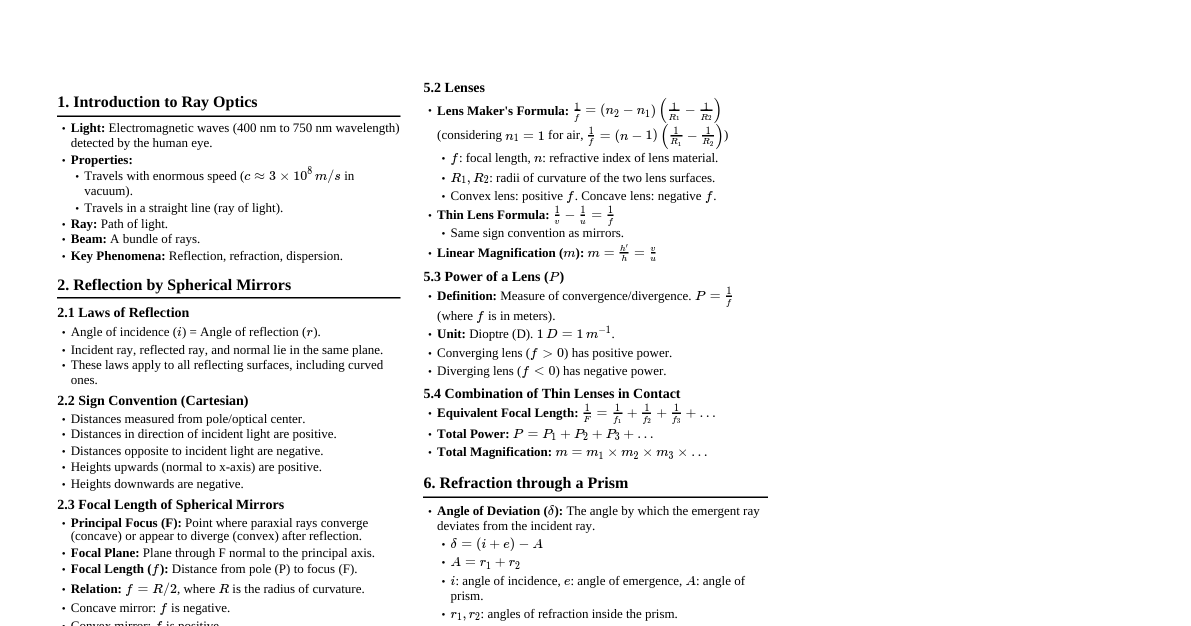
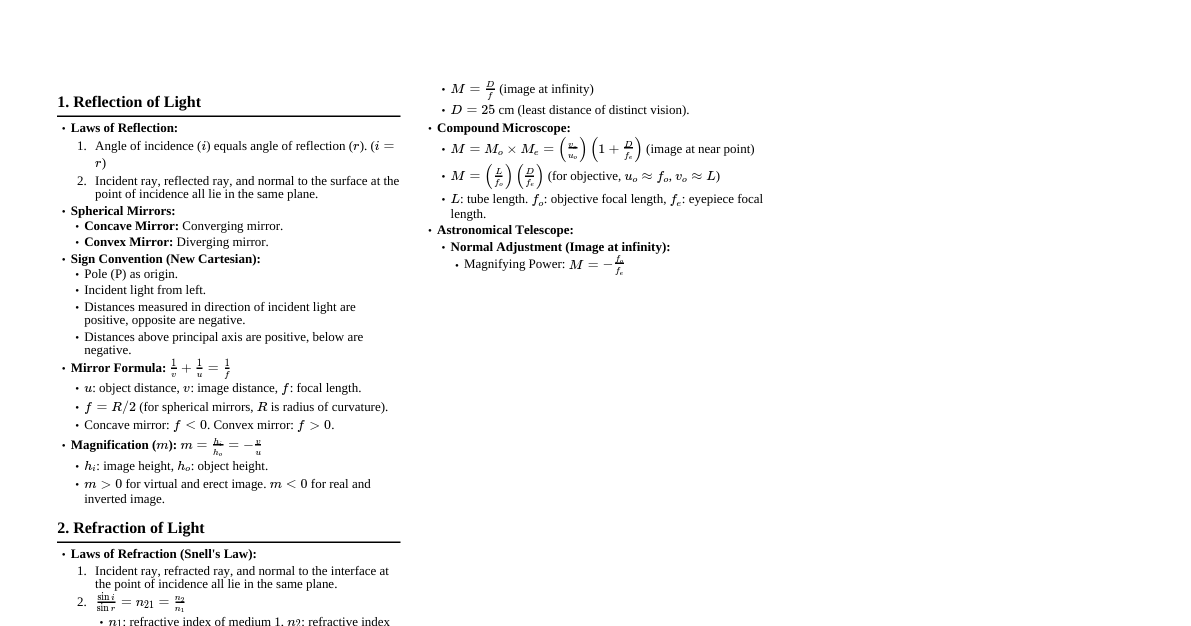
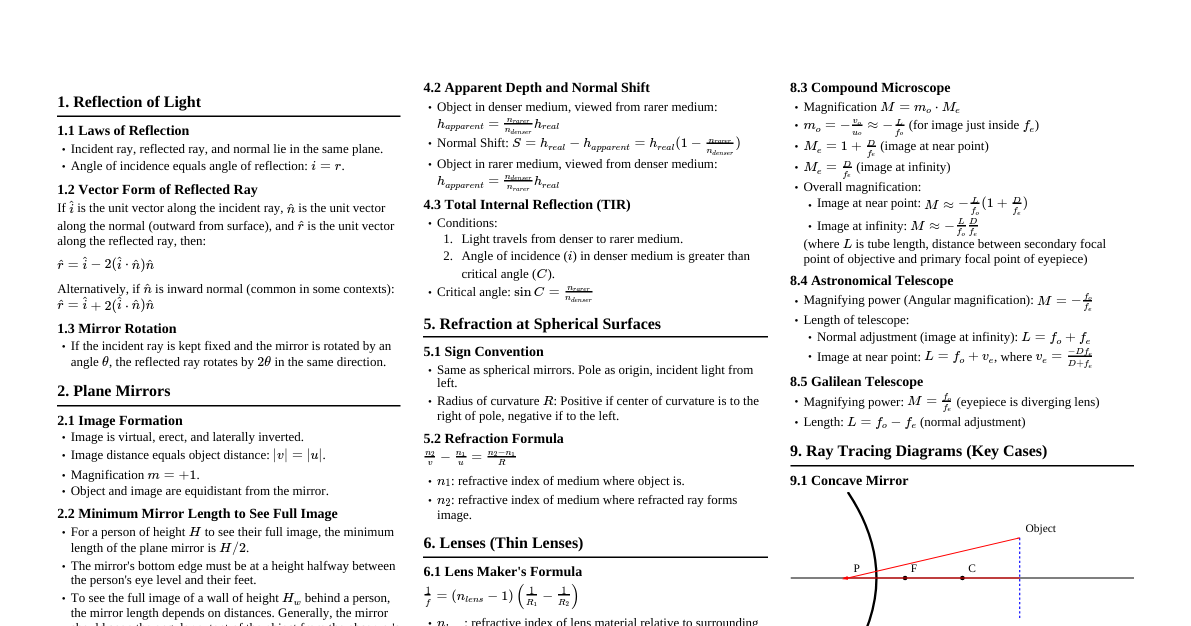
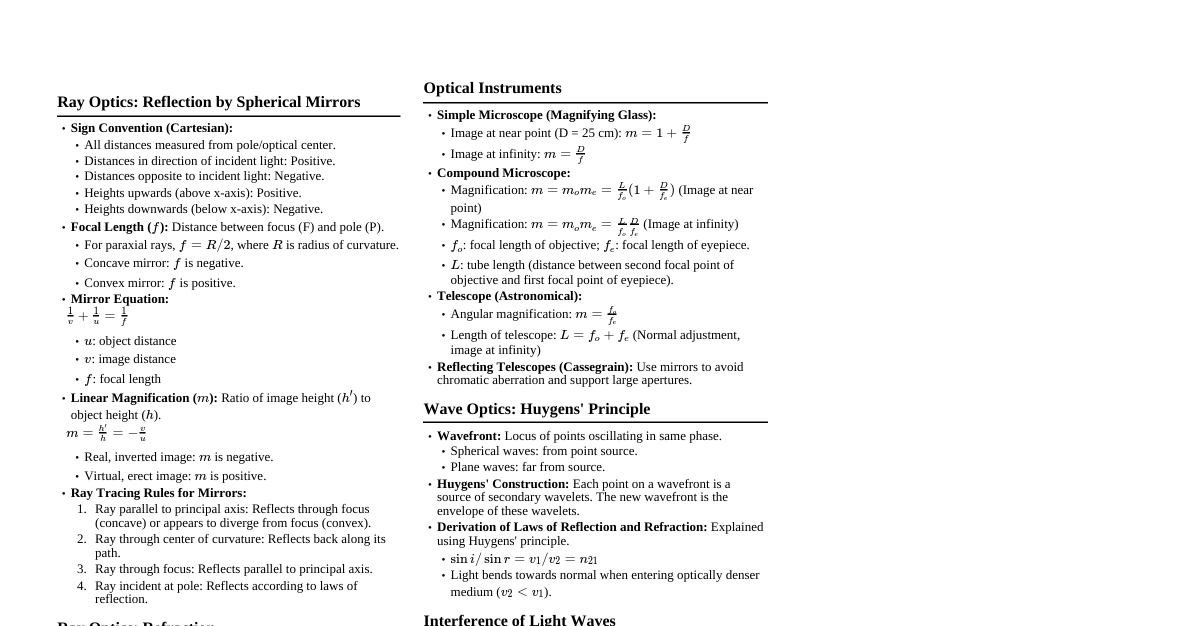
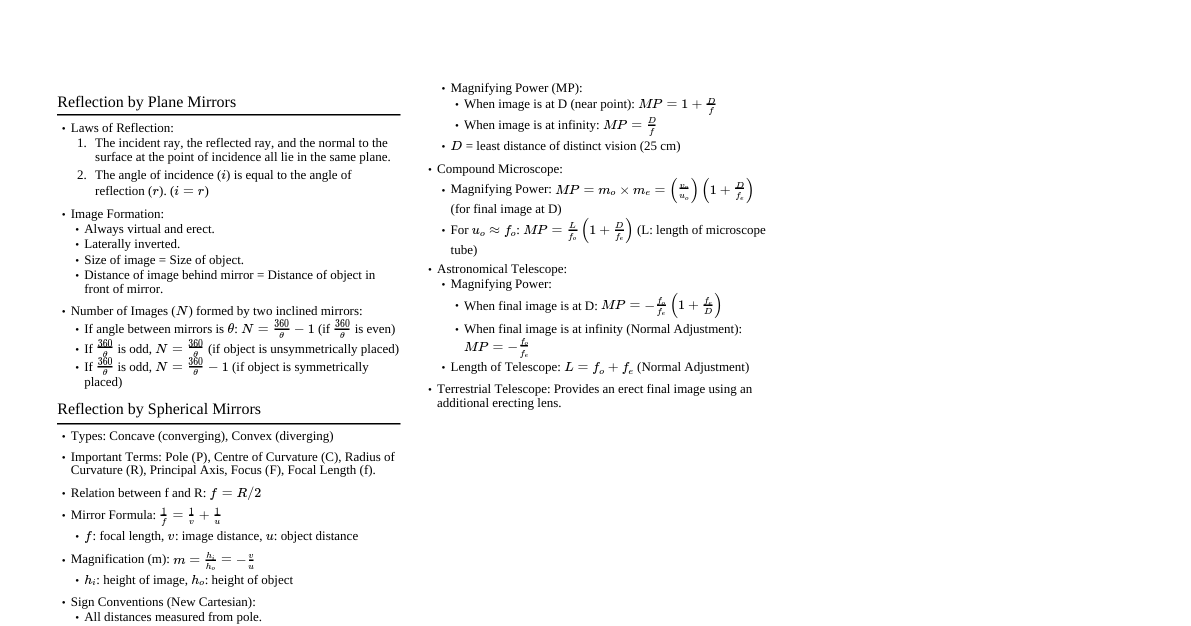
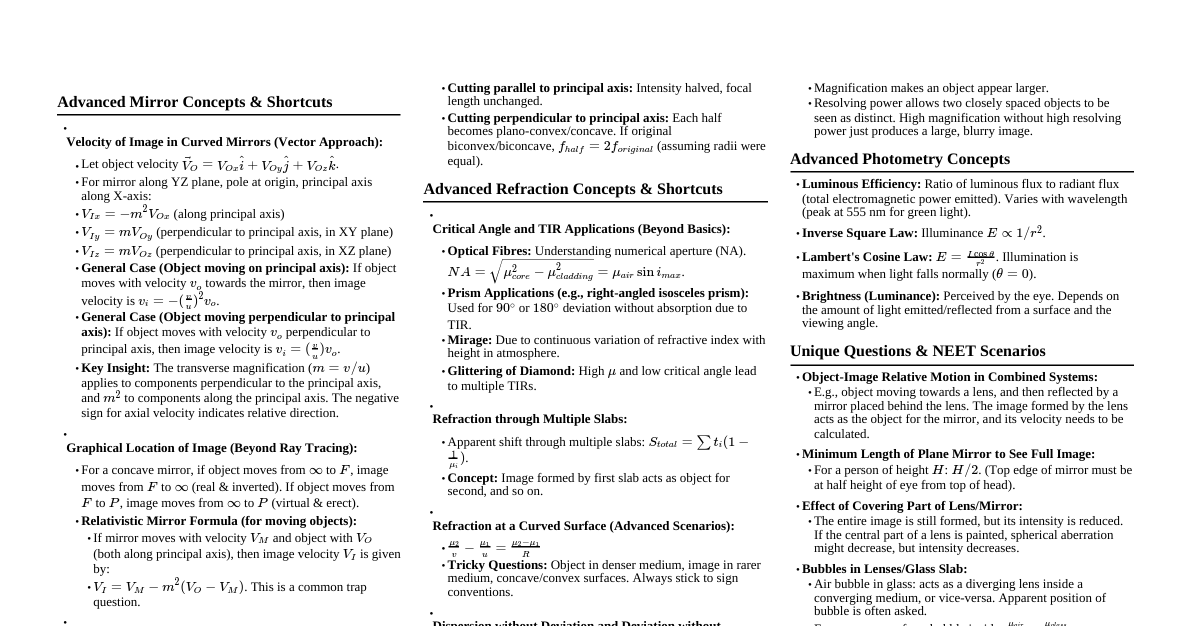
### Introduction to Ray Optics Ray optics (or geometrical optics) treats light as rays traveling in straight lines, valid when object sizes are much larger than the wavelength of light. This cheatsheet covers reflection, refraction, and optical instruments using the ray picture. #### Laws of Reflection 1. The incident ray, reflected ray, and the normal to the reflecting surface at the point of incidence all lie in the same plane. 2. The angle of incidence ($i$) equals the angle of reflection ($r$) . - This applies to both plane and spherical surfaces. ### Reflection by Spherical Mirrors #### Sign Convention (Cartesian) - All distances are measured from the mirror's pole (P) or lens's optical center. - Distances measured in the direction of incident light are positive (+) . - Distances measured opposite to incident light are negative (-) . - Heights measured upwards (above principal axis) are positive (+). - Heights measured downwards (below principal axis) are negative (-). #### Focal Length of Spherical Mirrors - **Principal Focus (F):** - Concave Mirror: Parallel rays converge to F after reflection. - Convex Mirror: Parallel rays appear to diverge from F after reflection. - **Focal Length ($f$):** Distance between F and P. - **Relation to Radius of Curvature (R):** $$f = R/2$$ - Concave mirror: $f$ is negative . - Convex mirror: $f$ is positive . #### Mirror Equation Relates object distance ($u$), image distance ($v$), and focal length ($f$): $$\frac{1}{v} + \frac{1}{u} = \frac{1}{f}$$ - Real image : $v$ is positive. - Virtual image : $v$ is negative. #### Linear Magnification ($m$) Ratio of image height ($h'$) to object height ($h$): $$m = \frac{h'}{h} = -\frac{v}{u}$$ - $|m| > 1$: Magnified image. - $|m| Diminished image. - $m > 0$: Erect image (virtual). - $m Inverted image (real). ### Refraction of Light #### Snell's Law When light passes from medium 1 to medium 2: $$n_1 \sin i = n_2 \sin r \quad \text{or} \quad \frac{\sin i}{\sin r} = n_{21}$$ - $n_{21}$: Refractive index of medium 2 with respect to medium 1. - $n_{21} = n_2/n_1$. - If $n_{21} > 1$ ( denser medium ), $r towards normal . - If $n_{21} rarer medium ), $r > i$, ray bends away from normal . #### Lateral Shift For a parallel-sided slab, the emergent ray is parallel to the incident ray but laterally shifted. #### Apparent Depth When viewed near normal direction: $$\text{Apparent Depth} (h_1) = \frac{\text{Real Depth} (h_2)}{\text{Refractive Index of Medium}}$$ ### Total Internal Reflection (TIR) Occurs when light travels from a denser to a rarer medium , and the angle of incidence ($i$) exceeds the critical angle ($i_c$). #### Critical Angle ($i_c$) The angle of incidence for which the angle of refraction is 90°. $$\sin i_c = \frac{n_2}{n_1} \quad (n_1 > n_2)$$ - No refraction occurs if $i > i_c$; all light is reflected back into the denser medium. #### Applications of TIR - **Prisms:** Used to bend light by 90° or 180° or to invert images without changing size (e.g., binoculars). - Requires $i_c ### Refraction at Spherical Surfaces and Lenses #### Refraction at a Single Spherical Surface Relates object distance ($u$), image distance ($v$), radius of curvature ($R$), and refractive indices ($n_1$, $n_2$): $$\frac{n_2}{v} - \frac{n_1}{u} = \frac{n_2 - n_1}{R}$$ #### Thin Lens Formula For a thin lens, combining refraction at two surfaces: $$\frac{1}{v} - \frac{1}{u} = \frac{1}{f}$$ #### Lens Maker's Formula Relates focal length ($f$) to refractive index ($n$) and radii of curvature ($R_1$, $R_2$) of the two surfaces: $$\frac{1}{f} = (n - 1) \left(\frac{1}{R_1} - \frac{1}{R_2}\right)$$ - $n = n_{2}/n_{1}$ (refractive index of lens material w.r.t. surrounding medium). - Convex lens : $f$ is positive. - Concave lens : $f$ is negative. #### Power of a Lens ($P$) Measure of a lens's convergence or divergence. $$P = \frac{1}{f \text{ (in meters)}}$$ - SI unit: Dioptre (D) . 1 D = 1 m⁻¹. - Converging lens: $P$ is positive. - Diverging lens: $P$ is negative. #### Magnification by a Lens ($m$) $$m = \frac{h'}{h} = \frac{v}{u}$$ - $m > 0$: Erect image (virtual). - $m Inverted image (real). #### Combination of Thin Lenses in Contact For lenses with focal lengths $f_1, f_2, \dots$ in contact: $$\frac{1}{f_{eq}} = \frac{1}{f_1} + \frac{1}{f_2} + \dots$$ $$P_{eq} = P_1 + P_2 + \dots$$ - Total magnification: $m = m_1 m_2 m_3 \dots$ ### Refraction through a Prism For a triangular prism with refracting angle $A$: - **Angle of Deviation ($\delta$):** $\delta = (i + e) - A$ - $i$: angle of incidence, $e$: angle of emergence. - **Relation between angles:** $A = r_1 + r_2$ - $r_1$: angle of refraction at first face, $r_2$: angle of incidence at second face. #### Minimum Deviation ($D_m$) - Occurs when $i = e$ and $r_1 = r_2 = A/2$. - Refractive index of prism material ($n_{21}$) can be found: $$n_{21} = \frac{\sin[(A + D_m)/2]}{\sin[A/2]}$$ - For small angle prisms: $D_m \approx (n_{21} - 1)A$. ### Optical Instruments #### Simple Microscope (Magnifying Glass) - Converging lens of small focal length. - Object placed within focal length to form a magnified, virtual, erect image . - **Magnifying Power (Angular Magnification):** - Image at Near Point (D = 25 cm): $m = 1 + \frac{D}{f}$ - Image at Infinity (relaxed eye): $m = \frac{D}{f}$ #### Compound Microscope - Uses two lenses: **Objective** ( small $f_o$ , small aperture) and **Eyepiece** ( larger $f_e$ , functions as simple microscope). - Objective forms a real, inverted, magnified intermediate image. - Eyepiece magnifies this intermediate image. - **Total Magnifying Power:** $m = m_o \times m_e$ - Where $m_o = \frac{L}{f_o}$ (L is tube length). - $m = \frac{L}{f_o} \left(1 + \frac{D}{f_e}\right)$ (final image at near point) - $m = \frac{L}{f_o} \frac{D}{f_e}$ (final image at infinity) - Requires both $f_o$ and $f_e$ to be small for high magnification. #### Telescope - Used to view distant objects, providing angular magnification. - Uses two lenses: **Objective** ( large $f_o$ , large aperture) and **Eyepiece** ( small $f_e$ ). - Objective forms a real, inverted image at its focal point. - Eyepiece magnifies this image. - **Angular Magnification:** $m = \frac{f_o}{f_e}$ - **Length of Telescope Tube:** $L = f_o + f_e$ (normal adjustment, image at infinity). - **Reflecting Telescopes (e.g., Cassegrain):** Use concave mirrors as objectives to avoid chromatic aberration and allow for larger apertures.