Ray Optics Class 12
Cheatsheet Content
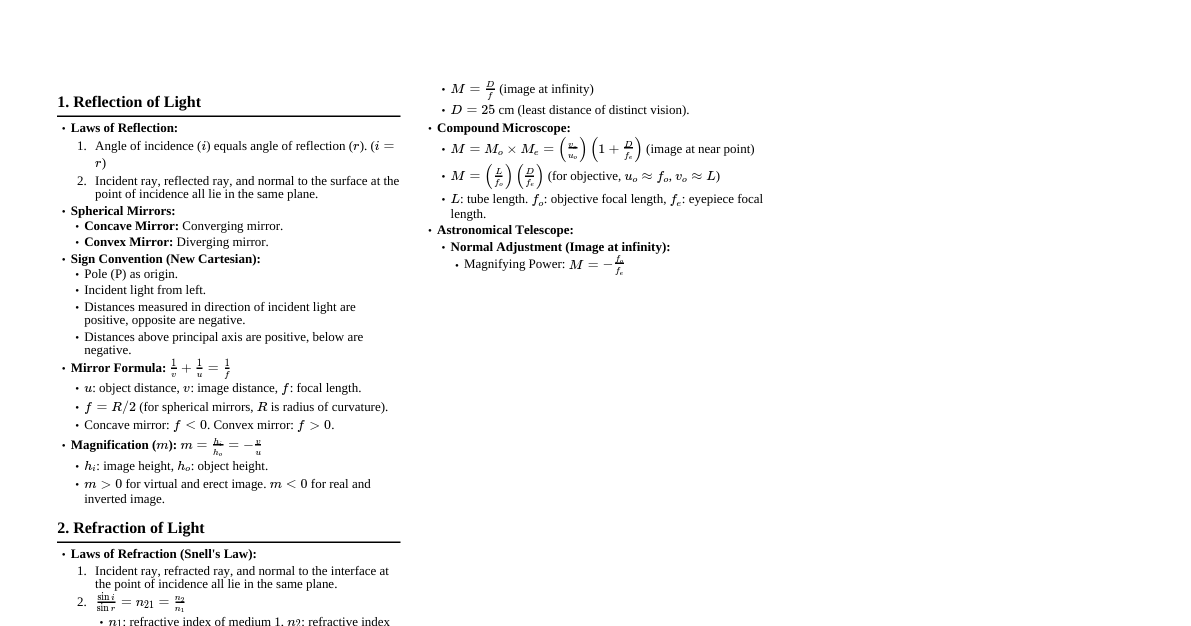
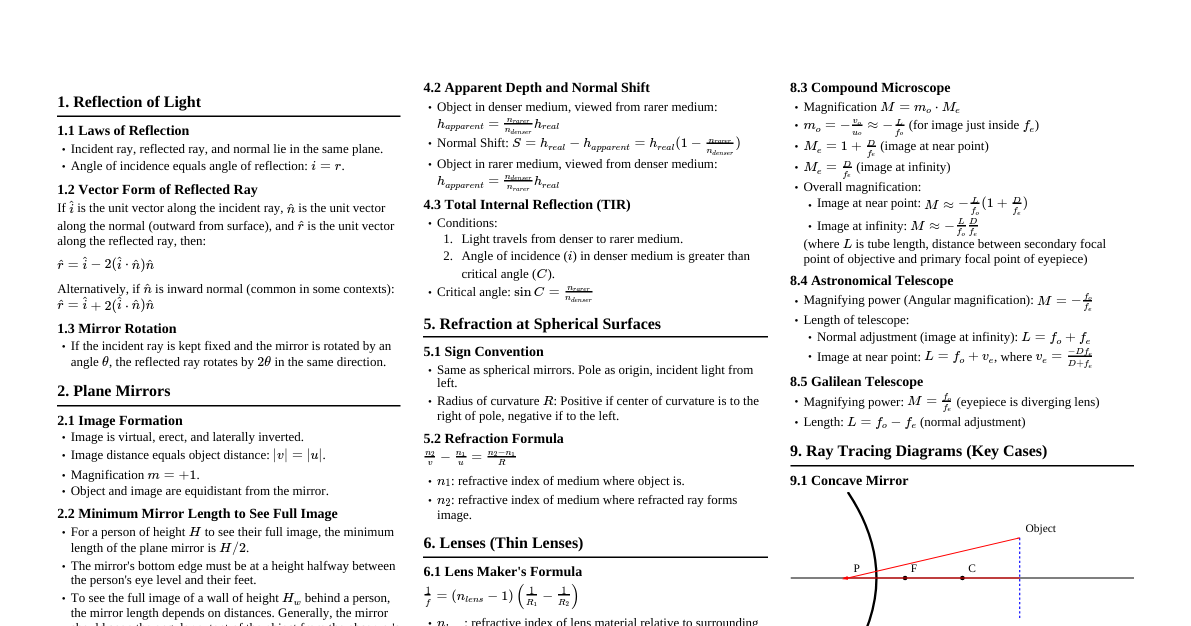
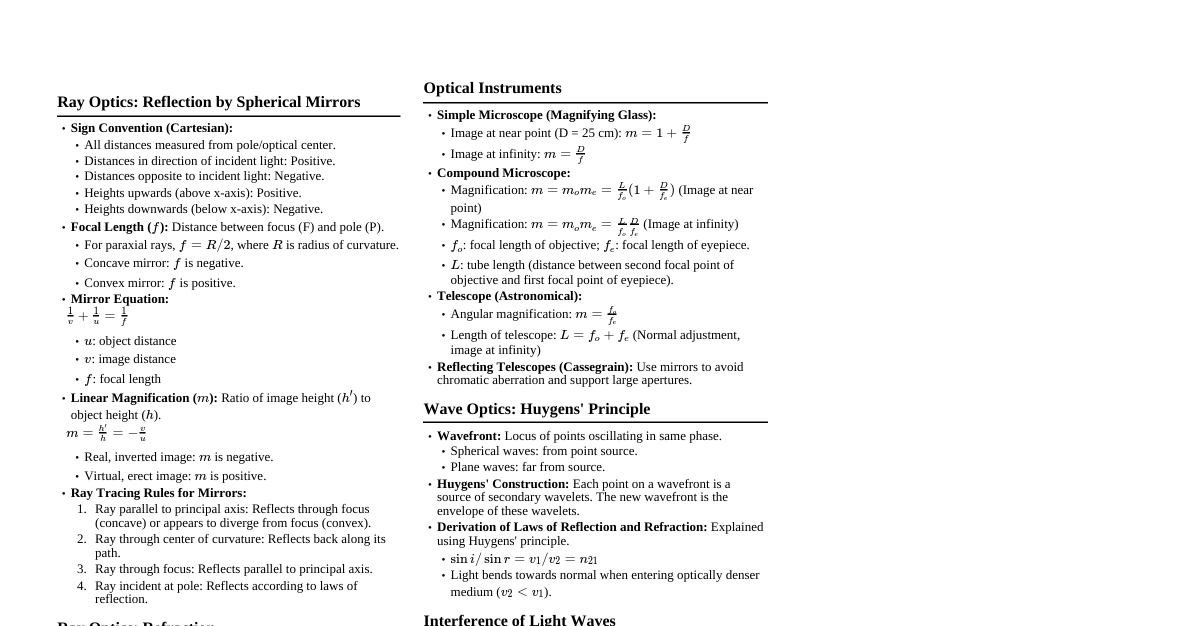
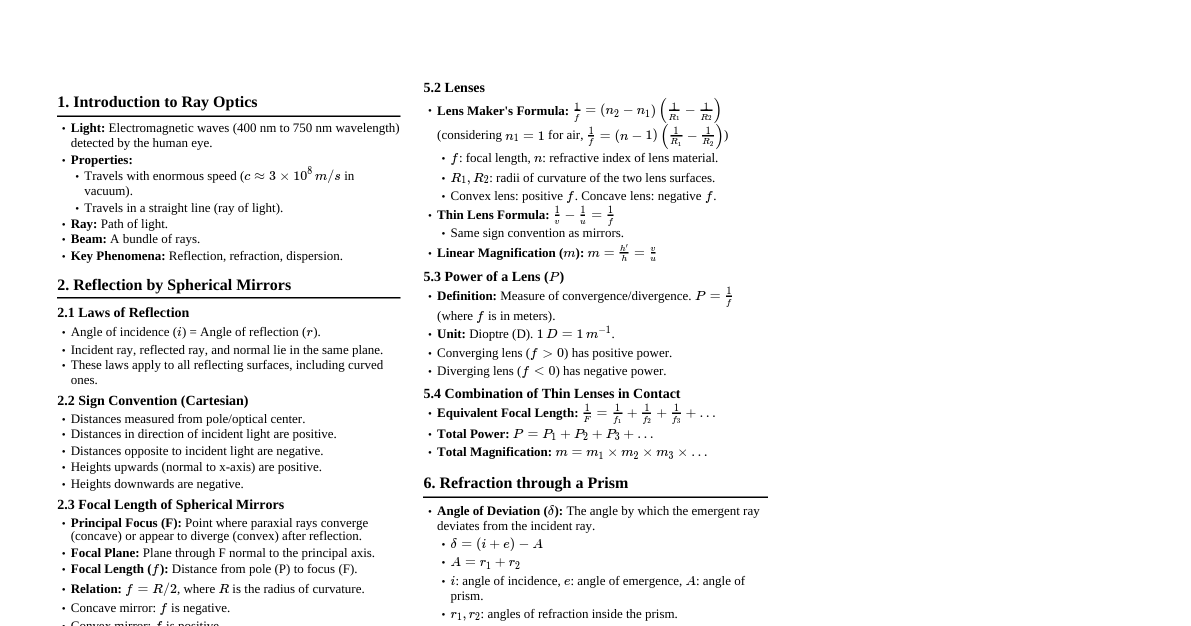
### Reflection by Plane Mirrors - **Laws of Reflection:** 1. The incident ray, the reflected ray, and the normal to the surface at the point of incidence all lie in the same plane. 2. The angle of incidence ($i$) is equal to the angle of reflection ($r$). ($i=r$) - **Image Formation:** - Always virtual and erect. - Laterally inverted. - Size of image = Size of object. - Distance of image behind mirror = Distance of object in front of mirror. - **Number of Images ($N$) formed by two inclined mirrors:** - If angle between mirrors is $\theta$: $N = \frac{360}{\theta} - 1$ (if $\frac{360}{\theta}$ is even) - If $\frac{360}{\theta}$ is odd, $N = \frac{360}{\theta}$ (if object is unsymmetrically placed) - If $\frac{360}{\theta}$ is odd, $N = \frac{360}{\theta} - 1$ (if object is symmetrically placed) ### Reflection by Spherical Mirrors - **Types:** Concave (converging), Convex (diverging) - **Important Terms:** Pole (P), Centre of Curvature (C), Radius of Curvature (R), Principal Axis, Focus (F), Focal Length (f). - **Relation between f and R:** $f = R/2$ - **Mirror Formula:** $\frac{1}{f} = \frac{1}{v} + \frac{1}{u}$ - $f$: focal length, $v$: image distance, $u$: object distance - **Magnification (m):** $m = \frac{h_i}{h_o} = -\frac{v}{u}$ - $h_i$: height of image, $h_o$: height of object - **Sign Conventions (New Cartesian):** - All distances measured from pole. - Distances in direction of incident light are positive, opposite are negative. - Heights above principal axis are positive, below are negative. - Concave mirror: $f$ is negative. Convex mirror: $f$ is positive. ### Refraction - **Laws of Refraction (Snell's Law):** 1. The incident ray, the refracted ray, and the normal to the interface at the point of incidence all lie in the same plane. 2. $\frac{\sin i}{\sin r} = \frac{n_2}{n_1} = n_{21}$ (relative refractive index of medium 2 with respect to medium 1) - **Refractive Index (n):** $n = \frac{c}{v}$ (c: speed of light in vacuum, v: speed of light in medium) - **Apparent Depth:** $n = \frac{\text{Real Depth}}{\text{Apparent Depth}}$ (when viewed from rarer to denser medium) - **Total Internal Reflection (TIR):** - Light travels from denser to rarer medium. - Angle of incidence ($i$) > Critical Angle ($i_c$). - $\sin i_c = \frac{n_2}{n_1}$ (where $n_1 > n_2$) ### Refraction at Spherical Surfaces - **Formula:** $\frac{n_2}{v} - \frac{n_1}{u} = \frac{n_2 - n_1}{R}$ - $n_1$: refractive index of medium 1 (where object is) - $n_2$: refractive index of medium 2 (where image is formed) - $u$: object distance, $v$: image distance, $R$: radius of curvature - **Lens Maker's Formula:** $\frac{1}{f} = (n_2 - 1) \left(\frac{1}{R_1} - \frac{1}{R_2}\right)$ (for a lens in air, $n_1=1$) - $n_2$: refractive index of lens material relative to surrounding medium. - $R_1, R_2$: radii of curvature of the two lens surfaces. - **Lens Formula:** $\frac{1}{f} = \frac{1}{v} - \frac{1}{u}$ - **Magnification (m):** $m = \frac{h_i}{h_o} = \frac{v}{u}$ - **Power of a Lens (P):** $P = \frac{1}{f}$ (in dioptres, if f is in meters) - Converging lens (convex): $P$ is positive. - Diverging lens (concave): $P$ is negative. - **Combination of Thin Lenses:** - **Power:** $P_{eq} = P_1 + P_2 + P_3 + ...$ - **Focal Length:** $\frac{1}{f_{eq}} = \frac{1}{f_1} + \frac{1}{f_2} + \frac{1}{f_3} + ...$ ### Prism - **Angle of Deviation ($\delta$):** $\delta = (i_1 + i_2) - A$ - $i_1$: angle of incidence, $i_2$: angle of emergence, $A$: angle of prism - **Relation between angles:** $A = r_1 + r_2$ - $r_1, r_2$: angles of refraction inside the prism - **Minimum Deviation ($\delta_m$):** Occurs when $i_1 = i_2$ and $r_1 = r_2 = A/2$. - **Refractive Index of Prism Material:** $n = \frac{\sin((A + \delta_m)/2)}{\sin(A/2)}$ - **Dispersion of Light:** Splitting of white light into its constituent colours. ### Optical Instruments - **Simple Microscope (Magnifying Glass):** - **Magnifying Power (MP):** - When image is at D (near point): $MP = 1 + \frac{D}{f}$ - When image is at infinity: $MP = \frac{D}{f}$ - $D$ = least distance of distinct vision (25 cm) - **Compound Microscope:** - **Magnifying Power:** $MP = m_o \times m_e = \left(\frac{v_o}{u_o}\right) \left(1 + \frac{D}{f_e}\right)$ (for final image at D) - For $u_o \approx f_o$: $MP = \frac{L}{f_o} \left(1 + \frac{D}{f_e}\right)$ (L: length of microscope tube) - **Astronomical Telescope:** - **Magnifying Power:** - When final image is at D: $MP = -\frac{f_o}{f_e} \left(1 + \frac{f_e}{D}\right)$ - When final image is at infinity (Normal Adjustment): $MP = -\frac{f_o}{f_e}$ - **Length of Telescope:** $L = f_o + f_e$ (Normal Adjustment) - **Terrestrial Telescope:** Provides an erect final image using an additional erecting lens.