General Organic Chemistry JEE
Cheatsheet Content
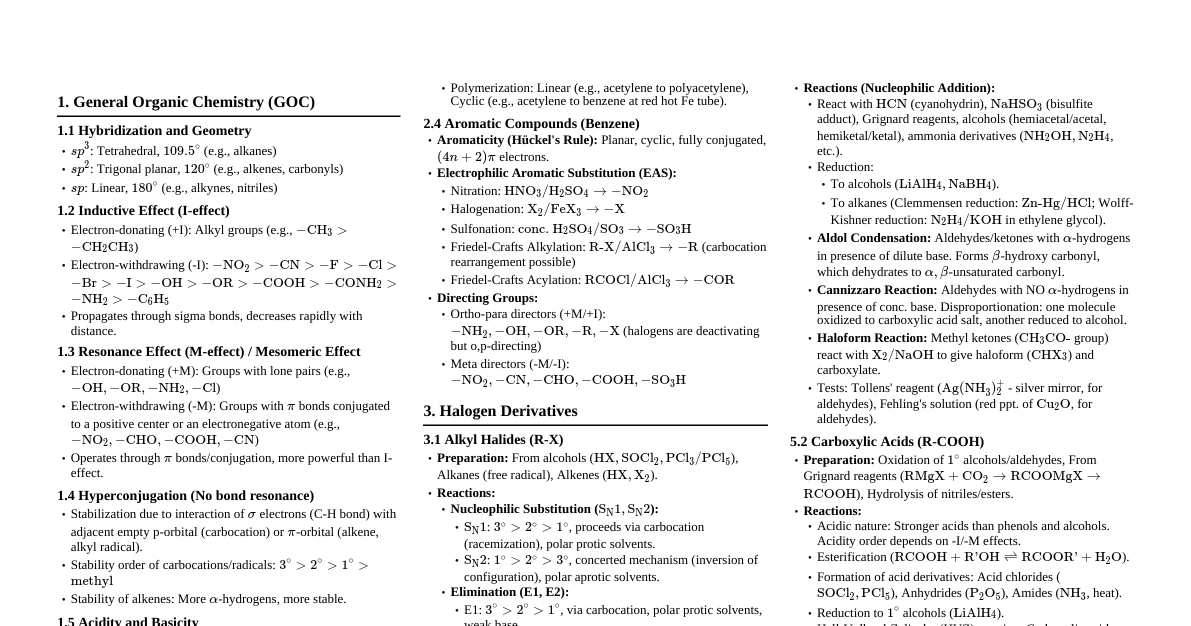
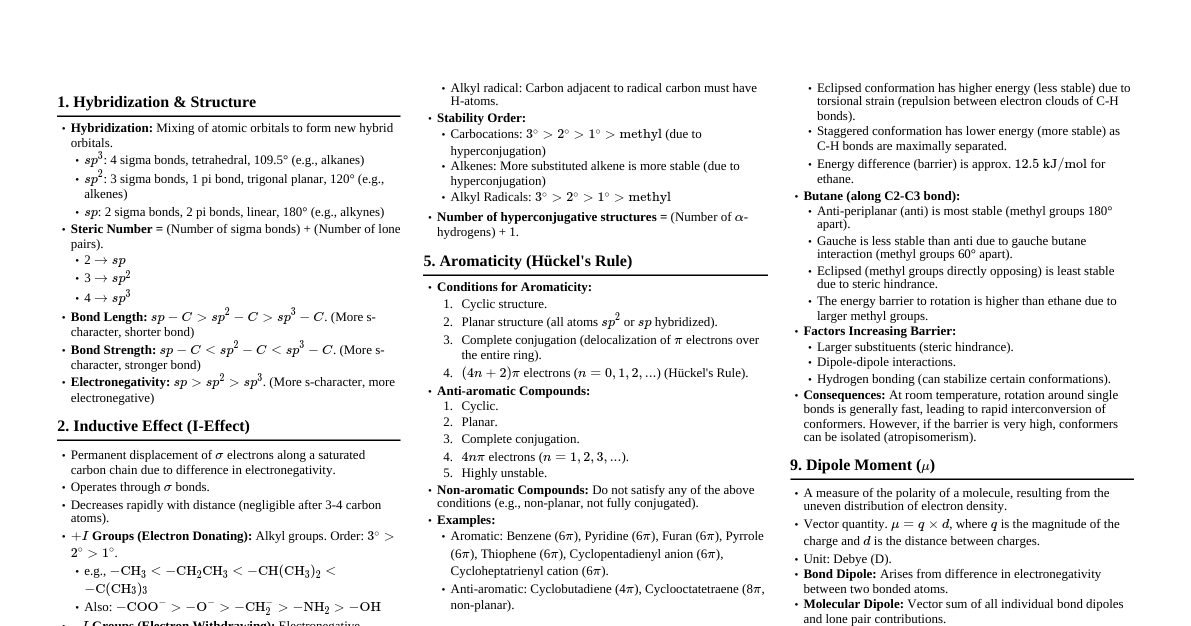
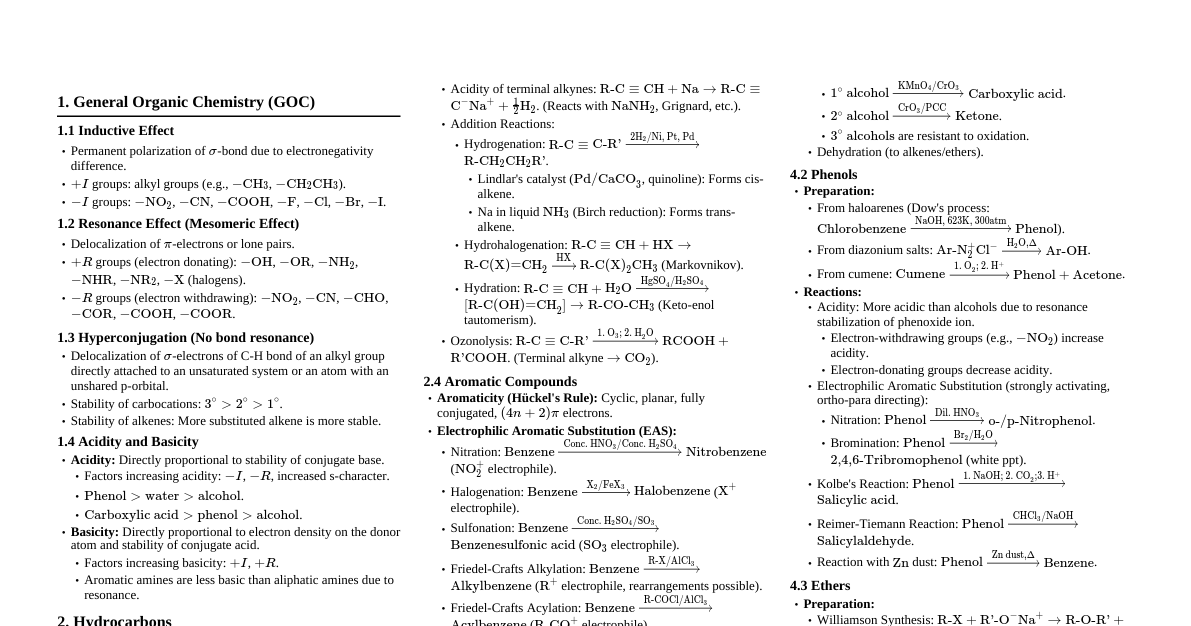
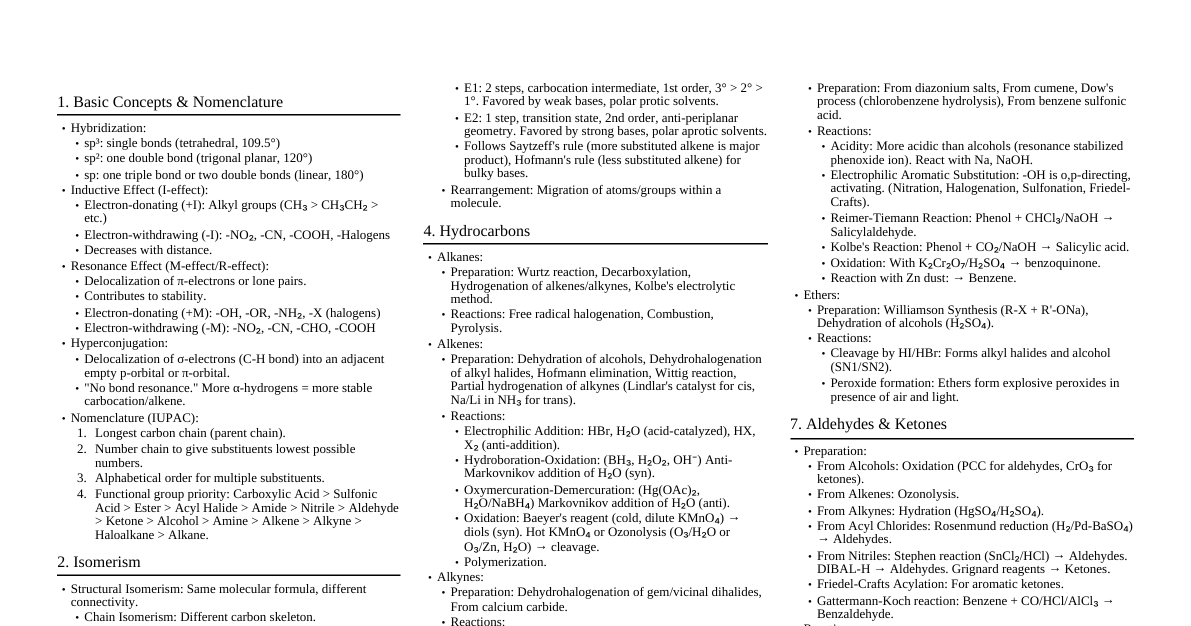
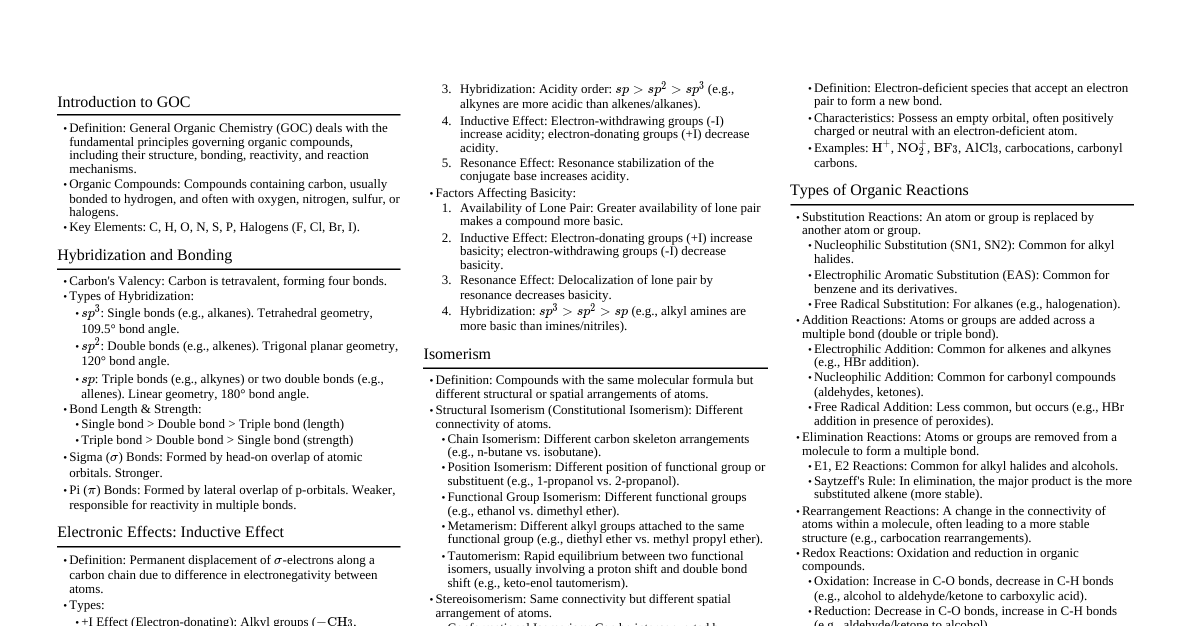
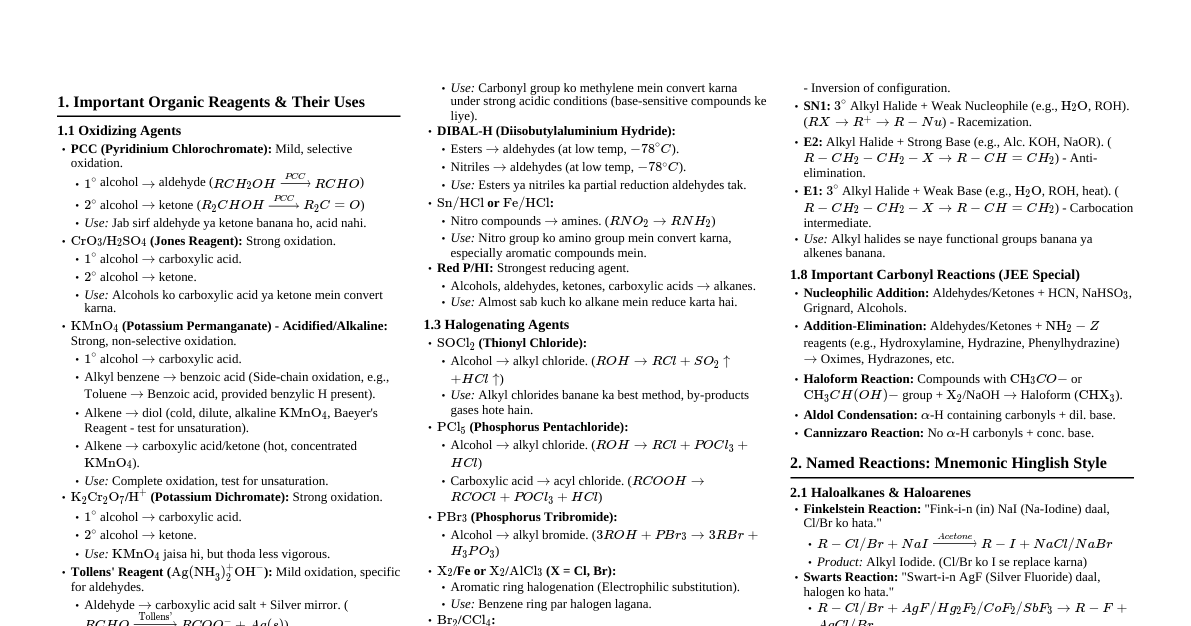
### Basic Concepts - **Organic Chemistry:** Study of hydrocarbons and their derivatives. - **Hybridization:** - $sp^3$: 4 sigma bonds, tetrahedral, 109.5° (e.g., alkanes) - $sp^2$: 1 pi bond, 3 sigma bonds, trigonal planar, 120° (e.g., alkenes) - $sp$: 2 pi bonds, 2 sigma bonds, linear, 180° (e.g., alkynes, nitriles) - **Bond Length & Strength:** - Single > Double > Triple (length) - Triple > Double > Single (strength) - **Inductive Effect (I-effect):** - Permanent displacement of $\sigma$-electrons along a carbon chain due to difference in electronegativity. - **+I effect:** Electron donating (e.g., alkyl groups: $3^\circ > 2^\circ > 1^\circ > CH_3$). Increases electron density. - **-I effect:** Electron withdrawing (e.g., $-NO_2, -CN, -COOH, -X$). Decreases electron density. - Decreases rapidly with distance. - **Electromeric Effect (E-effect):** - Temporary, complete transfer of $\pi$-electrons to one of the bonded atoms in the presence of an attacking reagent. - **+E effect:** $\pi$-electrons transferred to the atom to which the reagent attacks. - **-E effect:** $\pi$-electrons transferred away from the atom to which the reagent attacks. - **Resonance Effect (M-effect or R-effect):** - Delocalization of $\pi$-electrons or lone pair electrons within a conjugated system. - **+M effect:** Electron donating to the conjugated system (e.g., $-OH, -OR, -NH_2, -X$). - **-M effect:** Electron withdrawing from the conjugated system (e.g., $-CHO, -COR, -COOH, -NO_2, -CN$). - Resonance structures are hypothetical; the actual molecule is a resonance hybrid. - Rules for stability of resonance structures: 1. More covalent bonds. 2. Less charge separation. 3. Negative charge on more electronegative atom, positive charge on less electronegative atom. 4. Complete octets are preferred. - **Hyperconjugation (No-bond resonance):** - Delocalization of $\sigma$-electrons of C-H bond of an alkyl group directly attached to an unsaturated system (e.g., alkene, benzene ring) or an atom with an unshared p-orbital (e.g., carbocation). - Stability: Alkenes ($3^\circ > 2^\circ > 1^\circ$), Carbocations ($3^\circ > 2^\circ > 1^\circ$). - More $\alpha$-hydrogens, more hyperconjugation, more stability. ### Acid-Base Strength - **Acidity:** Tendency to donate a proton ($H^+$). - Factors increasing acidity: - Electron withdrawing groups (-I, -M) stabilize conjugate base. - Electronegativity of atom bearing H (Acidity: $HF > H_2O > NH_3$). - Size of atom bearing H (Acidity: $HI > HBr > HCl > HF$). - Hybridization ($sp > sp^2 > sp^3$ for C-H acidity). - Resonance stabilization of conjugate base. - **Basicity:** Tendency to accept a proton ($H^+$) or donate a lone pair. - Factors increasing basicity: - Electron donating groups (+I, +M) increase electron density on the basic atom. - Availability of lone pair (less delocalized, more basic). - Hybridization ($sp^3 > sp^2 > sp$ for N-atom basicity). - **Comparison:** - **Carboxylic acids:** More acidic than alcohols due to resonance stabilization of carboxylate ion. - **Phenols:** More acidic than alcohols due to resonance stabilization of phenoxide ion. - **Amines:** Aliphatic amines are generally more basic than ammonia due to +I effect. Aromatic amines are less basic due to resonance delocalization of lone pair. ### Reaction Intermediates - **Carbocations:** Positively charged carbon atom with 6 valence electrons. - $sp^2$ hybridized, trigonal planar geometry. - **Stability:** $3^\circ > 2^\circ > 1^\circ > CH_3^+$ (due to +I and hyperconjugation). - Can undergo rearrangements (hydride or alkyl shifts) to form more stable carbocations. - **Carbanions:** Negatively charged carbon atom with 8 valence electrons. - $sp^3$ hybridized, pyramidal geometry (similar to ammonia). - **Stability:** $CH_3^- > 1^\circ > 2^\circ > 3^\circ$ (opposite to carbocations, due to -I and less destabilization from +I). - Stabilized by -I, -M groups, and $sp$ hybridization. - **Free Radicals:** Neutral species with an unpaired electron. - $sp^2$ hybridized (planar) or $sp^3$ hybridized (pyramidal). - **Stability:** $3^\circ > 2^\circ > 1^\circ > CH_3^\cdot$ (due to hyperconjugation). - **Carbenes:** Neutral species with a divalent carbon containing two non-bonding electrons. - **Singlet carbene:** Paired electrons, $sp^2$ hybridized, bent. - **Triplet carbene:** Unpaired electrons, $sp$ hybridized, linear. - Triplet is generally more stable. - **Nitrenes:** Nitrogen analogue of carbenes. ### Isomerism - **Isomers:** Compounds with the same molecular formula but different structural or spatial arrangements. #### Structural Isomerism - **Chain Isomerism:** Different arrangement of carbon skeleton. (e.g., n-butane vs isobutane) - **Position Isomerism:** Different position of functional group or substituent. (e.g., 1-propanol vs 2-propanol) - **Functional Isomerism:** Different functional groups. (e.g., ethanol vs dimethyl ether) - **Metamerism:** Different alkyl groups attached to the same functional group. (e.g., diethyl ether vs methyl propyl ether) - **Tautomerism:** Dynamic equilibrium between two functional isomers (usually keto-enol). - Requires an $\alpha$-hydrogen and an electronegative atom (O, N, S) next to the double bond. - Enol form is usually less stable than keto form, except in cases of aromaticity or intramolecular H-bonding. #### Stereoisomerism - **Geometric Isomerism (cis-trans):** - Restricted rotation around a double bond or in a cyclic structure. - Requires two different groups on each carbon of the double bond. - **Cis:** Same groups on the same side. - **Trans:** Same groups on opposite sides. - E-Z nomenclature for more complex cases: - **E (entgegen):** Higher priority groups on opposite sides. - **Z (zusammen):** Higher priority groups on the same side. - **Optical Isomerism (Enantiomers & Diastereomers):** - **Chirality:** Non-superimposable mirror images. - **Chiral center:** Carbon atom bonded to four different groups. - **Enantiomers:** Non-superimposable mirror images. Have identical physical and chemical properties (except rotation of plane-polarized light and reaction with chiral reagents). - **Diastereomers:** Stereoisomers that are not mirror images. Have different physical and chemical properties. - **Meso compounds:** Possess chiral centers but are achiral due to internal plane of symmetry. Do not rotate plane-polarized light. - **Racemic mixture:** Equimolar mixture of enantiomers. Optically inactive. - **Configuration:** R/S nomenclature. 1. Assign priorities (Cahn-Ingold-Prelog rules: higher atomic number = higher priority). 2. Orient molecule so lowest priority group is pointing away. 3. Trace path from 1-2-3. Clockwise = R (Rectus), Counter-clockwise = S (Sinister). ### IUPAC Nomenclature - **Prefix:** Substituents, cyclo- - **Word Root:** Number of carbons in parent chain (meth-, eth-, prop-, but-, etc.) - **Primary Suffix:** Saturation (-ane, -ene, -yne) - **Secondary Suffix:** Functional group (-ol, -oic acid, -al, -one, -amine, etc.) #### Priority Order of Functional Groups (Highest to Lowest) 1. Carboxylic Acid (-COOH) 2. Sulfonic Acid ($-SO_3H$) 3. Esters ($-COOR$) 4. Acid Halides ($-COX$) 5. Amides ($-CONH_2$) 6. Nitriles ($-CN$) 7. Aldehydes ($-CHO$) 8. Ketones ($-CO-$) 9. Alcohols ($-OH$) 10. Thiols ($-SH$) 11. Amines ($-NH_2$) 12. Alkenes ($C=C$) 13. Alkynes ($C \equiv C$) 14. Ethers ($-OR$), Halogens ($-X$), Nitro ($-NO_2$), Alkyl ($-R$) (treated as substituents) #### Examples - $CH_3-CH_2-CH_2-COOH$: Butanoic acid - $CH_3-CH(OH)-CH_3$: Propan-2-ol - $CH_2=CH-CH_2-CHO$: But-3-enal - Benzene substituted with $-COOH$ and $-NO_2$: 4-Nitrobenzoic acid (or 2-nitrobenzoic acid, etc., depending on position) ### Reaction Mechanisms - **Nucleophiles:** Electron rich species, seek positive charge. (e.g., $OH^-, H_2O, NH_3, R_3C^-$) - **Electrophiles:** Electron deficient species, seek negative charge. (e.g., $H^+, NO_2^+, R_3C^+$) #### Types of Reactions - **Substitution:** One atom/group replaced by another. - **Nucleophilic Substitution ($S_N1, S_N2$):** - **$S_N1$ (Unimolecular):** Favored by $3^\circ$ alkyl halides, polar protic solvents, weak nucleophiles. Two steps (carbocation formation then nucleophilic attack). Racemization. - **$S_N2$ (Bimolecular):** Favored by $1^\circ$ alkyl halides, polar aprotic solvents, strong nucleophiles. One step (concerted). Inversion of configuration (Walden inversion). - **Electrophilic Substitution (Aromatic):** Characteristic of benzene and derivatives. - e.g., Nitration ($HNO_3/H_2SO_4$), Halogenation ($X_2/FeX_3$), Friedel-Crafts Alkylation/Acylation ($R-X/AlCl_3$). - **Activating groups (+M, +I):** Ortho/para directing (e.g., $-OH, -NH_2, -R$). - **Deactivating groups (-M, -I):** Meta directing (e.g., $-NO_2, -COOH, -CHO$). Halogens are deactivating but ortho/para directing. - **Addition:** Atoms/groups added across a double/triple bond. - **Electrophilic Addition:** Characteristic of alkenes and alkynes. - **Markovnikov's Rule:** In addition of H-X to unsymmetrical alkene, H adds to carbon with more H's (forms more stable carbocation). - **Anti-Markovnikov's Rule (peroxide effect):** Only for HBr in presence of peroxides, via free radical mechanism. - **Nucleophilic Addition:** Characteristic of aldehydes and ketones. - Carbonyl carbon is electrophilic. - e.g., Addition of HCN, Grignard reagents, alcohols. - **Elimination:** Removal of atoms/groups to form a double/triple bond. - **E1 (Unimolecular):** Two steps (carbocation formation then deprotonation). Favored by $3^\circ$ alkyl halides, weak bases. - **E2 (Bimolecular):** One step (concerted). Favored by $1^\circ/2^\circ$ alkyl halides, strong bases. Anti-periplanar geometry preferred. - **Saytzeff's Rule:** Major product is the more substituted alkene (more stable). - **Hofmann's Rule:** Major product is the less substituted alkene (favored for bulky bases or charged leaving groups). - **Rearrangement:** Migration of atoms/groups within a molecule (e.g., carbocation rearrangements). ### Important Named Reactions & Reagents - **Grignard Reagent ($RMgX$):** Strong nucleophile and base. Reacts with carbonyl compounds. - **Wurtz Reaction:** $2RX + 2Na \xrightarrow{dry \ ether} R-R + 2NaX$. Forms symmetrical alkanes. - **Kolbe's Electrolysis:** Electrolysis of sodium/potassium salts of carboxylic acids to form alkanes. - **Friedel-Crafts Reaction:** Alkylation/Acylation of benzene with $R-X$ or $RCO-X$ in presence of $AlCl_3$. - **Cannizzaro Reaction:** Aldehydes without $\alpha$-H react with conc. NaOH to give alcohol and carboxylic acid salt (disproportionation). - **Aldol Condensation:** Aldehydes/ketones with $\alpha$-H react with dil. NaOH to form $\beta$-hydroxy carbonyl compounds, which can dehydrate to $\alpha,\beta$-unsaturated carbonyls. - **Perkin Reaction:** Aromatic aldehyde + acetic anhydride + sodium acetate $\rightarrow$ $\alpha,\beta$-unsaturated carboxylic acid. - **Reimer-Tiemann Reaction:** Phenol + $CHCl_3$ + NaOH $\rightarrow$ Salicylaldehyde. - **Kolbe's Reaction (Carboxylation):** Phenol + NaOH + $CO_2$ $\rightarrow$ Salicylic acid. - **Diels-Alder Reaction:** [4+2] cycloaddition reaction between a conjugated diene and a dienophile. - **Hoffmann Bromamide Degradation:** Amide + $Br_2$ + NaOH $\rightarrow$ Primary amine (one carbon less). - **Gabriel Phthalimide Synthesis:** For preparing primary amines. - **Clemmensen Reduction:** Aldehydes/ketones $\xrightarrow{Zn(Hg)/HCl}$ Alkanes. - **Wolff-Kishner Reduction:** Aldehydes/ketones $\xrightarrow{NH_2NH_2/KOH, \ heat}$ Alkanes. - **Stephen Reaction:** Nitriles $\xrightarrow{SnCl_2/HCl}$ Aldehydes. - **Rosenmund Reduction:** Acyl chlorides $\xrightarrow{H_2/Pd-BaSO_4}$ Aldehydes. - **Gattermann-Koch Reaction:** Benzene $\xrightarrow{CO, HCl/anhyd. \ AlCl_3, \ CuCl}$ Benzaldehyde. - **Swern Oxidation:** Primary/secondary alcohols to aldehydes/ketones using $(COCl)_2$, DMSO, $Et_3N$. - **PCC (Pyridinium Chlorochromate):** Primary alcohols to aldehydes, secondary alcohols to ketones. - **Jones Reagent ($CrO_3/H_2SO_4$):** Primary alcohols to carboxylic acids, secondary alcohols to ketones. ### Stereochemistry (Advanced) - **Fischer Projections:** For representing chiral molecules in 2D. Horizontal lines are coming out, vertical lines are going back. - **Newman Projections:** For viewing conformational isomers along a specific C-C bond. - **Staggered:** Dihedral angle $60^\circ$, more stable. - **Eclipsed:** Dihedral angle $0^\circ$, less stable. - **Anti:** Groups $180^\circ$ apart (most stable staggered). - **Gauche:** Groups $60^\circ$ apart (staggered). - **Sawhorse Projections:** Another way to represent 3D structure. - **Conformational Analysis of Cyclohexane:** - **Chair form:** Most stable, no angle strain, minimal torsional strain. Axial and equatorial positions. - **Boat form:** Less stable (flagpole interactions, torsional strain). - **Ring flip:** Axial groups become equatorial and vice versa. Larger groups prefer equatorial positions.