Current Electricity
Cheatsheet Content
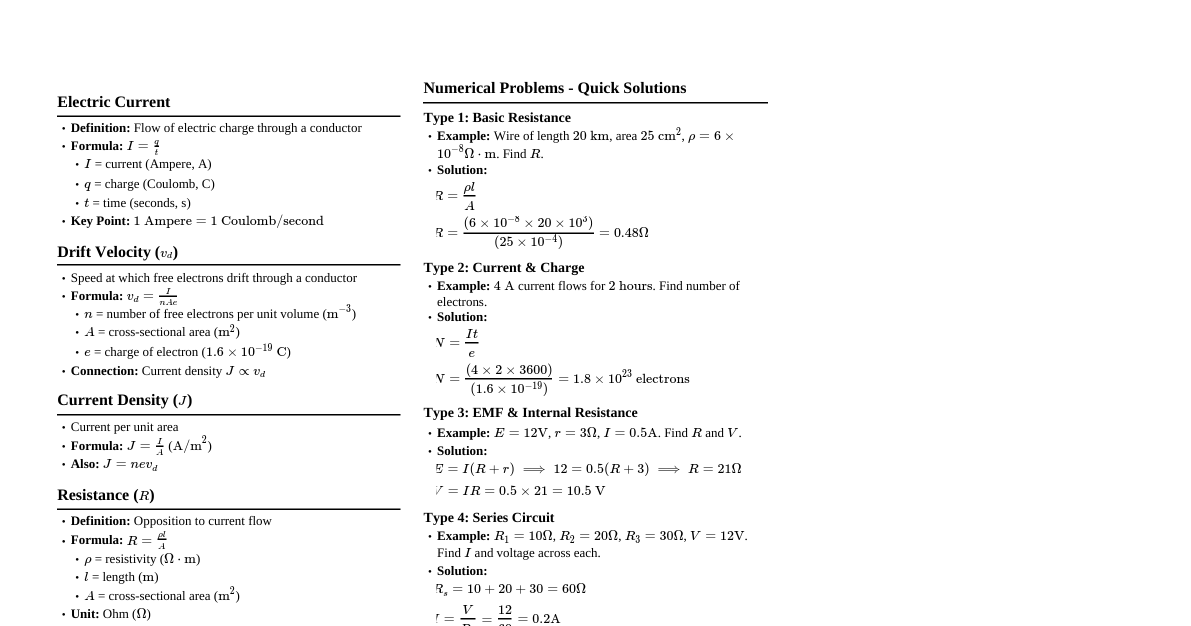
### Electric Current - **Definition:** The rate of flow of electric charge. - **Formula:** $I = \frac{dQ}{dt}$ (instantaneous current) - For steady current, $I = \frac{Q}{t}$ - **Unit:** Ampere (A). $1 \text{ A} = 1 \text{ C/s}$. - **Direction:** Conventional current flows from higher potential to lower potential (opposite to electron flow). - **Current Density (J):** Current per unit cross-sectional area. - **Formula:** $J = \frac{I}{A}$ - **Vector form:** $\vec{J} = n e \vec{v_d}$ (where $n$ is number density, $e$ is charge of electron, $\vec{v_d}$ is drift velocity). - **Unit:** A/m$^2$. ### Drift Velocity and Mobility - **Drift Velocity ($\vec{v_d}$):** The average velocity attained by charged particles (like electrons) in a material due to an electric field. - **Formula:** $\vec{v_d} = -\frac{e\vec{E}}{m}\tau$ (for electrons, where $\tau$ is relaxation time). - **Mobility ($\mu$):** The magnitude of drift velocity per unit electric field. - **Formula:** $\mu = \frac{|\vec{v_d}|}{E} = \frac{e\tau}{m}$ - **Unit:** m$^2$/Vs. ### Ohm's Law - **Statement:** At constant temperature and other physical conditions, the current flowing through a conductor is directly proportional to the potential difference across its ends. - **Formula:** $V = IR$ - Where $V$ is potential difference, $I$ is current, $R$ is resistance. - **Resistance (R):** Opposition to the flow of current. - **Unit:** Ohm ($\Omega$). - **Microscopic Form:** $\vec{J} = \sigma \vec{E}$ - Where $\sigma$ is conductivity. - **Resistivity ($\rho$):** Intrinsic property of a material. - **Formula:** $R = \rho \frac{L}{A}$ - **Unit:** Ohm-meter ($\Omega \cdot m$). - **Conductivity ($\sigma$):** Reciprocal of resistivity. - **Formula:** $\sigma = \frac{1}{\rho}$ - **Unit:** Siemens per meter (S/m) or $\Omega^{-1}m^{-1}$. ### Temperature Dependence of Resistance - **Formula:** $R_t = R_0 (1 + \alpha (T - T_0))$ - Where $R_t$ is resistance at temperature $T$, $R_0$ is resistance at reference temperature $T_0$, and $\alpha$ is the temperature coefficient of resistance. - **For metals:** $\alpha$ is positive, resistance increases with temperature. - **For semiconductors/insulators:** $\alpha$ is negative, resistance decreases with temperature. ### Series and Parallel Combinations #### Resistors - **Series:** - $R_{eq} = R_1 + R_2 + R_3 + ...$ - Current is same through each resistor. - Voltage divides. - **Parallel:** - $\frac{1}{R_{eq}} = \frac{1}{R_1} + \frac{1}{R_2} + \frac{1}{R_3} + ...$ - Voltage is same across each resistor. - Current divides. #### Cells (EMF, Internal Resistance) - **Series:** - $E_{eq} = E_1 + E_2 + ...$ (if connected positive to negative) - $r_{eq} = r_1 + r_2 + ...$ - **Parallel (Identical Cells):** - $E_{eq} = E$ - $\frac{1}{r_{eq}} = \frac{1}{r_1} + \frac{1}{r_2} + ...$ (for non-identical cells, $E_{eq} = \frac{\sum E_i/r_i}{\sum 1/r_i}$) ### Kirchhoff's Laws #### 1. Kirchhoff's Current Law (KCL) / Junction Rule - **Statement:** The algebraic sum of currents entering a junction is equal to the algebraic sum of currents leaving the junction. (Based on conservation of charge). - **Formula:** $\sum I_{in} = \sum I_{out}$ or $\sum I = 0$ at a junction. #### 2. Kirchhoff's Voltage Law (KVL) / Loop Rule - **Statement:** The algebraic sum of changes in potential around any closed loop in an electrical network is zero. (Based on conservation of energy). - **Formula:** $\sum \Delta V = 0$ in a closed loop. ### Wheatstone Bridge - **Principle:** Used to measure an unknown resistance. - **Condition for Balance:** $\frac{P}{Q} = \frac{R}{S}$ - When the bridge is balanced, no current flows through the galvanometer. - **Diagram:** ### Meter Bridge - **Principle:** Application of Wheatstone bridge. - **Formula for Unknown Resistance (S):** $S = R \left(\frac{100 - l}{l}\right)$ - Where $l$ is the balancing length from the left end. - **Diagram:** ### Potentiometer - **Principle:** Measures potential difference without drawing any current from the circuit (null method). - **Comparison of EMFs:** $\frac{E_1}{E_2} = \frac{l_1}{l_2}$ - **Internal Resistance of a Cell:** $r = R \left(\frac{l_1 - l_2}{l_2}\right)$ - Where $l_1$ is balancing length with cell in open circuit, $l_2$ is balancing length with cell in closed circuit with resistance $R$. - **Potential Gradient (k):** Potential drop per unit length of the potentiometer wire. - $k = \frac{V}{L}$ - Unit: V/m. - **Diagram:** ### Electric Power and Energy - **Electric Power (P):** The rate at which electrical energy is consumed or dissipated. - **Formulas:** $P = VI = I^2R = \frac{V^2}{R}$ - **Unit:** Watt (W). - **Electric Energy (E):** - **Formulas:** $E = P \times t = VIt = I^2Rt = \frac{V^2}{R}t$ - **Unit:** Joule (J). Commercial unit is kilowatt-hour (kWh). - $1 \text{ kWh} = 3.6 \times 10^6 \text{ J}$. - **Joule's Law of Heating:** Heat produced $H = I^2Rt$. ### Important Note Points - **EMF (Electromotive Force):** The maximum potential difference between the terminals of a cell when no current is drawn from it (open circuit). - **Terminal Voltage (V)::** The potential difference between the terminals of a cell when current is drawn from it. - **Relation between EMF, Terminal Voltage and Internal Resistance (r):** - **Discharging:** $V = E - Ir$ - **Charging:** $V = E + Ir$ - **Open Circuit:** $V = E$ (since $I=0$) - **Superconductors:** Materials with zero resistivity below a certain critical temperature. - **Colour Code for Resistors:** - **B**lack **B**rown **R**ed **O**range **Y**ellow **G**reen **B**lue **V**iolet **G**rey **W**hite - 0 1 2 3 4 5 6 7 8 9 - Tolerance: Gold (5%), Silver (10%), No Colour (20%) - **Note on Diagrams:** The diagrams provided for Wheatstone Bridge, Meter Bridge, and Potentiometer are schematic representations. For practical understanding, it is recommended to refer to laboratory manuals or textbooks for detailed circuit setups and component identification.