Alternating Current (JEE)
Cheatsheet Content
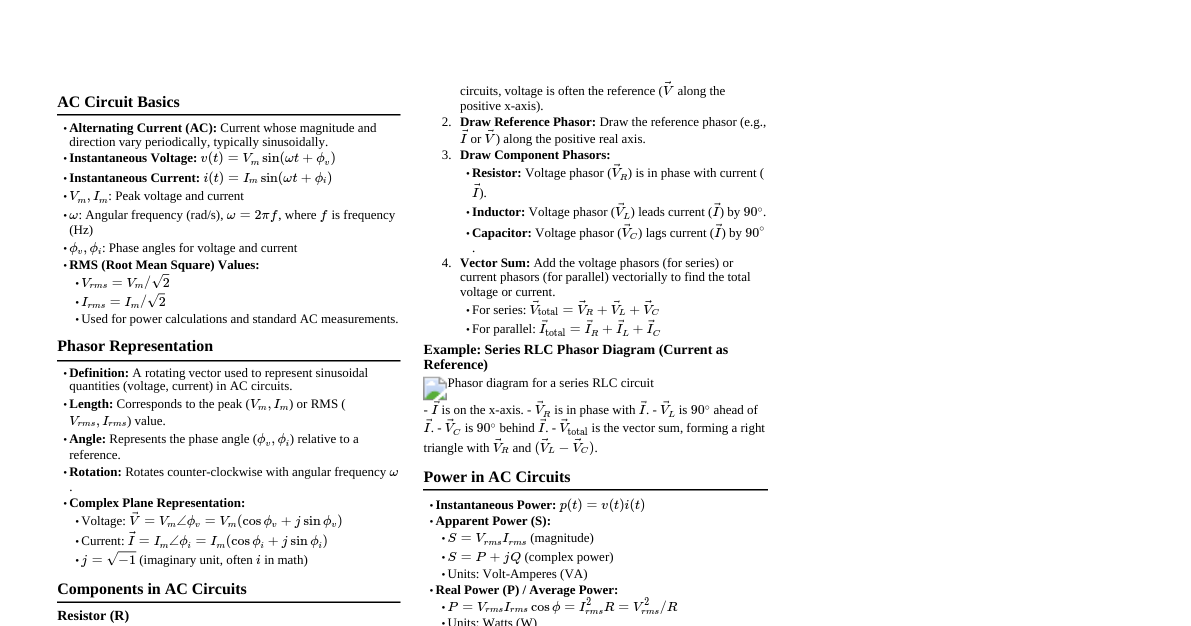
1. Basic Concepts of AC Alternating Current (AC): Current whose magnitude changes continuously with time and whose direction reverses periodically. Instantaneous Value: $I = I_0 \sin(\omega t + \phi)$ or $V = V_0 \sin(\omega t + \phi)$ Peak Value ($I_0, V_0$): Maximum value of current/voltage. Angular Frequency ($\omega$): $\omega = 2\pi f = \frac{2\pi}{T}$ (rad/s) Frequency ($f$): Number of cycles per second (Hz). Time Period ($T$): Time taken for one complete cycle (s). Phase ($\phi$): Initial phase angle. 2. Mean/Average Value of AC For a full cycle: Average value of AC current or voltage is zero. $$I_{avg} = \frac{1}{T} \int_0^T I_0 \sin(\omega t) dt = 0$$ For half cycle (0 to $T/2$): $$I_{avg} = \frac{2I_0}{\pi} \approx 0.637 I_0$$ $$V_{avg} = \frac{2V_0}{\pi} \approx 0.637 V_0$$ 3. RMS (Root Mean Square) Value of AC It is the effective value of AC. The DC current that produces the same amount of heat in a resistor as the AC current would. RMS Current: $I_{rms} = \sqrt{\frac{1}{T} \int_0^T I^2 dt} = \frac{I_0}{\sqrt{2}} \approx 0.707 I_0$ RMS Voltage: $V_{rms} = \sqrt{\frac{1}{T} \int_0^T V^2 dt} = \frac{V_0}{\sqrt{2}} \approx 0.707 V_0$ Most AC meters read RMS values. 4. AC Circuit with Resistor (R) Voltage: $V = V_0 \sin(\omega t)$ Current: $I = I_0 \sin(\omega t)$ Phase Relationship: Voltage and current are in phase. Phase difference $\phi = 0$. Resistance: $R = \frac{V_0}{I_0} = \frac{V_{rms}}{I_{rms}}$ Power: $P = V_{rms} I_{rms} = I_{rms}^2 R = \frac{V_{rms}^2}{R}$ 5. AC Circuit with Inductor (L) Voltage: $V = V_0 \sin(\omega t)$ Current: $I = I_0 \sin(\omega t - \frac{\pi}{2})$ Phase Relationship: Current lags voltage by $\frac{\pi}{2}$ (or $90^\circ$). Inductive Reactance ($X_L$): Opposition to AC flow by inductor. $$X_L = \omega L = 2\pi f L$$ (Units: Ohms) $I_0 = \frac{V_0}{X_L}$ Power: Average power consumed by a pure inductor is zero. $P_{avg} = 0$. 6. AC Circuit with Capacitor (C) Voltage: $V = V_0 \sin(\omega t)$ Current: $I = I_0 \sin(\omega t + \frac{\pi}{2})$ Phase Relationship: Current leads voltage by $\frac{\pi}{2}$ (or $90^\circ$). Capacitive Reactance ($X_C$): Opposition to AC flow by capacitor. $$X_C = \frac{1}{\omega C} = \frac{1}{2\pi f C}$$ (Units: Ohms) $I_0 = \frac{V_0}{X_C}$ Power: Average power consumed by a pure capacitor is zero. $P_{avg} = 0$. 7. L-C-R Series Circuit Applied Voltage: $V = V_0 \sin(\omega t)$ Impedance (Z): Total opposition to current flow. $$Z = \sqrt{R^2 + (X_L - X_C)^2}$$ (Units: Ohms) Peak Current: $I_0 = \frac{V_0}{Z}$ RMS Current: $I_{rms} = \frac{V_{rms}}{Z}$ Phase Difference ($\phi$): Between voltage and current. $$\tan \phi = \frac{X_L - X_C}{R}$$ If $X_L > X_C$: Circuit is inductive, current lags voltage. If $X_C > X_L$: Circuit is capacitive, current leads voltage. If $X_L = X_C$: Circuit is purely resistive, current is in phase with voltage (resonance). 8. Power in AC Circuits (L-C-R) Instantaneous Power: $P = VI$ Average Power: $P_{avg} = V_{rms} I_{rms} \cos \phi$ Power Factor ($\cos \phi$): $$\cos \phi = \frac{R}{Z}$$ For pure R circuit: $\phi = 0^\circ, \cos \phi = 1$, $P_{avg} = V_{rms} I_{rms}$ (Max power) For pure L or C circuit: $\phi = \pm 90^\circ, \cos \phi = 0$, $P_{avg} = 0$ Wattless Current: Component of current ($I_{rms} \sin \phi$) that does not contribute to average power. 9. Resonance in L-C-R Series Circuit Occurs when $X_L = X_C$. $$\omega L = \frac{1}{\omega C}$$ Resonant Frequency ($\omega_0$ or $f_0$): $$\omega_0 = \frac{1}{\sqrt{LC}}$$ $$f_0 = \frac{1}{2\pi\sqrt{LC}}$$ At resonance: Impedance $Z = R$ (minimum). Current $I_0 = \frac{V_0}{R}$ (maximum). Power factor $\cos \phi = 1$. Voltage across L and C are equal in magnitude and opposite in phase, cancelling each other. 10. Quality Factor (Q-factor) Measures the sharpness of resonance. $$Q = \frac{\omega_0 L}{R} = \frac{1}{\omega_0 C R} = \frac{1}{R} \sqrt{\frac{L}{C}}$$ A higher Q-factor means sharper resonance (narrower bandwidth). 11. Bandwidth ($\Delta \omega$) Frequency range over which power is at least half of the maximum power (half-power frequencies). $$\Delta \omega = \omega_2 - \omega_1 = \frac{R}{L}$$ $Q = \frac{\omega_0}{\Delta \omega}$ 12. L-C-R Parallel Circuit At resonance, the net current drawn from the source is minimum. Resonant frequency is approximately $f_0 = \frac{1}{2\pi\sqrt{LC}}$. Impedance is maximum at resonance. 13. Transformer Device used to change AC voltage levels. Works on mutual induction. Ideal Transformer: No energy loss. $$\frac{V_s}{V_p} = \frac{N_s}{N_p} = \frac{I_p}{I_s}$$ where $V_p, I_p, N_p$ are primary voltage, current, turns; $V_s, I_s, N_s$ are secondary. Step-up Transformer: $N_s > N_p \Rightarrow V_s > V_p$ (current decreases). Step-down Transformer: $N_s Efficiency ($\eta$): $$\eta = \frac{P_{out}}{P_{in}} = \frac{V_s I_s}{V_p I_p}$$ Energy Losses: Flux leakage Resistance of windings (copper loss) Eddy currents (iron loss) Hysteresis loss