Current Electricity JEE Cheatsheet
Cheatsheet Content
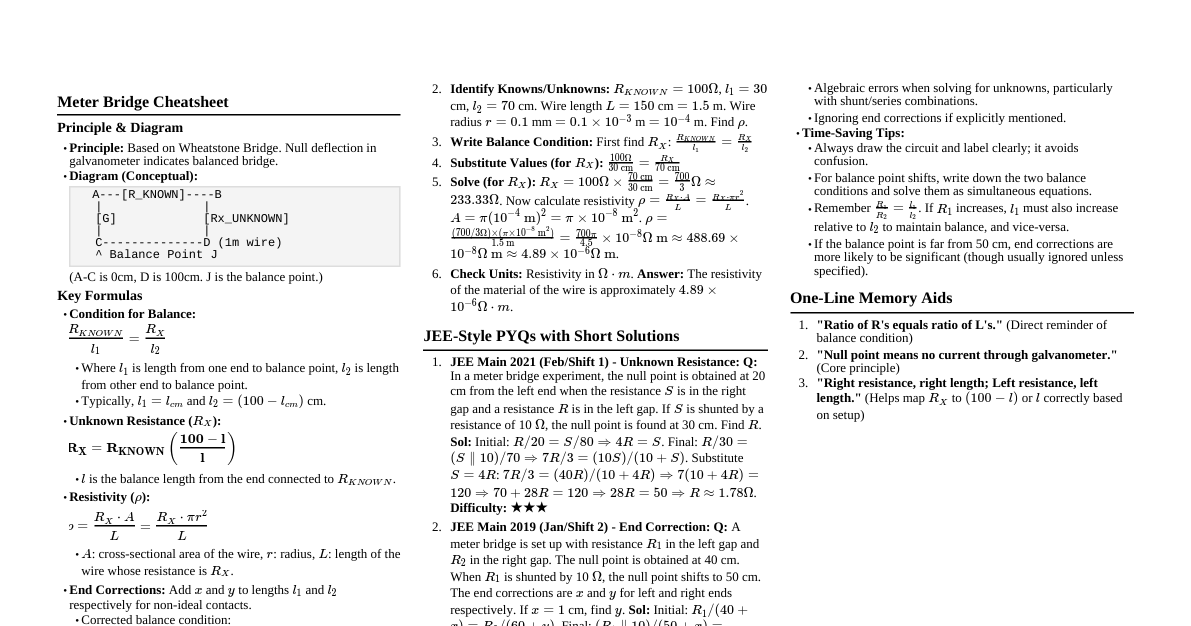
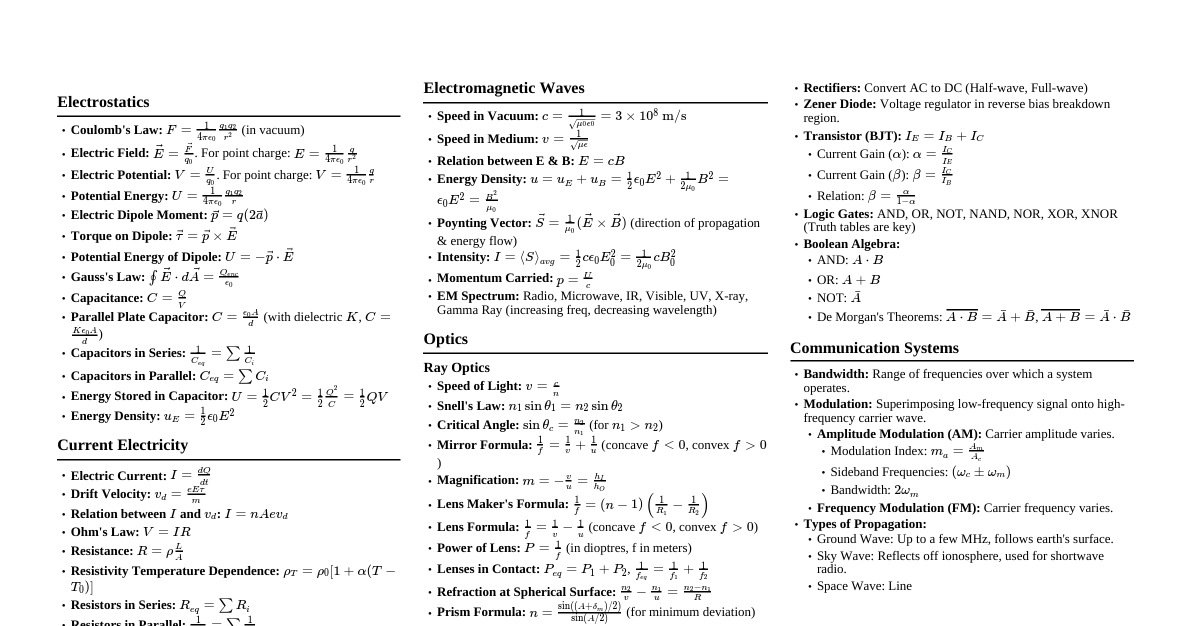
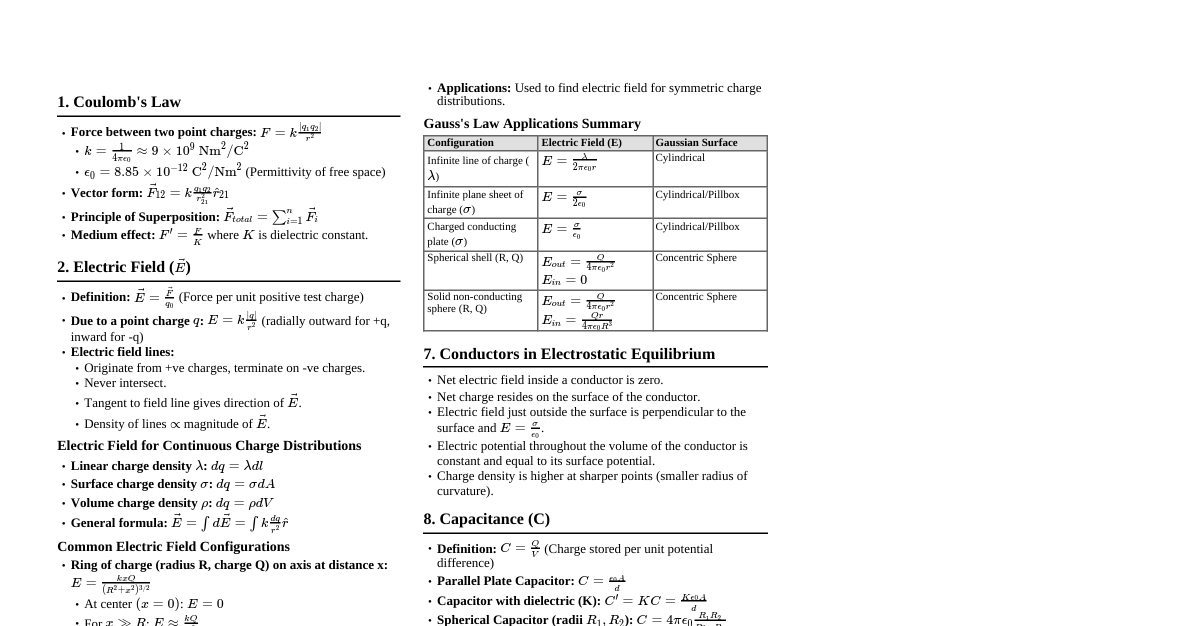
1. Electric Current & Current Density Electric Current ($I$): Rate of flow of charge. $I = \frac{dQ}{dt}$. For steady current, $I = \frac{Q}{t}$. Direction: Opposite to electron flow, along positive charge flow. Units: Ampere (A). Scalar quantity. Average Drift Velocity ($v_d$): Average velocity of free electrons in a conductor under an electric field. $v_d = \frac{eE\tau}{m}$, where $e$ is electron charge, $E$ is electric field, $\tau$ is relaxation time, $m$ is electron mass. $I = nAe v_d$, where $n$ is number density of free electrons, $A$ is cross-sectional area. Current Density ($\vec{J}$): Current per unit area. $\vec{J} = \frac{I}{A} \hat{n}$. Vector quantity. Direction is same as $I$. Units: A/m$^2$. $\vec{J} = n e \vec{v}_d$. $\vec{J} = \sigma \vec{E}$ (Ohm's Law in vector form). 2. Ohm's Law & Resistance Ohm's Law: $V = IR$, where $V$ is potential difference, $I$ is current, $R$ is resistance. Valid for ohmic conductors (metals) at constant temperature. Resistance ($R$): Opposition to current flow. $R = \rho \frac{L}{A}$. $\rho$ is resistivity (specific resistance), $L$ is length, $A$ is cross-sectional area. Units: Ohm ($\Omega$). Resistivity ($\rho$): Intrinsic property of material. $\rho = \frac{1}{\sigma}$, where $\sigma$ is conductivity. Units: Ohm-meter ($\Omega \cdot m$). Dependence: $\rho_T = \rho_0 [1 + \alpha (T - T_0)]$, where $\alpha$ is temperature coefficient of resistivity. Metals: $\alpha > 0$. Resistance increases with temperature. Semiconductors/Insulators: $\alpha Alloys (e.g., Nichrome): $\alpha \approx 0$. Resistivity nearly independent of temperature. Used in heating elements. Conductance ($G$): $G = \frac{1}{R}$. Units: Siemens (S) or mho ($\mho$). Conductivity ($\sigma$): $\sigma = \frac{1}{\rho}$. Units: S/m. 3. Combination of Resistors Series Combination: Same current ($I$) through each resistor. Total voltage $V = V_1 + V_2 + \dots$. Equivalent resistance $R_{eq} = R_1 + R_2 + \dots$. Voltage division: $V_i = V_{total} \frac{R_i}{R_{eq}}$. Parallel Combination: Same voltage ($V$) across each resistor. Total current $I = I_1 + I_2 + \dots$. Equivalent resistance $\frac{1}{R_{eq}} = \frac{1}{R_1} + \frac{1}{R_2} + \dots$. For two resistors, $R_{eq} = \frac{R_1 R_2}{R_1 + R_2}$. Current division: $I_i = I_{total} \frac{R_{eq}}{R_i}$. For two resistors, $I_1 = I_{total} \frac{R_2}{R_1+R_2}$. 4. Electromotive Force (EMF) & Internal Resistance EMF ($\mathcal{E}$): Work done by the source per unit charge to move it from lower to higher potential inside the source. Units: Volt (V). Terminal Voltage ($V$): Potential difference across the terminals of a cell. Discharging: $V = \mathcal{E} - Ir$. ($r$ is internal resistance). Charging: $V = \mathcal{E} + Ir$. Open circuit: $I=0 \implies V = \mathcal{E}$. Internal Resistance ($r$): Resistance offered by the electrolyte and electrodes of a cell. Depends on electrolyte concentration, electrode area, distance between electrodes, temperature. Power delivered by cell: $P_{cell} = \mathcal{E}I$. Power dissipated in internal resistance: $P_r = I^2 r$. Power delivered to external circuit: $P_{ext} = VI = I^2 R_{ext}$. Condition for maximum power transfer: $R_{ext} = r$. Max power $P_{max} = \frac{\mathcal{E}^2}{4r}$. 5. Combination of Cells Series Combination: $n$ cells, EMF $\mathcal{E}$, internal resistance $r$. $R_{eq} = R_{ext} + nr$. $\mathcal{E}_{eq} = n\mathcal{E}$. Current $I = \frac{n\mathcal{E}}{R_{ext} + nr}$. If cells are connected in opposition, net EMF is difference. Parallel Combination (Identical Cells): $m$ cells, EMF $\mathcal{E}$, internal resistance $r$. $\mathcal{E}_{eq} = \mathcal{E}$. $\frac{1}{r_{eq}} = \frac{m}{r} \implies r_{eq} = \frac{r}{m}$. Current $I = \frac{\mathcal{E}}{R_{ext} + r/m}$. Mixed Grouping: $N$ cells, $n$ rows of $m$ cells in series. ($N=nm$). Current $I = \frac{n\mathcal{E}}{R_{ext} + \frac{nr}{m}}$. For max current, $R_{ext} = \frac{nr}{m}$. 6. Kirchhoff's Laws Kirchhoff's Current Law (KCL) / Junction Rule: Sum of currents entering a junction equals sum of currents leaving it. $\sum I_{in} = \sum I_{out}$. Based on conservation of charge. Kirchhoff's Voltage Law (KVL) / Loop Rule: Algebraic sum of potential changes around any closed loop is zero. $\sum \Delta V = 0$. Based on conservation of energy. Sign convention: Resistor: $-IR$ if moving with current, $+IR$ if against. EMF source: $+\mathcal{E}$ if moving from $-$ to $+$ terminal, $-\mathcal{E}$ if moving from $+$ to $-$ terminal. 7. Wheatstone Bridge Circuit for accurate resistance measurement. Consists of four resistors $P, Q, R, S$ forming a bridge. Balanced condition: No current through galvanometer. $\frac{P}{Q} = \frac{R}{S}$. Used in Meter Bridge (Slide Wire Bridge) to find unknown resistance. 8. Potentiometer Device to measure potential difference, EMF of a cell, and compare EMFs. Works on the principle that potential drop across a uniform wire is directly proportional to its length ($V \propto L$) for constant current. Potential Gradient ($k$): Potential drop per unit length of wire ($k = \frac{V_{wire}}{L_{wire}}$). Comparison of EMFs: $\frac{\mathcal{E}_1}{\mathcal{E}_2} = \frac{l_1}{l_2}$. Measurement of internal resistance ($r$): $r = R \left(\frac{l_1}{l_2} - 1\right)$. ($l_1$ is balancing length for cell in open circuit, $l_2$ for cell shunted by resistance $R$). Key advantage: Draws no current from the source whose EMF is being measured (infinite resistance voltmeter). 9. Heating Effect of Current (Joule's Law) Heat produced ($H$): $H = I^2 Rt$ (in Joules). $H = VIt = \frac{V^2}{R}t$. If $H$ is in calories, $H = \frac{I^2 Rt}{4.18}$. Electric Power ($P$): Rate at which electrical energy is consumed/dissipated. $P = VI = I^2 R = \frac{V^2}{R}$. Units: Watt (W). Commercial unit of energy: kilowatt-hour (kWh). $1 \text{ kWh} = 3.6 \times 10^6 \text{ J}$. Filament bulbs: Higher power rating means lower resistance ($P = V^2/R$). For bulbs in series, lower power bulb glows brighter (higher resistance). For bulbs in parallel, higher power bulb glows brighter (lower resistance). 10. Important Concepts & Traps Superconductors: Zero resistivity below a critical temperature. Insulators: Very high resistivity. Fuses: Low melting point, high resistivity. Connected in series. Protects circuits from overcurrent. Color Code for Resistors: BB ROY Great Britain Very Good Wife (Black, Brown, Red, Orange, Yellow, Green, Blue, Violet, Gray, White). Digits 0-9. Tolerance: Gold (5%), Silver (10%), No color (20%). Ammeter: Low resistance, connected in series. Measures current. Ideal ammeter has zero resistance. Voltmeter: High resistance, connected in parallel. Measures potential difference. Ideal voltmeter has infinite resistance. Shunt Resistance: Low resistance connected in parallel with a galvanometer to convert it into an ammeter. $S = \frac{I_g G}{I - I_g}$. Multiplier Resistance: High resistance connected in series with a galvanometer to convert it into a voltmeter. $R = \frac{V}{I_g} - G$. Temperature coefficient ($\alpha$): Unit $K^{-1}$ or $^\circ C^{-1}$. Drift velocity vs. Thermal velocity: Drift velocity is very small ($\sim \text{mm/s}$), thermal velocity is very high ($\sim 10^5 \text{ m/s}$). Common mistake: Confusing EMF with terminal voltage. EMF is constant for a source, terminal voltage changes with current. Earth connection: Point connected to earth is considered at zero potential.