Electricity - RRB JE CBT-1
Cheatsheet Content
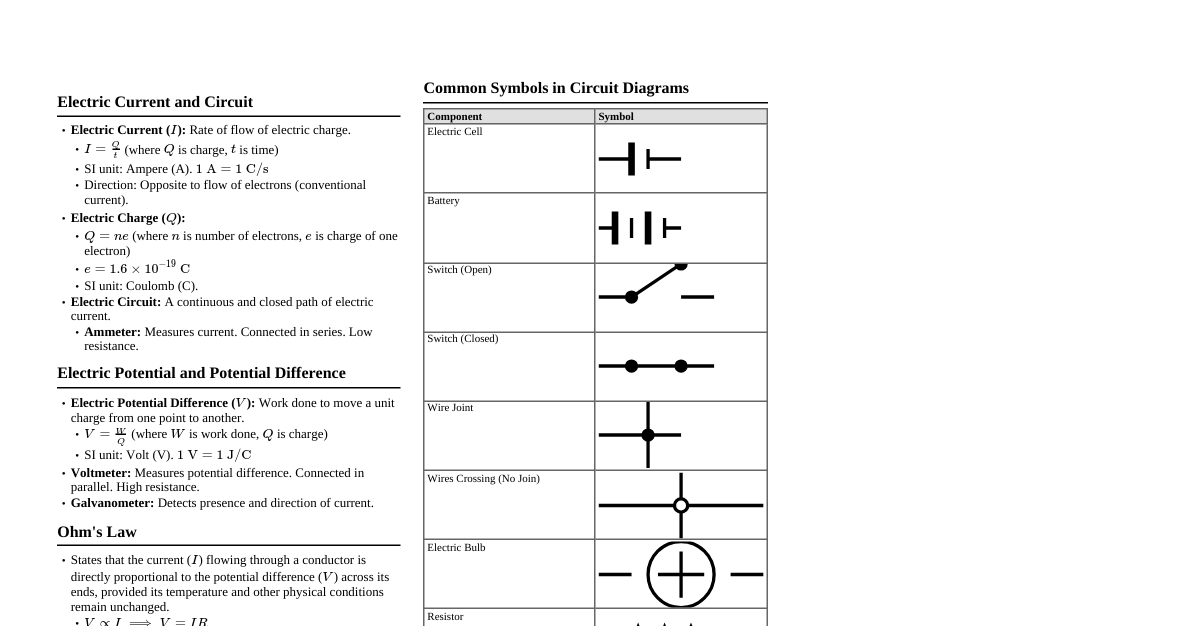
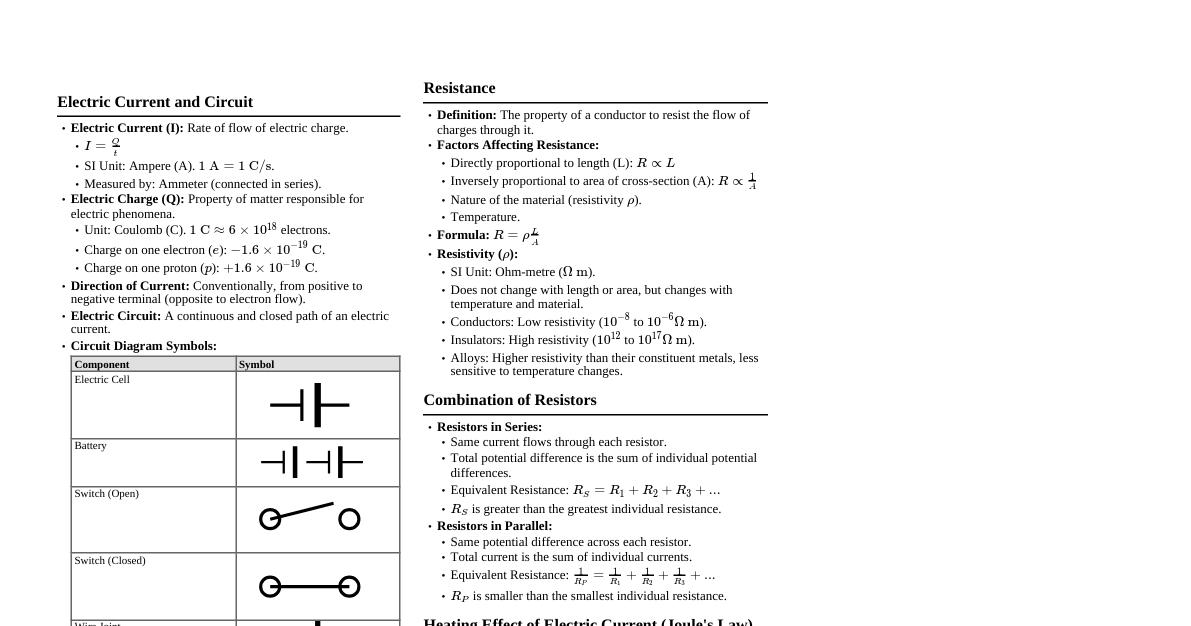
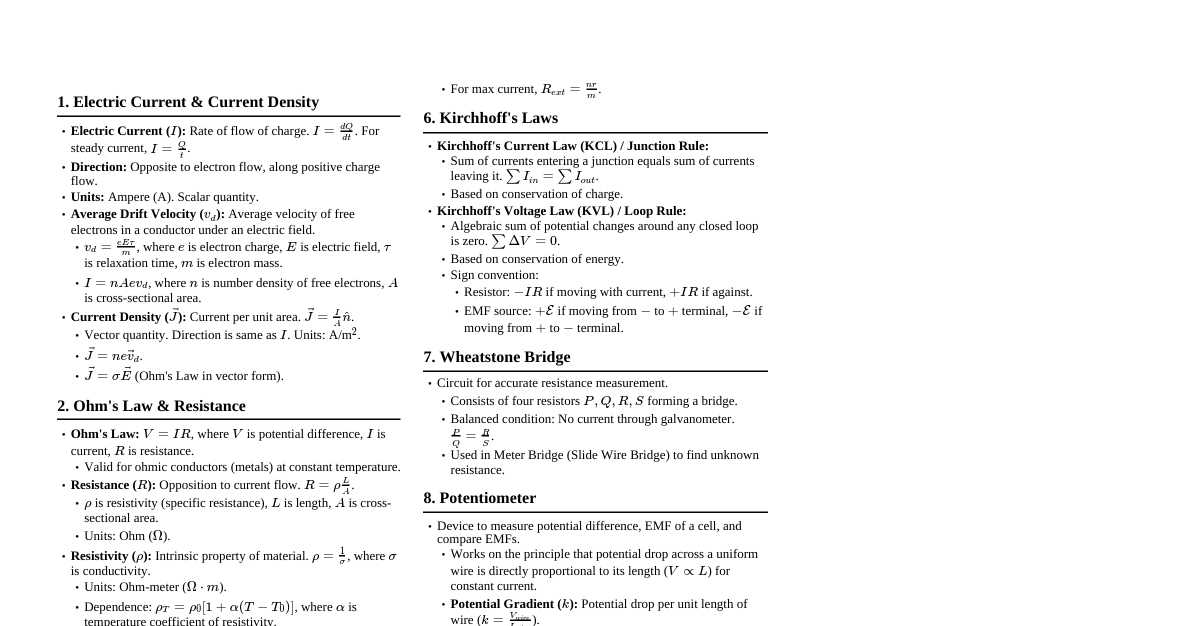
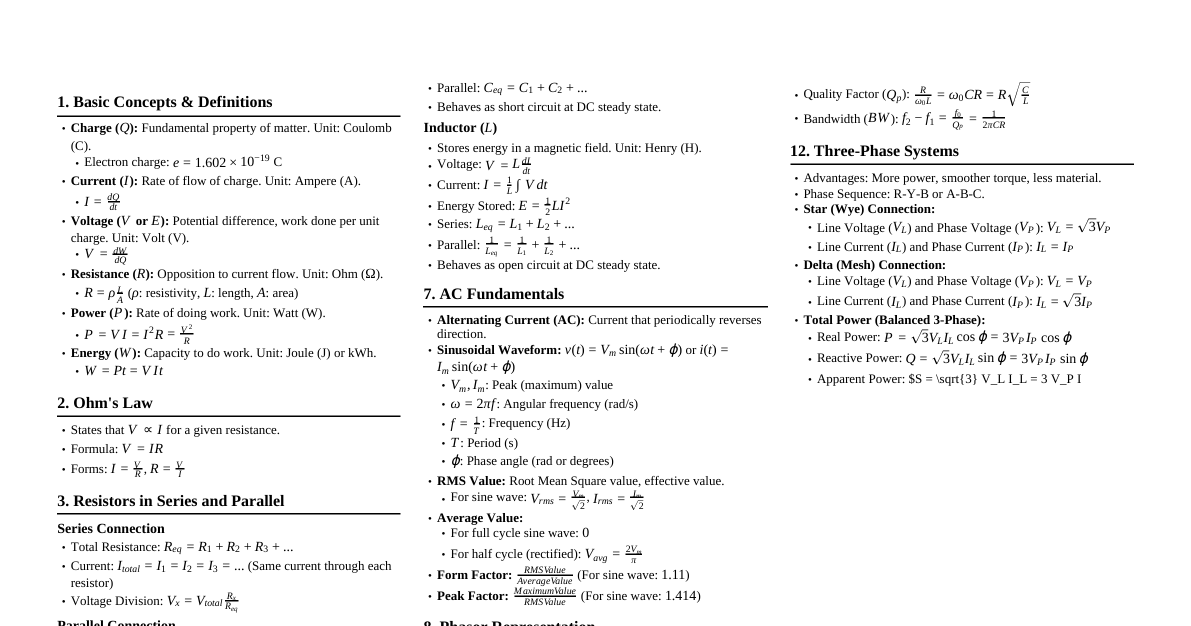
Electric Current and Circuit Electric Current ($I$): Rate of flow of electric charge. $I = \frac{Q}{t}$ SI Unit: Ampere (A). 1 A = 1 C/s. Measured by: Ammeter (always connected in series). Direction: Conventionally, from positive to negative terminal (opposite to electron flow). Electric Charge ($Q$): Property of matter, responsible for electric forces. SI Unit: Coulomb (C). Charge on one electron ($e$): $1.6 \times 10^{-19}$ C. $Q = ne$ (where $n$ is number of electrons). Electric Circuit: A continuous and closed path of an electric current. Electric Potential and Potential Difference Electric Potential ($V$): Work done per unit charge to move a charge from infinity to a point. Potential Difference ($\Delta V$ or $V$): Work done per unit charge in moving a charge from one point to another in an electric field. $V = \frac{W}{Q}$ SI Unit: Volt (V). 1 V = 1 J/C. Measured by: Voltmeter (always connected in parallel). Ohm's Law States that at constant temperature, the current ($I$) flowing through a conductor is directly proportional to the potential difference ($V$) across its ends. $V \propto I \implies V = IR$ Where $R$ is the constant of proportionality, called Resistance. Resistance ($R$): Opposition offered by the conductor to the flow of electric current. SI Unit: Ohm ($\Omega$). $1 \Omega = 1 \text{ V/A}$. Ohmic Resistors: Conductors that obey Ohm's Law (e.g., metals). Non-Ohmic Resistors: Conductors that do not obey Ohm's Law (e.g., semiconductors, diodes). Factors Affecting Resistance Resistance of a uniform metallic conductor depends on: Length ($l$): $R \propto l$ Area of cross-section ($A$): $R \propto \frac{1}{A}$ Nature of the material: $R = \rho \frac{l}{A}$ Resistivity ($\rho$): The resistance offered by a conductor of unit length and unit cross-sectional area. SI Unit: Ohm-meter ($\Omega \cdot m$). Resistivity depends only on the nature of the material and temperature, not on dimensions. Metals and alloys have very low resistivity (good conductors). Insulators have very high resistivity. Combination of Resistors 1. Resistors in Series Total equivalent resistance ($R_s$): $R_s = R_1 + R_2 + R_3 + ...$ Current is same through each resistor. Potential difference divides across each resistor. Total voltage: $V = V_1 + V_2 + V_3 + ...$ 2. Resistors in Parallel Reciprocal of equivalent resistance ($R_p$): $\frac{1}{R_p} = \frac{1}{R_1} + \frac{1}{R_2} + \frac{1}{R_3} + ...$ Potential difference is same across each resistor. Current divides through each resistor. Total current: $I = I_1 + I_2 + I_3 + ...$ Heating Effect of Electric Current (Joule's Law) When current flows through a resistor, electrical energy is converted into heat energy. Heat produced ($H$) is: Directly proportional to the square of current ($I^2$). Directly proportional to the resistance ($R$). Directly proportional to the time ($t$) for which current flows. Joule's Law of Heating: $H = I^2 Rt$ Also: $H = VIt = \frac{V^2}{R}t$ SI Unit: Joule (J). Applications: Electric heater, electric iron, electric bulb (filament glows due to heating), electric fuse. Electric Fuse: A safety device that protects circuits and appliances from damage by stopping the flow of excessively high current. Made of a wire with low melting point and high resistance. Connected in series. Electric Power Electric Power ($P$): The rate at which electrical energy is consumed or dissipated. $P = \frac{W}{t} = VI$ Also: $P = I^2 R = \frac{V^2}{R}$ SI Unit: Watt (W). 1 W = 1 J/s. Commercial Unit of Electrical Energy: Kilowatt-hour (kWh). 1 kWh = 1 unit of electricity. 1 kWh = $3.6 \times 10^6$ J. Common Symbols in Circuit Diagrams Component Symbol Electric Cell Battery (Combination of cells) Switch (Open) Switch (Closed) Wire Joint Wires Crossing (No Join) Electric Bulb Resistor Variable Resistor / Rheostat Ammeter A Voltmeter V Galvanometer G