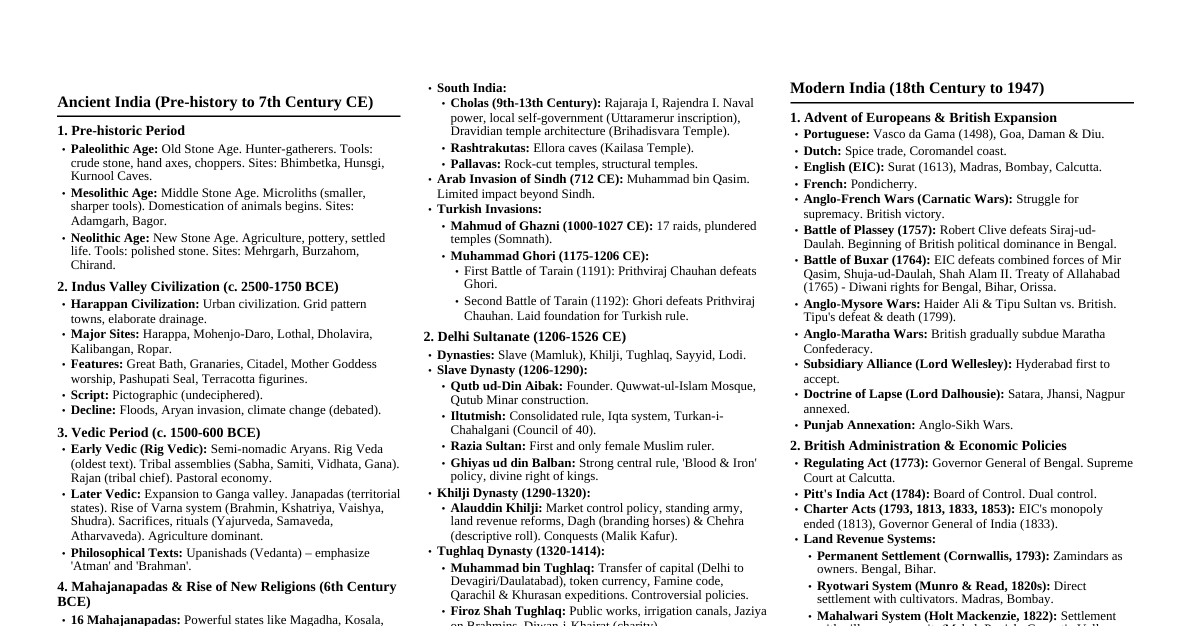
Modern History Compilation
Cheatsheet Content
### Introduction This cheatsheet compiles daily class notes on Modern Indian History, designed for STEM college students. It covers key events, policies, and movements from the decline of the Mughal Empire to India's independence. ### Fragmented Polity #### Mughal Decline (1526-1707) - **Babur (1526-1530):** Defeated Ibrahim Lodhi in the First Battle of Panipat (1526), established Mughal Dynasty. - **Akbar (1556-1605):** Defeated Hemu in Second Battle of Panipat (1556). Introduced Mansabdari and Jagirdari systems. - **Shahjahan (1628-1658):** Patron of architecture (Taj Mahal, Red Fort). Depleted treasury. - **Aurangzeb (1658-1707):** Expanded empire ("territorial climax"). Faced regional groups (Jats, Marathas, Sikhs). His policies and long wars drained the exchequer. #### Reasons for Mughal Decline - **Wars of Succession:** Lack of primogeniture led to frequent conflicts, weakening the empire. - **Aurangzeb's Policies:** Alienated Rajputs, drained treasury with long wars, bigoted religious policies. - **Weak Successors:** Later Mughals were inefficient, manipulated by nobles. - **Shifting Allegiance of Zamindars:** Increased power, carved independent territories. - **Jagirdari Crisis:** More Jagirdars than available land, leading to instability. - **Conflict among Nobles:** Divided by religion, homeland, and tribe; weak emperors failed to control them. - **Rise of Regional Aspirations:** Jats, Marathas, Sikhs sought independent kingdoms, leading to continuous warfare. - **Failure of Mughal Economy:** High expenses (Shah Jahan's construction, Aurangzeb's wars, luxurious lifestyle) and reduced *Khalisa* land (direct imperial control) led to economic instability. - **Rise of Independent States:** Provinces like Bengal, Oudh, Hyderabad became autonomous. - **External Invasions:** Nadir Shah (1739) and Ahmad Shah Abdali caused immense wealth loss. - **Lack of Scientific Progress:** Stagnancy in technology and administration. #### Later Mughals (1707-1806) - **Bahadur Shah I (1707-1712):** Muazzam, 65-year-old. Policy of compromise (Rajputs, Marathas, Bundelas, Jats, Sikhs). Called *Shah-i-Bekhabar* (Ignorant King) by Khafi Khan. Marathas and Sikhs gained power. - **Jahandar Shah (1712-1713):** Weak ruler, supported by Zulfikar Khan (Irani party). Abolished *jizya*. Introduced *ijarah* (revenue farming), oppressing peasantry. - **Sayyid Brothers (King Makers):** Abdullah Khan (Wazir) and Hussain Ali Khan (Mir Bakshi). Supported Farrukhsiyar. - **Farrukhsiyar (1713-1719):** Executed Sikh leader Banda Bahadur. Abolished *jizya* and pilgrimage tax. Granted trading privileges to EIC (1717 *farmans* - "Magna Carta of the Company"). Killed by Sayyid brothers with Maratha (Peshwa Balaji Vishwanath) help. - **Muhammad Shah 'Rangila' (1719-1748):** Pleasure-seeking. Urdu language developed. Sayyid brothers abolished *jizya* and pilgrimage tax. Anti-Sayyid nobles (Nizam-ul-Mulk) gained power. Nadir Shah's invasion (1739) caused major damage. - **Ahmad Shah Bahadur (1748-1754):** Weak, left affairs to Udham Bai and Javid Khan. Ahmad Shah Abdali invaded twice (1749, 1752), ceded Punjab and Multan. - **Alamgir II (1754-1759):** Military and financial position worsened. Battle of Plassey (1757) fought during his reign. - **Shah Alam II (1760-1806):** Fought Battle of Buxar (1764). Signed Treaty of Allahabad (1765), granting Diwani rights of Bengal, Odisha, Bihar to British. Became pensioner of English after 1803. - **Akbar II (1806-1837):** Gave 'Raja' title to Ram Mohan Roy. Mughal coins stopped in 1835. - **Bahadur Shah II 'Zafar' (1837-1857):** Last Mughal emperor. Face of Revolt of 1857. Exiled to Rangoon, died 1862. #### Emergence of Regional Powers - **Successor States:** Awadh, Bengal, Hyderabad (virtually independent, recognized Mughal authority). - **Independent Kingdoms:** Mysore, Kerala, Rajput states (destabilization of Mughal control). - **New States:** Marathas, Sikhs, Jats (set up by rebels against Mughal Empire). #### Nadir Shah's Invasion (1738-1739) - **Battle of Karnal (1739):** Nadir Shah defeated Mughals. Plundered Delhi, took Koh-i-Noor and Peacock Throne. Inflicted heavy damage, Mughals lost territory west of Indus. #### Notable Regional Rulers - **Saadat Khan Burhan Ul Mulk (Awadh, 1722-1739):** Helped Muhammad Shah. Appointed Governor of Awadh. Made Awadh independent. Committed suicide during Nadir Shah's invasion. - **Shuja Ud Daula (Awadh, 1754-1775):** Fought Battle of Buxar (1764) with Shah Alam II and Mir Qasim. Lost Allahabad and Kara. Signed defense treaty with British (1765). - **Nizam ul Mulk Asaf Jah (Hyderabad, 1724-1748):** Real name Mir Qamar-ud-din Khan Siddiqi Bayafandi. Founded Asaf Jahi house. Recognized Mughal sovereignty. Fought Marathas. - **Rohillas and Bangash Pathans:** Carved out principalities in Gangetic Valley (Rohilkhand, Farrukhabad). Result of Afghan migration. ### Advent of Europeans #### Factors for European Exploration - **Decline of Roman Empire (7th Century):** Arab dominance in Egypt and Persia disrupted direct trade routes to India. - **Ottoman Capture of Constantinople (1453):** Controlled land/sea routes, imposed heavy tariffs, forcing Europeans to find new sea routes. - **Renaissance & Technological Advancements:** Improved shipbuilding, navigation, and agricultural prosperity increased demand for Eastern goods (spices, silk). - **Mercantilism (17th Century):** Economic system focused on accumulating wealth (gold/silver) through maximizing exports and limiting imports; acquisition of colonies for raw materials. #### Key Explorations - **Christopher Columbus (Spain):** Reached America (1492) instead of India. - **Vasco da Gama (Portugal):** Found sea route via Cape of Good Hope, reached Calicut (1498). #### Portuguese in India - **Vasco da Gama (1498, 1501):** Reached Calicut. Faced opposition from Arab merchants. Established trading factory at Cannanore. Kochi became headquarters (later Goa). - **Pedro Alvares Cabral (1500):** Established factory at Calicut. Attacked Arab ships and bombarded Calicut. Made treaties with rulers of Cochin and Cannanore. - **Francisco D'Almeida (1505-1509):** First Viceroy. Vision: Blue Water Policy (control Indian Ocean, not land). Fought Battle of Diu (1509) against combined Mamluk-Gujarat fleet, securing Portuguese naval supremacy. - **Alfonso De Albuquerque (1509-1515):** Consolidated Portuguese power. Conquered Goa (1510) from Bijapur (abolished Sati). Introduced permit system for ships. Encouraged Portuguese men to marry local women. - **Nino da Cunha (1529-1538):** Shifted headquarters from Cochin to Goa. Gained Bassein and Diu from Bahadur Shah of Gujarat. Increased influence in Bengal (Hooghly became a headquarters). #### Portuguese Administration - Headed by Viceroy with a council. *Vedor Da Fazenda* for revenue. - **Reach:** Goa, Daman & Diu, Mangalore, Cannanore, Cochin, Calicut, San Thome (Chennai), Nagapattinam (Andhra), Hooghly (Bengal). - **Decline:** Piracy, human cruelties. Lost favor with Mughals (Jahangir, Shah Jahan). Capture of Hooghly (1632) by Shah Jahan due to slave trade and seizing Mumtaz Mahal's slave girls. #### Dutch (1605-1759) - **Dutch East India Company (1602):** Empowered for war, treaties, territories. - **First Factory (1605):** At Masulipatnam. Captured Amboyna from Portuguese. - **Headquarters:** Pulicat (initially), then Nagapattinam (1690). - **Trade:** Black pepper, spices. Also Indian textiles (silk, cotton, indigo, rice, opium). First company to issue shares. Minted coins. - **Battle of Colachel (1741):** Defeated by Marthanda Varma of Travancore. - **Factories:** Petapul, Masulipatnam, Pulicat, Cambay, Surat, Agra, Patna, Dacca, Chinsurah, Kasimbazar, Balasore, Negapatam. - **Dutch in Coromandel:** Established strong presence, built Fort Geldria (Pulicat). - **Pondicherry:** Briefly held by Dutch during Nine Years' War. - **Kew Letters (1795):** William V of Orange ordered Dutch colonies to surrender to British during Napoleonic Wars. - **Dutch Malabar (1661-1795):** Main settlement Cochin. Produced *Hortus Indicus Malabaricus*. - **Dutch Suratte:** Trading post in Surat (1616-1825). - **Dutch Bengal:** Presence from 1610. Fort Gustavus at Chinsurah. Directorate of Bengal (1655). - **Anglo-Dutch Conflict:** Agreement in 1667 (British withdrew from Indonesia, Dutch from India). Defeated by British in Battle of Bedara (1759), leading to collapse of Dutch power in India. #### British (1608-1947) - **John Mildenhall (1599):** Merchant adventurer, reached Agra (1603). - **East India Company (1600):** Queen Elizabeth I granted charter. First governor Thomas Smith. Joint stock company. - **Captain William Hawkins (1608):** Sent by James I to Jahangir's court to obtain trading rights. Faced Portuguese opposition. - **First Factory (1611):** At Masulipatnam. - **Battle of Swally Hole (1612):** British (Captain Best) defeated Portuguese off Surat coast. Impressed Jahangir, granted permission for factory at Surat. - **Sir Thomas Roe (1615-1618):** Secured *farmans* from Jahangir to establish factories (Agra, Ahmedabad, Baroch). - **Amboyna Massacre (1623):** Dutch tortured/executed English traders in Indonesia. British focused on India. - **Golden Farman (1632):** Sultan of Golconda allowed free trade for English from Golconda ports. - **Fort St. George (Madras, 1639):** Francis Day built fortified factory, became headquarters in South India. - **Bombay (1662):** Portuguese ceded to Charles II as dowry. Gerald Aungier first governor. Replaced Surat as headquarters (1687). - **Bengal:** Shah Shuja (Subedar) allowed trade for annual payment (1651). Factories at Hooghly, Kasimbazar, Rajmahal, Patna. Aurangzeb granted royal *farman* (1667). Job Charnock established factory at Sutanati (1690). Fort William (Calcutta, 1700) became Eastern presidency seat. - **Farrukhsiyar's Farmans (1717):** Granted valuable privileges in Bengal, Gujarat, Hyderabad ("Magna Carta"). Duty-free trade in Bengal. #### Danes (1616) - **Danish EIC (1616):** Factories at Tranquebar (TN) and Tanjore (TN). Principal settlement Serampore (Calcutta). Known for missionary activities. - Ceded Serampore to Britain in 1845. - **Bartholomaus Ziegenbalg:** First Protestant missionary (1707). Translated Bible into Tamil. Established first girls' school (1707). #### French (1664-1760) - **French EIC (1664):** Louis XIV, Colbert. 50-year monopoly. - **First Factory (1667):** At Surat. Mercara (Masulipatnam, 1669). - **Chandannagar (1673):** Township near Calcutta. - **Pondicherry (1674):** Founded by Francois Martin, became capital of French India. - **Other Settlements:** Mahe, Karaikal, Yanaon, Balasore, Kambazar. Mauritius, Reunion. - **Challenges:** Dutch captured Pondicherry (1693), restored by Treaty of Ryswick (1697). War of Spanish Succession led to abandonment of some factories. - **Joseph Marquis Dupleix (1742-1754):** Governor General. Fortified Pondicherry. Introduced Subsidiary Alliance (with Muzaffar Jang). Aimed to expand French influence. #### Anglo-French Rivalry (Carnatic Wars) - **First Carnatic War (1746-1748):** Extension of Austrian War of Succession. English Navy seized French ships. French (La Bourdonnais) captured Madras. French (Dupleix) defeated Nawab's army at St. Thome. Treaty of Aix-la-Chapelle (1748) returned Madras to English. - **Second Carnatic War (1749-1754):** Dupleix interfered in Hyderabad (supported Muzaffar Jung) and Carnatic (supported Chanda Sahib) succession disputes. English (Robert Clive) supported Nasir Jung and Muhammad Ali. Battle of Ambur (1749): French-backed forces won. Clive attacked Arcot. Dupleix recalled, replaced by Godehu. Treaty of Pondicherry (1755). - **Third Carnatic War (1756-1763):** Extension of Seven Years' War. French (Count de Lally) captured English forts. Battle of Wandiwash (1760): English (General Eyre Coote) defeated French. Treaty of Peace of Paris (1763) restored French factories but ended political influence. #### Why English Succeeded and Others Failed - **English EIC:** Private enterprise, quick decisions. - **French/Portuguese EIC:** Government-owned, slow decisions. - **Naval Superiority:** British had largest, most advanced navy. - **Industrial Revolution:** Early start in England provided economic strength. - **Military Skills/Discipline:** British soldiers disciplined, technologically advanced. - **Stable Government:** Britain had stable government. - **Lesser Religious Zeal:** British focused on trade, not conversion. - **Debt Market:** Britain used debt market to fund wars. ### Rise of EIC #### Bengal - Richest Mughal province (present-day West Bengal, Bangladesh, Bihar, Orissa). - Exported saltpeter, rice, indigo, sugar, silk, cotton textiles. 60% of British imports from Asia were from Bengal. - EIC traded freely for annual sum of Rs 3000. - **Murshid Quli Khan (1700-1727):** Dewan of Bengal, founded independent state. Trade and commerce flourished. - **Shuja ud din (1727-1739):** Added Bihar. - **Alivardi Khan (1740-1756):** Rebelled, killed Sarfaraz, seized power. Paid 2 Cr to Mughal emperor. Forced to cede part of Orissa and pay *chauth* to Marathas. Died, named Siraj-ud-Daulah successor. - **Siraj-ud-Daulah (1756-1757):** Faced challenges from Shaukat Jang (cousin), Ghasiti Begum (aunt), Mir Jafar (commander). Contempt for English due to fortifications, misuse of *dastaks*, asylum to Krishna Das. Seized Kasimbazar and Calcutta. - **Black Hole Incident (1756):** British prisoners held captive, many died. - **Treaty of Alinagar (Feb 1757):** Robert Clive recaptured Calcutta. - **Conspiracy:** Clive conspired with Mir Jafar, Rai Durlabh, Jagat Seth, Omi Chand. #### Battle of Plassey (1757) - Fought June 23, 1757. Mir Jafar betrayed Siraj-ud-Daulah. Siraj-ud-Daulah murdered by Miran (Mir Jafar's son). - **Significance:** Laid foundation of British Empire in India. Established English military supremacy in Bengal. French ousted. English gained grants of territories, revenue, and control over Calcutta. Robert Clive became Governor of Fort William. #### After Plassey - **Mir Jafar (1757-1760):** Became Nawab. Paid large sum to EIC, granted *zamindari* of 24 *parganas*. Continuous interference from Clive. Conspired with Dutch, defeated in Battle of Bedara (1759). Forced to resign. - **Mir Qasim (1760-1763):** Son-in-law of Mir Jafar. Signed Treaty of 1760, gave districts (Burdwan, Midnapur, Chittagong) and half share in Sylhet *chunam* trade. Paid off EIC dues. Reformed army (European lines), shifted capital to Monghyr. Clashed with EIC over *dastaks* misuse and internal trade duties. - **Battle of Buxar (1764):** Mir Qasim fled to Awadh. Formed confederacy with Shuja-ud-Daulah (Nawab of Awadh) and Shah Alam II (Mughal Emperor). Defeated by Major Munro. - **Significance:** British became de facto rulers of Bengal, Bihar, Orissa. Oudh became dependent. #### Return of Clive (1765-1767) - **Treaty of Allahabad (1765):** - **Oudh:** Nawab surrendered Allahabad and Kara to Shah Alam. Paid 50 lakh war indemnity. Defense treaty with British. Confirmed Balwant Singh (Zamindar of Banaras). - **Shah Alam II:** Handed over Diwani rights of Bengal, Bihar, Orissa to EIC. Resided at Allahabad. Received 26 lakhs annually. - **Bengal:** Dual System (Company and Nawab). EIC acquired real power (Diwani rights). Appointed deputy *diwans* (Mohd Reza Khan for Bengal, Raja Shitab Roy for Bihar) for revenue collection. Nawab (Nazm-ud-Daulah) retained Nizamat functions (defense, police, justice) but under EIC control. - **Dual System:** Administrative breakdown, disastrous for common people. Abolished by Warren Hastings (1772). - **Clive's Justification:** Feared uniting Indian princes, European powers. Lack of civil servants. EIC not interested in territories. British Parliament interference. #### Mysore - **Wodeyar Dynasty:** Hindu kingdom of Mysore (1612). Chikka Krishna Wodeyar (1734-1766). - **Haider Ali (1761-1782):** Started as horseman. Became de-facto ruler. Raised cavalry, artillery. Set up arms factory at Dundigal with French help. Raided Marathas. - **British vs. Mysore:** Apprehension of commercial loss (spice trade), French alliance with Mysore. - **First Anglo-Mysore War (1767-1769):** Haider Ali fought British, Nizam, Marathas. Defeated British. Treaty of Madras (1769): mutual restitution, defensive alliance. - **Second Anglo-Mysore War (1780-1784):** English did not aid Mysore against Marathas (1771). Haider Ali allied with French. British tried to capture Mahe. Haider Ali attacked Carnatic. Defeated by Sir Eyre Coote at Porto Novo. Haider Ali died, Tipu Sultan continued. Treaty of Mangalore (1784): inconclusive, restored territories. - **Tipu Sultan (1782-1799):** Son of Haider Ali. Reorganized state (European lines). New coinage, weights, calendar. Developed Navy, foreign trade. Planted Tree of Liberty, Jacobin club member. Died fighting in Fourth Anglo-Mysore War. - **Third Anglo-Mysore War (1789-1792):** Tipu attacked Travancore. English allied with Marathas, Nizam. Cornwallis attacked Seringapatam. Treaty of Seringapatam (1792): Tipu ceded half empire, paid war indemnity, surrendered sons as hostages. - **Fourth Anglo-Mysore War (1799):** Tipu refused to recognize minor Wodeyar ruler. Sought help from France. Lord Wellesley (Governor-General) attacked. Tipu died defending Seringapatam. Mysore placed under Wodeyar family (Krishnaraj III) with Subsidiary Treaty. William Bentinck took control (1831) due to misgovernance. Lord Rippon restored (1881). #### Marathas (Fall of Power) - Weak successors of Shivaji. Peshwas gained real power. - Battle of Panipat (1761) a major blow. - Absence of central authority, internal quarrels among Maratha *sardars*. - British diplomacy (divided Marathas). Death of strong leaders (Ahalya Bai Holker, Peshwa Madhav Rao II, Nana Phadnavis). - **First Anglo-Maratha War (1775-1782):** - **Cause:** Raghunath Rao (uncle of Narayan Rao) sought to become Peshwa, got Narayan Rao killed. Approached Bombay govt. for help. - **Treaty of Surat (1775):** Raghunath Rao promised Salsette, Bassein to British for military support. - **Treaty of Purandar (1776):** Calcutta Council condemned Treaty of Surat. Annulled it, pensioned Raghunath Rao. British retained Salsette, Broach. - **Violation (1777):** Nana Phadnavis granted port to French. English attacked. - **Course:** English defeated near Wadgaon, signed Treaty of Wadgaon (returned territories). - **Warren Hastings:** Rejected Treaty of Wadgaon. Colonel Goddard captured Ahmedabad, Bassein (1780). Captain Popham captured Gwalior (1780). - **Treaty of Salbai (1782):** Salsette to English. Bassein, other territories returned to Marathas. Raghunathrao not supported. Haidar Ali to return territories. Peshwa not to support other Europeans. 20 years of peace. - **Maratha Confederacy:** Peshwa (Poona), Gaekwad (Baroda), Scindia (Gwalior), Holkar (Indore), Bhonsle (Nagpur). Internal quarrels. - **Second Anglo-Maratha War (1803-1805):** - **Cause:** Peshwa Madhavrao Narayan died (1795). Bajirao II (son of Raghunath Rao) became Peshwa. Internal conflicts. Jaswantrao Holkar defeated Scindia and Bajirao II (1802). Bajirao II fled to Bassein. - **Treaty of Bassein (1802):** Bajirao II entered Subsidiary Alliance with English. Maintained subsidiary force, surrendered Surat, accepted British arbitration with Nizam and Gaekwad. "Death knell of Maratha Empire." - **Significance:** English gained key to India, strategic benefits. - **Course:** British (Arthur Wellesley) won. Treaties signed: Deogaon (Bhonsle, 1803), Surji-Anjangaon (Scindia, 1803), Rajpurghat (Holkar, 1806). All reduced to vassalage. - **Battle of Assaye (1803):** British decisive victory. - **Third Anglo-Maratha War (1817-1818):** - **Cause:** Lord Hastings (Governor General) aimed for British paramountcy. Charter Act of 1813 ended EIC trade monopoly. Pindaris (mercenaries) plundered territories. Treaty of Bassein seen as loss of independence. - **Course:** United Maratha Confederacy (Bajirao II) fought. Peshwa attacked Poona (1817). Appa Saheb (Nagpur) attacked. Madhav Rao Holkar prepared. - **Defeats:** Peshwa defeated at Khirki, Bhonsle at Sitabuldi, Holkar at Mahidpur. - **Treaties:** Poona (Peshwa), Gwalior (Scindia), Mandasor (Holkar). - **Result:** Confederacy dissolved. Peshwaship abolished. Bajirao became pensioner. Pratap Singh (Shivaji descendant) made ruler of Satara. #### Why Marathas Lost - Inefficient leadership (Bajirao II, Daulatrao Scindia, Jaswant Rao). - Inefficient political organization (loose confederation). - Inferior military (weak organization, firearms, leadership). - Unstable economic policy (no sound revenue system). - Defective nature of state (artificial cohesion, lacked unity). - Diplomatic skills of English (won allies, isolated enemies). - Progressive outlook of English (scientific innovation, colonization). ### Rise of EIC - Governor Generals #### Punjab before Ranjit Singh - **Guru Gobind Singh:** Transformed Sikhs into militant sect. - **Banda Bahadur:** Led Sikhs after Guru Gobind Singh. Defeated by Farrukhsiyar (1715). - **Misl:** Military brotherhood, democratic setup. 12 *misls* (e.g., Sukerchakia). Administered by *Gurumatta Sangh*. - **Ranjit Singh (Sukerchakia Misl):** Organized *misls*, strengthened kingdom. #### Ranjit Singh (1792-1839) - Captured Lahore (1799), Amritsar (1802). - Military genius, large army. Tolerant towards other religions. - **Relations with English:** British feared Franco-Russian invasion. Charles Metcalfe offered alliance (1807), but negotiations failed. - **Tilsit Alliance (1807):** Russia and Napoleon planned India invasion, compelled British to create buffer. - **Treaty of Amritsar (1809):** Signed with Charles Metcalfe. Sutlej River as boundary. Ranjit Singh directed energies west (Multan 1818, Kashmir 1819, Peshawar 1834). #### Punjab After Ranjit Singh - **Court Factions:** Kharak Singh (son) inefficient. Sudden death (1839), son Nau Nihal Singh accidental death (1840) led to anarchy. - **Chand Kaur (1841):** Only female ruler, abdicated. - **Sher Singh (1841-1843):** Murdered. Indiscipline in army. - **Rani Jindal and Daleep Singh (1843-1849):** Daleep Singh minor, Rani Jindan regent. Lal Singh became *wazir*. #### First Anglo-Sikh War (1845-1846) - **Causes:** Power struggle, annexation of Gwalior/Sindh, increased English troops near border. - **Course:** Sikh army crossed Sutlej (Dec 1845). Treachery of Lal Singh and Teja Singh led to Sikh defeats. Lahore fell (Feb 1846). - **Treaty of Lahore (1846):** War indemnity (1 crore rupees). Jalandhar Doab annexed. British resident (Henry Lawrence) at Lahore. Sikh army reduced. Daleep Singh ruler under Rani Jindan. Kashmir sold to Gulab Singh. - **Treaty of Bhairowal (1846):** Rani Jindan removed as regent. Council for regency (8 Sikh *sardars* + Henry Lawrence). #### Second Anglo-Sikh War (1848-1849) - **Causes:** Humiliating treaties, inhumane treatment of Rani Jindan. - **Course:** Mulraj (Governor of Multan) revolted. Sher Singh joined. Lord Dalhousie annexed Punjab. - **Battles:** Ramnagar, Chillianwala, Gujrat. Sikh army surrendered. - **Result:** Punjab annexed. Three-member board to govern (Lawrence brothers, Charles Mansel). John Lawrence first chief commissioner (1853). Sikhs fought on British side in 1857. #### Sindh - **Kallora Chiefs:** Ruled Sindh in 18th century. English factory at Thatta (1758). - **Talpura Mirs:** Baloch tribe, gained control (1783) under Mir Fateh Ali Khan. Divided kingdom among brothers (*Char Yar*). - **Ascendancy:** Napoleon's conspiracy with Tipu Sultan feared. Lord Wellesley counteracted. - **Treaty of 'Eternal Friendship' (1807):** British feared Russian invasion. Sent Metcalfe (Lahore), Elphinstone (Kabul), Malcolm (Teheran), Nicholas Smith (Sindh). Agreed to exclude French, exchange agents. Renewed 1820 (excluded Americans). - **Treaty of 1832:** William Bentinck sent Colonel Pottinger. Free passage for English traders through Sindh. No English merchants to settle. Tariff rates adjustable. Amirs to work with Jodhpur against robbers. - **Lord Auckland and Sindh (1838):** Prepared for Russian invasion. English consolidated position. Amirs agreed to new treaty (Company protection, troops at Amir's expense). Sindh became British protectorate. - **Tripartite Treaty (1838):** Ranjit Singh, Lord Auckland, Shah Shuja. Shah Shuja to give up sovereign rights in Sindh. - **Sindh Accepts Subsidiary Alliance (1839):** Amirs accepted under threat. British subsidiary force stationed. Paid 3 lakh annually. No foreign negotiations. - **Capitulation of Sindh:** Amirs disliked British presence during First Anglo-Afghan War (1839-1842). Charged with hostility. - **Lord Ellenborough:** Sent Outram to negotiate new treaty. Amirs to cede provinces, supply fuel for steamers, stop minting coins. - **Battle of Miani & Battle of Dobo (1843):** British (Charles Napier) defeated Baluchis. Amirs banished. - **Annexation (1843):** Sindh merged into British Empire. Charles Napier first governor. - **Criticisms:** Causes manufactured, annexed to compensate for Afghan war losses. #### Why British Became Masters of India - Superior Arms, Military, and Strategy. - Military Discipline and Regular Salary (loyalty). - Civil Discipline and Fair Selection System (merit-based officers). - Brilliant Leadership (Clive, Hastings, Dalhousie) and support of second-line leaders. - Strong Financial Backup (EIC profits). - Nationalism (British united, Indians divided). #### Governor Generals of Bengal/India - **Warren Hastings (1772-1785):** Administrative organizer. Abolished Dual System. Helped Nawab of Oudh. Ended First Maratha War (Treaty of Salbai, 1782). Managed Second Mysore War (Treaty of Mangalore, 1784). Supported Oriental philosophy (Calcutta Madrasa, Asiatic Society of Bengal). Impeached. - **Lord Cornwallis (1786-1793):** Father of Civil Services. Maintained peace. Third Mysore War (Treaty of Seringapatam, 1792). Introduced Permanent Settlement (Bengal). Judicial reforms (Cornwallis Code). Excluded Indians from high posts. - **Lord Wellesley (1798-1805):** Aggressive policy. Used Subsidiary Alliances (Hyderabad 1798, Peshwa via Treaty of Bassein 1802, Oudh). Dealt sternly with Mysore, Carnatic, Tanjore, Surat. - **Lord Hastings (1813-1822):** Paramountcy Policy (annexation, superior power). Broke Maratha confederacy. Peshwa deported. - **Anglo-Nepal Relations:** Gorkhas expanded south. Treaty of Sugauli (1816): British resident in Nepal, ceded Garhwal/Kumaon, Nepal withdrew from Sikkim. British expansion to Himalayas. - **Ryotwari System:** Established in Madras by Thomas Munro. - Exterminated Pindaris. Rajputana under British protection. - **Lord William Bentinck (1828-1835):** Abolished Sati. Suppressed Thagi. Education reforms (Anglicist, Western education). Governor General of Bengal became Governor General of India (Charter Act 1833). Annexed Mysore (1831), Coorg (1834), Central Cachar (1834). Macaulay's Minute (1835). Abolished provincial courts. - **Lord Dalhousie (1848-1856):** Imperialist, expansionist. Annexed Punjab (1849), Pegu (1852), Sikkim. - **Doctrine of Lapse:** Adopted son could not be heir. Annexed Satara (1848), Jaitpur (1849), Baghat (1850), Jhansi (1854), Nagpur (1854), Sambalpur, Udaipur. Kittur Uprising (1824) by Rani Chinnamma challenged this. - **Misrule:** Annexed Oudh (1856). - **Berar:** Took cotton-producing province from Nizam (1853) for arrears. - **Other Policies:** Wood’s Education Dispatch (1854). Railway Minute (1853) - first railway line (Bombay-Thane). Telegraph (Calcutta, Bombay, Madras). Postal Reforms. Widow Remarriage Act (1856). - **Anglo-Burma Relations:** - **First (1824):** Burmese westward expansion. British occupied Rangoon. Treaty of Yandabo (1826): Burma ceded Arakan/Tenasserim, recognized Manipur independence. - **Second (1852):** Dalhousie's imperialistic/commercial policy. British occupied Rangoon, Pegu. Lower Burma under British. - **Third (1885):** Thibaw Min (Burmese King) hostile. Allied with France. Lord Dufferin annexed Upper Burma. Burma separated from India (1935). #### British Policies - Education - **18th Century Education:** Traditional, limited to literature, philosophy, law, religion, logic. Elementary schools (Pathshalas, Maktabs). Higher education (Chatuspathis, Tols, Madrasahs). - **Early British Efforts:** - **Warren Hastings (1781):** Established Calcutta Madrasa (Arabic, Persian, Muslim laws). - **Jonathan Duncan (1791):** Established Sanskrit College (Hindu laws, philosophy). - **Lord Wellesley (1800):** Established Fort William College (Oriental studies). - **Charter Act of 1813:** Allocated 1 lakh rupees annually for education. Allowed Christian missionaries. - **General Committee of Public Instruction (1823):** Managed funds. Divided into Orientalists (H.T. Princep) vs. Anglicists (Lord Macaulay). - **Orientalism:** William Jones (1783) translated Indian texts. Asiatic Society of Bengal (1784). Encouraged study of ancient Indian texts. - **Criticism of Orientalism:** James Mill, Thomas Babington Macaulay (1835) argued Eastern knowledge was flawed. Advocated Western science/literature in English. - **English Education Act of 1835:** Based on Macaulay's Minute. English as medium for higher education. Abolished promotion of Oriental institutions. "Downward Filtration Theory" (educate elite, who teach masses). - **Lord Hardinge:** Preferred English-educated for public employment. - **Thomson's Efforts (1843-1853):** Developed village education in vernaculars. - **Wood’s Dispatch (1854):** "Magna Carta of English Education in India." Promoted Western education. English for higher, vernacular for primary. Hierarchical system (primary to universities). Grants for private institutions. Department of Public Instruction. Universities in Calcutta, Bombay, Madras (1857). Emphasized vocational, teacher training, female education. - **Hunter Commission (1882-1883):** Reviewed education progress since 1854. Endorsed Wood's Dispatch. Recommended transfer of control to local boards, primary in vernaculars, two divisions for secondary. Encouraged private sector. - **University Commission (1902):** Lord Curzon appointed Sir Thomas Raleigh. Led to Indian Universities Act of 1904. Tightened government control over universities. - **Gokhale's Resolution (1910):** Demanded compulsory primary education. Ignored. - **Government Resolution on Education Policy (1913):** Refused compulsory education. Encouraged free elementary for poor. - **Sadler Commission (1917-1919):** Examined Calcutta University. Recommended 12-year school, 3-year degree, residential universities, expanded scientific/technological/female education, teacher training. Seven new universities by 1921. - **Government of India Act of 1919:** Transferred education to provincial ministers. - **Hartog Committee (1929):** Surveyed education growth. Noted quality issues in primary/secondary/higher education. Recommended consolidation over hasty expansion, selective admission, diversified curriculum. - **National Education:** Mahatma Gandhi opposed Western education, advocated mother tongue, practical knowledge. Rabindranath Tagore founded Santiniketan (1901) for creative learning in nature. Sri Aurobindo Ghose advocated vernacular education, national spirit. - **Wardha Scheme of Basic Education (1937):** Mahatma Gandhi. Free/compulsory for 7 years in mother tongue. Craft-centered learning. Self-sufficient system. Zakir Hussain Committee detailed plan. - **Sargent Plan of Education (1944):** Sir John Sergeant. Elementary/high schools. Compulsory free education (6-11 years). Technical/commercial/arts education. Restricted higher education. Two types of high schools. - **Radhakrishnan Committee (1948-1949):** University Education Commission. Rural universities. Emphasized agriculture, commerce, engineering, medicine, law. University degree not essential for administrative services. University Grants Commission (UGC) recommended. - **UGC (1953):** Established to regulate/finance universities. ### British Economic Policy #### Trade and Commerce - **18th Century India:** Self-sufficient in handicrafts, agricultural products. Exported cotton textiles, raw silk, indigo, spices. Imported pearls, wool, tea, gold/silver. India was a "sink of precious metals." - **Decline of Shipping Industry:** British discouraged Indian-made ships after their own flourished. - **Decline of Handicraft Industry:** Indian market flooded with cheap British goods. EIC appointed *Gomastas* (agents), later dealt directly with artisans. Promoted raw silk over finished goods. Loss of traditional patrons (Nawabs). Industrial Revolution in Europe (power looms). - **Changing Phases of Colonialism:** - **Pre-Colonial Stage (1600-1757):** EIC exchanged goods. British manufacturers jealous of Indian goods. Calico Act (1720) banned Indian chintz. - **Colonial Stage (1757-1813) - Merchant Capitalism:** EIC bought cheap, sold dear. Eliminated rivals, gained political control. Used territorial revenue to finance exports. *Gomasta* system. *Khatbandi* system (forced production). *Ryoti* system (forced cultivation). Heavy import duties on Indian goods in England. - **Industrial Capitalism (1813-1858) - Free Trade Era:** Industrial Revolution in Britain. Demanded ending EIC monopoly (Charter Act 1813). India became market for British goods, supplier of raw materials. Trade discrimination (heavy duties on Indian exports, free trade for British imports). De-industrialization of India. - **Fiscal Capitalism (1858-1947) - Financial Imperialism:** British capital investment in India (railways, plantations, loans). Not for India's development, but for British trade/export. #### Indigo Cultivation - **Demand:** Indian indigo used by European cloth manufacturers. Woad (European dye) was inferior. French, Portuguese, English cultivated indigo in colonies. - **Britain Turns to India:** Bengal indigo dominated world market by late 18th century. EIC expanded cultivation. - **Production:** Multi-vat process (fermenting, beating). - **Systems:** - **Nij System:** Planters directly controlled land. Difficult to expand due to need for fertile land, large plots, ploughs/bullocks. Less than 25% of indigo land. - **Ryoti System:** Planters forced *ryots* (peasants) to sign contracts (*satta*). Cash advances, forced cultivation on 25% of land. Low prices, cycle of debt. Indigo exhausted soil. #### Development of Modern Industries - Began after 1850s. Financed/controlled by British. - First cotton textile mill (1853, Cowasjee Nanabhoy). First jute mill (1856, Rishra). First iron plant (1870, Bengal Iron Works). - Sugar, cement industries (1900s). First steel plant (1907, Jamshedji Tata). - **Issues:** Late development, focus not on core industries, regional disparity, illiterate workforce, capital problems for Indian-owned industries, unequal competition with British. #### Revenue Administration - **Bengal (1765-1772):** Robert Clive introduced Dual System. EIC collected revenue (Diwani rights), Nawab maintained law/order (Nizamat). Deputy *diwans* collected maximum revenue. Led to administrative breakdown, Great Bengal Famine (1770). - **Warren Hastings (1772-1785):** Abolished Dual System. Quinquennial system (5-year settlement), then annual. Revenue farming (*Ijaradari*). Board of Revenue established. Collectors appointed. Failed due to over-assessment. - **Permanent Settlement (1793) - Cornwallis:** Also Zamindari, Jagirdari, Malguzari, Biswedari, Istemrari Bandobast. Extended to Bengal, Bihar, Orissa, parts of Madras/Varanasi. - **Features:** Zamindars recognized as landowners (paid fixed revenue). Ryots became tenants. Administrative/judicial functions of zamindars removed. No land survey. - **Negative Impact:** Disastrous for ryots (exploitation, illegal taxes, eviction). Absentee landlordism. Zamindars defaulted, lost land. - **Jotedars:** Rich peasants, gained power. Controlled trade, moneylending. Weakened zamindari authority. - **Fifth Report (1813):** Exaggerated collapse of zamindari power. - **Ryotwari Settlement (1820s) - Thomas Munro, Alexander Reed:** Introduced in Madras, Bombay, Berar, Assam. Covered 51% of British India. - **Provisions:** Peasants made proprietors. No intermediaries. Tax fixed for 20-40 years. Personally responsible for payment. Cash collection. - **Mechanism:** Land survey, assessment. Faulty surveys led to over-assessment in Bombay. Wingate/Goldsmith improved system. - **Negative Impact:** Ryots indebted to moneylenders. Government became large zamindar. Harsh collection, no relaxation for crop failure. - **Bombay:** High revenue demand, peasants left villages. Decline in prices (1830s), famines. Cotton boom (1860s) due to American Civil War, then crash. Deccan Riots (1875) against moneylenders. Deccan Agriculturists Relief Act (1879). - **Mahalwari Settlement (1833) - Holt Mackenzie, William Bentinck:** Introduced in Punjab, Central Provinces, NW Provinces. Synthesis of Zamindari and Ryotwari. - **Provisions:** Village/group of villages (*Mahal*) as unit. Ownership with peasants. Village community responsible for revenue. Village headman (*lambardar*) collected tax. - **Regulation of 1822:** Fixed revenue at 80% rental value (zamindar) or 95% (cultivator). Failed. - **Regulation of 1833:** State demand 66% rental value (later 50% by Dalhousie). Fixed for 30 years. Used field maps. Robert Merttins Bird ("Father of Land Settlement in Northern India"). - **Shortcomings:** Officials' calculations inaccurate. Excessive tax, peasants lost land to moneylenders. Impoverishment, dispossession. Cost of collection high. #### Overall Impact of Economic Policies - Drain of wealth. - Deindustrialization, ruin of artisans. - Ruralization, impoverishment of peasantry. - Commercialization of Indian Agriculture. - Famine and Poverty. - Rise of Indian Bourgeoisie. - Development of Modern Industries (late). - Development of Railway network. ### Various Revolts Before 1857 #### Impact of British Policies - **Peasants:** Exorbitant rent, dependent on intermediaries. - **Artisans:** Destroyed handicraft industry, lost jobs. - **Zamindars/Poligars:** Lost land, power. - **Priests:** Lost patronage. - **Foreign Character:** Hurt native pride. #### Types of Resistance ##### Civil Rebellions - Led by deposed rulers, zamindars, religious leaders. Mass support from peasants, artisans, soldiers. - **Sanyasi Revolt/Fakir Rebellion (1770s):** Jalpaiguri, WB. Against restrictions on holy places, famine of 1770. Leaders: Majnu Shah, Chirag Ali, Bhawani Pathak, Debi Chaudhurani. Hindu-Muslim unity. Mentioned in Bankim Chandra Chattopadhyay's *Anandmath*. - **Civil Uprisings (1781):** Gorakhpur, Basti, Bahraich. Against revenue farming by Major Alexander Hannay. - **Revolt of Raja of Vizianagaram (1794):** Against EIC's failure to honor treaty, annexation of state. Raja Vijayaramaraju died fighting. - **Revolt of Dhundia Wagh (1799-1800):** Bednur. Maratha leader, organized anti-British forces. Killed by Lord Wellesley. - **Kerala Varma Pazhassi Raja (1797, 1800-1805):** "Kerala Simham." Resisted Hyder Ali, Tipu Sultan, British. Fought guerilla warfare. Died 1805. - **Revolt of Awadh (1799):** Wazir Ali Khan (4th Nawab) replaced by Saadat Ali Khan II. Wazir Ali killed British resident George Cherry ("Massacre of Benaras"). - **Poligars' Revolt (1795-1805):** South India (Tinneveli, Madurai). Against EIC control of Tinnevelly. - **First Phase (1795-1799):** Kattabomman Nayakan led. Betrayed and hanged. - **Second Phase (1801-1805):** More violent. Oomathurai (Kattabomman's brother) joined Maradus. Suppressed. - **Uprisings in Haryana (1803-1810):** Against British takeover from Scindia. Leaders: Zabita Khan, Khan Bahadur Khan. Suppressed. - **Diwan Velu Thampi Revolt (1808-1809):** Travancore. Against Subsidiary Alliance terms, British interference. *Kundara Proclamation*. Velu Thampi killed himself. - **Disturbances in Bundelkhand (1808-1812):** Against EIC. Bundela chiefs resisted. - **Kutch Rebellion (1816-1832):** Against British interference in power struggle between Maharaja Bharmal II and chieftains. Bharamal deposed. Chieftains continued rebellion. - **Rising at Bareilly (1816):** Against Police Tax. Religious turn. Suppressed. - **Waghera Rising (1818-1820):** Okha Mandal. Against alien rule, Gaekwar's exactions. - **Kittur Uprising (1824):** Rani Chennamma revolted against Doctrine of Lapse. - **Revolt of Moamarias (1769-1799):** Assam. Low-caste peasants against Ahom kings. Weakened Ahom kingdom. - **Ahom Revolt (1828):** Led by Gomdhar Konwar. British didn't withdraw from Assam after First Burma War. Suppressed. - **Pagal Panthis (1825-1850):** Mymensingh district. Semi-religious sect (Hajong, Garo tribes). Founded by Karam Shah. Tipu (son) led cause against zamindars. - **Faraizi Revolts (1838-1857):** Eastern Bengal. Muslim sect by Haji Shariatullah. Against un-Islamic practices. Dudu Mian led, organized paramilitary forces against Hindu landlords. - **Wahabi Movement (1830s):** Syed Ahmed Barelvi (India). Purify Islam, remove non-Islamic practices. Against Sikhs, then British. Patna became center. Armed struggle during 1857. - **Kuka Movement (1840):** Western Punjab. Bhagat Jawahar Mal. Baba Ram Singh. Religious purity to political campaign. Boycott British institutions. Swadeshi, non-cooperation. Crushed. - **Surat Salt Agitation (1844):** Against raising salt duty. - **Uprising in Ganjam and Gumsur (1800, 1835-1837):** Odisha. Zamindars (Strikara Bhanj) refused revenue. - **Uprisings in Palamu (1800-1802):** Jharkhand. Bhukhan Singh (Chero chief) against landlordism. - **Parlakimidi Outbreak:** Ganjam, Odisha. Narayan Deo (Raja) resisted EIC. - **Upsurge in Hathras (1817):** Dayaram (talukdar) against EIC. - **Kolhapur and Sawantwadi Revolt (1844):** Gadkaris revolted due to unemployment after disbandment. - **Sambalpur Outbreaks (1827-1840):** Odisha. Surendra Nath led against British interference. - **Bundela Revolt (1842):** Madhukar Shah, Jawahar Singh against oppressive revenue. - **Phadke's Revolt (1877):** Vasudev Balwant Phadke led armed revolt after famine. - **Naikdas Revolt (1858-1859):** Roop Singh, Joria Bhagat. ##### Tribal Uprisings - Against British intrusion, loss of land, exploitation. - **Tribal Groups:** - **Hunters/Gatherers:** Khonds (Orissa), Baigas (Central India). - **Herders:** Van Gujjars (Punjab hills), Labadis (Andhra), Gaddis (Kulu), Bakarwals (Kashmir). - **Settled Cultivation:** Mundas (Chota Nagpur) - Khantkutti system. - **Mainland vs. Frontier:** Mainland (Santhal, Khond, Munda, Koya). Frontier (Khasi, Singphos, Naga). - **Characteristics:** Violence against moneylenders/landlords, messiah-like figures, traditional arms. - **Problem with Trade:** Traders/moneylenders exploited tribals. Silk production for EIC. - **Search for Work:** Tea plantations, mining. Low wages, dangerous conditions. - **Pahariyas' Rebellion:** Rajmahal hills. Against intrusion, pacification policy. Raja Jagganath (1778). - **Chuar Uprising/Revolt of Jungle Mahal (1766-1816):** Midnapore, Bengal. Bhumij tribes. Against increased revenue. Leaders: Madhab Singh, Raja Mohan Singh, Durjon Singh. - **Tamar Revolt (1798):** Chotanagpur. Bholanath Sahay Singh against alien systems. Munda tribals joined. - **Kol Uprising (1831-1832):** Chotanagpur, Singhbhum. Against land transfer to non-tribals, high taxes. Buddho Bhagat led. - **Ho and Munda:** Chotanagpur, Singhbhum. Against British occupation. Raja of Parahat led Ho (1820). Mundas joined (1831). Birsa Munda (1890s) led "Ulgulan" against Khuntkutti system, forced labor, missionaries. - **Khond Uprisings (1837-1856):** Against suppression of human sacrifice, new taxes. Charkha Bisnoi led. - **Koya Revolt:** Eastern Godavari. Against moneylenders, police, new regulations. Tomma Sora led. - **Bhils Uprising (1817-1819, 1825, 1831, 1846):** Khandesh, NW Maharashtra. Against famine, economic distress. Sewaram led. Govind Guru (1913) for Bhils of South Rajasthan. - **Koli Uprising (1824, 1829, 1839, 1844-1848):** Sahyadri Hills. Against British rule, dismantlement of forts. - **Ramosi Rising (1822, 1825-1826, 1839):** Western Ghats. Chittur Singh led. Umaji Naik, Bapu Trimabakji Sawant. - **Frontier Tribal Movements:** Khasi Uprising (1829-1832) by Tirot Singh. Singphos Rebellion (1830). Khampti rebellion (1839-1842). Lushai's revolt (1842-1844). - **Later Revolts:** Bhills (1913) by Govind Guru. Oraons (1914-1915) by Jatra Bhagat, Tana Bhagat. Kukis (1917-1919) by Jaonang. ##### Urban Revolts - Grain riots (1823-1838), Rice riots (1806-1858), Vellore revolt (against conversion). Artisans' revolts. #### Sepoy Mutiny (Pre-1857) - **1764:** Bengal, 30 sepoys blown from cannon. - **1806:** Vellore Mutiny (uniform changes, Tipu Sultan's family). Crushed. - **1824:** Barrackpore, 47th regiment refused to go to Burma by sea. - **1844:** Seven battalions revolted (salaries, *Batta*). ### Sepoy Mutiny and Revolt of 1857 #### Causes of the Revolt - **Enfield Rifle:** Cartridges greased with cow/pig fat, offensive to Hindus/Muslims. - **Political:** Lord Dalhousie's indiscriminate imperialistic policy (annexations of Punjab, Satara, Nagpur, Jhansi, Oudh). Disrespect to Mughal emperor. - **Economic:** Exploitation of India's resources. Poverty. Land settlements (Lord William Bentinck) victimized many. Imam Commission (1852) confiscated 20,000 estates. Disbanded soldiers of annexed states. - **Awadh in Revolt:** Annexed (1856) on grounds of maladministration. Nawab Wajid Ali Shah popular. Dissolution of court led to artists losing livelihood. British introduced Summary Settlement (1856), dispossessed *talukdars*. Peasants exploited. Sepoys (mostly from Awadh) had close links to rural areas. - **Socio-Religious:** British socio-religious reforms (English education, abolition of Sati, change in inheritance law, widow remarriage) seen as interference. Railways (mixing castes). Christian missionaries' conversion attempts. Religious Disability Act (1856). Dalhousie's Doctrine of Lapse. Confiscation of religious grants. - **Influence of Events Outside India:** British losses in First Afghan War, Punjab Wars, Crimean Wars, Santhal Rebellion. - **Discontent among Sepoys:** Low salaries, bad treatment. Lord Canning's regulations (Post Office Act 1854, General Services Enlistment Act 1856). Disproportion of British vs. native soldiers. Indian sepoys held strategic points. #### The Revolt Starts - **Meerut (May 10, 1857):** 90 men of 3rd Native Cavalry refused greased cartridges. 85 imprisoned. Soldiers mutinied, released prisoners, killed officers, marched to Delhi. - **Delhi:** Local infantry joined. Killed Europeans. Bahadur Shah Zafar proclaimed emperor. - **What Rebels Wanted:** Unity (Hindu-Muslim). Azamgarh Proclamation (1857) appealed to unity, denounced British tyranny. No religious divisions during uprising. - **Civilian Participation:** Peasants, artisans, shopkeepers, laborers, zamindars, priests, civil servants. Attacked British symbols (police station, courts). - **Leaders:** - **Delhi:** Bahadur Shah II (nominal), General Bakht Khan (real command). - **Kanpur:** Nana Sahib (adopted son of Peshwa Baji Rao II). Tantia Tope. - **Lucknow:** Begum Hazrat Mahal (wife of Nawab). Birjis Qadir (son) proclaimed Nawab. - **Bareilly:** Khan Bahadur. - **Bihar:** Kunwar Singh (Zamindar of Jagdishpur). - **Faizabad:** Maulvi Ahmadullah. - **Jhansi:** Rani Laxmibai. Tantia Tope joined her. - **Lines of Communication:** Rumors (greased cartridges, bone dust in flour). Prophecies (British rule end on Plassey centenary). Chapatti movement. Sepoys planned, coordinated. Panchayats. - **Two Rebels:** - **Shah Mal:** Jat cultivator, Baraut, UP. Mobilized villagers against oppressive land revenue. Killed July 1857. - **Maulvi Ahmadullah Shah:** Madras native. Preached jihad. "Danka Shah." Fought Battle of Chinhat. #### Repression - British passed laws (martial law). Military officers tried Indians. - British forces from Calcutta and Punjab reconquered Delhi (Sept 1857). Bahadur Shah Zafar exiled to Rangoon. - Kanpur captured by Sir Colin Campbell. Nana Sahib escaped to Nepal. - Jhansi captured by Sir Hugh Rose. Laxmibai died. - By end of 1859, British authority re-established. - **Fate of Leaders:** Bahadur Shah II arrested/deported. Nana Sahib escaped. Begum Hazrat Mahal hid in Nepal. Rani Laxmi Bai died. Tantia Tope betrayed/executed. Kunwar Singh died. #### Failure of Mutiny - **Lack of Arms/Ammunitions:** Mutineers weak. British had adequate supplies. - **Absence of Leadership:** No good generals. Rani Laxmi Bai, Nana Sahib brave but lacked military genius. British had competent generals (Campbell, Nicholson). - **Absence of Common Ideal:** Initial ideal (restoration of Bahadur Shah) disappeared. British sowed division. - **Mutual Differences Among Leaders:** Personal jealousies, individual leadership. - **Lack of Unity/All India Participation:** South, Punjab, Sikh states, Rajputana did not join. Some supported British. - **Limited Resources:** Mutineers had limited resources. British had resources from South India, Nepal. - **No Unified Ideology:** Leaders lacked clear understanding of colonial rule. No modern nationalism. #### Results of Mutiny - **Political:** EIC rule ended. India under British Crown (Act of 1858). Viceroy (Lord Canning first). Policy of subordinate isolation replaced by subordinate union. Annexation ended. Doctrine of Lapse discarded. - **Princes:** Rewarded for loyalty. Nizam of Hyderabad, Nepal, Gwalior, Bhopal, Baroda, Rajputana. - **Nana Sahib/Mughals:** Peshwaship ended. Mughal line extinguished. - **White Mutiny:** British forces protested transfer to Crown. Demanded discharge. Led to army reorganization. - **Finances:** Indian debt increased. - **Administration:** Shift from external to internal development. Secretary of State gained control. - **Social:** Widened gulf between Indians and Europeans. Rose of extremism. Hindus/Muslims estrangement. Muslim civilization setback. - **Queen's Proclamation (1858):** Religious freedom, equal treatment. Justice, benevolence, religious tolerance. #### Significance of Revolt - **For British:** Exposed shortcomings in administration/army. - **For Indians:** Taught lesson for future freedom struggle. Inspired masses with nationalism. #### Nature of Mutiny (Divergent Views) - **British Historians:** "Mutiny" (Kaye, Malleson, Lawrence). "War of fanatic religionists" (L.E.R. Rees). "Conflict between civilization and barbarism" (T.R. Holmes). - **Indian Historians:** "First National War of Independence" (V.D. Savarkar). "National revolt" (Karl Marx). - **Recent Studies:** Inclined towards National Revolt. Greater interconnection, common distaste for British rule. - **Search for Alternative Power:** Rebel leadership wanted to restore pre-British 18th-century order. - **Images of Revolt:** Few rebel records. British accounts (letters, diaries). British newspapers/magazines showed violence of mutineers. Pictorial images (paintings, cartoons). - **Celebrating Saviors:** British heroes (Campbell, Outram, Havelock). "Relief of Lucknow." - **English Women/Honor:** Violence against women/children. "In Memoriam" by Paton. Ms. Wheeler defending self. - **Vengeance/Retribution:** "British Lion's Vengeance on the Bengal Tiger." Brutal repression. - **Performance of Terror:** Rebels blown from guns/hanged. - **No Clemency:** Lord Canning mocked. "Clemency of Canning" cartoon. - **Nationalist Imageries:** Celebrated as First War of Independence. Leaders as heroic figures (Rani of Jhansi). ### Social Reform Movements #### Social Conditions in 19th Century - **Obscurantism, Superstitions:** Hinduism "compound of magic, animism, superstition" (Max Weber). - **Caste System:** Hierarchical, based on birth. Untouchability. - **Plight of Women:** Infanticide, child marriage, polygamy, Sati. Denied property rights (Hindus). Unequal divorce rights (Muslims). - **Priests:** Overwhelming influence. Idolatry, polytheism reinforced their position. - **Thugs:** Peripatetic groups stereotyped as robbers/ritual killers. #### Circumstances for Reforms - **Renaissance & British Rule:** Modern views, new intelligentsia, English education. Scientific outlook, rationalism, humanism. Urbanization, modernization. - **Opposition to Western Culture:** Intrusion of Western culture led to call for traditional institution re-energization. - **Awareness among Enlightened Indians:** Realization that internal weakness led to colonization. - **Nationalism:** Rising nationalism, demand for democracy. - **Humanism:** Emphasized individual/social potential. - **Rationalism:** Reason as source of knowledge. - **Individualism:** Right to make own decisions. #### Social Base and Ideology - **Social Base:** Newly emerging middle class, Western-educated intellectuals (law, education, journalism). - **Ideology:** Rationalism, Humanism, Religious Humanism. Principle of causality (Rammohan Roy). Evaluation of truth by logic, reason, science (Swami Vivekananda). - **Universalistic Approach:** Reformers tried reforming their own religion but with a universal perspective (Rammohan Roy, Syed Ahmed Khan, Keshab Chandra Sen). #### Why Reform was 'Religious' - Religion was dominant ideology. - Social ills (untouchability, gender discrimination, Sati) derived legitimacy from religion. #### Types of Reform Movements - **Reformist:** Brahmo Samaj, Prarthana Samaj, Aligarh Movement. - **Revivalist:** Arya Samaj, Deoband Movement. - Appealed to lost purity of religion. - **Social Reform:** Based on 'Social Equality', 'Equal worth of all individuals'. - **Early Years:** Narrow social base (educated upper/middle class). Led by organizations (Social Conference, Servants of Indian Society). - **Later Years:** Penetrated lower strata. Leadership by National Movement leaders. Used novels, dramas, poetry, press. - **Agendas:** Betterment of women, removal of untouchability. #### Methods Adopted - **Reform of Individual:** Change from within. - **Reform by Legislation:** Legal sanction for change (widow remarriage, Sati abolition, age of marriage). - **Reform by Adopting Symbols of Change:** Challenging caste rules (eating with lower castes). - **Reform by Intellectual Work:** Education (science, technology), vernacular languages, rationality, role of scripture. - **Reform through Social Work:** Vidyasagar. #### Factors Leading to Reforms (Women) - **Condition of Women:** Patriarchy, low status. Purdah, early marriage, ban on widow remarriage, Sati. Denied inheritance rights (Hindus). Unequal divorce (Muslims). Polygamy. - **Steps Taken:** - **Ban on Female Infanticide:** Bengal Regulation of 1795, 1804. Act of 1870 (registration). - **Abolition of Sati:** Raja Rammohan Roy's efforts. Regulation of 1829 (Lord Bentinck). - **Widow Remarriage:** Brahmo Samaj. Hindu Widow’s Act Remarriage Act of 1856 (Ishwar Chandra Vidyasagar). Widow Remarriage Association (Vishnu Shastri Pandit). *Satya Prakash* (Karsandas Mulji). D.K. Karve (Widow’s Home, Indian Women’s University). - **Curbing Child Marriage:** Age of Consent Act (1891) forbade marriage below 12. Sarda Act (1930) extended to 18 (boys), 14 (girls). - **Women’s Education:** JED Bethune (1849) Bethune School. Ishwar Chandra Vidyasagar. Wood's Dispatch (1854). Women participated in Swadeshi, Non-cooperation. Sarojini Naidu first Indian woman INC President. #### Achievements of Reform Movements - **Legislations:** Sati, infanticide, widow remarriage, child marriage. - **Emphasis on Female Education.** - **Link between Belief and Society.** #### Caste-Based Exploitation & Untouchability - **Factors for Dilution of Caste:** - **British Rule:** 'Equality before law', open administrative services, secular education, modern commerce, free land buying/selling. - **Social Reform Movements:** Brahmo Samaj, Prarthana Samaj, Ramakrishna Mission, Arya Samaj. - **National Movement:** Unity, ideology of liberty/equality. Gandhi's *Harijan* paper, Harijan Sangh. - **Spread of Education:** Lower castes asserted rights. Jyotiba Phule (Maharashtra), B.R. Ambedkar (All India Scheduled Caste Federation), E.V. Ramaswamy Naicker (Self-Respect Movement), Sri Narayan Guru (Kerala). - **Polytheism/Idol Worship:** Denounced by intellectuals. - **Misleading Rituals/Ceremonies:** Discouraged priestly classes. - **Thuggee:** Campaign by Lord Bentinck (1830s). Thuggee Act (1836). #### Key Reformers and Movements ##### Rammohan Roy (1772-1833) - "Morning Star of Reform Movement," "Father of Indian Renaissance." - Believed in monotheism (*Gift to Monotheists*). Translated Vedas/Upanishads. - Atmiya Sabha (1815), Calcutta Unitarian Committee (1823). - Anti-Sati movement (Regulation of 1829). Against polygamy, for widow rights/property. - Brahmo Sabha (1828), later Brahmo Samaj. Advocated prayers, meditation, Upanishads. Opposed idolatry. - Supported English language, Western science (helped establish Hindu College, founded Vedanta College). - Public opinion on political issues (Indianization of services, press freedom, separation of executive/judiciary). - Literary Works: *Tuhfat-ul-Muwahhidin*, *Precepts of Jesus*, *Sambad Kaumudi*, *Mirat ul Akhbar*. ##### Debendranath Tagore (1817-1905) - Joined Brahmo Samaj (1843). Headed Tattvabodhini Sabha (1839), Tattvabodhini Patrika. - Fought for widow remarriage, women's education. Opposed Christian missionaries. - Condemned idol worship, pilgrimages. ##### Keshab Chandra Sen (1838-1884) - Joined Brahmo Samaj (1858), became Acharya. Published *The Indian Mirror*. - Popularized movement, expanded branches. Liberal, cosmopolitan outlook. - First Split (1866): Formed Brahmo Samaj of India. Debendranath's became Adi Brahmo Samaj. - New Dispensation (1868): Founded new church. Introduced diverse religious ceremonies. - Visit to England (1870): Disappointed by sectarian Christianity. - Indian Reform Association (1870): Secular side of Brahmo Samaj. Promoted cheap literature, female improvement, education, temperance, charity. - Second Split (1878): Followers regarded him as incarnation. Married 13-year-old daughter. Sadharan Brahmo Samaj formed. - Relation with Ramkrishna Paramhansa: Influenced by his universalism. ##### Ramkrishna Paramhansa (1836-1886) - Priest at Kali temple, Dakshineshwar. Fought caste, orthodoxy. - Practiced various paths (Tantric, Vaishnav Bhakti, Advaita Vedanta, Christianity, Islam). - "Yato mat, tato path" (As many faiths, so many paths). - Influenced Brahmo Samaj, Swami Vivekananda. "Service of man is the service of God." ##### Swami Vivekananda (1863-1902) - Original name Narendranath Datt. Follower of Ramkrishna Paramhansa. - World Parliament of Religions (Chicago, 1893). Emphasized blend of Western materialism and Eastern spiritualism. - Preacher of Neo Hinduism. Subscribed to Vedanta. Against untouchability, caste. - Ramakrishna Mission (1897): Humanitarian, social work (Belur). - Bridged *Paramarth* (service) and *Vyavahara* (behavior). - Literary Work: *Bartaman Bharat*, *Karma Yoga*, *Raja Yoga*. - National Youth Day (Jan 12). ##### Dayanand Saraswati (1824-1883) - Original name Mulshankar. From Gujarat. Vedic teacher. - "India for Indians" (Swarajya). - Arya Samaj (1875, Bombay), later Lahore. Monotheistic Hindu reform. - Attacked idolatry, polytheism, superstitions. Advocated Karma, Reincarnation. - "Go Back to Veda." Rejected Puranas. *Satyartha Prakash*. - Supported Vedic notion of four Varna systems (based on occupation). - Shuddhi Movement (reconvert to Hinduism). - Promoted women's rights, education. Established Vedic Schools, Dayanand Anglo-Vedic (DAV) institutions. - Literary Work: *Satyartha Prakash*. ##### Shiv Narayan Agnihotri (1850-1929) - Founded Dev Samaj/Deva Sadan (1887, Lahore). - Rejected Brahmo rationalism. Advocated vegetarianism, caste integration, women's education, widow remarriage, end child marriage. - Initially theistic, later atheistic. *Dev Shastra*. ##### Western India Reform Movement - **Balshastri Jambhekar (1812-1846):** Father of Marathi journalism. *Darpan* (1832). *Digdarshan*. Founded Bombay Native General Library. First professor of Hindi at Elphinstone College. - **Dadoba Pandurang (1814-1882):** Opponent of rituals/caste. Supported widow remarriage, women's education. Leader of Paramhans Mandali (1849). *Maharashtra Bhasheche Vyakaran*. - **Bhaskar Pandurang Tarkhadkar (1816-1847):** Militant critic of colonial rule. Wrote letters as "A Hindoo." - **Karsandas Mulji (1832-1871):** Social reformer for women's emancipation. *Satya Prakash* (1852) advocated widow remarriage. Maharaj libel case (1862). - **Gopal Hari Deshmukh (1823-1892):** "Lokahitawadi." Social reformer, rationalist. Wrote *Shatapatren* in *Prabhakar*. Advocated reorganization of society on rational principles. Promoted women's emancipation/education. "If religion does not sanction social reform, then change the religion." - **Vishnu Bhikaji Gokhale (1825-1871):** "Vishnubawa Brahamchari." Denounced caste. - **Vishnu Parshuram Shastri Pandit (1827-1876):** Agitated for female emancipation. Established *Indu Prakash* (1862). Founded Widow Remarriage Association (1850). Married a widow. - **Ramkrishna Gopal Bhandarkar (1837-1925):** Scholar, Orientalist, Social Reformer. Member of Paramhansa Sabha. Established Maharashtra Girls Education Society (MGE). Pune Prarthana Samaj (1870). - **Mahadev Govind Ranade (1842-1901):** "Justice Ranade." Indian scholar, social reformer, judge. Influenced by Western culture. Against caste, untouchability. Advocated widow remarriage, women's liberation. "Humanize, Equalise and Spiritualize." Founding member INC. Poona Sarvajanik Sabha, Social Conference, Prarthana Samaj. - **Indian Social Conference:** Founded by M.G. Ranade and Raghunath Rao. Met annually with INC. Issues: inter-caste marriage, polygamy, child marriage. - **KT Telang (1850-1893):** Judge, Bombay High Court. Founder Bombay Presidency Association. Deep knowledge of Hindu scriptures. First Indian Vice-Chancellor (Bombay University). Member Hunter Commission. - **Vishnu Shastri Chiplunkar (1850-1882):** Marathi writer. Founded *Kesari* (Marathi), *Mahratta* (English) with Tilak. Deccan Education Society. - **Gopal Ganesh Agarkar (1856-1895):** Social reformer, educationist. Co-founder New English School, Deccan Education Society. Editor *Kesari*, founder *Sudharak*. Campaigned against untouchability. - **Ganesh Vyankatesh Joshi (1851-1911):** "Rao Bahadur." Critic of colonial economic policy. - **Narayan Ganesh Chandavarkar:** Leader Prarthana Samaj. President INC (1900). - **Dhondo Keshav Karve (1858-1962):** "Maharshi Karve." Advocate of widow remarriage, women's education. First widow's school (1896). First women's university (SNDT, 1916). Bharat Ratna (1958). - **Sakharam Ganesh Deuskar (1869-1912):** Teacher, writer, journalist. Editor *Hitwadi*. Political teacher Bal Gangadhar Tilak. Wrote *Desher Katha*. ##### Behramji M. Malabari (1853-1912) - Parsi social reformer. Advocate of women's rights. Campaign against child marriage, enforced widowhood. - Editor *Indian Spectre*, *Voice of India*, *East and West*. - Rukhmabai case (child bride) led to Age of Consent Act (1891). - Seva Sadan (1885): Founded with Diwan Dayaram Gidumal. Cared for exploited women. ##### Ramabai Ranade (1862-1924) - Marathi women's rights activist. Wife of M.G. Ranade. - Actively worked for women's education, legal rights, equal status. - Seva Sadan (Bombay & Pune). Established branch of Arya Mahila Samaj. *Amachya Ayushyatil Kahi Athavani* (autobiography). ##### Pandit Ramabai Saraswati (1858-1922) - Sanskrit scholar. Advocated girls' education, campaigned against child marriage, promoted widow remarriage. - Arya Mahila Samaj (1882, Poona). Testified before Hunter Commission. - *The High Caste Hindu Woman*. Sharada Sadan (1889, Poona) for child widows. Mukti Mission. Kaiser I Hind medal (1919). ##### Caste Associations in Madras Presidency - Kongu Vella Sangam, Tamil Nadu Vokkaliga, Lingayat Associations, Sri Narayan Guru Dharma Paripalana Yogam (SNDP Yogam, 1902). ##### Theosophical Movement - Theosophy: "God's wisdom," esoteric philosophy. - Theosophical Society: Founded by Madame H.P. Blavatsky and Colonel Olcott (1875, New York). Headquarters (1882) in Adyar, Madras. - Goals: Universal Brotherhood, study of Comparative Religion, investigate laws of Nature. - Opposed conversions, believed in transmigration, occult mysticism. Worked for abolition of caste/untouchability. - **Annie Besant (1847-1933):** Irish lady. Sympathetic to Indian movement. Represented Theosophical Society at World Parliament of Religion (Chicago, 1893). President Theosophical Society (1907). Founded Central Hindu College (Benaras, 1898). Home Rule League (1916). Women's Indian Association. Published *Commonweal*, *New India*. First female INC President. - **Fabianism:** Gradual, reformist socialism. Annie Besant a proponent. ##### Miscellaneous Movements - **Dharma Sabha (1830):** Radhakanta Deb (Calcutta). Countered social reform. Opposed Sati ban, Hindu Widow Remarriage Act. - **Ved Samaj (1864):** Keshab Chandra Sen, K. Sridharalu Naidu. Later Brahmo Samaj of Southern India. - **Bharat Dharma Mahamadala:** Pt. Madan Mohan Malviya. Orthodox Hindus. Defend Hinduism. - **Radhaswami Movement (1860):** Swami Shiv Dayal Singh (Agra). Supremacy of one God, Guru. Simple social life. Rejected rituals. ##### Muslim Reform Movements - **Wahabi Movement:** Syed Ahmad Barelvi (India). Purify Islam, remove non-Islamic practices. Against Sikhs, then British. India as *Dar-ul-Harb*. Killed in Battle of Balakot (1831). - **Titu Mir’s Movement (1820s-1830s):** Bengal. Wahabi doctrine. Muslim peasants against Hindu landlords. Killed 1831. - **Faraizi Movement:** Haji Shariatullah (Eastern Bengal). Give up un-Islamic practices. Dudu Mian led, paramilitary forces against Hindu landlords. - **Mohammedan Literary Society (1863):** Nawab Abdul Latif (Kolkata). Promote English education for Muslim youth. - **Deoband School (1866):** Md Qasim Nanotvi, Rashid Ahmed Gangohi. Revivalist. Propagate pure Quran, revive Jihad against British. Opposed Syed Ahmed Khan. - **Aligarh Movement:** Sir Syed Ahmad Khan. Give dignified status to Muslims. Modern Western education. Muhammadan Anglo-Oriental College (1875). Loyalty to British. Opposed polygamy, purdah. - **Ahmadiyya Movement (1889):** Mirza Ghulam Ahamad (Punjab). Defended Islam. Claimed to be Masih, Mahdi. Opposed Jihad. Promoted Western education. - **Tablighi Jamaat (1927):** Muhammad Ilyas al-Kandhlawi. Islamic missionary movement. Return to practicing religion as in Prophet Muhammad's time. ##### Sikh Reform Movements - **Nirankari Movement (1851):** Baba Dyal Das (Punjab). Restore purity of Sikh belief. Opposed idol worship, worship of tombs. Simple marriage ceremonies (*Anand Karaj*). - **Namdhari (Kuka Movement) (1840):** Bhagat Jawahar Mal. Baba Ram Singh. Worship one God. Against caste, infanticide, early marriage. Swadeshi, non-cooperation. - **Singh Sabha Movement (1873):** Amritsar. Reaction to proselytizing. Provide modern Western education. Counter missionaries. Khalsa Schools. - **Akali Movement (1920s):** Gurudwara Reform Movement. Against corrupt *mahants*. Shiromani Gurudwara Prabandhak Committee formed. Sikh Gurdwaras Act (1925). ##### Parsi Reform Movements - **Rehnumai Mazdayasan Sabha (1851):** Dadabhai Naoroji, J.B. Wacha, S.S. Bengali, Naoroji Furdonji (Bombay). Regeneration of Parsis. Restoration of Zoroastrian religion. *Rast Goftar* newspaper. Criticized ceremonies. Improved status of women. #### Lower Caste Movements - **Non-Brahmanical Movements:** Rise of Western education. Criminal Procedure Code (1861), Indian Penal Code (1860). Struggle against caste. - **Jyotiba Phule (1827-1890):** Low-caste Mali. Social activist, anti-caste reformer. Rejected caste, authoritarian family, women's subordination. Accused Vedas/Aryans. Education as liberation. Opened schools for untouchables. Widow remarriage. Satya Shodhak Samaj (1873). *Sarvajanik Satyadharma*, *Gulamgiri*. Coined 'Dalit'. - **Savitribai Phule (1831-1897):** Wife of Jyotiba Phule. Pioneer of women's education. Founded Native Female School (1848). Mahila Seva Mandal. Campaigned against widow dehumanization. Balhatya Pratibandhak Griha (for unwed mothers). - **Satyashodhak Samaj (1873):** Jyotiba Phule. Education, social rights for underprivileged (women, Shudras, Dalits). Against upper caste/Brahminical hierarchy. - **Gopal Baba Walangkar (1840-1900):** Mahar family. Influenced by Phule. Opposed caste. *Vital Vidhwansak*. Considered pioneer of Dalit movement by Ambedkar. - **Kisan Faguji Bansod (1879-1946):** Mahar family. Promoted education for Dalit boys/girls. Chokhamela girls' school. *Nirashrit Hind Nagarik*. - **Vitthal Ramji Shinde (1873-1944):** Social reformer. Eradicate untouchability. Depressed Classes Mission (1906, Bombay). *Bhartiya Asprushyatecha Prashna*. - **Bahujan Samaj (1910):** Mukundrao Patil (Satara). Opposed exploitation of lower caste. - **B.R. Ambedkar (1891-1956):** Mahar caste. Jurist. All-India Scheduled Caste Federation. Against caste system. Launched Satyagraha for temple entry, public wells. *Bahishkrit Hitkarini Sabha* (1924, Bombay). Samaj Samata Sangh (1927). *Bahishkrit Bharat*, *Janata*. Attended 3 RTCs. Poona Pact (1932). Independent Labour Party (1936). Scheduled Caste Federation (1942). Law Minister, Constituent Assembly Drafting Committee chairman. Converted to Buddhism (1956). Mahad Satyagraha (1927). Literary Work: *Castes in India*, *Annihilation of Caste*, *Who Were the Shudras?*, *The Buddha and his Dhamma*. - **Aruvippuram Movement (1888):** Sri Narayan Guru (Kerala). Installed Shiva idol, challenged Brahmin monopoly. - **Shri Narayan Dharma Paripalana Yogam (SNDP Yogam, 1902):** Kerala. Ezhava caste. Opposed religious disabilities, attacked Brahmin domination. "One religion, one caste and one God for Mankind." - **Temple Entry Movement:** K.P. Kesava (Vaikom Satyagraha, 1924-1925). K. Kelappan (Guruvayur Satyagraha, 1931). Temple Entry Proclamation (1936, Travancore). - **Self-Respect Movement (1925):** E.V. Ramaswami Naicker "Periyar" (Madras). Anti-Brahmin, Hindu Orthodoxy. Advocated weddings without priests, forcible temple entry. Criticized Brahminical domination. - **Justice Party:** South Indian Liberal Federation (1916). Dr. C. Natesa Mudaliar. Represented non-Brahman communities. - **Non-Brahmin Movement in Karnataka:** Vokkaligas and Lingayat Associations (1918). - **Self-Respect Movement in Andhra:** Tripuraneni Ramaswamy Chowdary. Challenged sacred texts. - **Harijan Sevak Sangh (1932):** Mahatma Gandhi (Pune). All India Anti Untouchability League. #### Impact of Reform Movements - **Positive:** Awakened nationalism, liberated individual, fatal blow to superstitions, improved women's condition, spread education, less fatalism. - **Negative:** Limited to middle/upper strata, compartmentalized communities, overemphasized past glory, communal consciousness, urban phenomena. - **Limitations:** Gap between intellectuals and masses. Localized. Ideological conflict. Lack of art/culture influence. Illiterate masses. British rule integration. #### Growth of Modern Political Ideas - Industrialization, urbanization, print capitalism, acts of 1861-1892. - Impact of British rule, nationalism, self-determination. - Political unity, peace, administrative unification. Transport, communication, education, press. - Rise of middle class. Historical research. European movements. Socio-religious reforms. Racialism. Economic exploitation. Lord Lytton. Ilbert Bill controversy. #### Factors for Rise of National Movement - **British Rule:** Modern methods, imperial character. Political unity (Himalayas to Kanya Kumari). Pax Britannica (peace, unified administration). Economic unification. - **Economic Exploitation:** Drain of wealth. Famines. - **Western Thought/Education:** English as lingua franca. Writings of Rousseau, Mill, Voltaire. Mazzini, Garibaldi. - **European Movements:** Nationalist movements in Russia, China, Ireland. - **New Urban Middle-Class Intelligentsia:** Led by educated class. - **Socio-Religious Movements:** Brahmo Samaj, Arya Samaj. Renaissance. - **Role of Press:** Indian-owned newspapers (Indian Mirror, Bengalee, Amrita Bazar Patrika, Hindoo Patriot, Kesari). - **Scholarly Research:** Revealed India's past greatness. - **British Apartheid:** Considered Indians uncivilized. - **Reactionary Policies of Lord Lytton (1876-1880):** Reduced ICS age limit. Imperial Durbar (1877) during famine. Vernacular Press Act (1878). Arms Act (1878). Proposed Statutory Civil Services. Second Afghan War. - **Lord Ripon (1880-1884):** Democratic, honest. "Bread outlook." Repealed Vernacular Press Act (1882). First Factory Act (1881). Local Self Government (1882). Hunter Commission (1882). Ilbert Bill (1883-1884) controversy. #### Predecessors of Indian National Congress - **Early Political Associations:** Educated middle class. - **Bengal:** - **Bangbhasha Prakashika Sabha (1836):** Associates of Ram Mohan Roy. Reforms, education, pushed Indian demands. - **Landholders’ Society (1838):** Zamindari Association. Promoted landholders' interests, halted rent-free tenures, extended permanent settlement. - **Bengal British India Society (1843):** George Thompson. Welfare of Indian subjects. - **British Indian Association (1851):** Combined Landholders Society and British India Society. Raja Radhakanta Deb (President), Debendranath Tagore (Secretary). Petitioned for separate legislature, executive-judiciary separation, reduced salaries, abolition of salt/Akbari/stamp duties. - **India League (1875):** Sisir Kumar Ghosh. Stimulated nationalism, political education. Superseded by Indian Association. - **Indian Association (1876):** Surendranath Banerjee, Ananda Mohan Bose. "Promoting advancement of people." All-India Civil Services Agitation (1877) against age limit reduction. Campaign against Arms Act, VPA. All-India Conference (1883). Merged with INC (1886). - **Bombay:** - **Bombay Association (1852):** Jagannath Shankarsheth. Suggestions/petitions to advance Indian interests. - **Poona Sarvajanik Sabha (1870):** S.H. Chiplunkar, M.G. Ranade, Ganesh Vasudev Joshi. Mediating body, popularized peasant rights. - **Bombay Presidency Association (1885):** Pherozeshah Mehta, K.T. Telang, Badruddin Tyabji. Against Lytton's policies, Ilbert Bill. - **Madras:** - **Madras Native Association (1857):** Gajula Lakshminarasu Chetty. - **Madras Mahajan Sabha (1884):** M. Veeraraghavachariar, G. Subramania Iyer, P. Anandacharlu. Demanded legislative council, greater Indian representation. - **England:** - **East India Association (1866):** Dadabhai Naoroji (London). Discussed Indian matters, represented Indians to government. #### Indian National Congress (INC) - **Evolution:** Resentment against colonial rule. Emergence of intelligentsia. Art, culture, media. Political associations. - **A.O. Hume:** Retired British civil servant. Founder of INC. Provided "safety valve" (Lala Lajpat Rai). - **First Session (1885):** Bombay. W.C. Banerjee (President). 72 delegates. Earlier Indian National Union. - **Objectives:** Promote friendly relations, national unity, common demands, public opinion training, democratic movement, anti-colonial ideology. - **Safety Valve Theory:** Hume formed Congress to release Indian discontent. Disputed by modern historians. Congress leaders used Hume as "lightning conductor" (Bipan Chandra). - **Lord Dufferin:** Called INC "microscopic minorities." - **Moderates Era (1885-1905):** Dadabhai Naoroji, Pherozeshah Mehta, D.E. Wacha, W.C. Banerjee, S.N. Banerjee. - **Approach:** Constitutional methods (3P's: Prayer, Petition, Protest). Believed British were just. Two fronts: public opinion, persuade British for reforms. - **Dadabhai Naoroji:** "Grand Old Man of India." East India Association (1866). Liberal Party MP. Calculated per capita income. *Poverty and Un-British Rule in India* (drain theory). President INC 3 times. First to use "Swaraj." - **Gopal Krishna Gokhale:** Political Guru of Gandhi, Jinnah. Social reforms. Servants of Indian Society. President Benaras session (1905). - **Pherozeshah Mehta:** "Lion of Bombay." President Bombay Presidency Association. President INC (1890). Started *The Bombay Chronicle*. - **Kadambini Ganguly:** First Indian female doctor. First woman speaker in INC. - **Drawbacks:** Failed to reach masses. Limited to educated elite. Believed British presence necessary. - **Achievements:** Economic critique of colonialism (drain theory). Constitutional reforms (demanded legislative council expansion, executive-judiciary separation). Administrative reforms (Indianization of services, police reform). Civil rights. #### Acts after 1858 - **Indian Councils Act 1861:** Viceroy's Executive Council (5th member, jurist). Portfolio system (Lord Canning). Viceroy could issue ordinances. Legislative members (6-12, half non-official). Raja of Benaras, Maharaja of Patiala, Sri Dinkar Rao nominated. Decentralization (restored legislative powers to Madras/Bombay). Legislative councils for Bengal (1862), NWFP (1886), Punjab (1897). Limited functions. - **Indian Councils Act 1892 (Lord Cross Act):** Increased additional members (10-16 central, 8-20 provincial). Indirect election for non-officials (municipalities, district boards). Increased rights of legislators (discuss financial statements, ask questions). - **Lord Curzon (1899-1905):** - **Administrative Reforms:** Police Commission (1902, Sir Andrew Fraser) - increased salaries/strength, training schools. Indian Universities Act (1904) - tightened control. Judicial reforms - increased judges, improved benefits. Economic reforms - Famine Commission (1899, Sir Anthony MacDonnell), land revenue, irrigation (1901, Sir Colin Scott Moncrieff), Punjab Land Alienation Act (1900), Cooperative Credit Society Act (1904). Imperial Agriculture Department. Indian Coinage and Paper Currency Act (1899). Railway Reform (1901, Thomas Robertson). Army reforms (1902, Lord Kitchener). Calcutta Corporation Act (1899). Ancient Monuments Act (1904). - **Partition of Bengal (1905):** Official reason: administrative convenience. Real reason: divide Hindus/Muslims. Opposed by Bengali intelligentsia, nationalists. Swadeshi movement. - **Foreign Policy:** Persian Gulf, Tibet (Younghusband expedition 1903), NW Frontier. Curzon-Kitchener controversy. - **Morley-Minto Reforms, 1909 (Indian Councils Act):** - **Causes:** Failure of 1909 reforms, Muslim discontent (Balkan Wars, Turkey), help in WWI unrewarded, Home Rule Movements. - **Provisions:** Enlarged legislatures (central 60, provincial varied). Official majority in central, non-official in provincial (but nominated non-officials meant official control). Separate electorates for Muslims. Increased rights (discuss budget, ask supplementary questions). - **Criticism:** No responsible government. Communal electorates (seeds of partition). Narrow franchise. Indirect elections. Limited powers. Weak non-official members. No self-government encouragement. - **Indian Councils Act 1909 (Significance):** Improvement over 1892. Indian in Central Executive (Satyendra Sinha). Enlarged councils. Democratic element introduced. Milestone. ### Extremist Era (1905-1919) #### Causes of Rise of Extreme Nationalism - **British Rule not in Indian Interest:** Indian Council Act (1892) failed. Famine (1896-1900), plague. Tilak imprisoned (1897), Natu Brothers deported. IPC Section 124A (sedition) made draconian. Calcutta Corporation (1899) reduced members. Official Secret Act (1904) curbed press. Indian University Act (1904) controlled universities. - **Frustration with Moderate Politics:** Young educated frustrated with 3P's (Political Mendicancy). - **Role of Intellectuals:** Vivekananda, Aurobindo Ghosh, Rabindranath Tagore. - **World Events:** Italy defeated by Ethiopia. Russia defeated by Japan (1905). Nationalist movements in Russia, China, Ireland, Egypt, Persia. - **Curzon's Reactionary Policy:** Maladministration (7-year rule). Refused to recognize India as nation. Educational policy, local self-government, frontier policy, Official Secret Act, Indian University Act, Partition of Bengal. - **Trained Leadership:** Bal, Lal, Pal (Tilak, Lajpat Rai, Bipin Chandra Pal). - **Militant School of Thought:** Raj Narain Bose, Ashwini Kumar Dutt, Aurobindo Ghosh, B.C. Pal, Vishnushastri Chiplunkar, B.G. Tilak, Lala Lajpat Rai. Hatred of foreign rule, Swaraj, direct political action, faith in masses. - **Reaction to Westernization:** New leadership felt India's identity submerged. Vivekananda, Bankim Chandra, Dayananda Saraswati. - **Partition of Bengal:** Stirred anger. - **Rising Unemployment:** Educated youth attracted to radical politics. - **Socio-Religious/Cultural Reform:** Vivekananda, Bankim Chandra, Dayanand. #### New Wave of Nationalism (Neo-Nationalism/Extremism) - Bal Gangadhar Tilak led. Disapproved of mendicant policy. Aggressive assertion of rights. - Hated foreign rule, faith in masses. Criticized government. #### 'Lokmanya' Bal Gangadhar Tilak (1856-1920) - "Swaraj is my Birthright and I will have it." "Father of Indian unrest" (Valentine Chirol). - Joined Congress (1890). Radical stance. Advocated Swaraj. - 'Lal-Bal-Pal' trio. - Started *Maratha* (English) and *Kesari* (Marathi) weeklies (1881). - Deccan Education Society (1885). - Imprisoned for sedition (1897). - Used Ganesh Chaturthi and Shiv Jayanti festivals. - Led Swadeshi Movement (1905). Imprisoned in Mandalay (1908-1914). - Co-founder All-India Home Rule League. Died at start of Non-cooperation movement. - Literary Work: *The Orion*, *The Arctic Home in the Vedas*, *Gita-Rahasya*. - **Sedition Law:** Law Commission recommended retention of Section 124A, enhanced punishment. Supreme Court stayed proceedings (2022) due to misuse. #### Lala Lajpat Rai (1865-1928) "Punjab Kesari" - Arya Samaj. Established DAV schools. - Participated in Swadeshi movement. Deported to Burma (1907). - Founded Indian Home Rule League in USA (1913). Editor *Punjabee*. - President INC (Calcutta Special Session, 1920). - Literary Work: *Unhappy India*, *Young India*, *Arya Samaj*. - Founded Servants of People Society (1921). Associated with PNB, Lakshmi Insurance. Died protesting Simon Commission. #### Bipin Chandra Pal - "Father of revolutionary thought in India." - Started *Pradarshak* weekly. Assistant editor *Bengal Public Opinion*, *Tribune*. - Edited *Bande Mataram* with Aurobindo Ghosh. Preached Swadeshi, Boycott, National Education. #### Aurobindo Ghosh - Criticized moderates (*New Lamps for the Old*). Editor *Bande Mataram*. Advocated Passive Resistance. - Assisted in forming "Swaraj, Swadesh, Boycott, National education" objectives (1906). - Principal Bengal National College (1906). - Arrested in Alipore Conspiracy (1908). Retired to Pondicherry. - Literary Work: *The Life divine*, *Synthesis of Yoga*, *Savitri*. #### Extremists vs. Moderates - **Politics/Demands:** Extremists wanted to root out alien rule (Swaraj). Moderates believed in internal reform. - **Method:** Extremists used extra-constitutional methods (boycott, passive resistance). Moderates used 3P's. - **Mass Role:** Extremists had faith in masses. Moderates thought masses unready. - **Social Base:** Extremists (educated middle/lower middle class in towns). Moderates (Zamindars, upper middle class). - **Attitude to British:** Extremists mistrusted British justice. Moderates believed in British fairness. - **Ideology:** Extremists (Indian history, culture, Hindu symbols). Moderates (Western liberal thoughts). #### Activities of Extremism - Protest against Age of Consent Bill. Organizing Ganpati, Shivaji festivals. - Appealed to refuse revenue payment. - **Plan of Action:** Swadeshi, boycott foreign goods. National Education (DAV, Bengal National College). Passive resistance. Cooperative organizations. - **Goal:** Swaraj (Tilak: self-government within empire; B. Pal: complete autonomy; Aurobindo: absolute independence). - **Hindu Revivalism:** Defined Indian nation using Hindu symbols. Bankim Chandra Chatterjee (*Anandmath*, *Vande Mataram*). Tilak's festivals. Arya Samaj cow protection. Language controversy (Hindi vs. Urdu). #### Swadeshi Movement (1905) - Anti-partition agitation broadened. Swadeshi and boycotts. Hit government profit. Public burning of foreign clothes. Social boycott. Focus on self-reliance. Boosted Indian industry. - **Leadership to Extremists:** Moderates failed. Government's divide-and-rule. Brutal suppression (Carlyle Circular 1905). Extremists used passive resistance (boycott of schools, services, courts). Slogan: India's Independence. - **Aspects:** Boycott (foreign goods). Mass Mobilisation (meetings, processions). Atmasakti (self-reliance). Samitis (volunteer corps) for mass mobilization (Swadesh Bandhab Samiti, Dawn Society). National Education (National Council of Education, Bengal National College). Economy (Swadeshi textile mills, banks). Culture (Tagore's *Amar Sonar Bangla*, Bharati's *Sudesh Geetam*, folk theatre, painting). - **Mass Participation:** Students, women, Muslims (some), workers. - **Muslim League (1906):** British favored upper-class Muslims. Extremist Hindu leaders used religious beliefs. Muslim deputation to Lord Minto (1906) requested separate electorates. All India Muslim League established (Dhaka, 1906). - **Labour Participation:** 1905-1908 strikes. Lala Lajpat Rai, Ajit Singh led Railway strikes. - **Turning Point:** Increased participation, new techniques (Gandhian), diversification, readying masses, undermined colonial ideologies. #### Towards the Surat Split (1907) - Internal fights between Moderates and Extremists. - Lord Minto, John Morley persuaded moderates with reform promises. - Calcutta Session (1906): Dadabhai Naoroji (President). Swaraj, Swadeshi, Boycott, National Education resolutions passed. - **Surat Congress (Dec 1907):** Rash Behari Ghosh (President). Clash between groups. Congress dominated by moderates. - **Causes:** Resolution on Prince of Wales (1905). National color to Swadeshi/Boycott. Presidentship. - **Aftermath:** Moderates pacified by Morley-Minto Reforms (1909). Extremists lost protection, suppressed. - **Government Reaction:** Severe actions. Banned Vande Mataram. Restricted meetings. Press freedom curbed (Seditious Meeting Act 1907, Indian Newspaper Act 1908, Criminal Law Amendment Act 1908, Indian Press Act 1910). Tilak jailed (1908). #### Revolutionary Activities (Phase I) - **Genesis:** Fallout of Swadeshi movement. Young nationalists turned to force. - **Method:** Individual heroic actions (assassinations, dacoities), military conspiracies. - **Influence:** Mazzini, Garibaldi, Irish revolutionaries. Japan's victory over Russia. - **Maharashtra:** - **Ramosi Peasant Force (1879):** Vasudev Balwant Phadke. Suppressed. - **Chapekar Brothers (1897):** Damodar, Bal Krishna. Killed W.C. Rand (Plague Commissioner). Tilak imprisoned. - **Savarkar Brothers:** Vinayak Savarkar founded Mitra Mela (1899), renamed Abhinava Bharat (1904). *Mazzini Charitra*. - **Shyamji Krishna Varma (1857-1930):** Founded Indian Home Rule Society, India House, *The Indian Sociologist* (London). - **Madan Lal Dhingra (1909):** Assassinated Col. William Curzon Wyllie (London). - **Nasik Conspiracy:** Anant Kanhere killed AMT Jackson. Savarkar linked, deported to Andamans. - **Bengal:** - **Anushilan Samiti (1902):** Satish Chandra Basu, P. Mitra. Physical/moral training. - **Dhaka Anushilan Samiti (1906):** Pulin Behari Das. - **Yugantar (1906):** Barindra Kumar Ghosh, Bhupendra Nath Dutta. Weekly. Advocated violence. Bomb manufacturing at Maniktala. - **Muzaffarpur Conspiracy (1908):** Prafulla Chaki, Khudiram Bose threw bomb, killed two women. Chaki shot self, Bose hanged. Alipore Conspiracy Case (Aurobindo acquitted). - **Indo-German Plot:** Jugantar planned revolt with German help (WWI). Bagha Jatin killed. - **Punjab:** - Lala Lajpat Rai, Ajit Singh organized Anjuman-i-Mohisban-i-Watan (*Bharat Mata*). *Pagdi Sambhal Jatta* movement. - Bhai Parmananda, Lala Hardayal. - **Delhi:** - **Delhi Conspiracy Case (1912):** Threw bomb at Lord Hardinge. Basant Kumar Biswas, Amir Chand, Awadh Behari executed. Rash Behari Bose evaded arrest. - **Madras:** - **Vanchinathan Iyer (1911):** Assassinated British officer Ashe. Bharatha Matha Association. - **Revolutionary Activities Abroad:** - **London:** Shyamaji Krishna Varma (India House). Madan Lal Dhingra. - **USA:** Lala Hardayal (Ghadar Movement). *Ghadar* paper. - **Germany:** Indian Independence Committee (Berlin, 1915). Virendra Chattopadhyay, Hardayal. - **Singapore:** Mutiny (1915) by Punjabi Muslim Infantry, Sikh regiment. - **Ghadar Movement (USA, 1913):** Lala Hardayal, Sohan Singh Bhakna. Formed Pacific Coast Hindustan Association. *Ghadar* weekly (Urdu, Gurumukhi). Aimed at armed revolution. - **Komagata Maru Incident (1914):** Japanese steamship with Indian passengers denied entry to Canada. Returned to Calcutta, fired upon. Incited Ghadarites. - **Hindu German Conspiracy:** Plans for Pan-Indian rebellion during WWI. - **Berlin Committee (1915):** Virendra Nath Chattopadhyay, Bhupendranath Dutta, Lala Hardayal. Incite rebellion among Indian troops. - **Government Retaliation:** Prevention of Seditious Meetings Act (1907). Explosive Substances Act (1908). Indian Criminal Law Amendment Act (1908). Newspaper (Incitement to Offence) Act (1908). Press Act (1910). Defence of India Rules (1915). - **First Lahore Conspiracy Case (1915):** Failed Ghadar conspiracy. 42 executed. - **Decline:** Lack of mass base, severe suppression. Overemphasis on Hindu religion. ### Advent of Gandhi #### Early Life and South Africa - **Mahatma Gandhi (1869-1948):** Born Porbandar. Married Kasturba Bai. Law degree from England. - **South African Experience (1893-1914):** Fought apartheid, racial discrimination. - **Indians in SA:** Indentured labor (*Girmitiyas*), merchants, ex-indentured laborers. - **Racial Discrimination:** Called *coolies*, marriages not recognized, taxes (3 Euro poll tax), derogatory rules. - **Political Stance in SA:** - **Moderate Phase (1894-1906):** Protested Natal Assembly Bill (1894). Natal Indian Congress (NIC, 1894). Wrote *Green Pamphlet*. Formed Natal Indian Ambulance Corps (Boer War). Awarded 'Kaiser-i-Hind'. - **Satyagraha/Civil Disobedience (1906-1914):** Passive resistance. - Against Registration Certificates (1906, "Black Law"). Formed Passive Resistance Association. - Against Restrictions on Indian Migration. - Against Poll Tax (3 pounds). - Invalidation of marriage (Supreme Court 1913). - Against Transvaal Immigration Act. - **Tolstoy Farm (1910):** Communal living, self-sufficiency. - **Great March (1913):** From Newcastle to Transvaal. Gandhi arrested. - **Compromise:** Gandhi, Lord Hardinge, C.F. Andrews, General Smuts. South African government conceded demands. India Relief Act (1914). - **Lessons from SA:** Masses' capacity for sacrifice, unity of diverse groups, leadership style (Satyagraha). - **Fundamental Principles:** Satya (Truth), Ahimsa (Non-Violence), Asteya (Non-stealing), Aparigraha (Non-possession), Brahmacharya (Self-control). - **Techniques:** Satyagraha, Non-cooperation, Civil Disobedience, constructive programs (Hindu-Muslim unity, women's upliftment, Harijan welfare, Khadi). - **Ideology:** "Counter modernist critic of the West" (Ashis Nandy). "Critique of modern civilization" (Bhikhu Parekh). Satya, Ahimsa as basis. Means as important as ends. - **Journals:** *Indian Opinion*, *Young India*, *Navjivan*, *Harijan*. - **Books:** *Hind Swaraj*, *My Experiment with Truth*, *Satyagraha in South Africa*, *Sarvodaya*. #### World War I (1914-1918) - Accelerated Indian National Movement. - **Factors:** Nationalists needed popular pressure. Moderates disillusioned with Morley-Minto reforms. Wartime miseries (high taxation, rising prices). - **Myth of White Superiority:** Exposed by Italy's defeat by Ethiopia, Russia's defeat by Japan. - **Tilak's Release (1914):** Restarted Swaraj struggle. #### Return of Gandhiji (Jan 9, 1915) - Returned at Gokhale's call. Warm welcome. - **Wartime Support:** Organized Ambulance Corps for British. Awarded Kaisar-e-Hind Gold Medal (returned 1920). - **Tour of Country:** Advised by Gokhale. First public appearance at Banaras Hindu University (1916). Spoke about laboring poor. - **Entry into Indian Politics (1917-1918):** - **Champaran Satyagraha (1917, Bihar):** Against Tinkathia system (forced indigo cultivation). Raj Kumar Shukla invited Gandhi. First act of civil disobedience in India. Champaran Agrarian Committee recommended abolition, refund. - **Ahmedabad Mill Strike (1918):** Internal conflict (mill-owners vs. workers). Workers demanded 50% raise. Gandhi advised strike, hunger-strike. 35% wage increase. Anasuya Sarabhai. - **Kheda Satyagraha (1918):** Against revenue payment despite crop failure. Gandhi asked to withhold taxes. Vallabhbhai Patel. Government collected from those who could pay. - **Long Term Impact:** Demonstrated Satyagraha's efficacy. Understood masses. Gandhi emerged as all-India leader. - **Gandhi and WWI:** Attended war conference. Believed India should help Britain. #### Rowlatt Act, Satyagraha, Jallianwala Bagh - **Rowlatt Act (1919):** Anarchical and Revolutionary Crimes Act. Wartime restrictions continued. Trial by special court, no appeal. Detention without trial. Arrest without warrant. - **Gandhi's Response:** Called it "Black Act." Formed Satyagraha Sabha (1919). Pledged non-violent disobedience. - **Supporters:** Jamnadas Dwarkadas, Sankarlal Banker, Umar Sobhani, B.G. Horniman. Mahadev Desai, C. Rajagopalachari. Pan-Islamic leaders (Abdul Bari, M.A. Ansari). - **Opposition:** Liberals (Surendra Nath Banerjee, T.B. Sapru) opposed. Annie Besant. - **Satyagraha against Rowlatt Act:** First mass strike (hartals, fasting). Peasants, artisans, urban poor involved. - **Violence:** Widespread violence, especially in Ahmedabad. Gandhi called off Satyagraha ("Himalayan blunder"). - **Protest in Punjab/Amritsar:** Hartals. Lt. Governor Michael O’Dwyer. Arrests of Dr. Satyapal, Dr. Kitchlew. - **Jallianwala Bagh Massacre (April 13, 1919):** Baisakhi day. 20,000 gathered. Gen. Dyer ordered firing. Thousands killed/injured. Martial law. - **Aftermath:** Gandhi returned Kaiser-i-Hind. Tagore renounced Knighthood. Sir Shankaran Nayer resigned. Gandhi decided to launch Non-cooperation movement. - **Hunter Commission:** Investigated massacre. Condemned Dyer. Indemnity Act for officers. Dyer dismissed. - **1919 Congress Session (Amritsar):** Motilal Nehru (President). Condemned massacre. Supported Khilafat Movement. ### Non-Cooperation Movement #### Conditions Before NCM - **Discontent:** Economic distress (high prices, taxes). Rowlatt Act, Jallianwala Bagh. Mont-ford reform failure. - **Hindu-Muslim Unity:** Lucknow Pact (1916). Agitation against Rowlatt Act. Radical Muslim leaders (Mohammed Ali, Abul Kalam). #### Khilafat Movement (1919-1922) - Ottoman Turkish Empire defeated in WWI. Treaty of Sevres imposed harsh terms. - Sympathy for Sultan of Turkey (Khalifa). - Indian Muslims demanded retention of Khalifa's control over sacred places, restoration of position, sufficient territory. - Ali Brothers (Muhammad Ali, Shaukat Ali), Maulana Abul Kalam Azad organized mass movement. - **Khilafat Committee (Bombay, 1919):** Ali Brothers, Maulana Abul Kalam Azad, Hakim Ajmal Khan, Hasrat Mohani. - **All India Khilafat Conference (Nov 1919, Delhi):** Militant measures. Hasrat Mohani called for boycott. Gandhi elected president. - **Congress Stand:** Initially opposed (Tilak). Later supported (opportunity for Hindu-Muslim unity, constitutional struggle ineffective, tap mass energy). Muslim League supported. #### Non-Cooperation Movement (NCM) - **Common Demands:** Swaraj, redressal of Khilafat issue, redressal of Punjab wrongs. - **Gandhi's Effort:** Many leaders dissatisfied. Lala Lajpat Rai, C.R. Das opposed council boycott. - **June 1920 (Allahabad):** Central Khilafat Committee. Boycott program accepted. Non-cooperation from Aug 1. - **Sept 1920 (Calcutta Special Session):** Lala Lajpat Rai (President). Congress approved NCM till demands met. - **Boycott Program:** Schools, colleges, legislative assemblies, law courts, foreign cloth. Renunciation of titles. Civil Disobedience (resignation from government, non-payment of taxes). Hindu-Muslim unity, removal of untouchability. - **Dec 1920 (Nagpur Session):** C. Vijayaraghavachariar (President). Congress endorsed "non-violent non-cooperation resolution." Gandhi sole leader. New Congress constitution (mass-based). "Swaraj in one year." Some leaders left (Jinnah, Annie Besant). - **Constructive Program:** National schools/colleges, Swadeshi, arbitration boards, Charkha/Khadi, volunteer corps. Tilak Swarajya Fund (1 crore rupees). - **Course of Movement:** Hindu-Muslim unity. Boycotts. Panchayats. National schools (Jamia Millia, Bihar Vidyapeeth). Swadeshi, Khadi. Fought social evils. Lawyers left practice. Civil Disobedience call. No tax movement (Midnapore, Guntur). Strikes (Assam). - **Khilafat Committee:** Call to Muslims not to serve British Army. Ali Brothers arrested. Prince of Wales greeted with demonstrations. - **Ahmedabad Session (Dec 1921):** C.R. Das (President). Congress determined to continue. - **Phases:** - **First (Jan-Mar 1921):** Students leaving schools/colleges, lawyers giving up practice. - **Second (Apr-Jun 1921):** Tilak Swaraj Fund. Mass membership. Boycott foreign cloth. Prince of Wales hartal. - **Third (July 1921):** Boycott foreign clothes, Prince of Wales visit. Charkha, Khadi, Jail Bharo. Picketing toddy shops. - **Fourth (Nov 1921-Feb 1922):** Government repression. Gandhi decided to launch mass civil disobedience from Bardoli (Surat). - **Chauri-Chaura Incident (Feb 5, 1922):** Angry peasants burnt 22 policemen. Gandhi abruptly called off movement. "Himalayan blunder." - **Decline:** Khilafat ended (Mustafa Kamal Pasha abolished Caliphate 1924). Gandhi arrested. Bardoli Resolution (Feb 12, 1922) stopped movement. - **Appraisal:** Involved diverse regions/classes. Gandhi emerged as all-India leader. Tremendous Muslim participation. Swaraj not realized. ### Swaraj Party and Simon Commission #### Swaraj Party (1923) - **Formation:** After NCM suspension, Congress divided over council entry. Pro-council group (C.R. Das, Motilal Nehru) formed Swaraj Party. - **Factors:** NCM withdrawal, political vacuum, Civil Disobedience Enquiry Committee report, need for political initiative. - **Evolution:** - **Gaya Session (1922):** C.R. Das (President), Motilal Nehru (Secretary) advocated council entry. Defeated. Resigned. - **Jan 1923:** Formed Congress-Khilafat Swarajya Party. - **Pro-Changers (Swarajist):** C.R. Das, Motilal Nehru, Ajmal Khan. Advocated legislative entry to wreck councils. - **No-Changers:** Sardar Patel, Rajendra Prasad, C. Rajagopalachari. Focused on constructive work. - **Elections (Nov 1923):** Swarajists won 42/101 seats in Central Legislative Assembly. - **Gandhi's Stand:** Released 1924. Initially aimed to eliminate Swarajists (Ahmedabad AICC). Later adjusted stand due to British expectations of split, close ties to Das/Nehru, Swarajist success. - **Joint Statement (1924):** Swaraj Party integral part of Congress. Gandhi-Nehru-Das Pact. - **Belgaum Session (1924):** Gandhi (President). Endorsed Swarajists. - **Objectives:** Achieve Swaraj. Use legislature to control government. "Uniform, continuous, consistent obstruction." Promote national life, protect labor rights. - **Achievements:** Challenged repressive laws, developed indigenous industries. Formed coalition (Nationalist Party). Alexander Muddiman's Reforms Enquiry Committee. Amended Lee Commission. Vithalbhai Patel became President Central Legislative Assembly (1925). Defeated Public Safety Bill (1928). - **Lee Commission (1923):** Recommended 40% British, 40% Indian (direct), 20% Indian (promoted) for superior posts. - **Muddiman Committee (1924):** Investigated 1919 Act defects. - **Constructive Work (No-Changers):** Ashrams, national schools, Khadi, Hindu-Muslim unity, untouchability. - **Drawbacks (Swarajists):** Failed to synchronize legislative/mass struggle. Limited obstruction ability. Failed to support peasants. - **Decline:** Death of C.R. Das (1925). Division into Responsivists (Madan Mohan Malviya, Lala Lajpat Rai) and Non-Responsivists (Motilal Nehru). Communal Angle (Hindu Mahasabha, Muslim League). Fragmentation. #### Simon Commission (Nov 1927) - **Background:** GOI Act 1919 specified commission after 10 years. Appointed early due to British political situation, communal tussle in India. - **Composition:** 7 members, all British (Sir John Simon chairman). No Indian representation. - **Concerns:** Violation of self-determination, insult to Indians. - **Reaction:** Boycott by Congress, part of Muslim League, liberals. Slogans: "Simon Go Back." - **Recommendations (1930):** Abolition of dyarchy, provincial autonomy. Increased provincial members. No mention of dominion status. Governor discretionary power. Rejected power transfer at center. Retained communal electorate. Separation of Sindh from Bombay, Burma from India. Indianization of army. - **Muslim League Delhi Proposal (1927):** Joint Electorates with reserved seats for Muslims. 1/3 representation in Central Assembly. Proportional representation in Punjab/Bengal. New Muslim-majority provinces (Sindh, Balochistan, NWFP). - **Hindu Mahasabha Demands:** Opposed Muslim majority provinces, reservations. Unitary structure. - **All Parties Conference (May 1928):** Chaired by M.A. Ansari. Birkenhead challenged Indians to draft constitution. Sub-committee under Motilal Nehru. - **Nehru Report (1928):** - **Recommendations:** Dominion Status (some wanted complete independence). Rejected separate communal electorates (demanded joint with reserved seats for Muslims in minority provinces). 19 Fundamental Rights. Linguistic Provinces. Responsible government at center/provinces. Bicameral parliament. - **Characteristics:** National approach, idealism, accommodative. - **Objections by Muslim League:** Rejected Congress-League Agreement (1916). Non-uniform seat distribution. Jinnah's "Parting of the way." - **Nehru Report failed to satisfy Nationalists:** Younger nationalists (Jawaharlal Nehru, S.C. Bose) formed Independence for India League (demanded Complete Independence). - **Princely States:** All India States People's Conference (AISPC, 1927). Butler Committee (Harcourt Butler) emphasized preserving states through British paramountcy. - **Jinnah's 14 Points (1929):** Separate electorate, 1/3 Muslim representation in central cabinet, provincial autonomy, federal constitution, no constitutional amendment without states concurrence. ### Civil Disobedience Movement #### Revolutionary Movement (Phase II) - **Genesis:** Fallout of Swadeshi, NCM. Conditions for terrorist activities. Revival of Anushilan Samiti, Yugantar Samitis. Success of Russian Revolution (1917). Emergence of communist groups. Inciting journals. - **Northern India:** Ramprasad Bismil (1922) criticized NCM withdrawal. - **Hindustan Republican Association (HRA, 1924):** Kanpur. Sachindranath Sanyal, Jogesh Chandra Chatterjee, Ramprasad Bismil, Chandra Shekhar Azad. Overthrow colonial government, establish Federal Republic. - **Kakori Conspiracy (1925):** Ram Prasad Bismil, Ashfaqullah Khan, Chandrashekhar Azad looted train. Four hanged. - **Hindustan Socialist Republican Association (HSRA, 1928):** Ferozshah Kotla, Delhi. Bhagat Singh, Sukhdev, Bhagwaticharan Vohra. Adopted Socialism. - **Saunders Murder Case (1928):** Bhagat Singh, Azad, Rajguru killed Asst. Superintendent of Police Saunders (mistook for James Scott). - **Bomb in Central Legislative Assembly (1929):** Bhagat Singh, Batukeshwar Dutta. Protested Public Safety Bill, Trade Dispute Bill. Used trial for propaganda. - **Lahore Conspiracy Case II:** Bhagat Singh, Sukhdev, Rajguru tried, hanged (Mar 23, 1931). - **Chandra Shekhar Azad:** Died in police encounter (Allahabad, 1931). - **Shaheed Bhagat Singh (1907-1931):** Ideological shift from terrorism to mass movement. Formed Naujawan Bharat Sabha (1926). Lahore Students Union. "Why I am an atheist." - **Hemu Kalani (1923-1943):** Revolutionary, leader Swaraj Sena. Executed. - **Bengal:** - **Revolutionaries:** Worked underground, contributed to Congress. Chittaranjan Das linked Congress/revolutionaries. - **Charles Tegart Case (1924):** Gopinath Saha killed Mr. Ernest Day (mistook for Tegart). - **Chittagong Armoury Raid (1930):** Surya Sen (teacher) led. Seized armories. Hoisted national flag, proclaimed provisional government. Escaped to Jalalabad Hills. Arrested, hanged (1933). Pritilata Waddedar, Kalpana Dutt, Shanti Ghosh, Sunita Chandheri, Bina Das. - **Decline:** Imprisonment of leaders. Assassination of Azad, Sen. Shift to Gandhian/Marxist principles. #### Khudai Khidmatgar Movement (1929) - "Servants of God." Led by Khan Abdul Ghaffar Khan ("Frontier Gandhi"). - Oppose British in NWFP non-violently. Red uniform ("Red Shirt"). - Advocated Hindu-Muslim unity. Refused Congress presidency. Bharat Ratna (1987). #### Lahore Session of the Congress (Dec 1929) - Jawaharlal Nehru (President). - Resolution for Complete Independence (*Poorna Swarajya*). - Jan 26, 1930 fixed as first Independence Day. Independence Pledge. #### Civil Disobedience Movement (1930-1934) - **Jan 31, 1930:** Gandhi announced 11-point ultimatum to Lord Irwin. - General interest (military expenditure, civil service salaries, political prisoners). - Bourgeois (rupee-sterling exchange, textile protection, coastal shipping). - Peasant (land revenue, salt tax). - **Dandi March (Mar 12 - Apr 6, 1930):** Sabarmati Ashram to Dandi. 240 miles. Collected salt. "Do or Die." - **Impact of Salt Satyagraha:** - **Tamil Nadu:** C. Rajagopalachari led march (Tiruchirapalli to Vedaranniyam). - **Malabar:** K. Kelappan led march (Calicut to Payyannur). - **Assam:** Satyagrahis marched Sylhet to Naokhali. Strikes against Cunningham Circular. - **Andhra:** *Sibarams* (camps) as headquarters. - **Orissa:** Gopabandhu Chaudhary. - **Bihar:** Champaran, Saran. Chowkidari Tax agitation. Bonga Manjhi, Somra Manjhi (Hazaribagh). - **Peshawar:** Khan Abdul Ghaffar Khan's Khudai Khidmatgars. - **Dharsana:** Sarojini Naidu, Imam Saheb, Manilal Gandhi led raid on salt works. Brutal police beating. - **Extent of Mass Participation:** Women (picketing liquor/foreign cloth shops). Muslims (NWFP). Traders (boycotts). Tribals (Central Provinces, Maharashtra, Karnataka). Workers (Madras, Bombay, Sholapur). Peasants (UP, Bihar, Gujarat). Business groups (GD Birla). Mobilization (Prabhat Pheris, Vanar Senas, Secret Patrikas). - **Government Suppression:** 90,000 Satyagrahis imprisoned. Congress declared illegal. Confiscation of property. Lathi charges, firing. Sholapur parallel government. - **First Round Table Conference (RTC, 1930):** London. Congress boycotted. Discussed Simon Commission report. Tej Bahadur Sapru proposed All-India Federation. Failed. - **Gandhi-Irwin Pact (Delhi Pact, Mar 5, 1931):** Gandhi agreed to discontinue CDM, attend RTC. Irwin agreed to release political prisoners, remit fines, return lands, lenient treatment for servants, right to make salt (personal use), peaceful picketing. Refused inquiry into police excesses, commutation of Bhagat Singh's death sentence. - **Karachi Session (Mar 1931):** Vallabhbhai Patel (President). Reiterated Purna Swaraj. Endorsed Gandhi-Irwin Pact. Resolution on Fundamental Rights (Jawaharlal Nehru). National Economic Program. - **Second Round Table Conference (Sept-Dec 1931):** London. Gandhi sole Congress representative. Deadlocked on communal question (separate electorates). Princely States lacked interest. Failed. - **Outcome of Session:** Creation of Muslim-Majority Provinces (NWFP, Sindh). Indian Consultative Committee. Expert Committees (Finance, Franchise, States). Prospect of Communal Award. - **Truce Period (Mar-Dec 1931):** U.P. (rent reduction). NWFP (tax collection). Bengal (draconian ordinance). - **Government Repression (Jan 1932):** Arrested Congress leaders. Banned Congress. Gagged press. Viceroy Willingdon refused to meet Gandhi. - **Second Phase of CDM (1932-1934):** Less widespread. Bombay, Bengal important centers. Limited involvement from Gandhi. Unprepared masses. Severe government repression. Suspended May 1933, withdrew May 1934. Gandhi focused on Harijans. - **Communal Award (Aug 1932):** British PM Ramsay MacDonald. Minority representation in provincial legislatures. Separate electorates for Muslims, Europeans, Sikhs, Depressed Classes. Congress rejected. Gandhi opposed, saw it as attack on unity. - **Poona Pact (Sept 25, 1932):** Madan Mohan Malaviya, B.R. Ambedkar, M.C. Rajah, Gandhi. Abolished separate electorates for Depressed Classes. Reserved seats increased to 148 (provincial), 18% (central). - **Gandhi's Harijan Campaign:** All India Anti-Untouchability League (1932), Harijan Sewak Sangh. *Harijan* weekly. Toured country. Temple entry. - **Third Round Table Conference (Nov-Dec 1932):** London. Congress boycotted. Agreed on all issues. White paper for constitution. Joint Select Committee (Marquess of Linlithgow). ### GOI 1935 & Congress Ministries #### Government of India Act, 1935 - **Sources:** Simon Commission, Nehru Report, RTC discussions, White Paper, Joint Selection Committee Report, Lothian report. - **Provisions:** - **All India Federation:** Governors' Provinces, Chief Commissioners' Provinces, acceding Indian States. Voluntary accession for States. - **Federal Executive (Dyarchy):** Reserved subjects (Defense, External Affairs, etc.) with Governor-General (G-G). Transferred subjects with G-G + Council of Ministers (responsible to legislature). G-G had "special responsibilities." - **Federal Legislature (Bicameral):** - **Federal Assembly (Lower House):** 5-year tenure. 375 members (250 British India, 125 states). Indirect election for British India. - **Council of State (Upper House):** Permanent (1/3 triennially). 260 members (156 British India, 104 states). Direct election for British India. - Women's voting eligibility expanded. - G-G's powers: veto, reconsider, reserve bills. - **Provincial Autonomy:** - **Provincial Executive:** Governor appointed by Crown. Ministers appointed by Governor from legislature, responsible to legislature. Governor had "special responsibilities," could act in discretion. - **Provincial Legislatures:** Elected members in majority. Bicameral in 6 provinces (Madras, Bombay, Bengal, UP, Bihar, Assam). - **Dyarchy in Provinces:** Reserved departments (Governor) and Transferred departments (Minister responsible to Legislative Council). - **Communal Award (1932):** Separate electorates for religious communities. Seats divided. Modified by Poona Pact (for Scheduled Castes). - **Other Provisions:** - Federal Court (1937) to interpret constitution. - Reserve Bank of India. - Federal Railway Authority. - Federal/Provincial Public Service Commissions. - Rigid constitution (amended by British Government). - Crown Representative for Indian States. - Abolished India Council of Secretary of State. - Extended communal representation to Sikhs, women, labor. - Reorganization of provinces (Sindh from Bombay, Orissa new). - Separation of Burma (1937). - **Criticism:** "New charter of slavery," "all brakes and no engine" (Nehru). "Thoroughly rotten" (Jinnah). Defective Federation. No real autonomy (Governor's powers). Communal electorates. Denied self-determination. #### Congress Ministries (1937-1939) - **What to do after CDM withdrawal?** - Constructive work (Gandhian lines). - New Swarajists: Constitutional struggle, council entry. - Leftists (Nehru): Non-constitutional mass struggle. - **Lucknow Session (Apr 1936):** Jawaharlal Nehru (President). Advocated socialism. All India Agrarian Programme. All-India Kisan Sabha formed. - **Manifesto of Congress (Aug 1936):** Rejected 1935 Act. Independence = power to solve issues. End oppressive acts. Promises: civil liberty, peasant welfare, release prisoners, untouchability, women's upliftment, indigenous products, worker rights. - **Faizpur Session (1936):** JL Nehru (President). First rural Congress session. Condemned Italy/Japan aggression. Demanded Constituent Assembly. Adopted agrarian programme (rent reduction, tax agricultural income, abolish feudal levies). No Zamindari abolition. - **1937 Provincial Election:** Congress won 6/11 provinces (Madras, CP, Bihar, Orissa, UP, Bombay, later NWFP, Assam). Muslim League lost badly. - **Office Acceptance (Mar 1937 AICC):** Debatable. Leftists (Nehru, S.C. Bose) opposed. Non-leftists favored. Gandhi initially opposed, then agreed. "Crowns of thorns." - **Rajendra Resolution:** "Conditional acceptance" (Governor not to use special power). Governor refused assurance. Interim ministries formed. - **Parliamentary Sub-Committee:** Sardar Patel, Maulana Abul Kalam Azad, Rajendra Babu. - **28 Months of Congress Rule:** - **Achievements:** Honesty, public service. Reduced salaries. Accessible to common people. - **Civil Liberties:** Repealed emergency laws. Lifted bans (Hindu Seva Dal, books). Press restrictions lifted. Police powers curbed. Political prisoners released. - **Peasant Welfare:** Bihar (Tenancy legislation 1937-38). UP (Tenancy Act 1939). Orissa (Tenancy Bill). Madras (T. Prakashan Committee). Debtors' relief. - **Labour Welfare:** Industrial peace. Improved conditions, wages. Textile Enquiry Committee. Industrial Dispute Act (1938). Labour Enquiry Committee. - **Wardha Scheme of Basic Education (1937):** Mahatma Gandhi. Free/compulsory 7 years in mother tongue. Craft-centered. Zakir Hussain Committee. - **Social Welfare:** Prohibition on liquor. Harijan welfare. Health/education improved. Khadi encouraged. Prison reforms. - **National Planning Committee (1938):** Subhas Chandra Bose. - **Utilization of Office:** Mass mobilization. Committees in villages. Congress grievances committee. Mass literacy. - **Negative Aspects:** Civil liberties used for protests. Tussle between Congress/organizations. #### Challenges - Party weakness: Personal/ideological strife. - Indiscipline, corruption. - Communist Party attacked Congress. - Tripuri crisis, Bose's resignation. #### Evaluation - Disproved myth of Indians unfit to rule. People perceived future independence. Record positive. Resigned Oct 1939 (WWII deadlock). ### Quit India Movement #### Emergence of Nehru and Bose - By 1938, Nehru and Bose emerged as spokespersons. Ideological divide (conservative vs. radical). - Bose critical of Gandhi's conservative ideology. Wanted to force British out. "Britain's Peril is India's Opportunity." - **Haripura Session (1938):** Subhas Bose (President). Resolution for 6 months ultimatum to British. National Planning Committee (Nehru as President) for socialist reconstruction. - **Tripuri Crisis (1939):** Bose stood for presidential race against Gandhi-backed Pattabhi Sitaramayya. Bose won. Gandhi expressed discontent. Bose resigned. Rajendra Prasad succeeded. Bose formed Forward Block. - **Congress and World Affairs (1935-1939):** Condemned racism, imperialism. Supported national movements. Opposed fascism. - **All India States People's Conference (AISPC, 1927):** Princely states. Initially moderate demands. Congress stance of non-intervention shifted (1936, Nehru). Haripura Session (1938) supported movements. Nehru president AISPC (1939). - **Sergeant Plan of Education (1944):** Sir John Sergeant. Elementary/high schools. Compulsory/free education (6-11). Technical/commercial/arts. Two types of high schools. Abolished intermediate course. - **Radha Krishnan Committee (1948-1949):** University Education Commission. Rural universities. Emphasized various subjects. University degree not essential for administrative services. UGC recommended. - **UGC (1953):** Established to regulate/finance universities. #### World War II (1939-1945) - Began Sept 1, 1939 (Germany invaded Poland). UK/France declared war. - Allied Powers: UK, France, China, Soviet Union, USA. Axis Powers: Germany, Italy, Japan. - **Viceroy Lord Linlithgow (1939):** Associated India with war without consulting Indian leaders. - **Congress Stand at Wardha (Sept 1939):** - **Gandhi:** India should not seek independence from Britain's ruin. Allied cause just. - **Nehru:** Justice on side of Allies. But Allies were imperialist. No Indian participation till freedom granted. - **Subhash Chandra Bose:** Britain's peril, India's opportunity. All-out mass struggle. - **CWC Resolution:** India not party to war. Britain must end imperialism, establish democracy in India. Demanded war aims, application of democracy to India. - **Government Response:** Linlithgow used Muslim League, Princes. Refused war aims. - **Congress Ministries Resigned (Oct 1939):** "Bitter pill" (Gandhi). Jinnah, Ambedkar celebrated "Day of Deliverance." - **Ramgarh Session (1940):** Azad declared "India cannot endure Nazism and Fascism, but she is more tired of British imperialism." Demanded complete independence. Mahatma Gandhi to launch civil disobedience. #### August Offer (Aug 8, 1940) - Viceroy Lord Linlithgow. Secure India's cooperation in war. - **Proposals:** Indian representatives in Executive Council, War Advisory Council. Constitution-making body after war (Indians decide). Dominion Status. Power not transferred to system opposed by "large and powerful element" (Muslim League veto). - **Congress Rejected:** Nehru dismissed Dominion Status. - **Muslim League:** Welcomed veto assurance, but demanded partition. - **Significance:** Recognized Indians' right to frame constitution. Accepted constituent assembly demand. Concession of Dominion status. Expansion of Viceroy's executive council. #### Individual Satyagraha (Oct 1940-1941) - "Delhi Chalo Movement." Dissatisfaction with August Offer. Censorship on press. - Vinoba Bhave, Jawaharlal Nehru led. 25,000 imprisoned. - Demanded freedom of speech against war. - **Changing Equation of War (1942):** Britain faced defeats (Fall of Singapore). German invasion of Soviet Union. Japan's entry (Pearl Harbor), rapid conquests in Southeast Asia. - **Congress Leaders Released (Dec 1941):** Passed resolution offering support to war effort (full independence after war, immediate transfer of power). - **Cripps Mission (Mar-Apr 1942):** Sir Stafford Cripps. Interim settlement (British defense, Indian government mobilize resources). Failed due to inadequate concessions. - **Post-War Proposals:** Dominion status, constitution-making body, right to opt out for states/provinc