Chemical Bonding
Cheatsheet Content
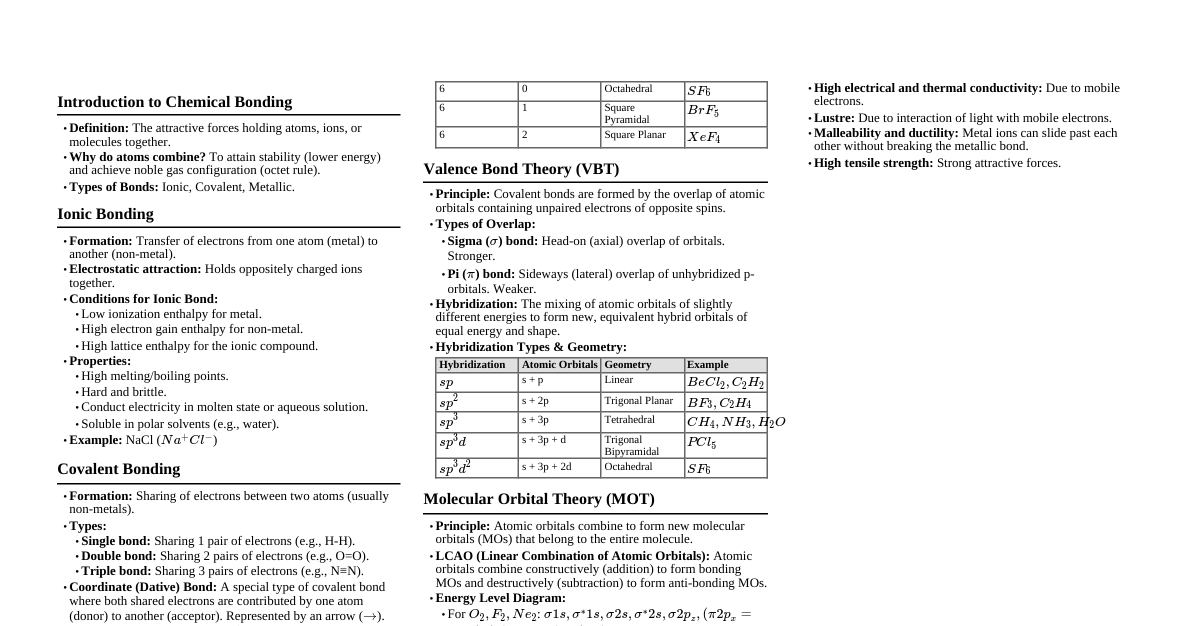
### 1. Introduction & The Octet Rule * **Chemical Bond**: The intramolecular attractive force that holds atoms, ions, or molecules together. It directly dictates both the chemical and physical properties of the resulting substance. * **Driving Force of Bonding**: Atoms combine to achieve a lower potential energy state, yielding a configuration that is significantly more stable than that of free, isolated atoms. * **The Octet Rule**: Noble gases (except Helium, which has a stable $1s^2$ doublet) possess highly stable $ns^2 np^6$ valence electron configurations. This stability is characterized by high ionization energies and low electron affinities. Consequently, other atoms react to gain, lose, or share electrons until their outer shell matches this eight-electron configuration. --- ### 2. Ionic Bonding: Principles and Energetics * **Ionic (Electrovalent) Bond**: Formed by the electrostatic attraction between oppositely charged ions (cations and anions) resulting from the complete transfer of one or more valence electrons from an electropositive atom to an electronegative atom. * **Favorable Thermodynamic Conditions**: 1. **Low Ionization Energy (IE)** of the metallic element, facilitating easy cation formation (typical of alkali and alkaline earth metals). 2. **High Electron Affinity (EA)** of the non-metallic element, facilitating anion formation (typical of halogens). 3. **High Lattice Energy ($U$)**, which provides the exothermic driving force that overcomes the net endothermic energy required for electron transfer. --- ### 3. The Born-Haber Cycle & Quantitative Calculations The cycle utilizes Hess’s Law to determine the lattice energy of an ionic solid. Hess's Law states that the overall enthalpy change of a reaction is equal to the sum of the enthalpy changes of its constituent individual steps. ### Mathematical Framework $$\Delta H^\circ_f = \Delta H^\circ_{\text{sub}} + \Delta H^\circ_{\text{diss}} + \text{IE} + \text{EA} + U_f$$ ### Variable Definitions and Units * $\Delta H^\circ_f$: Standard enthalpy of formation of the ionic solid ($\text{kJ}\cdot\text{mol}^{-1}$). * $\Delta H^\circ_{\text{sub}}$ (or $\Delta H^\circ_{\text{step } 1}$): Enthalpy of sublimation/vaporization of the solid metal ($\text{kJ}\cdot\text{mol}^{-1}$). * $\Delta H^\circ_{\text{diss}}$ (or $\Delta H^\circ_{\text{step } 2}$): Dissociation energy of the diatomic non-metal gas ($\text{kJ}\cdot\text{mol}^{-1}$); often scaled as $\frac{1}{2}\text{D}$ for monatomic halogen production. * $\text{IE}$ (or $\Delta H^\circ_{\text{step } 3}$): Ionization energy of the gaseous metal atom ($\text{kJ}\cdot\text{mol}^{-1}$). * $\text{EA}$ (or $\Delta H^\circ_{\text{step } 4}$): Electron affinity of the gaseous non-metal atom ($\text{kJ}\cdot\text{mol}^{-1}$). * $U_f$ (or $\Delta H^\circ_{\text{step } 5}$): Lattice energy contribution from gaseous ions coalescing into the crystalline solid ($\text{kJ}\cdot\text{mol}^{-1}$). ### Stepwise Enthalpy Breakdown (Example: $\text{NaCl}$) 1. **Vaporization**: $\text{Na}(s) \rightarrow \text{Na}(g) \quad (\Delta H^\circ_{\text{step } 1} = +108 \text{ kJ}\cdot\text{mol}^{-1})$ 2. **Dissociation**: $\frac{1}{2}\text{Cl}_2(g) \rightarrow \text{Cl}(g) \quad (\Delta H^\circ_{\text{step } 2} = \frac{1}{2} \text{ Bond Energy of } \text{Cl}_2 = +120 \text{ kJ}\cdot\text{mol}^{-1})$ 3. **Ionization**: $\text{Na}(g) \rightarrow \text{Na}^+(g) + e^- \quad (\Delta H^\circ_{\text{step } 3} = \text{IE}_1 = +496 \text{ kJ}\cdot\text{mol}^{-1})$ 4. **Ion Formation**: $\text{Cl}(g) + e^- \rightarrow \text{Cl}^-(g) \quad (\Delta H^\circ_{\text{step } 4} = \text{EA} = -349 \text{ kJ}\cdot\text{mol}^{-1})$ 5. **Lattice Consolidation**: $\text{Na}^+(g) + \text{Cl}^-(g) \rightarrow \text{NaCl}(s) \quad (\Delta H^\circ_{\text{step } 5} = U_{\text{NaCl}})$ ### Calculation Method Using the standard enthalpy of formation of $\text{NaCl}(s)$ ($\Delta H^\circ_f = -411 \text{ kJ}\cdot\text{mol}^{-1}$): $$U_{\text{NaCl}} = \Delta H^\circ_f - \left(\Delta H^\circ_{\text{step } 1} + \Delta H^\circ_{\text{step } 2} + \Delta H^\circ_{\text{step } 3} + \Delta H^\circ_{\text{step } 4}\right)$$ $$U_{\text{NaCl}} = -411 - [108 + 120 + 496 + (-349)] = -786 \text{ kJ}\cdot\text{mol}^{-1}$$ ### Lattice Energy Relationship (Coulomb's Law) The lattice energy ($U$) represents the enthalpy change when 1 mol of ionic solid separates into gaseous ions (endothermic definition) or when gaseous ions coalesce into a solid (exothermic definition). It is defined proportionally by: $$U \propto \frac{q_1 \times q_2}{r}$$ * $q_1, q_2$: Magnitudes of the charges on the cation and anion respectively (dimensionless units of charge). * $r$: Interionic distance separating the charges ($\text{pm}$ or $\text{m}$). * **Application**: Smaller ions with higher ionic charges generate larger lattice energies, creating stronger ionic bonds and higher melting points. --- ### 4. Structural Exceptions in Ionic Crystals * **Less than Octet (Helium-Isoelectronic Ions)**: Light ions situated near Helium ($\text{H}^-$, $\text{Li}^+$, $\text{Be}^{2+}$, $\text{B}^{3+}$) achieve stability by acquiring a stable duet ($1s^2$) rather than an octet. * **More than Octet (The 18-Electron Rule)**: Transition and post-transition metal cations do not form noble-gas configurations ($ns^2 np^6$) upon ionization. Instead, their valence electrons are first lost from the shell with the highest principal quantum number ($n$), resulting in filled $d$ subshells and a pseudo-noble gas configuration ($ns^2 np^6 nd^{10}$). ### Electron Configurations of Key Cations * **Iron Cations**: * $_{26}\text{Fe}$: $1s^2 2s^2 2p^6 3s^2 3p^6 4s^2 3d^6$ * $_{26}\text{Fe}^{2+}$: $1s^2 2s^2 2p^6 3s^2 3p^6 3d^6$ (Stable, non-isoelectronic with noble gases) * $_{26}\text{Fe}^{3+}$: $1s^2 2s^2 2p^6 3s^2 3p^6 3d^5$ (Stable, half-filled $d$-orbital) * **Zinc Cation**: * $_{30}\text{Zn}^{2+}$: $1s^2 2s^2 2p^6 3s^2 3p^6 3d^{10}$ or $[\text{Ar}]3d^{10}$ * **Gallium Cation**: * $_{31}\text{Ga}^{3+}$: $1s^2 2s^2 2p^6 3s^2 3p^6 3d^{10}$ or $[\text{Ar}]3d^{10}$ (Valence configuration: $ns^2 np^6 nd^{10}$) --- ### 5. Physical and Chemical Properties of Ionic Materials * **State & Structure**: Rigid, regular, three-dimensional crystalline solids designed to maximize attractions and minimize repulsions based on ionic sizes. * **Brittleness**: Applying mechanical stress shifts adjacent ionic layers. Like-charged ions align next to each other, causing strong electrostatic repulsion that cleaves the crystal. * **Thermal Behavior**: Exceptionally high melting and boiling points due to the extensive network of strong interionic forces. * **Solubility**: Readily soluble in polar solvents (e.g., water) where ion-dipole interactions stabilize the solvated ions. Insoluble in non-polar solvents (e.g., cyclohexane, petroleum ether) because the weak solvent-solute interactions cannot overcome the crystal's high lattice energy. * **Electrical Conductivity**: * **Solid State**: Insulators, because the ions are locked into fixed positions within the crystalline lattice and cannot act as charge carriers. * **Molten/Aqueous States**: Excellent conductors, because the lattice is disrupted and the ions are free to migrate toward electrodes. --- ### 6. Covalent Bonding: Mechanics of Formation * **Covalent Bond**: Formed when a pair of valence electrons is shared between two non-metal atoms of similar electronegativity, concentrating electron density between the two nuclei. * **Balance of Forces**: As two atoms approach, electrostatic repulsions (nucleus-nucleus, electron-electron) and attractions (each nucleus to both electron clouds) occur. A stable bond forms at an optimum internuclear distance where net attractive forces are maximized and potential energy is at a minimum. * **Bond Length**: The internuclear distance at this minimum energy point (e.g., for $\text{H}_2$, the bond length is $74 \text{ pm}$). * **Electron Classification**: * **Bonding Pairs**: Shared pairs of electrons located between the atomic nuclei. * **Non-bonding (Lone) Pairs**: Valence electron pairs localized on a single atom that do not participate in sharing. --- ### 7. Lewis Structural Formulation and Resonance ### Steps to Writing a Lewis Formula 1. **Sum Valence Electrons**: Add up the valence electrons of all constituent atoms. For anions, add one electron per unit of negative charge; for cations, subtract one electron per unit of positive charge. 2. **Skeletal Structure**: Position the most electropositive atom as the central atom (Hydrogen is always terminal and never central). Connect adjacent atoms using single lines representing shared electron pairs. 3. **Complete Terminal Octets**: Distribute remaining electrons as lone pairs to complete octets on all terminal atoms (except Hydrogen, which requires a duet). 4. **Complete Central Octet**: Assign any leftover electrons to the central atom as lone pairs. If the central atom lacks an octet, convert terminal lone pairs into double or triple bonds. ### Coordinate (Dative) Covalent Bonding Occurs when one participating atom donates both electrons to the shared bonding pair. The receiving atom must possess a vacant valence orbital. Examples include: * **Ammonium Ion ($\text{NH}_4^+$)**: Formed when the lone pair on the nitrogen of $\text{NH}_3$ is donated to a vacant $1s$ orbital of an $\text{H}^+$ ion. * **Other Examples**: Hydronium ion ($\text{H}_3\text{O}^+$), Boron trichloride-ammonia adducts, and Tetrachloroaluminate ($\text{AlCl}_4^-$). ### Resonance Structures When a single Lewis formula cannot accurately describe the electronic structure of a molecule, it is represented by multiple equivalent Lewis structures (resonance contributors) linked by double-headed arrows ($\leftrightarrow$). * **True Structure (Resonance Hybrid)**: A single stable composite structure showing electron-pair delocalization. The molecule does *not* flip between resonance forms. * **Ozone ($\text{O}_3$)**: Possesses two equivalent resonance structures. Experimental measurements show both oxygen-oxygen bonds are identical, with a length of $1.278 \text{ \text{\AA}}$—a value intermediate between a single ($1.47 \text{ \text{\AA}}$) and double ($1.21 \text{ \text{\AA}}$) bond. * **Nitrite Ion ($\text{NO}_2^-$)**: Features two equivalent structures with intermediate nitrogen-oxygen bonds. --- ### 8. Structural Exceptions in Covalent Bonding 1. **Electron-Deficient Compounds (Less than Octet)**: Compounds with stable central atoms from Group IIA and IIIA containing fewer than eight valence electrons. * $\text{BeCl}_2$ ($4$ electrons around $\text{Be}$) * $\text{BF}_3$ ($6$ electrons around $\text{B}$) * $\text{AlCl}_3$ ($6$ electrons around $\text{Al}$) 2. **Expanded Octet (More than Octet)**: Occurs in elements from Period 3 and below. Their larger atomic radii and the availability of vacant, energetically accessible $d$-orbitals allow them to accommodate $10$ or $12$ valence electrons. * $\text{PF}_5$ ($10$ valence electrons around $\text{P}$) * $\text{SF}_6$ ($12$ valence electrons around $\text{S}$) * $\text{XeF}_4$ ($12$ valence electrons around $\text{Xe}$) 3. **Odd-Electron Molecules (Free Radicals)**: Unstable or highly reactive molecules containing an odd number of valence electrons. * $\text{ClO}_2$ ($19$ valence electrons) * $\text{NO}$ ($11$ valence electrons) * $\text{NO}_2$ ($17$ valence electrons) --- ### 9. Molecular Polarity & Quantitative Dipole Moments * **Non-Polar Covalent Bond**: Formed between identical atoms with equal sharing of bonding electrons (e.g., $\text{H}-\text{H}$, $\text{F}-\text{F}$). * **Polar Covalent Bond**: Formed between atoms of different electronegativities, resulting in unequal sharing. The bonding electrons spend more time near the more electronegative atom, generating partial charges ($\delta^+, \delta^-$). ### Quantitative Dipole Moment ($\mu$) For a diatomic molecule, the dipole moment ($\mu$) is a vector quantity that measures bond polarity. $$\mu = \delta \times d$$ * $\mu$: Dipole moment ($\text{C}\cdot\text{m}$ or Debye, $\text{D}$). * $\delta$: Magnitude of the partial charge ($\text{C}$). * $d$: Separation distance between the charges ($\text{m}$). ### Conversions & Units $$1\text{ D} = 3.33564 \times 10^{-30} \text{ C}\cdot\text{m}$$ ### Polarity of Polyatomic Molecules The net molecular dipole moment ($\mu_{\text{net}}$) is the vector sum of all individual bond dipoles. It depends directly on molecular geometry: * **Symmetrical Geometries**: If polar bonds are arranged symmetrically, their vector components cancel out, yielding $\mu_{\text{net}} = 0\text{ D}$. * *Examples*: Carbon dioxide ($\text{CO}_2$, linear, $\mu = 0\text{ D}$); Boron trichloride ($\text{BCl}_3$, trigonal planar, $\mu = 0\text{ D}$); Carbon tetrachloride ($\text{CCl}_4$, tetrahedral, $\mu = 0\text{ D}$). * **Asymmetrical Geometries**: If the bonds are arranged asymmetrically, the bond dipoles reinforce each other, yielding $\mu_{\text{net}} > 0\text{ D}$. * *Examples*: Water ($\text{H}_2\text{O}$, bent, $\mu = 1.87\text{ D}$); Chloroform ($\text{CHCl}_3$, asymmetrical tetrahedral, $\mu = 1.02\text{ D}$). ### Isomeric Influence on Polarity * **cis-1,2-dichloroethene**: The polar $\text{C}-\text{Cl}$ bonds lie on the same side of the double bond. Their dipoles reinforce each other, giving the molecule a net dipole moment ($\mu = 1.89\text{ D}$). * **trans-1,2-dichloroethene**: The polar $\text{C}-\text{Cl}$ bonds lie on opposite sides of the double bond. Their dipoles cancel out, resulting in a non-polar molecule ($\mu = 0\text{ D}$). --- ### 10. Properties of Covalent Materials * **States of Matter**: Exist as gases ($\text{CO}_2$, $\text{H}_2$, $\text{Cl}_2$, $\text{NH}_3$), liquids ($\text{H}_2\text{O}$, $\text{Br}_2$), or volatile solids ($\text{I}_2$) at room temperature due to weak intermolecular forces. * **Volatility**: Highly volatile with low melting and boiling points, as phase transitions only require overcoming weak intermolecular forces rather than breaking strong covalent bonds. * **Solubility**: Generally insoluble in polar solvents like water, but highly soluble in non-polar organic solvents (e.g., cyclohexane, petroleum ether) because they match in polarity. * **Electrical Conductivity**: Non-electrolytes that do not conduct electricity in either the solid or liquid state due to the absence of mobile ions or free electrons. --- ### Key Notes * **Sign and Direction Conventions**: When drawing bond dipoles, the dipole arrow points from the positive end ($\delta^+$) to the negative end ($\delta^-$), with a crossed tail indicating the positive side: $$\overset{\mapsto}{\text{H}-\text{F}}$$ * **Lattice Energy Sign Convention**: * *Lattice Separation*: $\text{NaCl}(s) \rightarrow \text{Na}^+(g) + \text{Cl}^-(g) \quad (\Delta H^\circ = +786 \text{ kJ}\cdot\text{mol}^{-1}$, endothermic) * *Lattice Formation*: $\text{Na}^+(g) + \text{Cl}^-(g) \rightarrow \text{NaCl}(s) \quad (\Delta H^\circ = -786 \text{ kJ}\cdot\text{mol}^{-1}$, exothermic) * **Critical Transition Metal Ionization Rule**: Always remove electrons from the outermost $s$ subshell (highest $n$) before removing them from the inner $d$ subshell. For example, $\text{Fe}^{2+}$ has a configuration of $[\text{Ar}]3d^6$, not $[\text{Ar}]4s^2 3d^4$. * **Extremes**: Element groups on opposite sides of the periodic table (such as Group IA and Group VIIA) possess the greatest electronegativity differences, making them the most likely to form highly ionic compounds with very high lattice energies. * **Stability of Electron Deficients**: Although molecules like $\text{BF}_3$ are stable with less than an octet (six valence electrons), they remain Lewis acids and will readily form coordinate covalent bonds (e.g., yielding $\text{BF}_4^-$) to complete their octet when a suitable donor is present. --- ### 1. Molecular Geometry & VSEPR Theory Molecular geometry describes the three-dimensional spatial arrangement of atoms within a molecule or polyatomic ion. The fundamental tool for predicting this geometry is the **Valence-Shell Electron-Pair Repulsion (VSEPR) model**. ### VSEPR Fundamental Postulate Electron pairs in the valence shell of a central atom repel one another. To minimize these electrostatic repulsions, valence electron sets position themselves as far apart as possible, establishing distinct spatial orientations. ### Electron Pair Arrangement vs. Molecular Shape * **Electron Pair Arrangement**: Defined by the spatial orientation and distribution of *all* valence electron pairs (both bonding and non-bonding/lone pairs) surrounding the central atom. * **Molecular Shape**: Defined strictly by the relative positions of the atomic nuclei. When the central atom lacks lone pairs, the molecular shape matches the electron pair arrangement. When lone pairs are present, the same electron pair arrangement yields different molecular shapes. ### Pure Coordination Geometries ($AB_x$) For molecules of the general formula $AB_x$ (where central atom $A$ has no lone pairs and $x$ is an integer from $2$ to $6$): * **$AB_2$ (Linear)**: Two electron sets orient at a bond angle of $180^\circ$. Example: $\text{BeCl}_2$. * **$AB_3$ (Trigonal Planar)**: Three electron sets orient at a bond angle of $120^\circ$. Example: $\text{BF}_3$. * **$AB_4$ (Tetrahedral)**: Four electron sets orient at a bond angle of $109.5^\circ$. Example: $\text{CH}_4$. * **$AB_5$ (Trigonal Bipyramidal)**: Five electron sets orient in two distinct positions: * *Equatorial Position*: Three coplanar bonds with $120^\circ$ angles relative to each other. * *Axial Position*: Two collinear bonds perpendicular to the equatorial plane, forming $90^\circ$ angles with the equatorial bonds and a $180^\circ$ angle with each other. Example: $\text{PCl}_5$. * **$AB_6$ (Octahedral)**: Six electron sets orient at mutual bond angles of $90^\circ$ and $180^\circ$. *Note on Multiple Bonds*: Under VSEPR guidelines, multiple bonds (double or triple) are treated as a single electron set. For example, carbon dioxide ($\text{O}=\text{C}=\text{O}$) and acetylene ($\text{H}-\text{C}\equiv\text{C}-\text{H}$) each contain only two electron sets around their respective central atoms, resulting in linear arrangements. --- ### 2. Repulsive Force Hierarchies and Coordinate Distortions When the central atom of a molecule ($A$) accommodates both bonding pairs ($B$) and lone pairs ($E$), represented by the general formula $AB_xE_y$, the ideal bond angles undergo predictable distortions due to unequal repulsive interactions. ### The Repulsion Hierarchy $$\text{Lone Pair vs. Lone Pair (LP-LP)} > \text{Lone Pair vs. Bonding Pair (LP-BP)} > \text{Bonding Pair vs. Bonding Pair (BP-BP)}$$ Lone pairs are physically larger and more diffuse than bonding pairs because they are held by only one nucleus rather than being localized between two. Consequently, they occupy more space and exert stronger repulsions on neighboring electron pairs. ### Specific Structural Distortions ($AB_xE_y$) * **Sulfur Dioxide ($\text{SO}_2$ / $AB_2E$)**: Contains three electron sets (two double bonds, one lone pair). The overall electron pair arrangement is trigonal planar, but the presence of the lone pair distorts the shape to **bent** (V-shaped). The stronger LP-BP repulsion compresses the $\text{O}-\text{S}-\text{O}$ bond angle to less than $120^\circ$. * **Ammonia ($\text{NH}_3$ / $AB_3E$)**: Contains four electron sets (three bonding pairs, one lone pair) arranged in a tetrahedral geometry. The shape is **trigonal pyramidal**. Strong LP-BP repulsion pushes the $\text{N}-\text{H}$ bonds closer together, compressing the ideal tetrahedral angle of $109.5^\circ$ down to $107^\circ$. * **Water ($\text{H}_2\text{O}$ / $AB_2E_2$)**: Contains four electron sets (two bonding pairs, two lone pairs) arranged in a tetrahedral geometry. The molecular shape is **bent** (V-shaped). The presence of two lone pairs generates strong LP-LP and LP-BP repulsions, compressing the $\text{H}-\text{O}-\text{H}$ bond angle further to $104.5^\circ$. * **Sulfur Tetrafluoride ($\text{SF}_4$ / $AB_4E$)**: Contains five electron sets (four bonding pairs, one lone pair) arranged in a trigonal bipyramidal geometry. The lone pair can theoretically occupy either an axial or an equatorial position: * *Equatorial Option*: The lone pair encounters only two neighboring pairs at $90^\circ$ angles. * *Axial Option*: The lone pair encounters three neighboring pairs at $90^\circ$ angles. Because the equatorial option minimizes high-repulsion $90^\circ$ interactions, the lone pair occupies the equatorial position. This asymmetry distorts the bond angles away from the ideal trigonal bipyramidal values. --- ### 3. Molecular Symmetry & Polarity Transitions A molecule containing polar covalent bonds is not necessarily polar itself. The overall molecular polarity depends on its three-dimensional shape. ### Conditions for Non-Polarity in Polyatomic Molecules A molecule with polar bonds ($\mu_{\text{bond}} \neq 0$) will be non-polar ($\mu_{\text{net}} = 0\text{ D}$) if its geometry is highly symmetrical, allowing individual bond dipole vectors to cancel each other out. * **Carbon Dioxide ($\text{CO}_2$)**: The two polar $\text{C}-\text{O}$ bond dipoles are equal in magnitude but point in opposite directions ($180^\circ$ apart) along a linear geometry, resulting in a net dipole moment of $\mu = 0\text{ D}$. * **Carbon Tetrachloride ($\text{CCl}_4$)**: The four polar $\text{C}-\text{Cl}$ bond dipoles point toward the corners of a regular tetrahedron, canceling out completely to yield $\mu = 0\text{ D}$. ### Conditions for Polarity in Polyatomic Molecules A molecule will be polar ($\mu_{\text{net}} > 0\text{ D}$) if its geometry is asymmetrical, preventing the individual bond dipole vectors from canceling out. * **Water ($\text{H}_2\text{O}$)**: Its bent geometry prevents the two polar $\text{O}-\text{H}$ bond dipoles from canceling. Instead, they partially reinforce each other, resulting in a net dipole moment of $\mu = 1.87\text{ D}$ directed toward the oxygen atom. * **Chloroform ($\text{CHCl}_3$)**: Substituting one Chlorine atom in the symmetrical $\text{CCl}_4$ molecule with a less electronegative Hydrogen atom breaks the tetrahedral symmetry. The bond dipoles no longer cancel, resulting in a net molecular dipole moment of $\mu = 1.02\text{ D}$. ### Isomeric Polarization (Constitutional & Geometric) The physical properties of geometric isomers are strongly influenced by symmetry and dipole cancellation: * ***cis*-1,2-dichloroethene**: Both highly electronegative Chlorine atoms lie on the same side of the $\text{C}=\text{C}$ double bond. Their bond dipoles reinforce each other, giving the molecule a net dipole moment of $\mu = 1.89\text{ D}$ and a higher boiling point. * ***trans*-1,2-dichloroethene**: The Chlorine atoms lie on opposite sides of the $\text{C}=\text{C}$ double bond. Their bond dipoles point in opposite directions and cancel out, resulting in a non-polar molecule ($\mu = 0\text{ D}$). --- ### 4. Intermolecular Forces: Van der Waals & Hydrogen Bonding Intermolecular forces are the electrostatic attractions that hold separate molecules or monatomic particles together in a condensed state. They are weaker than intramolecular chemical bonds because they involve smaller, partial charges separated by larger distances. These forces determine physical properties such as melting points, boiling points, and solubility. ### Dipole-Dipole Forces * **Mechanism**: Electrostatic attractions that occur between polar molecules possessing permanent dipole moments. When these molecules align, the partially positive ($\delta^+$) region of one molecule attracts the partially negative ($\delta^-$) region of an adjacent molecule. * **Strength**: Stronger than London dispersion forces but weaker than ion-ion interactions. The strength of these attractions decreases rapidly as the distance between the dipoles increases. ### Hydrogen Bonding * **Mechanism**: An exceptionally strong type of dipole-dipole attraction that occurs when a Hydrogen atom is covalently bonded to a highly electronegative, small atom with lone pairs—specifically Nitrogen ($\text{N}$), Oxygen ($\text{O}$), or Fluorine ($\text{F}$). The highly polar bond draws electron density away from the Hydrogen nucleus, leaving a bare positive charge that strongly attracts a lone pair on the $\text{N}$, $\text{O}$, or $\text{F}$ atom of a neighboring molecule. * **Sequence Representations**: $$\text{F}-\text{H}\cdots\text{O} \quad \text{O}-\text{H}\cdots\text{N} \quad \text{N}-\text{H}\cdots\text{F}$$ * **Impact**: Hydrogen bonding is the strongest intermolecular attraction between neutral molecules, resulting in unusually high melting and boiling points (e.g., explaining why water is a liquid at room temperature while methane, $\text{CH}_4$, is a gas). --- ### 5. Dispersion Force Dynamics London dispersion forces (or dispersion forces) are weak attractions that exist between all particles, including non-polar molecules and noble gas atoms. ### Mechanism of Formation 1. In any atom or non-polar molecule, electrons are generally distributed symmetrically on average. 2. However, their continuous motion can cause a temporary, instantaneous imbalance in electron density, creating a momentary dipole. 3. This temporary dipole polarizes the electron cloud of a neighboring atom or molecule, inducing a matching temporary dipole. 4. The electrostatic attraction between these temporary dipoles holds the particles together. ### Factors Influencing the Strength of Dispersion Forces 1. **Molecular Weight (Size/Polarizability)**: Larger atoms or molecules have more electrons that are held further from the nucleus, making their electron clouds easier to distort (more polarizable). Consequently, dispersion forces increase with molecular weight, which explains why boiling points rise as molar mass increases. 2. **Molecular Geometry (Surface Area)**: Molecules with elongated, linear shapes provide more points of contact (greater surface area) than compact, spherical isomers. This allows their electron clouds to polarize more easily, resulting in stronger dispersion forces. ### Boiling Point Variations in Pentane Isomers ($\text{C}_5\text{H}_{12}$) * **$n$-pentane** (linear, high surface area contact): $\text{B.P.} = 36^\circ\text{C}$ * **2-methylbutane** (branched, intermediate surface area): $\text{B.P.} = 28^\circ\text{C}$ * **2,2-dimethylpropane** (spherical, low surface area contact): $\text{B.P.} = 9.5^\circ\text{C}$ --- ### 6. Metallic Bonding & The Electron-Sea Model Metallic bonding is the chemical attraction that holds atoms together in solid metals (e.g., copper, iron, aluminum). ### The Electron-Sea Model This model represents a solid metal as an orderly, three-dimensional array of positively charged metal cations submerged in a highly mobile, delocalized "sea" of valence electrons. * **Conduction Electrons**: The valence electrons are not bound to any individual metal nucleus. Instead, they are shared among all the atoms in the crystal lattice and are free to move throughout the entire metallic structure. * **Cohesive Force**: The metallic lattice is held together by the strong electrostatic attraction between the positive metal cations and this mobile sea of delocalized electrons. ### Factors Determining Metallic Bond Strength The strength of a metallic bond depends on: 1. **The Number of Delocalized Electrons**: A higher number of valence electrons contributed to the shared electron sea generates stronger electrostatic attractions and raises the melting point. 2. **Packing Efficiency**: More closely packed metal atoms decrease the distance between the metal cations and the delocalized electrons, increasing the strength of the metallic bond and raising the melting point. --- ### 7. Structural Origin of Metallic Properties * **Malleability and Ductility**: Unlike brittle ionic crystals, the metallic lattice is regular but not rigid. When a metal is struck by a hammer, its cations can slide past one another without experiencing repulsive forces or breaking the bond, because the mobile electron sea continually adjusts and cushions the shifting ions. This allows metals to be flattened into sheets (malleable) or drawn into wires (ductile). * **Electrical and Thermal Conductivity**: The delocalized conduction electrons move easily through the lattice when an electric potential is applied, making metals excellent conductors of electricity. These mobile electrons also transfer thermal vibrations rapidly from warmer regions of the metal to cooler ones, resulting in high thermal conductivity. * **Wide Phase Boundaries (Melting vs. Boiling Points)**: Melting a metal does not require completely breaking the metallic bonds; the cations simply gain enough energy to slide past one another in a mobile liquid state. However, boiling requires individual cations to completely break free from the attractive forces of the electron sea. Consequently, metals often have moderate melting points but exceptionally high boiling points. ### Gallium Phase Properties $$\text{Melting Point} = 29.8^\circ\text{C} \quad \text{Boiling Point} = 2403^\circ\text{C}$$ ### Group IA vs. Group IIA Comparison Alkaline earth metals (Group IIA) have significantly higher melting points than alkali metals (Group IA). This is because Group IIA metals contribute twice as many valence electrons to the shared electron sea and form more highly charged cations ($2+$ vs. $1+$), generating much stronger metallic bonds. --- ### Key Notes * **VSEPR Double Bond Rule**: Always treat double and triple bonds as a single electron group when predicting molecular geometry using VSEPR theory. * **Equatorial vs. Axial Selection Rule**: In a trigonal bipyramidal arrangement ($AB_5$ derivatives), lone pairs always occupy the equatorial positions to minimize high-energy $90^\circ$ electrostatic repulsions. * **Instantaneous Dipole Universality**: London dispersion forces are present in *all* matter (polar molecules, non-polar molecules, and monatomic noble gases), but they are the *only* intermolecular force keeping non-polar substances in a condensed phase. * **Gallium Anomaly**: Gallium ($\text{Ga}$) has a remarkably low melting point of $29.8^\circ\text{C}$, allowing it to melt in a human hand, but it does not boil until $2403^\circ\text{C}$. This extremely wide liquid range is a direct consequence of the unique balance of forces within its metallic lattice. * **Isomeric Polarity Rule**: In geometric isomers containing polar bonds, the *cis* configuration generally has a net dipole moment ($\mu_{\text{net}} > 0\text{ D}$) due to asymmetrical reinforcement, whereas the *trans* configuration has no net dipole moment ($\mu_{\text{net}} = 0\text{ D}$) due to symmetrical cancellation. --- ### 1. Modern Bonding Theories & Orbital Overlap Modern chemical bonding theories address the mechanical limitations of the Lewis and VSEPR models. While the Lewis model represents bonds schematically through valence electron-dot formulas, it fails to explain the physical mechanism of bond formation. Similarly, while VSEPR predicts molecular shapes, it does not explain how or why bonds form and has limited physical applicability. ### Valence Bond (VB) Theory Valence Bond theory proposes that a covalent bond forms when the valence atomic orbitals of two approaching atoms overlap in space. This overlapping region, situated between the nuclei, is occupied by a pair of shared electrons with paired (opposite) spins. * **Mechanics of Overlap**: As atomic orbitals overlap, the electron density between the two nuclei increases. This accumulation of negative charge provides the electrostatic attraction that pulls the positive nuclei together. * **Conditions for Maximum Bond Strength**: The strength of a covalent bond depends on the extent of orbital overlap. To maximize overlap and stability, orbitals with directional properties ($p$ and $d$ orbitals) orient themselves along the specific axes that allow the greatest spatial intersection. --- ### 2. Sigma ($\sigma$) and Pi ($\pi$) Bonds Covalent bonds are classified into two distinct types based on the spatial symmetry of their orbital overlap along the internuclear axis. ### Sigma ($\sigma$) Bonds A $\sigma$ bond is formed by the end-to-end, head-on, or linear overlap of atomic orbitals along the internuclear axis. This results in maximum electron density concentrated directly along the imaginary line connecting the two nuclei. * **Permissible Overlaps**: * $s-s$ orbital overlap (e.g., the $\text{H}-\text{H}$ bond in $\text{H}_2$, where two spherical $1s$ orbitals overlap). * $s-p$ orbital overlap (e.g., the $\text{H}-\text{F}$ bond in $\text{HF}$, where the $1s$ orbital of Hydrogen overlaps axially with the half-filled $2p_z$ orbital of Fluorine). * $p-p$ end-to-end overlap (e.g., the $\text{F}-\text{F}$ bond in $\text{F}_2$, where two $2p$ orbitals overlap along their collinear axes). * **Characteristics**: All single covalent bonds are $\sigma$ bonds. They allow free rotation of the bonded atoms around the bond axis. ### Pi ($\pi$) Bonds A $\pi$ bond is formed by the lateral, sideways, or parallel overlap of two half-filled $p$ orbitals that are oriented perpendicular to the internuclear axis. * **Characteristics**: The electron density in a $\pi$ bond is concentrated in two lobes located above and below the internuclear axis, with a node (zero electron density) directly along the axis. * **Restrictions**: $s-s$ and $s-p$ orbitals can never form $\pi$ bonds; they only overlap along the nuclear axis to form $\sigma$ bonds. $\pi$ bonds only occur in molecules containing multiple bonds. ### Structural Analysis of Multiple Bonds * **Single Bond**: Consists of exactly one $\sigma$ bond. * **Double Bond**: Consists of one $\sigma$ bond and one $\pi$ bond. The $\pi$ bond increases electron density between the nuclei, pulling them closer. * **Triple Bond**: Consists of one $\sigma$ bond and two mutually perpendicular $\pi$ bonds. --- ### 3. Hybridization of Atomic Orbitals ($sp, sp^2, sp^3$) To explain observed molecular geometries and valencies—such as carbon forming four equivalent bonds in methane ($\text{CH}_4$) despite having only two unpaired $p$-electrons in its ground state—VB theory introduces **hybridization**. This is the mathematical mixing of nonequivalent valence atomic orbitals ($s, p, d$) on a single atom to produce a new set of equivalent **hybrid orbitals**. ### General Principles of Hybridization 1. The number of hybrid orbitals produced is always equal to the number of pure atomic orbitals combined. 2. Hybrid orbitals are equivalent to each other in shape and energy, but they point in different directions in space to minimize electron-pair repulsion. 3. The notation for a hybrid orbital indicates the types and relative numbers of atomic orbitals mixed (e.g., $sp^3$ represents the mixing of one $s$ and three $p$ orbitals). ### $sp$ Hybrid Orbitals (Diagonal Hybridization) * **Composition**: Formed by mixing one $s$ and one $p$ orbital, producing two equivalent $sp$ hybrid orbitals. Each orbital has $50\%$ $s$-character and $50\%$ $p$-character. * **Geometry**: Linear, with a bond angle of $180^\circ$. * **Application ($\text{BeCl}_2$)**: * Ground state $\text{Be}$ ($1s^2 2s^2$) has no unpaired electrons. * Excitation promotes one $2s$ electron to a vacant $2p$ orbital: $$\text{Be}^* = 1s^2 2s^1 2p_x^1$$ * Mixing the $2s$ and $2p_x$ orbitals yields two linear $sp$ hybrid orbitals. These overlap axially with the $3p$ orbitals of Chlorine to form two $\text{Be}-\text{Cl}$ $\sigma$ bonds. ### $sp^2$ Hybrid Orbitals * **Composition**: Formed by mixing one $s$ and two $p$ orbitals, producing three equivalent $sp^2$ hybrid orbitals. Each orbital has $33.3\%$ $s$-character and $66.7\%$ $p$-character. * **Geometry**: Trigonal planar, with bond angles of $120^\circ$. * **Application ($\text{BCl}_3$)**: * Ground state $\text{B}$ ($1s^2 2s^2 2p^1$) has one unpaired electron. * Excitation yields: $$\text{B}^* = 1s^2 2s^1 2p_x^1 2p_y^1$$ * Mixing these three orbitals yields three trigonal planar $sp^2$ hybrid orbitals. These overlap with the $3p$ orbitals of Chlorine to form three $\text{B}-\text{Cl}$ $\sigma$ bonds. ### $sp^3$ Hybrid Orbitals * **Composition**: Formed by mixing one $s$ and three $p$ orbitals, producing four equivalent $sp^3$ hybrid orbitals. Each orbital has $25\%$ $s$-character and $75\%$ $p$-character. * **Geometry**: Tetrahedral, with bond angles of $109.5^\circ$. * **Application ($\text{CH}_4$)**: * Ground state $\text{C}$ ($1s^2 2s^2 2p^2$) has two unpaired electrons. * Excitation yields: $$\text{C}^* = 1s^2 2s^1 2p_x^1 2p_y^1 2p_z^1$$ * Mixing these four orbitals yields four equivalent $sp^3$ hybrid orbitals directed toward the corners of a tetrahedron. ### Hybridization in Heteroatomic Systems with Lone Pairs * **Ammonia ($\text{NH}_3$)**: The valence configuration of Nitrogen is $2s^2 2p^3$. It undergoes $sp^3$ hybridization to produce four equivalent orbitals. One $sp^3$ orbital is occupied by a lone pair of electrons, while the other three contain single electrons that overlap with the $1s$ orbitals of Hydrogen. LP-BP repulsion compresses the bond angles from $109.5^\circ$ to $107^\circ$. * **Water ($\text{H}_2\text{O}$)**: The valence configuration of Oxygen is $2s^2 2p^4$. It undergoes $sp^3$ hybridization, producing four hybrid orbitals. Two of these orbitals are occupied by lone pairs, and the remaining two overlap with the $1s$ orbitals of Hydrogen. Strong LP-LP and LP-BP repulsions compress the bond angle to $104.5^\circ$, forming a bent geometry. --- ### 4. d-Orbital Hybridization in Expanded Valence Shells Elements in the third period and below possess vacant $d$ orbitals in their valence shell ($3d, 4d$, etc.) that are energetically accessible. This allows them to undergo hybridization involving $d$ orbitals to accommodate $10$ or $12$ valence electrons. ### $sp^3d$ Hybridization ($\text{PCl}_5$) * **Composition**: Mixing one $s$, three $p$, and one $d$ orbital produces five equivalent $sp^3d$ hybrid orbitals. * **Excitation of Phosphorus ($Z=15$)**: * Ground state: $[Ne] 3s^2 3p^3 3d^0$ * Excited state: $[Ne] 3s^1 3p_x^1 3p_y^1 3p_z^1 3d_{z^2}^1$ * **Geometry**: Trigonal bipyramidal. * **Bond Anisotropy**: The three equatorial $\text{P}-\text{Cl}$ bonds lie in a single plane at $120^\circ$ angles. The two axial $\text{P}-\text{Cl}$ bonds lie perpendicular to this plane, forming $90^\circ$ angles with the equatorial bonds. Because the axial bond pairs experience stronger repulsion from the equatorial bond pairs, the axial bonds are slightly longer and weaker than the equatorial bonds, making $\text{PCl}_5$ highly reactive. ### $sp^3d^2$ Hybridization ($\text{SF}_6$) * **Composition**: Mixing one $s$, three $p$, and two $d$ orbitals produces six equivalent $sp^3d^2$ hybrid orbitals. * **Excitation of Sulfur ($Z=16$)**: * Ground state: $[Ne] 3s^2 3p^4 3d^0$ * Excited state: $[Ne] 3s^1 3p_x^1 3p_y^1 3p_z^1 3d_{z^2}^1 3d_{x^2-y^2}^1$ * **Geometry**: Octahedral, with all mutual bond angles at $90^\circ$. --- ### 5. Multiple Bond Hybridization & Rotational Restraints ### Ethene ($\text{C}_2\text{H}_4$) * **Carbon Hybridization**: Each carbon atom is surrounded by three electron sets, predicting a trigonal planar geometry and requiring $sp^2$ hybridization. * **Excitation and Mixing**: For each Carbon, the $2s$ orbital mixes with the $2p_x$ and $2p_y$ orbitals, leaving the $2p_z$ orbital unhybridized: $$\text{Hybrid State} = (sp^2)^3 (2p_z)^1$$ * **Bond Formation**: * The three $sp^2$ hybrid orbitals form three $\sigma$ bonds: two with Hydrogen $1s$ orbitals and one with the $sp^2$ orbital of the other Carbon. * The unhybridized $2p_z$ orbitals, which contain one electron each and are oriented perpendicular to the planar $\sigma$-bond framework, overlap laterally to form a $\pi$ bond. * **Rotational Restriction**: Ethene is a planar molecule. Rotation of one carbon atom relative to the other around the $\sigma$ bond is restricted at room temperature. Rotating the carbon atoms would misalign the parallel unhybridized $p$ orbitals, reducing their spatial overlap and breaking the $\pi$ bond. ### Acetylene ($\text{C}_2\text{H}_2$) * **Carbon Hybridization**: Each carbon atom is surrounded by two electron sets, requiring $sp$ hybridization. * **Excitation and Mixing**: For each Carbon, the $2s$ orbital mixes with the $2p_x$ orbital, leaving the $2p_y$ and $2p_z$ orbitals unhybridized: $$\text{Hybrid State} = (sp)^2 (2p_y)^1 (2p_z)^1$$ * **Bond Formation**: * The two $sp$ hybrid orbitals form two linear $\sigma$ bonds: one with a Hydrogen $1s$ orbital and one with the $sp$ orbital of the other Carbon. * The two unhybridized $2p$ orbitals on each Carbon are oriented perpendicular to the bond axis and to each other. They overlap laterally with the corresponding $2p$ orbitals of the adjacent Carbon to form two mutually perpendicular $\pi$ bonds. Thus, the carbon-carbon triple bond consists of one $\sigma$ bond and two $\pi$ bonds. --- ### 1. Molecular Orbital Theory (MOT) Molecular Orbital Theory offers a sophisticated quantum mechanical approach to chemical bonding, addressing key phenomena that Valence Bond Theory cannot explain, such as the paramagnetism of the oxygen molecule. ### Core Postulate When atomic nuclei approach one another, their individual atomic orbitals (AOs) combine and lose their identity, simultaneously transforming into a new set of delocalized molecular orbitals (MOs). * **Atomic Orbitals**: Represent the region of space where an electron moves under the electrostatic influence of a single nucleus. * **Molecular Orbitals**: Represent the region of space where an electron moves under the electrostatic influence of multiple nuclei. ### Bonding and Antibonding States The combination of two atomic orbitals always yields two molecular orbitals, which differ in energy and spatial distribution: * **Bonding Molecular Orbitals ($\sigma, \pi$)**: Generated by the mathematical addition of overlapping atomic orbital wavefunctions. This constructive interference concentrates electron density directly between the nuclei, shielding the positive charges from one another. Consequently, the potential energy of the system is lowered compared to the isolated atomic orbitals, providing stabilization. * **Antibonding Molecular Orbitals ($\sigma^*, \pi^*$)**: Generated by the mathematical subtraction of overlapping atomic orbital wavefunctions. This destructive interference concentrates electron density away from the region between the nuclei, creating a node (a plane of zero electron probability) between them. Lacking electrostatic shielding, the nuclei repel each other, raising the energy of the system and destabilizing it. ### Rules for Filling Molecular Orbitals Electrons fill molecular orbitals according to the same physical laws that govern atomic orbital occupation: 1. **The Aufbau Principle**: Orbitals are filled in order of increasing energy. 2. **The Pauli Exclusion Principle**: Each molecular orbital can accommodate a maximum of two electrons, which must possess opposite (paired) spins. 3. **Hund's Rule**: In degenerate molecular orbitals (orbitals of equal energy), electrons occupy empty orbitals singly with parallel spins before pairing begins. --- ### 2. Quantitative Bond Order & Molecular stability ### Mathematical Formula $$\text{Bond Order} = \frac{1}{2} (N_b - N_a)$$ ### Components * $N_b$: The total number of electrons residing in bonding molecular orbitals. * $N_a$: The total number of electrons residing in antibonding molecular orbitals. ### Application (How to Use) * **Stability**: If the calculated Bond Order is greater than zero, the molecule is stable relative to the isolated atoms. A Bond Order of zero indicates no net stabilization, meaning the molecule cannot exist (e.g., $\text{He}_2$). * **Physical Correlation**: Higher bond orders correspond to shorter bond lengths and higher bond dissociation energies. * A Bond Order of $1$ represents a single bond. * A Bond Order of $2$ represents a double bond. * A Bond Order of $3$ represents a triple bond. * Fractional bond orders (such as $0.5$ or $1.5$) are common in molecular ions like $\text{H}_2^+$ or $\text{He}_2^+$. --- ### 3. Molecular Orbital Energy Hierarchies & Electron Configurations The relative energy levels of molecular orbitals are determined experimentally by spectroscopy and depend on the total number of electrons in the homonuclear diatomic system. ### Configuration for Homonuclear Diatomics with 14 or Fewer Electrons For light elements (such as $\text{B}_2$, $\text{C}_2$, $\text{N}_2$, and their ions) where $Z \le 7$, $s-p$ mixing occurs, which raises the energy of the $\sigma_{2p_x}$ orbital above that of the degenerate $\pi_{2p}$ orbitals: $$\sigma_{1s} 7$, the energy difference between the $2s$ and $2p$ subshells is large enough to prevent significant $s-p$ mixing, restoring the expected ordering where $\sigma_{2p_x}$ is lower in energy than the $\pi_{2p}$ orbitals: $$\sigma_{1s} --- ### 4. Solid-State Classifications: Crystalline vs. Amorphous Solids are broadly divided into two structural categories based on their atomic organization: * **Crystalline Solids**: Composed of atoms, ions, or molecules arranged in a highly ordered, repeating three-dimensional pattern (the crystal lattice). Because all bonds within the lattice have equivalent environments, crystalline solids possess sharp, precise melting points. * **Amorphous Solids**: Characterized by a highly disordered internal structure lacking a long-range repeating pattern. They are typically formed when a liquid cools rapidly, freezing the particles in random positions before they can organize into a lattice. Because their intermolecular bonds have varying strengths, amorphous solids do not have a sharp melting point; instead, they gradually soften over a wide range of temperatures (e.g., butter, glass). --- ### 5. Crystalline Lattice Taxonomies & Properties Crystalline solids are classified into four distinct groups based on the particles occupying the lattice points and the forces holding them together: ### Ionic Crystals * **Lattice Particles**: Positive metal cations and negative non-metal anions. * **Cohesive Forces**: Strong electrostatic (ionic) bonds extending throughout the lattice. * **Properties**: Extremely hard, rigid, brittle, high melting points, non-conductors in the solid state but excellent conductors when molten or dissolved in water. * **Examples**: $\text{NaCl}$, $\text{CsCl}$. ### Molecular Crystals * **Lattice Particles**: Discrete, neutral molecules or monatomic elements. * **Cohesive Forces**: Weak intermolecular forces, including London dispersion forces, dipole-dipole attractions, and hydrogen bonds. * **Properties**: Soft, volatile, very low melting and boiling points, electrical and thermal insulators, often transparent. * **Examples**: Water ice ($\text{H}_2\text{O}$), dry ice ($\text{CO}_2$), sucrose, iodine ($\text{I}_2$). ### Covalent Network Crystals * **Lattice Particles**: Non-metal atoms. * **Cohesive Forces**: A continuous, three-dimensional network of strong, localized covalent bonds (making the entire crystal function as a single giant molecule). * **Properties**: Extremely hard, exceptionally high melting and boiling points, highly rigid, insoluble in water, typically electrical and thermal insulators. * **Examples**: Diamond ($\text{C}$), Quartz/Silicates ($\text{SiO}_2$). ### Metallic Crystals * **Lattice Particles**: Positive metal cations. * **Cohesive Forces**: Metallic bonds formed by the electrostatic attraction between the array of cations and a mobile, delocalized sea of valence electrons. * **Properties**: Malleable, ductile, lustrous (reflective), outstanding conductors of electricity and heat, variable hardness, moderate to high melting points. * **Examples**: Copper ($\text{Cu}$), Silver ($\text{Ag}$), Gold ($\text{Au}$), Iron ($\text{Fe}$). --- ### Final Unit Synthesis: Theoretical Models of Chemical Bonding To understand chemical bonding comprehensively, we must analyze and compare the three primary theoretical frameworks developed by chemists to explain how atoms interact to form compounds. ### 1. The Lewis Model * **Theoretical Basis**: Based on the octet rule, proposing that chemical bonds form when atoms share, gain, or lose valence electrons to achieve a stable, eight-electron noble gas configuration. * **Analytical Utility**: Simple, intuitive method for tracking valence electrons, predicting compound stoichiometry, and drawing skeletal structures of molecules and polyatomic ions. * **Limitations**: It is a purely two-dimensional, schematic model. It fails to explain three-dimensional molecular geometry, the physical mechanism of electron sharing, or the energetic changes that drive bond formation. ### 2. The Valence Bond (VB) Theory (incorporating VSEPR) * **Theoretical Basis**: Proposes that a covalent bond forms when the localized valence atomic orbitals of two approaching atoms overlap in space. To explain observed molecular geometries and coordinate directions, pure atomic orbitals ($s, p, d$) mix to form equivalent hybrid orbitals ($sp, sp^2, sp^3, sp^3d, sp^3d^2$). * **Analytical Utility**: Provides a physical, spatial mechanism for bond formation. It explains the structural difference between single and multiple bonds ($\sigma$ vs. $\pi$ overlap), accounts for restricted rotation around double bonds, and predicts molecular shapes and bond angles when paired with the VSEPR model. * **Limitations**: It treats electrons as being localized between specific pairs of atoms, which cannot account for resonance without drawing multiple hypothetical structures. It also fails to predict magnetic properties accurately, such as the paramagnetism of $\text{O}_2$. ### 3. The Molecular Orbital (MO) Theory * **Theoretical Basis**: Proposes that atomic orbitals combine mathematically to form delocalized molecular orbitals that span the entire molecule. Electrons are placed into these shared orbitals following quantum mechanical rules. * **Analytical Utility**: The most complete quantum mechanical model for bonding. It accurately predicts whether a molecule can exist using Bond Order calculations, explains fractional bonds, and correctly accounts for electron-pair delocalization and magnetic properties (paramagnetism vs. diamagnetism) without needing resonance structures. * **Limitations**: It is mathematically complex and computationally intensive. Unlike the intuitive Lewis or localized Valence Bond models, it does not provide a simple, easily visualized schematic of a molecule's structure. --- ### Key Notes * **Valence Bond vs. Molecular Orbital Theory**: * **VBT**: Focuses on localized bonds; electrons remain within the overlapping atomic orbitals of two specific bonded atoms. * **MOT**: Focuses on delocalized bonds; electrons move throughout molecular orbitals that extend over the entire molecule. * **The Oxygen Anomaly**: * **VBT Prediction**: Predicts a double bond ($\text{O}=\text{O}$) with all electrons paired, indicating that oxygen should be diamagnetic. * **MOT Prediction**: Predicts two unpaired electrons in degenerate $\pi^*_{2p}$ antibonding orbitals, correctly explaining why liquid oxygen is paramagnetic. * **The Diamond vs. Graphite Contrast**: Both are covalent network solids made of pure carbon, but they have completely different properties due to their hybridization: * **Diamond**: Carbon is $sp^3$ hybridized, forming a three-dimensional tetrahedral network. This structure makes it extremely hard, a thermal conductor, and an electrical insulator. * **Graphite**: Carbon is $sp^2$ hybridized, forming two-dimensional trigonal planar sheets linked by weak dispersion forces. The remaining unhybridized $p$ orbitals form a delocalized $\pi$ system, allowing the sheets to slide past one another (making it soft and slippery) and making it an excellent electrical conductor. * **The Solid-State $\text{PCl}_5$ Transformation**: * In the gas phase, phosphorus pentachloride exists as discrete, covalent, trigonal bipyramidal $\text{PCl}_5$ molecules. * In the solid phase, $\text{PCl}_5$ undergoes an autoionization reaction to form an ionic crystal lattice composed of alternating tetrahedral $[\text{PCl}_4]^+$ cations ($sp^3$ hybridized) and octahedral $[\text{PCl}_6]^-$ anions ($sp^3d^2$ hybridized): $$2\text{PCl}_5(g) \rightarrow [\text{PCl}_4]^+[\text{PCl}_6]^-(s)$$ * **Comparing Bond Characteristics**: * **Bond Length**: $\text{Single} > \text{Double} > \text{Triple}$ * **Bond Strength**: $\text{Triple} > \text{Double} > \text{Single}$ * **Orbital Overlap**: $\sigma$ bonds involve stronger head-on overlap than the weak sideways overlap of $\pi$ bonds, making a $\sigma$ bond stronger than a $\pi$ bond. However, a double bond ($\sigma + \pi$) is stronger than a single $\sigma$ bond alone.