Integration Cheatsheet
Cheatsheet Content
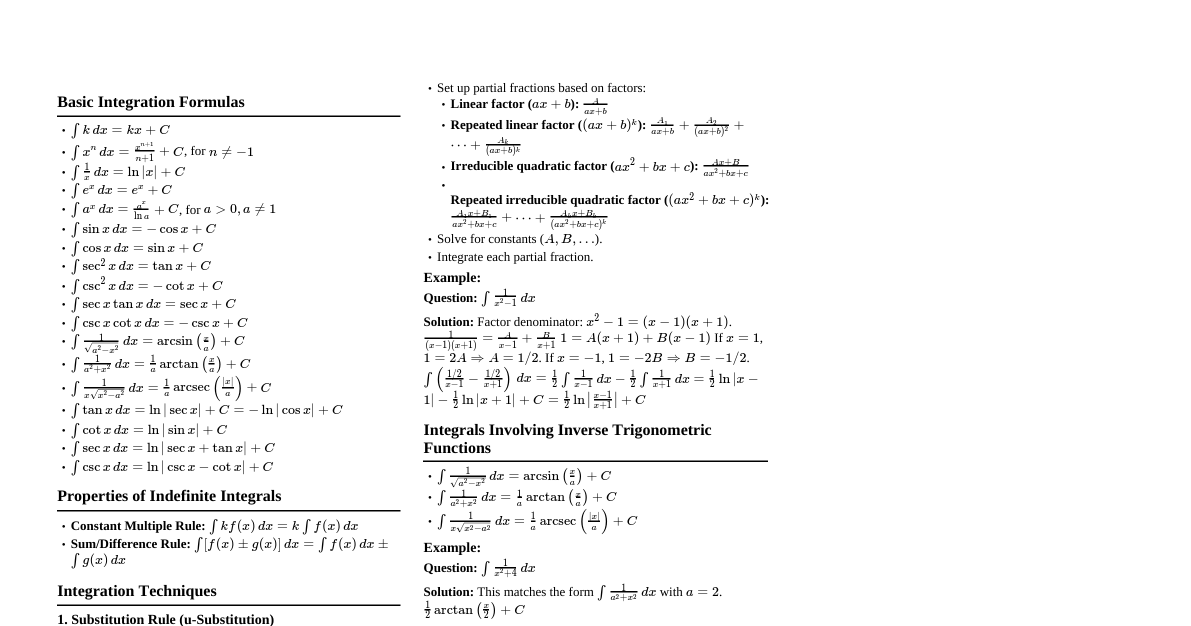
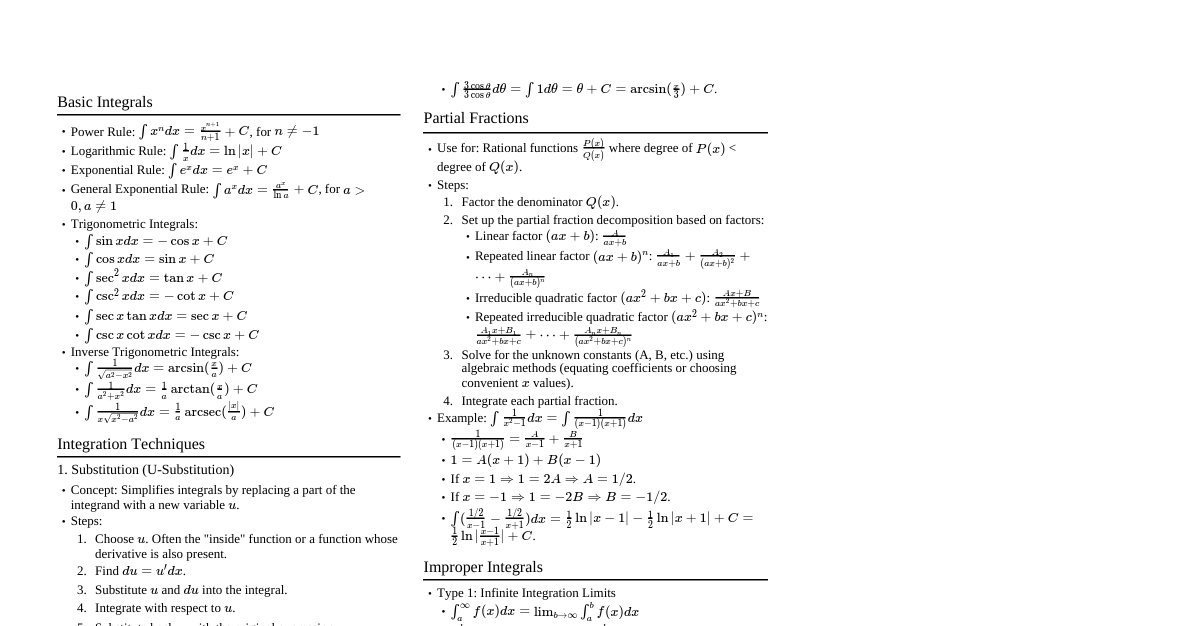
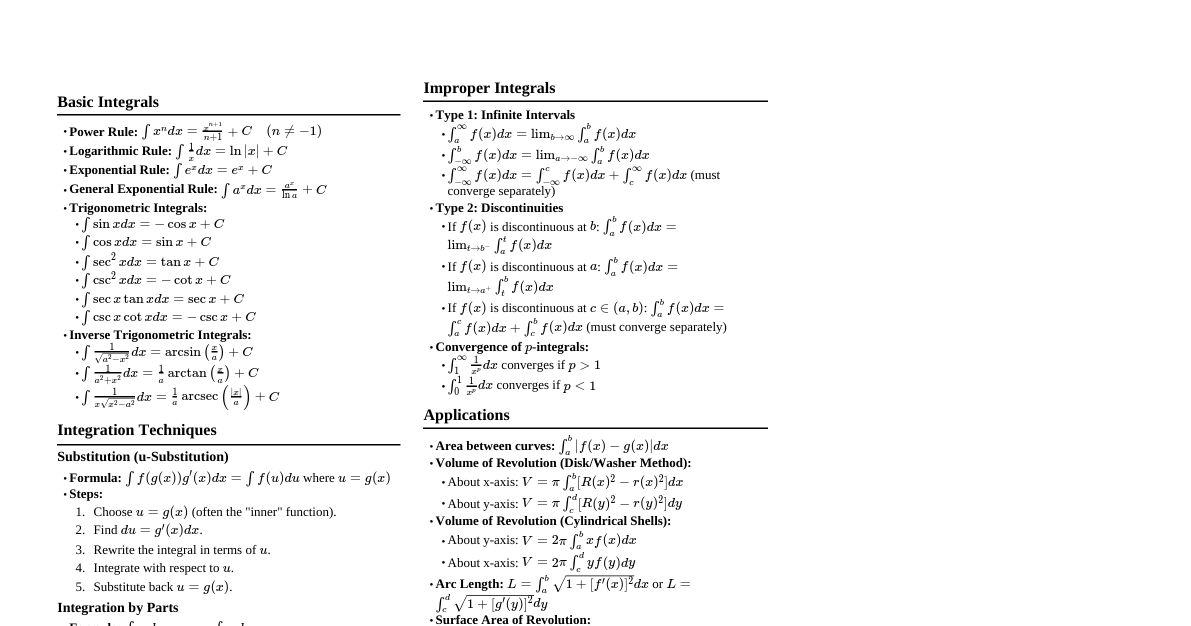
Definite Integration as Sum Riemann's Lower Sum: Let $h = \frac{b-a}{n}$. $$L = h[f(a) + f(a+h) + f(a+2h) + \dots + f(a+(n-1)h)]$$ Riemann's Upper Sum: Let $h = \frac{b-a}{n}$. $$U = h[f(a+h) + f(a+2h) + \dots + f(a+nh)]$$ Definite Integral as a Limit: $$\int_a^b f(x)dx = \lim_{h \to 0} h \sum_{r=0}^{n-1} f(a+rh) = \lim_{n \to \infty} \frac{b-a}{n} \sum_{r=1}^{n} f(a+r\frac{b-a}{n})$$ Fundamental Theorem of Calculus (FTOC) If $f(x)$ is continuous in $[a, b]$ and $F(x)$ is any antiderivative of $f(x)$ (i.e., $F'(x) = f(x)$), then: $$\int_a^b f(x)dx = F(b) - F(a)$$ Geometrical Meaning: The definite integral $\int_a^b f(x)dx$ gives the net signed area enclosed by $y=f(x)$, the x-axis, and the lines $x=a$ and $x=b$. Important: The antiderivative $F(x)$ must be continuous and derivable on $[a,b]$. Change of Variable in Definite Integration If $x = g(t)$, then $dx = g'(t)dt$. The limits of integration must also change from $a,b$ to $c,d$ where $a=g(c)$ and $b=g(d)$. $$\int_a^b f(x)dx = \int_c^d f(g(t)) \cdot g'(t)dt$$ If using $t=h(x)$, then $dt = h'(x)dx$. The limits of integration change from $a,b$ to $h(a),h(b)$. $$\int_a^b f(h(x)) \cdot h'(x)dx = \int_{h(a)}^{h(b)} f(t)dt$$ Properties of Definite Integral P(1) Change of Variable: $\int_a^b f(x)dx = \int_a^b f(t)dt$ (The value does not change). P(2) Reversal of Limits: $\int_a^b f(x)dx = - \int_b^a f(x)dx$ P(3) Interval Addition: If $c$ is a point between $a$ and $b$: $$\int_a^b f(x)dx = \int_a^c f(x)dx + \int_c^b f(x)dx$$ This is useful when $f(x)$ is not continuous or uniformly defined on $[a,b]$. P(4) Jack/King Property: $$\int_0^a f(x)dx = \int_0^a f(a-x)dx$$ $$\int_{-a}^a f(x)dx = \begin{cases} 2\int_0^a f(x)dx, & \text{if } f(x) \text{ is even} \\ 0, & \text{if } f(x) \text{ is odd} \end{cases}$$ P(5) King Property: $\int_a^b f(x)dx = \int_a^b f(a+b-x)dx$ P(6) Queen Property: $$\int_0^{2a} f(x)dx = \begin{cases} 2\int_0^a f(x)dx, & \text{if } f(2a-x) = f(x) \\ 0, & \text{if } f(2a-x) = -f(x) \end{cases}$$ P(7) Ace Property (Periodic Functions): If $f(T+x) = f(x)$, then: $$\int_0^{nT} f(x)dx = n \int_0^T f(x)dx$$ $$\int_a^{a+nT} f(x)dx = n \int_0^T f(x)dx$$ Platinum Point If $g(x)$ is the inverse of $f(x)$ and $f(x)$ has domain $x \in [a,b]$ where $f(a)=c$ and $f(b)=d$, then: $$\int_a^b f(x)dx + \int_c^d g(y)dy = bd-ac$$ Newton-Leibnitz Formula (Differentiation under Integral Sign) If $h(x)$ and $g(x)$ are differentiable functions of $x$, and $f(t)$ is a continuous function: $$\frac{d}{dx} \int_{g(x)}^{h(x)} f(t)dt = f(h(x))h'(x) - f(g(x))g'(x)$$ Walli's Formula For $\int_0^{\pi/2} \sin^m x \cos^n x dx$, where $m,n$ are non-negative integers: $$ \frac{[(m-1)(m-3)\dots 1 \text{ or } 2][(n-1)(n-3)\dots 1 \text{ or } 2]}{(m+n)(m+n-2)\dots 1 \text{ or } 2} \times K $$ where $K = \begin{cases} \pi/2, & \text{if both } m \text{ and } n \text{ are even} \\ 1, & \text{otherwise} \end{cases} $ Estimation of Definite Integrals Monotonically Increasing $f(x)$ in $[a,b]$: $$(b-a)f(a) < \int_a^b f(x)dx < (b-a)f(b)$$ Monotonically Decreasing $f(x)$ in $[a,b]$: $$(b-a)f(b) < \int_a^b f(x)dx < (b-a)f(a)$$ Non-Monotonic $f(x)$ in $[a,b]$: Let $m$ be the least value and $M$ be the greatest value of $f(x)$ in $[a,b]$. $$m(b-a) < \int_a^b f(x)dx < M(b-a)$$ Triangle Inequality for Integrals: $$\left| \int_a^b f(x)dx \right| \le \int_a^b |f(x)|dx$$ If $f(x) \le g(x) \le h(x)$ in $[a,b]$: $$\int_a^b f(x)dx \le \int_a^b g(x)dx \le \int_a^b h(x)dx$$ Differentiating & Integrating Series $(1+x)^n = \binom{n}{0} + \binom{n}{1}x + \binom{n}{2}x^2 + \dots + \binom{n}{n}x^n$ Differentiating this series can lead to sums involving binomial coefficients. Evaluating Integrals Dependent on Parameters To evaluate $I(c) = \int_{a(c)}^{b(c)} f(x,c)dx$: $$\frac{dI}{dc} = \int_{a(c)}^{b(c)} \frac{\partial}{\partial c} f(x,c)dx + f(b(c),c)\frac{db}{dc} - f(a(c),c)\frac{da}{dc}$$ Indefinite Integration: Basic Formulae $\int x^n dx = \frac{x^{n+1}}{n+1} + C \quad (n \ne -1)$ $\int e^x dx = e^x + C$ $\int \sin x dx = -\cos x + C$ $\int \cos x dx = \sin x + C$ $\int \sec^2 x dx = \tan x + C$ $\int \csc^2 x dx = -\cot x + C$ $\int \sec x \tan x dx = \sec x + C$ $\int \csc x \cot x dx = -\csc x + C$ $\int \frac{1}{x} dx = \ln|x| + C$ $\int a^x dx = \frac{a^x}{\ln a} + C$ Inverse Trigonometric Integrals $\int \frac{1}{\sqrt{a^2-x^2}} dx = \sin^{-1}\left(\frac{x}{a}\right) + C$ $\int \frac{1}{a^2+x^2} dx = \frac{1}{a}\tan^{-1}\left(\frac{x}{a}\right) + C$ $\int \frac{1}{x\sqrt{x^2-a^2}} dx = \frac{1}{a}\sec^{-1}\left(\frac{x}{a}\right) + C$ Properties of Indefinite Integrals $\int (f_1(x) + f_2(x))dx = \int f_1(x)dx + \int f_2(x)dx$ $\int k f(x)dx = k \int f(x)dx$ If $\int f(x)dx = \phi(x)+C$, then $\int f(ax+b)dx = \frac{1}{a}\phi(ax+b)+C$ $\frac{d}{dx} \left( \int f(x)dx \right) = f(x)$ $\int \frac{d}{dx} f(x)dx = f(x)+C$ Integration by Substitution If $I = \int f(x)dx$, substitute $x=g(z)$ so $dx=g'(z)dz$. Then $I = \int f(g(z))g'(z)dz$. Four Loving Integrals: $\int \tan x dx = \ln|\sec x| + C = -\ln|\cos x| + C$ $\int \cot x dx = \ln|\sin x| + C$ $\int \sec x dx = \ln|\sec x + \tan x| + C = \ln\left|\tan\left(\frac{\pi}{4}+\frac{x}{2}\right)\right| + C$ $\int \csc x dx = \ln|\csc x - \cot x| + C = \ln\left|\tan\left(\frac{x}{2}\right)\right| + C$ Some Important Substitutions: Expression Substitution $\sqrt{a^2-x^2}$ $x=a\sin\theta$ or $x=a\cos\theta$ $\sqrt{a^2+x^2}$ $x=a\tan\theta$ or $x=a\cot\theta$ $\sqrt{x^2-a^2}$ $x=a\sec\theta$ or $x=a\csc\theta$ $\sqrt{\frac{a-x}{a+x}}$ $x=a\cos 2\theta$ $\sqrt{(x-a)(b-x)}$ or $\sqrt{\frac{x-a}{b-x}}$ $x=a\cos^2\theta+b\sin^2\theta$ $\sqrt{(x-a)(x-b)}$ or $\sqrt{\frac{x-a}{x-b}}$ $x=a\sec^2\theta-b\tan^2\theta$ More Loving Integrals $\int \frac{1}{\sqrt{x^2+a^2}} dx = \ln|x+\sqrt{x^2+a^2}| + C$ $\int \frac{1}{\sqrt{x^2-a^2}} dx = \ln|x+\sqrt{x^2-a^2}| + C$ $\int \frac{dx}{a^2-x^2} = \frac{1}{2a}\ln\left|\frac{a+x}{a-x}\right| + C$ $\int \frac{dx}{x^2-a^2} = \frac{1}{2a}\ln\left|\frac{x-a}{x+a}\right| + C$ $\int \sqrt{a^2-x^2} dx = \frac{x}{2}\sqrt{a^2-x^2} + \frac{a^2}{2}\sin^{-1}\left(\frac{x}{a}\right) + C$ $\int \sqrt{x^2+a^2} dx = \frac{x}{2}\sqrt{x^2+a^2} + \frac{a^2}{2}\ln|x+\sqrt{x^2+a^2}| + C$ $\int \sqrt{x^2-a^2} dx = \frac{x}{2}\sqrt{x^2-a^2} - \frac{a^2}{2}\ln|x+\sqrt{x^2-a^2}| + C$ Integration by Partial Fractions Non-repeated linear factors: $$\frac{P(x)}{(x-a)(x-b)\dots} = \frac{A}{x-a} + \frac{B}{x-b} + \dots$$ Repeated linear factors: $$\frac{P(x)}{(x-a)^k} = \frac{A}{x-a} + \frac{B}{(x-a)^2} + \dots + \frac{K}{(x-a)^k}$$ Non-repeated non-factorable quadratic factors: $$\frac{P(x)}{(x^2+ax+b)(x^2+cx+d)\dots} = \frac{Ax+B}{x^2+ax+b} + \frac{Cx+D}{x^2+cx+d} + \dots$$ Integration by Parts (IBP) $\int u dv = uv - \int v du$ To choose $u$ and $dv$, use the ILATE rule (Inverse, Logarithmic, Algebraic, Trigonometric, Exponential). The function appearing first in ILATE is $u$. If no other function is present, take $1$ as the second function. General Formula: $\int u v dx = u v_1 - u' v_2 + u'' v_3 - u''' v_4 + \dots$ (where $v_n = \int v_{n-1} dx$) Classical Integrals $\int e^x (f(x) + f'(x))dx = e^x f(x) + C$ $\int (f(x) + x f'(x))dx = x f(x) + C$ $\int \sec^3 x dx = \frac{1}{2} (\sec x \tan x + \ln|\sec x + \tan x|) + C$ Integrals of Type $\int \frac{P(x)}{Q(x)}dx$ If $Q(x)$ contains $(a+b\sin 2x)$ or $(a+b\cos 2x)$, try to create $(\cos x \pm \sin x)$ in the numerator. If the limits of integration are reciprocal of each other, try the substitution $x=1/t$. Integration of Irrational Functions $\int \frac{dx}{(ax+b)\sqrt{px+q}}$: Substitute $px+q = t^2$. $\int \frac{dx}{(ax+b)\sqrt{px^2+qx+r}}$: Substitute $ax+b = \frac{1}{t}$. $\int \frac{dx}{(ax^2+bx+c)\sqrt{px+q}}$: Substitute $px+q = t^2$. $\int \frac{dx}{(ax^2+bx+c)\sqrt{px^2+qx+r}}$: If $ax^2+bx+c$ can be factored into linear factors, use partial fractions. If $ax^2+bx+c$ is a perfect square, say $(Ax+B)^2$, substitute $Ax+B = \frac{1}{t}$. If $b=0, q=0$, i.e., $\int \frac{dx}{(ax^2+c)\sqrt{px^2+r}}$, substitute $x = \frac{1}{t}$ or use trigonometric substitutions. Reduction Formulae $\int \tan^n x dx = \frac{\tan^{n-1}x}{n-1} - \int \tan^{n-2} x dx$ $\int \cot^n x dx = -\frac{\cot^{n-1}x}{n-1} - \int \cot^{n-2} x dx$ $\int \sec^n x dx = \frac{\sec^{n-2}x \tan x}{n-1} + \frac{n-2}{n-1} \int \sec^{n-2} x dx$ $\int \csc^n x dx = -\frac{\csc^{n-2}x \cot x}{n-1} + \frac{n-2}{n-1} \int \csc^{n-2} x dx$ $\int (a^2+x^2)^n dx = \frac{x(a^2+x^2)^n}{2n+1} + \frac{2na^2}{2n+1} \int (a^2+x^2)^{n-1} dx$ $\int \sin^n x dx = -\frac{\sin^{n-1}x \cos x}{n} + \frac{n-1}{n} \int \sin^{n-2} x dx$ $\int \cos^n x dx = \frac{\cos^{n-1}x \sin x}{n} + \frac{n-1}{n} \int \cos^{n-2} x dx$ Some Integrals Which Cannot Be Found in Terms of Known Elementary Functions $\int \frac{\sin x}{x} dx$ (Sine Integral) $\int \frac{\cos x}{x} dx$ (Cosine Integral) $\int \sqrt{\sin x} dx$ $\int \sin^2 x dx$ $\int \cos^2 x dx$ $\int x \tan x dx$ $\int e^{-x^2} dx$ (Error Function) $\int e^{x^2} dx$ $\int \frac{x^3}{1+x^6} dx$ $\int (1+x^2)^{3/2} dx$ $\int \frac{dx}{\ln x}$ (Logarithmic Integral) $\int \sqrt{1+k^2 \sin^2 x} dx$ (Elliptic Integral)