Indefinite Integration Cheatsheet
Cheatsheet Content
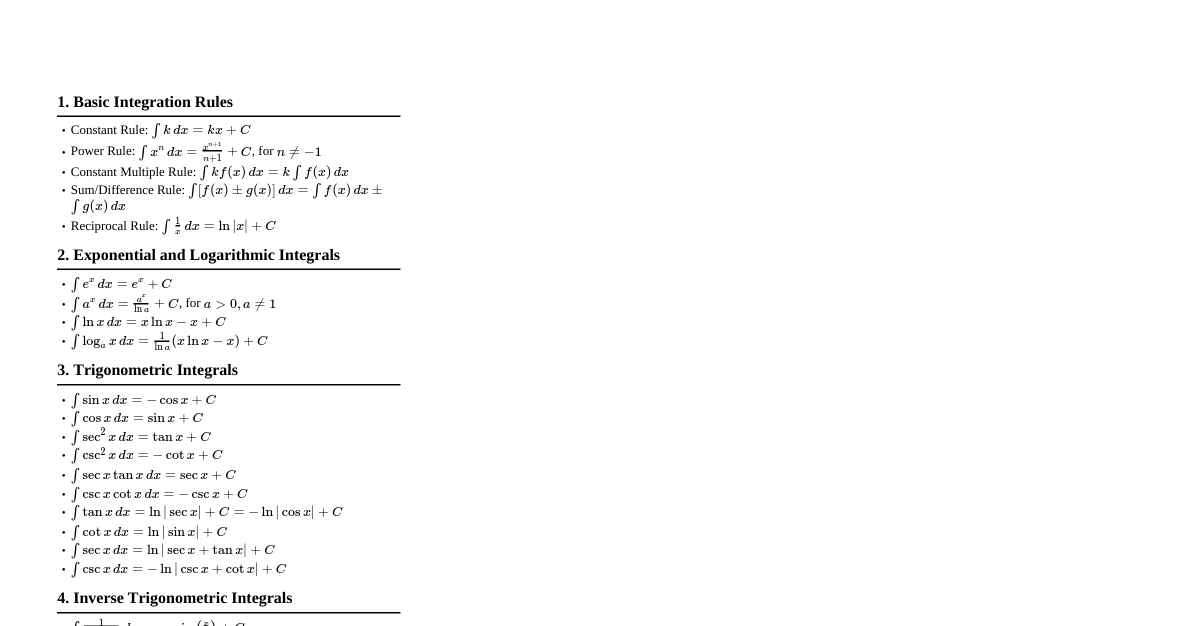
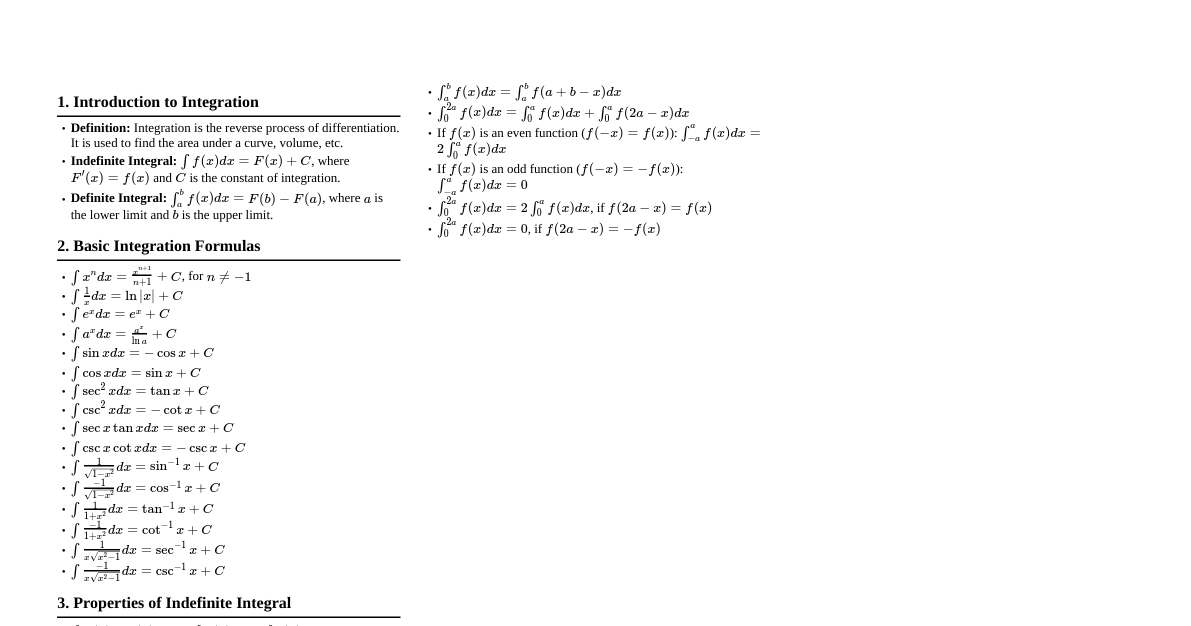
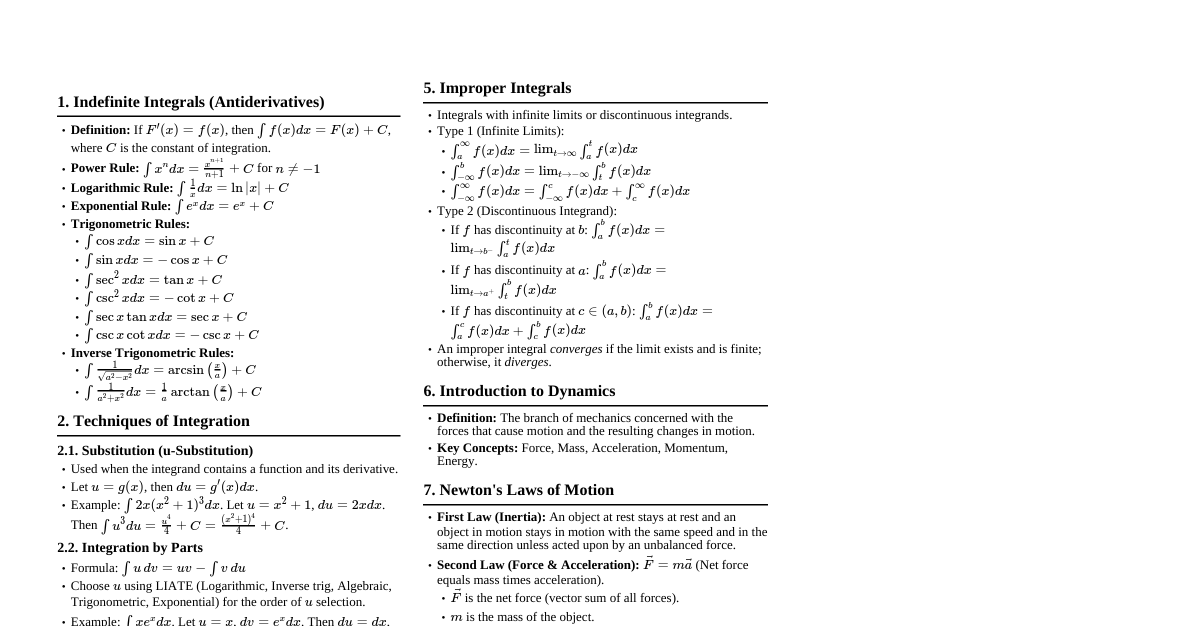
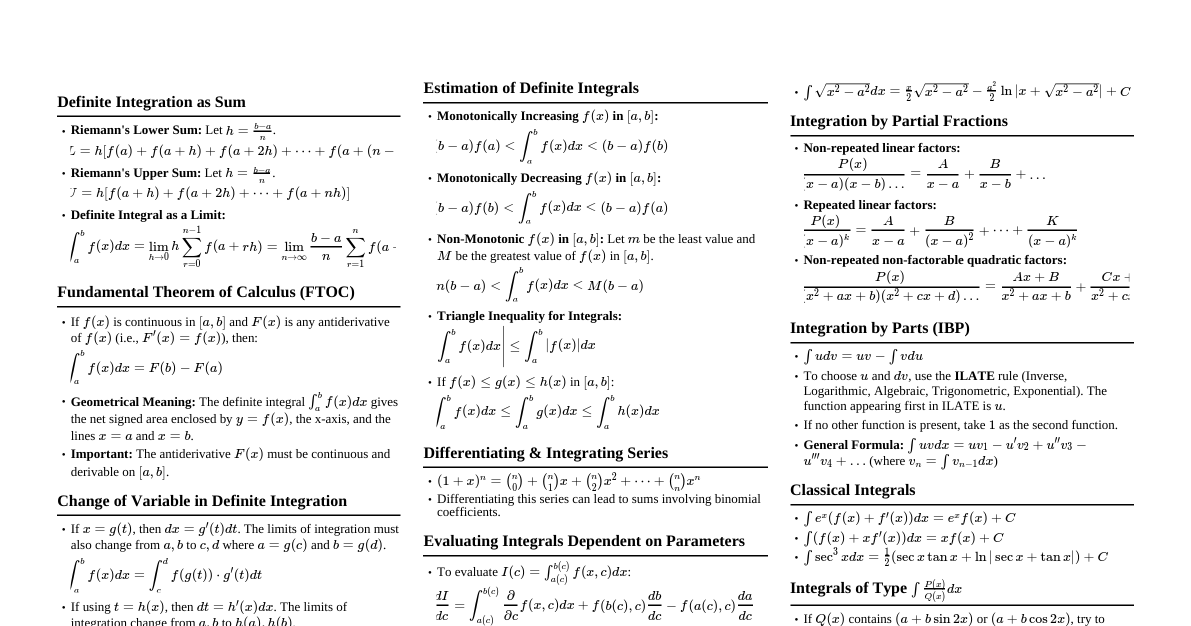
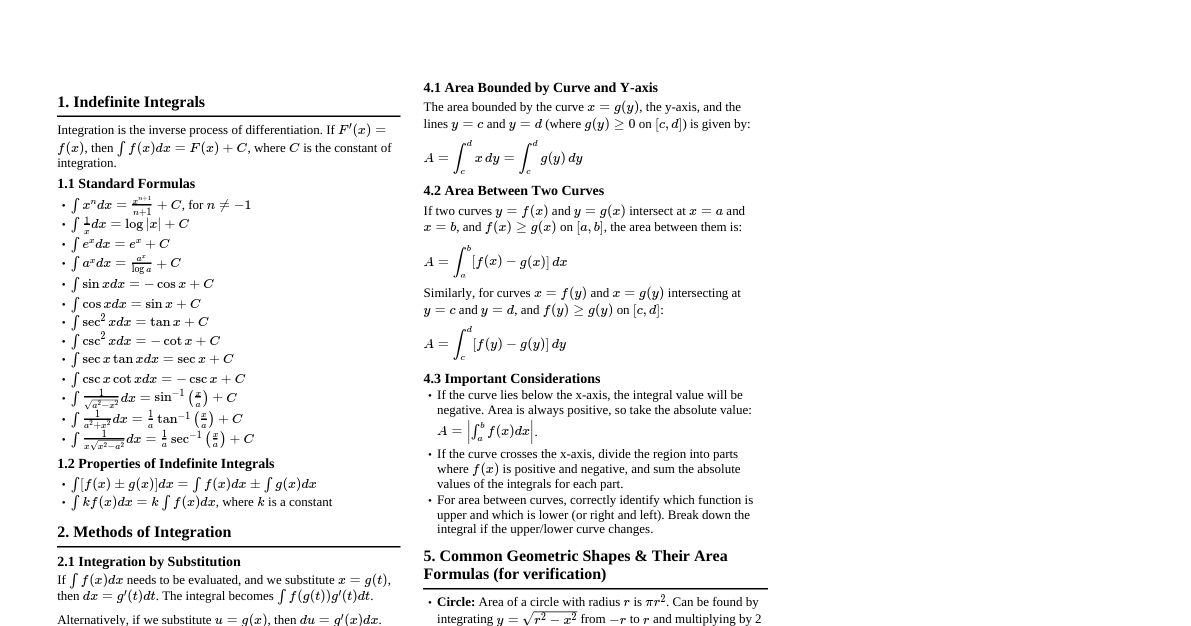
Basic Integration Formulas $\int k \, dx = kx + C$ $\int x^n \, dx = \frac{x^{n+1}}{n+1} + C$, for $n \neq -1$ $\int \frac{1}{x} \, dx = \ln|x| + C$ $\int e^x \, dx = e^x + C$ $\int a^x \, dx = \frac{a^x}{\ln a} + C$, for $a > 0, a \neq 1$ $\int \sin x \, dx = -\cos x + C$ $\int \cos x \, dx = \sin x + C$ $\int \sec^2 x \, dx = \tan x + C$ $\int \csc^2 x \, dx = -\cot x + C$ $\int \sec x \tan x \, dx = \sec x + C$ $\int \csc x \cot x \, dx = -\csc x + C$ $\int \frac{1}{\sqrt{a^2 - x^2}} \, dx = \arcsin\left(\frac{x}{a}\right) + C$ $\int \frac{1}{a^2 + x^2} \, dx = \frac{1}{a} \arctan\left(\frac{x}{a}\right) + C$ $\int \frac{1}{x\sqrt{x^2 - a^2}} \, dx = \frac{1}{a} \operatorname{arcsec}\left(\frac{|x|}{a}\right) + C$ $\int \tan x \, dx = \ln|\sec x| + C = -\ln|\cos x| + C$ $\int \cot x \, dx = \ln|\sin x| + C$ $\int \sec x \, dx = \ln|\sec x + \tan x| + C$ $\int \csc x \, dx = \ln|\csc x - \cot x| + C$ Properties of Indefinite Integrals Constant Multiple Rule: $\int k f(x) \, dx = k \int f(x) \, dx$ Sum/Difference Rule: $\int [f(x) \pm g(x)] \, dx = \int f(x) \, dx \pm \int g(x) \, dx$ Integration Techniques 1. Substitution Rule (u-Substitution) If $u = g(x)$, then $du = g'(x) \, dx$. Formula: $\int f(g(x))g'(x) \, dx = \int f(u) \, du$ Example: Question: $\int x \cos(x^2) \, dx$ Solution: Let $u = x^2$, then $du = 2x \, dx \Rightarrow x \, dx = \frac{1}{2} du$. $\int \cos(u) \frac{1}{2} du = \frac{1}{2} \int \cos(u) \, du = \frac{1}{2} \sin(u) + C$ Substitute back $u=x^2$: $\frac{1}{2} \sin(x^2) + C$ 2. Integration by Parts Formula: $\int u \, dv = uv - \int v \, du$ Choose $u$ using LIATE rule (Logarithmic, Inverse trig, Algebraic, Trigonometric, Exponential). Example: Question: $\int x e^x \, dx$ Solution: Let $u = x$ and $dv = e^x \, dx$. Then $du = dx$ and $v = e^x$. $\int x e^x \, dx = x e^x - \int e^x \, dx = x e^x - e^x + C$ 3. Trigonometric Integrals Using identities to simplify. $\int \sin^m x \cos^n x \, dx$ If $m$ is odd: pull out $\sin x$, convert rest to $\cos x$ using $\sin^2 x = 1 - \cos^2 x$. Let $u = \cos x$. If $n$ is odd: pull out $\cos x$, convert rest to $\sin x$ using $\cos^2 x = 1 - \sin^2 x$. Let $u = \sin x$. If $m, n$ are both even: use half-angle identities: $\sin^2 x = \frac{1-\cos(2x)}{2}$, $\cos^2 x = \frac{1+\cos(2x)}{2}$. $\int \tan^m x \sec^n x \, dx$ If $n$ is even ($n \ge 2$): pull out $\sec^2 x$, convert rest to $\tan x$ using $\sec^2 x = 1 + \tan^2 x$. Let $u = \tan x$. If $m$ is odd ($m \ge 1$): pull out $\sec x \tan x$, convert rest to $\sec x$ using $\tan^2 x = \sec^2 x - 1$. Let $u = \sec x$. Example: Question: $\int \sin^3 x \, dx$ Solution: $\int \sin^2 x \sin x \, dx = \int (1 - \cos^2 x) \sin x \, dx$ Let $u = \cos x$, then $du = -\sin x \, dx$. $\int (1 - u^2) (-du) = \int (u^2 - 1) \, du = \frac{u^3}{3} - u + C$ Substitute back $u=\cos x$: $\frac{\cos^3 x}{3} - \cos x + C$ 4. Trigonometric Substitution Used for integrands involving $\sqrt{a^2 \pm x^2}$ or $\sqrt{x^2 - a^2}$. Expression Substitution Identity $\sqrt{a^2 - x^2}$ $x = a \sin \theta$ $a^2 \cos^2 \theta$ $\sqrt{a^2 + x^2}$ $x = a \tan \theta$ $a^2 \sec^2 \theta$ $\sqrt{x^2 - a^2}$ $x = a \sec \theta$ $a^2 \tan^2 \theta$ Example: Question: $\int \frac{1}{\sqrt{9 - x^2}} \, dx$ Solution: Let $x = 3 \sin \theta$, then $dx = 3 \cos \theta \, d\theta$. $\sqrt{9 - x^2} = \sqrt{9 - 9 \sin^2 \theta} = \sqrt{9 \cos^2 \theta} = 3 |\cos \theta|$. Assume $\cos \theta > 0$. $\int \frac{3 \cos \theta}{3 \cos \theta} \, d\theta = \int 1 \, d\theta = \theta + C$ Since $x = 3 \sin \theta$, $\sin \theta = \frac{x}{3}$, so $\theta = \arcsin\left(\frac{x}{3}\right)$. Result: $\arcsin\left(\frac{x}{3}\right) + C$ 5. Partial Fraction Decomposition Used for rational functions $\frac{P(x)}{Q(x)}$ where degree of $P(x)$ is less than degree of $Q(x)$. Factor the denominator $Q(x)$. Set up partial fractions based on factors: Linear factor ($ax+b$): $\frac{A}{ax+b}$ Repeated linear factor ($(ax+b)^k$): $\frac{A_1}{ax+b} + \frac{A_2}{(ax+b)^2} + \dots + \frac{A_k}{(ax+b)^k}$ Irreducible quadratic factor ($ax^2+bx+c$): $\frac{Ax+B}{ax^2+bx+c}$ Repeated irreducible quadratic factor ($(ax^2+bx+c)^k$): $\frac{A_1x+B_1}{ax^2+bx+c} + \dots + \frac{A_kx+B_k}{(ax^2+bx+c)^k}$ Solve for constants ($A, B, \dots$). Integrate each partial fraction. Example: Question: $\int \frac{1}{x^2 - 1} \, dx$ Solution: Factor denominator: $x^2 - 1 = (x-1)(x+1)$. $\frac{1}{(x-1)(x+1)} = \frac{A}{x-1} + \frac{B}{x+1}$ $1 = A(x+1) + B(x-1)$ If $x=1$, $1 = 2A \Rightarrow A = 1/2$. If $x=-1$, $1 = -2B \Rightarrow B = -1/2$. $\int \left(\frac{1/2}{x-1} - \frac{1/2}{x+1}\right) \, dx = \frac{1}{2} \int \frac{1}{x-1} \, dx - \frac{1}{2} \int \frac{1}{x+1} \, dx$ $= \frac{1}{2} \ln|x-1| - \frac{1}{2} \ln|x+1| + C = \frac{1}{2} \ln\left|\frac{x-1}{x+1}\right| + C$ Integrals Involving Inverse Trigonometric Functions $\int \frac{1}{\sqrt{a^2 - x^2}} \, dx = \arcsin\left(\frac{x}{a}\right) + C$ $\int \frac{1}{a^2 + x^2} \, dx = \frac{1}{a} \arctan\left(\frac{x}{a}\right) + C$ $\int \frac{1}{x\sqrt{x^2 - a^2}} \, dx = \frac{1}{a} \operatorname{arcsec}\left(\frac{|x|}{a}\right) + C$ Example: Question: $\int \frac{1}{x^2 + 4} \, dx$ Solution: This matches the form $\int \frac{1}{a^2 + x^2} \, dx$ with $a=2$. $\frac{1}{2} \arctan\left(\frac{x}{2}\right) + C$ Integrals of Hyperbolic Functions $\int \sinh x \, dx = \cosh x + C$ $\int \cosh x \, dx = \sinh x + C$ $\int \operatorname{sech}^2 x \, dx = \tanh x + C$ $\int \operatorname{csch}^2 x \, dx = -\coth x + C$ $\int \operatorname{sech} x \tanh x \, dx = -\operatorname{sech} x + C$ $\int \operatorname{csch} x \coth x \, dx = -\operatorname{csch} x + C$ Completing the Square Used to transform quadratic expressions in the denominator or under a square root into forms suitable for trig substitution or inverse trig formulas. Example: Question: $\int \frac{1}{x^2 + 2x + 2} \, dx$ Solution: Complete the square for $x^2 + 2x + 2$: $x^2 + 2x + 1 + 1 = (x+1)^2 + 1$ So, $\int \frac{1}{(x+1)^2 + 1} \, dx$. Let $u = x+1$, then $du = dx$. $\int \frac{1}{u^2 + 1} \, du = \arctan(u) + C$ Substitute back $u=x+1$: $\arctan(x+1) + C$