Integration Cheatsheet
Cheatsheet Content
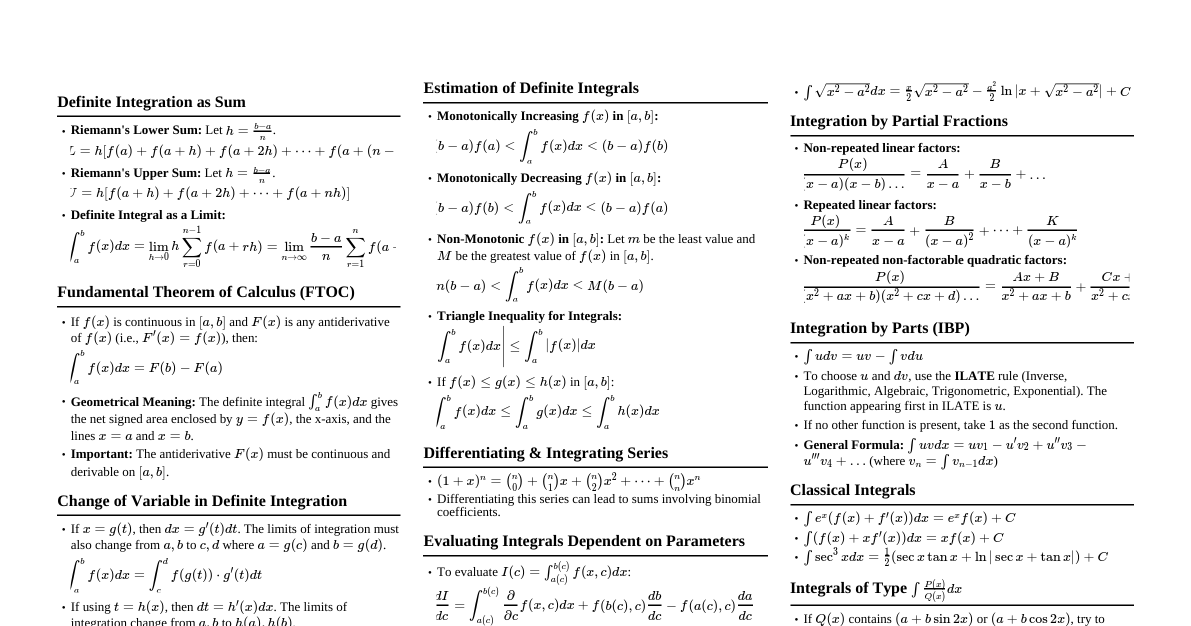
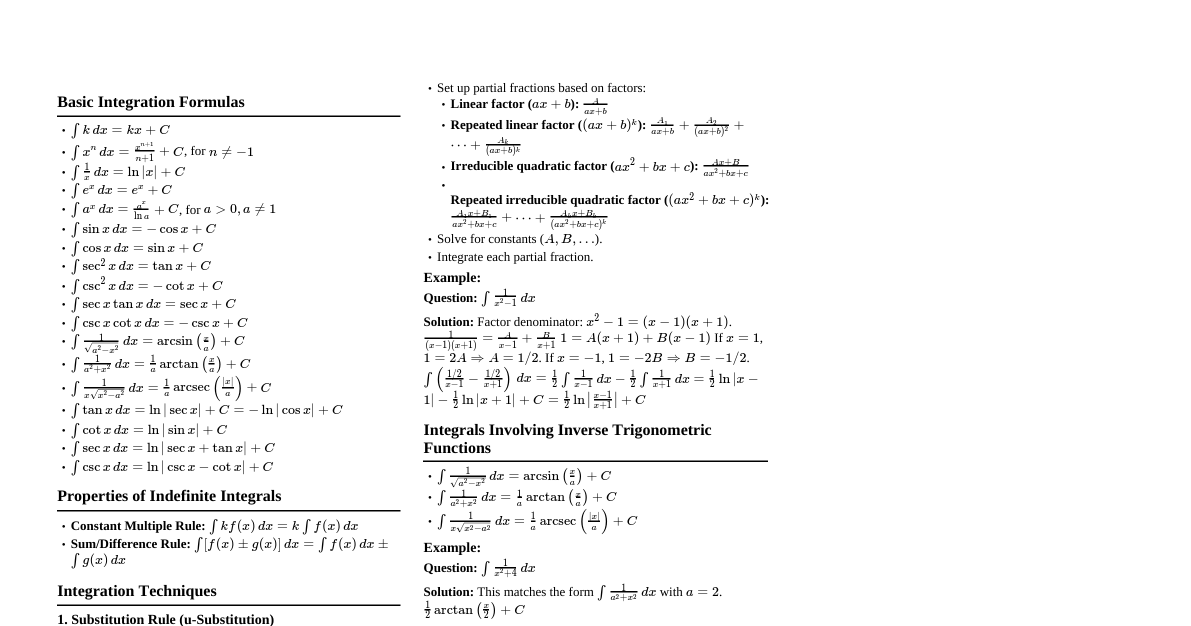
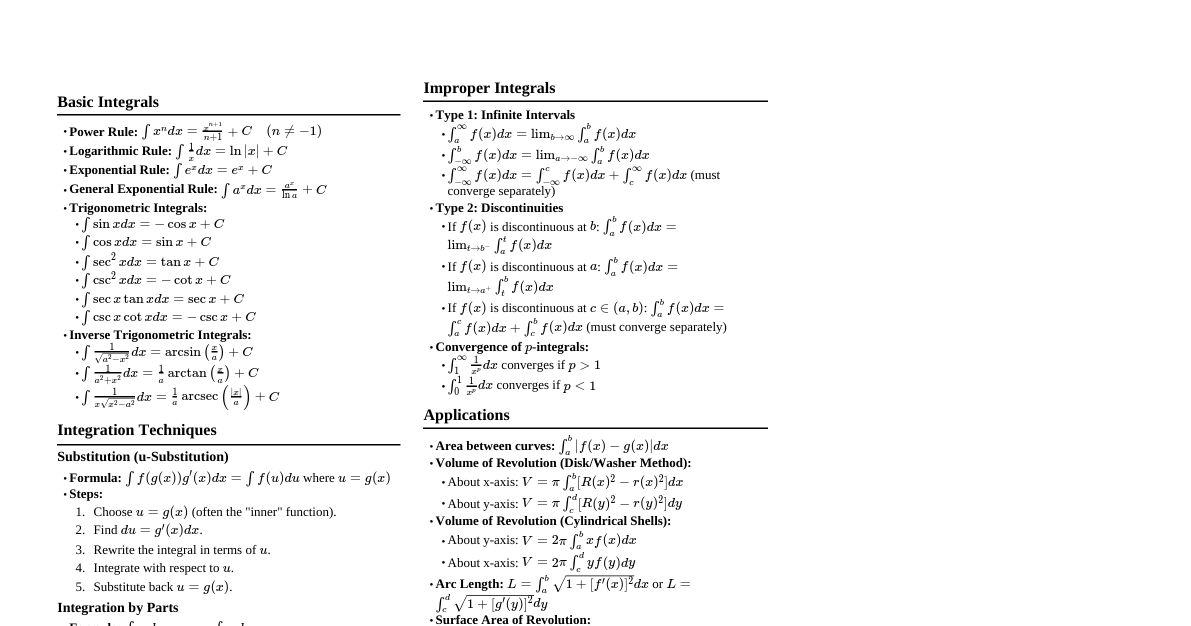
### Basic Integrals - **Power Rule:** $\int x^n dx = \frac{x^{n+1}}{n+1} + C$, for $n \neq -1$ - **Logarithmic Rule:** $\int \frac{1}{x} dx = \ln|x| + C$ - **Exponential Rule:** $\int e^x dx = e^x + C$ - **General Exponential Rule:** $\int a^x dx = \frac{a^x}{\ln a} + C$, for $a > 0, a \neq 1$ - **Trigonometric Integrals:** - $\int \sin x dx = -\cos x + C$ - $\int \cos x dx = \sin x + C$ - $\int \sec^2 x dx = \tan x + C$ - $\int \csc^2 x dx = -\cot x + C$ - $\int \sec x \tan x dx = \sec x + C$ - $\int \csc x \cot x dx = -\csc x + C$ - **Inverse Trigonometric Integrals:** - $\int \frac{1}{\sqrt{a^2 - x^2}} dx = \arcsin(\frac{x}{a}) + C$ - $\int \frac{1}{a^2 + x^2} dx = \frac{1}{a} \arctan(\frac{x}{a}) + C$ - $\int \frac{1}{x\sqrt{x^2 - a^2}} dx = \frac{1}{a} \operatorname{arcsec}(\frac{|x|}{a}) + C$ ### Integration Techniques #### 1. Substitution (U-Substitution) - **Concept:** Simplifies integrals by replacing a part of the integrand with a new variable $u$. - **Steps:** 1. Choose $u$. Often the "inside" function or a function whose derivative is also present. 2. Find $du = u' dx$. 3. Substitute $u$ and $du$ into the integral. 4. Integrate with respect to $u$. 5. Substitute back $u$ with the original expression. - **Example:** $\int x \cos(x^2) dx$ - Let $u = x^2$, then $du = 2x dx \Rightarrow x dx = \frac{1}{2} du$. - $\int \cos(u) \frac{1}{2} du = \frac{1}{2} \int \cos(u) du = \frac{1}{2} \sin(u) + C = \frac{1}{2} \sin(x^2) + C$. #### 2. Integration by Parts - **Formula:** $\int u \, dv = uv - \int v \, du$ - **LIATE Rule (for choosing $u$):** 1. **L**ogarithmic functions ($\ln x$) 2. **I**nverse trigonometric functions ($\arctan x$) 3. **A**lgebraic functions ($x^n$) 4. **T**rigonometric functions ($\sin x, \cos x$) 5. **E**xponential functions ($e^x$) - **Example:** $\int x e^x dx$ - Let $u = x$, $dv = e^x dx$. - Then $du = dx$, $v = e^x$. - $\int x e^x dx = x e^x - \int e^x dx = x e^x - e^x + C$. ### Trigonometric Integrals #### 1. Powers of Sine and Cosine - **Case 1: Odd power of $\sin x$ or $\cos x$** - Save one factor of $\sin x$ or $\cos x$. - Convert remaining factors to the other function using $\sin^2 x + \cos^2 x = 1$. - Use u-substitution. - **Example:** $\int \sin^3 x dx = \int \sin^2 x \sin x dx = \int (1 - \cos^2 x) \sin x dx$ - Let $u = \cos x$, $du = -\sin x dx$. - $\int (1 - u^2)(-du) = \int (u^2 - 1) du = \frac{u^3}{3} - u + C = \frac{\cos^3 x}{3} - \cos x + C$. - **Case 2: Even powers of $\sin x$ and $\cos x$** - Use half-angle identities: - $\sin^2 x = \frac{1 - \cos(2x)}{2}$ - $\cos^2 x = \frac{1 + \cos(2x)}{2}$ - $\sin x \cos x = \frac{\sin(2x)}{2}$ #### 2. Powers of Tangent and Secant - **Case 1: Even power of $\sec x$** - Save $\sec^2 x$. - Convert remaining $\sec^2 x$ to $\tan^2 x$ using $\sec^2 x = 1 + \tan^2 x$. - Use u-substitution with $u = \tan x$, $du = \sec^2 x dx$. - **Case 2: Odd power of $\tan x$ (or odd power of $\sec x$ and $\tan x$)** - Save $\sec x \tan x$. - Convert remaining $\tan^2 x$ to $\sec^2 x - 1$. - Use u-substitution with $u = \sec x$, $du = \sec x \tan x dx$. ### Trigonometric Substitution - **Forms:** - $\sqrt{a^2 - x^2} \Rightarrow x = a \sin \theta$, $dx = a \cos \theta d\theta$ - $\sqrt{a^2 + x^2} \Rightarrow x = a \tan \theta$, $dx = a \sec^2 \theta d\theta$ - $\sqrt{x^2 - a^2} \Rightarrow x = a \sec \theta$, $dx = a \sec \theta \tan \theta d\theta$ - **Example:** $\int \frac{1}{\sqrt{9 - x^2}} dx$ - Let $x = 3 \sin \theta$, $dx = 3 \cos \theta d\theta$. - $\sqrt{9 - x^2} = \sqrt{9 - 9 \sin^2 \theta} = \sqrt{9 \cos^2 \theta} = 3 \cos \theta$. - $\int \frac{3 \cos \theta}{3 \cos \theta} d\theta = \int 1 d\theta = \theta + C = \arcsin(\frac{x}{3}) + C$. ### Partial Fractions - **Use for:** Rational functions $\frac{P(x)}{Q(x)}$ where degree of $P(x)$ ### Improper Integrals - **Type 1: Infinite Integration Limits** - $\int_a^\infty f(x) dx = \lim_{b \to \infty} \int_a^b f(x) dx$ - $\int_{-\infty}^b f(x) dx = \lim_{a \to -\infty} \int_a^b f(x) dx$ - $\int_{-\infty}^\infty f(x) dx = \int_{-\infty}^c f(x) dx + \int_c^\infty f(x) dx$ (if both converge) - **Type 2: Discontinuities within the Interval** - If $f(x)$ is discontinuous at $b$: $\int_a^b f(x) dx = \lim_{t \to b^-} \int_a^t f(x) dx$ - If $f(x)$ is discontinuous at $a$: $\int_a^b f(x) dx = \lim_{t \to a^+} \int_t^b f(x) dx$ - If $f(x)$ is discontinuous at $c \in (a, b)$: $\int_a^b f(x) dx = \int_a^c f(x) dx + \int_c^b f(x) dx$ (if both converge) - **Convergence:** An improper integral converges if the limit exists and is finite; otherwise, it diverges. - **p-test for $\int_1^\infty \frac{1}{x^p} dx$:** - Converges if $p > 1$. - Diverges if $p \le 1$. ### Applications of Integrals #### 1. Area Between Curves - **Formula:** $A = \int_a^b |f(x) - g(x)| dx$ - If $f(x) \ge g(x)$ on $[a,b]$, then $A = \int_a^b (f(x) - g(x)) dx$. - For integration with respect to $y$: $A = \int_c^d |f(y) - g(y)| dy$. #### 2. Volume of Solids - **Disk Method (Rotation about x-axis):** $V = \int_a^b \pi [R(x)]^2 dx$ - **Washer Method (Rotation about x-axis with a hole):** $V = \int_a^b \pi ([R(x)]^2 - [r(x)]^2) dx$ - **Shell Method (Rotation about y-axis):** $V = \int_a^b 2\pi x h(x) dx$ - Where $h(x)$ is the height of the shell. #### 3. Arc Length - **Formula:** $L = \int_a^b \sqrt{1 + [f'(x)]^2} dx$ (for $y=f(x)$) - **Formula:** $L = \int_c^d \sqrt{1 + [g'(y)]^2} dy$ (for $x=g(y)$) #### 4. Surface Area of Revolution - **Rotation about x-axis:** $S = \int_a^b 2\pi y \sqrt{1 + [f'(x)]^2} dx$ - **Rotation about y-axis:** $S = \int_a^b 2\pi x \sqrt{1 + [f'(x)]^2} dx$ #### 5. Work - **Formula:** $W = \int_a^b F(x) dx$ (Work done by a variable force $F(x)$) - **Hooke's Law (springs):** $F(x) = kx$, where $k$ is the spring constant. #### 6. Average Value of a Function - **Formula:** $f_{avg} = \frac{1}{b-a} \int_a^b f(x) dx$