Life Processes Class 10
Cheatsheet Content
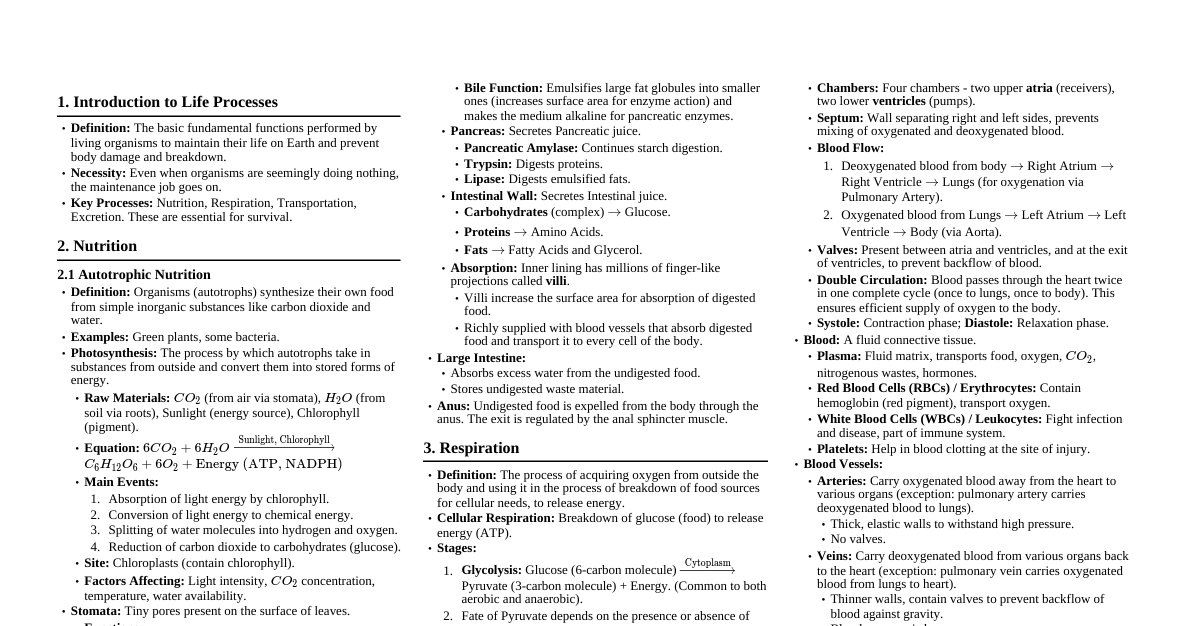
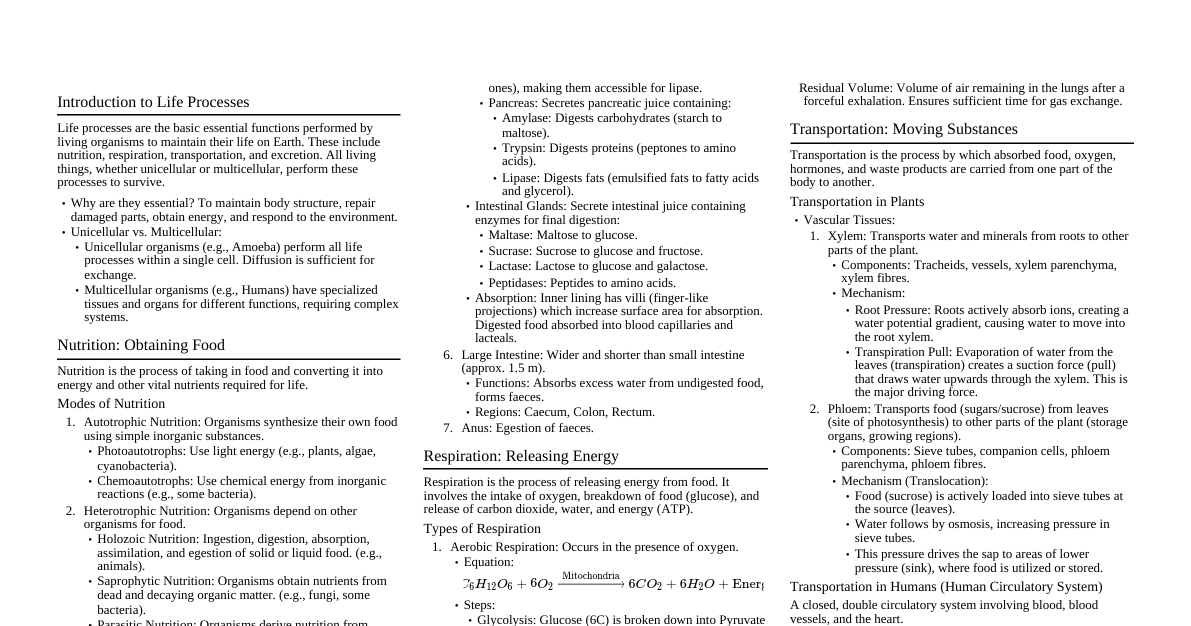
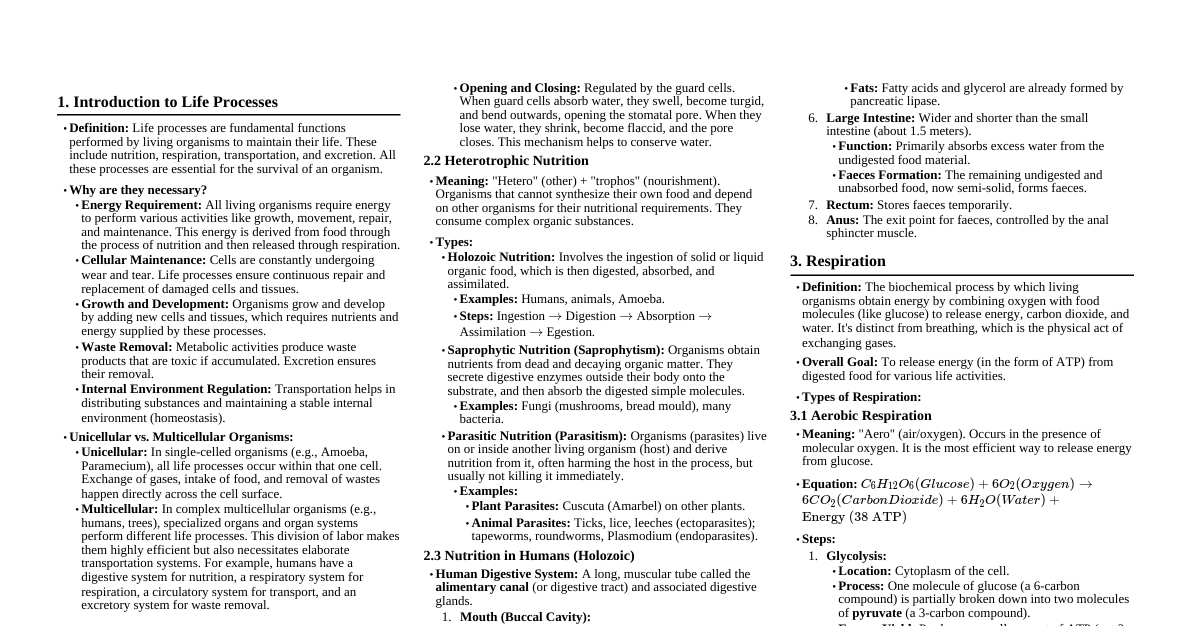
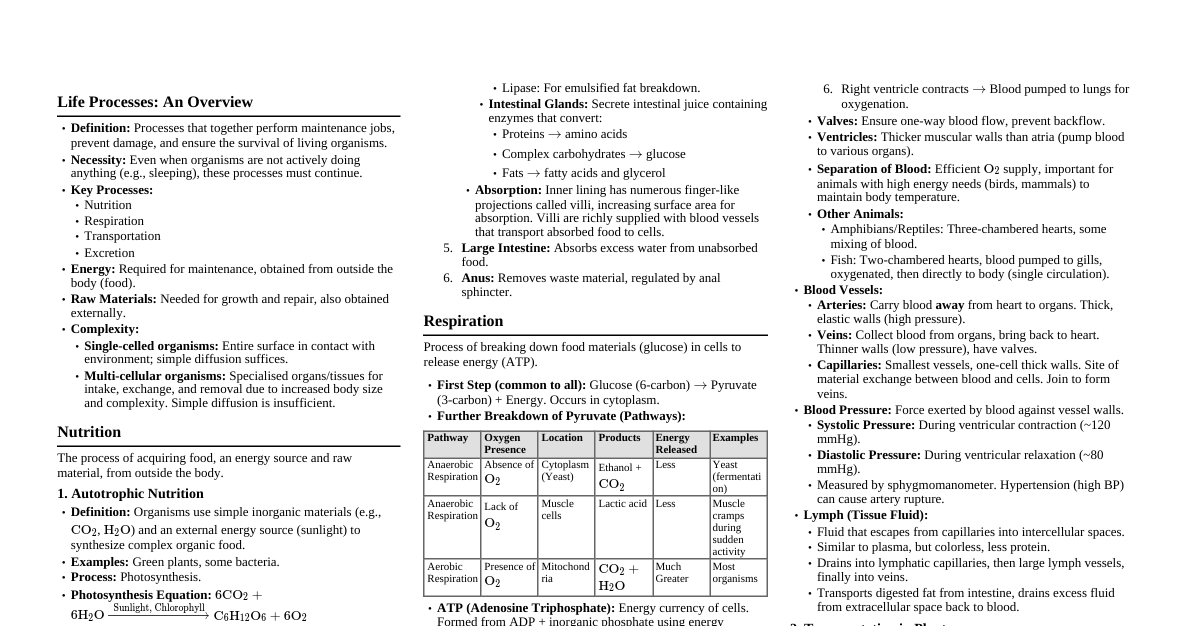
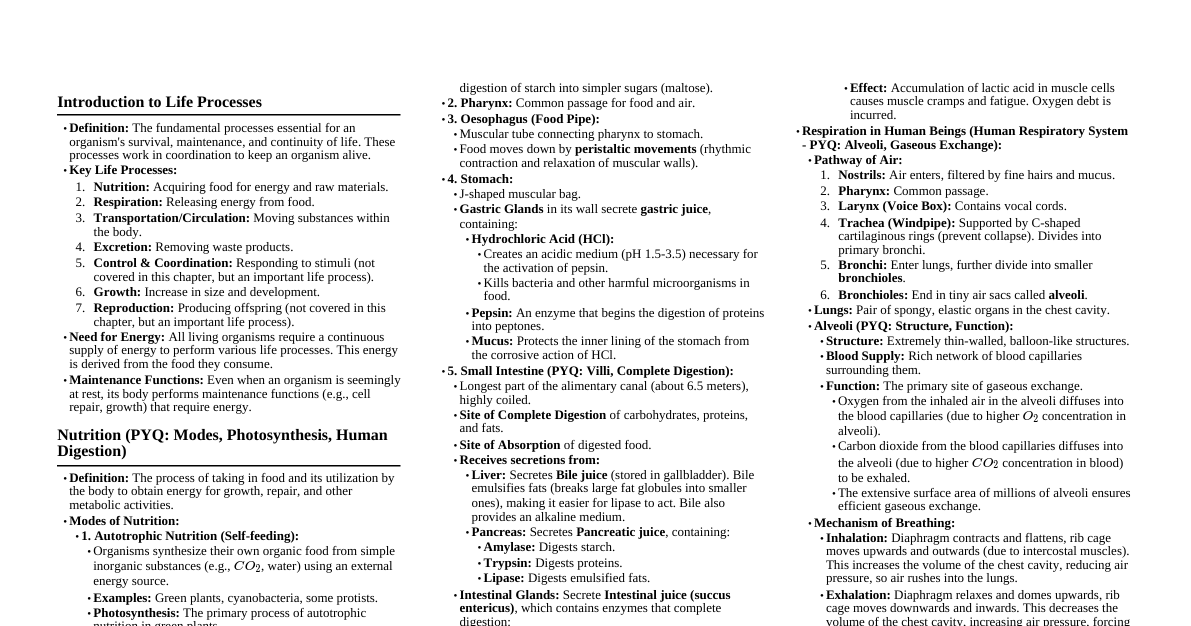
### Introduction to Life Processes - **Definition:** Basic essential activities performed by living organisms to maintain and sustain life. - **Key Characteristics of Living Beings:** - Growth - Movement - Respiration - Nutrition - Excretion - Reproduction - Response to stimuli - **Main Life Processes:** Nutrition, Respiration, Transportation, Excretion. ### Nutrition in Plants - **Autotrophic Nutrition:** Organisms synthesize their own food from simple inorganic substances. - **Photosynthesis:** Process by which green plants make their own food. - **Equation:** $6CO_2 + 6H_2O \xrightarrow{\text{Sunlight, Chlorophyll}} C_6H_{12}O_6 + 6O_2$ - **Raw Materials:** Carbon dioxide (from air via stomata), Water (from soil via roots). - **Sites:** Chloroplasts (contain chlorophyll). - **Events:** 1. Absorption of light energy by chlorophyll. 2. Conversion of light energy to chemical energy. 3. Splitting of water molecules into hydrogen and oxygen. 4. Reduction of carbon dioxide to carbohydrates. - **Stomata:** Tiny pores on leaf surface for gaseous exchange ($CO_2$ intake, $O_2$ release, Transpiration). - **Guard Cells:** Regulate opening and closing of stomata. - **Heterotrophic Nutrition:** Organisms depend on other organisms for food. (e.g., insectivorous plants like Pitcher plant, Venus flytrap – partial heterotrophs). ### Nutrition in Animals - **Heterotrophic Nutrition:** Organisms obtain food from other sources. - **Holozoic:** Ingestion, digestion, absorption, assimilation, egestion. (e.g., humans, amoeba). - **Saprophytic:** Feed on dead and decaying matter. (e.g., fungi, bacteria). - **Parasitic:** Obtain nourishment from host without killing it. (e.g., tapeworm, leeches). - **Nutrition in Amoeba:** 1. **Ingestion:** Pseudopodia engulf food (phagocytosis). 2. **Digestion:** Food vacuole formed, digestive enzymes break down food. 3. **Absorption:** Digested food diffuses into cytoplasm. 4. **Assimilation:** Used for energy, growth. 5. **Egestion:** Undigested food expelled. ### Human Digestive System - **Alimentary Canal:** Mouth $\to$ Pharynx $\to$ Oesophagus $\to$ Stomach $\to$ Small Intestine $\to$ Large Intestine $\to$ Anus. - **Associated Glands:** Salivary glands, Gastric glands, Liver, Pancreas, Intestinal glands. - **Process Breakdown:** - **Mouth:** Mechanical digestion (chewing), Chemical digestion (salivary amylase breaks starch to maltose). - **Oesophagus:** Peristaltic movement pushes food to stomach. - **Stomach:** - **Gastric Glands:** Secrete HCl (kills bacteria, activates pepsin), Pepsin (digests proteins), Mucus (protects stomach lining). - Churning mixes food with gastric juices. - **Small Intestine:** - **Site of complete digestion and absorption.** - **Liver:** Produces bile (emulsifies fats), stored in gallbladder. - **Pancreas:** Pancreatic amylase (starch), Trypsin (proteins), Lipase (fats). - **Intestinal Glands:** Intestinal juice contains peptidases (peptides $\to$ amino acids), sucrase, lactase, maltase (disaccharides $\to$ monosaccharides), intestinal lipase (fats $\to$ fatty acids + glycerol). - **Villi:** Finger-like projections increase surface area for absorption. - **Large Intestine:** Absorbs water, forms faeces. - **Anus:** Egestion of faeces. ### Respiration - **Definition:** Process of releasing energy from food. - **Equation:** $C_6H_{12}O_6 + 6O_2 \to 6CO_2 + 6H_2O + \text{Energy (ATP)}$ - **Types of Respiration:** - **Aerobic Respiration:** Occurs in presence of oxygen. - **Steps:** 1. **Glycolysis:** Glucose (6C) $\to$ Pyruvate (3C) + Energy. (Cytoplasm) 2. **Krebs Cycle (Citric Acid Cycle):** Pyruvate $\to$ $CO_2$ + Energy. (Mitochondria) 3. **Electron Transport Chain:** High energy yield. (Mitochondria) - **Products:** $CO_2$, $H_2O$, 38 ATP. - **Anaerobic Respiration:** Occurs in absence of oxygen. - **In Yeast:** Glucose $\to$ Ethanol + $CO_2$ + 2 ATP (Fermentation). - **In Muscle Cells:** Glucose $\to$ Lactic Acid + 2 ATP (during strenuous exercise). - **Gaseous Exchange in Plants:** Via stomata (leaves), lenticels (stems), general surface (roots). ### Human Respiratory System - **Pathway:** Nostrils $\to$ Pharynx $\to$ Larynx $\to$ Trachea $\to$ Bronchi $\to$ Bronchioles $\to$ Alveoli. - **Lungs:** Pair of organs in thoracic cavity. - **Alveoli:** Air sacs, site of gaseous exchange (diffusion of $O_2$ into blood, $CO_2$ out of blood). - **Mechanism of Breathing:** - **Inhalation:** Diaphragm contracts, ribs move up and out, volume of chest cavity increases, air pressure decreases, air rushes in. - **Exhalation:** Diaphragm relaxes, ribs move down and in, volume of chest cavity decreases, air pressure increases, air forced out. - **Transport of Gases:** - **Oxygen:** Carried by haemoglobin in RBCs to tissues. - **Carbon Dioxide:** Mainly transported as bicarbonate in plasma, some by haemoglobin. ### Transportation in Plants - **Vascular Tissues:** - **Xylem:** Transports water and minerals from roots to leaves. - **Components:** Tracheids, vessels, xylem parenchyma, xylem fibres. - **Transpiration:** Loss of water vapour from aerial parts of plants, creates a suction pull aiding water ascent. - **Phloem:** Transports food (sugars) from leaves to other parts of the plant. - **Components:** Sieve tubes, companion cells, phloem parenchyma, phloem fibres. - **Translocation:** Movement of food in phloem. ### Transportation in Human Beings - **Circulatory System:** - **Heart:** Pumping organ. - **Blood Vessels:** Arteries, Veins, Capillaries. - **Blood:** Fluid connective tissue. - **Blood Components:** - **Plasma:** Fluid matrix, transports food, $CO_2$, nitrogenous wastes. - **RBCs (Erythrocytes):** Contains haemoglobin, transports $O_2$. - **WBCs (Leukocytes):** Fight infection, provide immunity. - **Platelets:** Help in blood clotting. - **Lymph:** Tissue fluid, formed from plasma that leaks out of capillaries. Transports digested fats, drains excess fluid from extracellular space back to blood. ### Human Heart - **Four Chambers:** Two Atria (upper), Two Ventricles (lower). - **Double Circulation:** Blood passes twice through the heart in one complete cycle. - **Pulmonary Circulation:** Heart $\leftrightarrow$ Lungs. - **Systemic Circulation:** Heart $\leftrightarrow$ Body. - **Blood Flow:** 1. Deoxygenated blood from body enters Right Atrium. 2. Right Atrium $\to$ Right Ventricle. 3. Right Ventricle pumps deoxygenated blood to Lungs via Pulmonary Artery. 4. Oxygenated blood from Lungs enters Left Atrium via Pulmonary Vein. 5. Left Atrium $\to$ Left Ventricle. 6. Left Ventricle pumps oxygenated blood to Body via Aorta. - **Valves:** Prevent backflow of blood. - **Blood Pressure:** Force exerted by blood against artery walls. - **Systolic Pressure:** (Contraction) ~120 mmHg. - **Diastolic Pressure:** (Relaxation) ~80 mmHg. ### Excretion - **Definition:** Removal of metabolic waste products from the body. - **Excretion in Plants:** - Gaseous wastes ($O_2$, $CO_2$) removed via stomata and lenticels. - Excess water removed by transpiration. - Other wastes stored in vacuoles, leaves (fall off), gums, resins (old xylem), bark. ### Human Excretory System - **Components:** Pair of kidneys, a pair of ureters, a urinary bladder, a urethra. - **Kidneys:** Filter blood to remove nitrogenous wastes (urea, uric acid). - **Nephron:** Functional unit of kidney. - **Structure:** Glomerulus, Bowman's capsule, Renal tubule (Proximal convoluted tubule, Loop of Henle, Distal convoluted tubule), Collecting duct. - **Urine Formation:** 1. **Glomerular Filtration:** Blood filtered in glomerulus, forms filtrate (water, salts, glucose, amino acids, urea). 2. **Tubular Reabsorption:** Useful substances (glucose, amino acids, most water, salts) reabsorbed into blood from renal tubule. 3. **Tubular Secretion:** Excess ions, wastes like urea, creatinine secreted into filtrate. - **Ureters:** Carry urine from kidneys to bladder. - **Urinary Bladder:** Stores urine. - **Urethra:** Tube for urine expulsion. - **Haemodialysis (Artificial Kidney):** Used for kidney failure patients to filter blood.