Organic Reaction Mechanisms
Cheatsheet Content
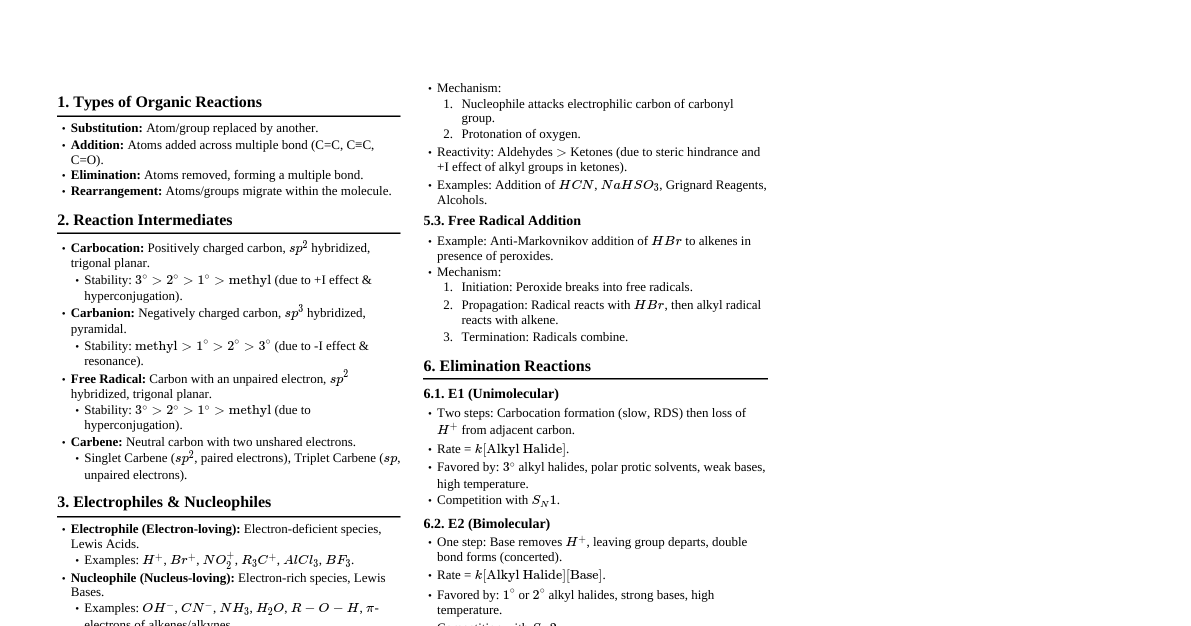
### Introduction to Organic Reactions Organic reactions involve the breaking and forming of covalent bonds. Understanding reaction mechanisms helps predict products and reaction rates. #### Types of Bond Fission - **Homolytic Fission:** Each atom takes one electron from the shared pair, forming radicals. - A:B → A• + B• (e.g., Cl-Cl → 2Cl• in presence of light) - **Heterolytic Fission:** One atom takes both electrons from the shared pair, forming ions. - A:B → A⁺ + :B⁻ (e.g., CH₃-Cl → CH₃⁺ + Cl⁻) ### Types of Reagents Reagents are classified based on their electron density. #### Electrophiles (Electron-loving) - Electron-deficient species that accept an electron pair. - **Examples:** H⁺, NO₂⁺, R₃C⁺, AlCl₃, BF₃ (Lewis acids). - Attack electron-rich centers (nucleophiles). #### Nucleophiles (Nucleus-loving) - Electron-rich species that donate an electron pair. - **Examples:** OH⁻, CN⁻, H₂O, NH₃, R-O⁻ (Lewis bases). - Attack electron-deficient centers (electrophiles). ### Electron Displacement Effects These effects influence reactivity and stability of molecules. #### Inductive Effect (I-Effect) - Permanent displacement of σ-electrons along a carbon chain towards a more electronegative atom or group. - Decreases rapidly with distance. - **+I Effect (Electron-donating):** Alkyl groups (CH₃-, CH₃CH₂-), -COO⁻ - **-I Effect (Electron-withdrawing):** -NO₂, -CN, -COOH, -X (halogens) - **Applications:** - **Acidity:** Increases with -I effect on conjugate base. (e.g., FCH₂COOH > ClCH₂COOH > CH₃COOH) - **Basicity:** Decreases with -I effect near basic site. - **Stability of Carbocations:** +I groups stabilize. (3° > 2° > 1° > CH₃⁺) - **Stability of Carbanions:** -I groups stabilize. (CH₃⁻ > 1° > 2° > 3° if no other effects) #### Resonance Effect (Mesomeric Effect, M-Effect) - Permanent delocalization of π-electrons or lone pairs through a conjugated system. - Represented by resonance structures. - **+M Effect (Electron-donating):** Groups with lone pairs that can be donated (e.g., -OH, -OR, -NH₂, -X). - Increases electron density at ortho/para positions in benzene. - **-M Effect (Electron-withdrawing):** Groups with multiple bonds where electrons can be withdrawn (e.g., -NO₂, -CHO, -COOH, -CN). - Decreases electron density at ortho/para positions in benzene. - **Applications:** - **Acidity/Basicity:** Stronger than I-effect for conjugated systems. - **Stability:** Resonance structures contribute to stability (e.g., allyl carbocation). #### Hyperconjugation (No-bond Resonance) - Delocalization of σ-electrons of C-H bond with an adjacent empty p-orbital (carbocation), π-orbital (alkene), or partially filled orbital (radical). - More α-hydrogens → more hyperconjugation → greater stability. - **Applications:** - **Stability of Carbocations:** 3° > 2° > 1° (due to more α-H). - **Stability of Alkenes:** More substituted alkenes are more stable (e.g., 2-butene > 1-butene). - **Reactivity:** Influence electrophilic addition to alkenes. #### Electromeric Effect (E-Effect) - Temporary and complete transfer of π-electrons of a multiple bond to one of the bonded atoms in the presence of an attacking reagent. - Operates only when a reagent is present. - **+E Effect:** π-electrons are transferred towards the attacking reagent. (e.g., attack of H⁺ on alkene). - **-E Effect:** π-electrons are transferred away from the attacking reagent. (e.g., attack of CN⁻ on carbonyl). ### Reactive Intermediates Short-lived, highly reactive species formed during reactions. #### Carbocations - Carbon atom with a positive charge and 6 valence electrons. - **Hybridization:** sp² (trigonal planar geometry). - **Stability Order:** 3° > 2° > 1° > CH₃⁺ (due to +I and hyperconjugation). - **Rearrangements:** Can undergo 1,2-hydride or 1,2-alkyl shifts to form more stable carbocations. #### Carbanions - Carbon atom with a negative charge and 8 valence electrons (a lone pair). - **Hybridization:** sp³ (pyramidal geometry). - **Stability Order:** CH₃⁻ > 1° > 2° > 3° (due to -I effect stabilizing the negative charge). - Stabilized by -I/-M groups. #### Free Radicals - Carbon atom with an unpaired electron. - **Hybridization:** sp² (planar) or sp³ (pyramidal, rapidly interconverting). - **Stability Order:** 3° > 2° > 1° > CH₃• (due to hyperconjugation). - Formed by homolytic fission. #### Carbenes - Neutral species with a divalent carbon atom having 6 valence electrons (2 bonded, 2 non-bonded). - **Types:** - **Singlet Carbene:** Electron pair in one sp² orbital, empty p-orbital. Diamagnetic. - **Triplet Carbene:** Two unpaired electrons in two sp orbitals. Paramagnetic. - Highly reactive. (e.g., :CH₂ from diazomethane) #### Nitrenes - Analogous to carbenes, but with a nitrogen atom instead of carbon. - Neutral species with a monovalent nitrogen atom having 6 valence electrons (1 bonded, 2 lone pairs, 1 empty orbital or 2 unpaired electrons). - Highly reactive. #### Benzynes (Aryl Intermediates) - Highly strained cyclic alkyne with a triple bond in a benzene ring. - Generated by strong bases reacting with haloarenes. - Extremely reactive. ### Isomerism Compounds with the same molecular formula but different structures or spatial arrangements. #### Structural Isomerism (Constitutional Isomerism) Different connectivity of atoms. - **Chain Isomerism:** Different carbon chain arrangements (e.g., n-butane & isobutane). - **Position Isomerism:** Different positions of functional group or substituent (e.g., 1-propanol & 2-propanol). - **Functional Isomerism:** Different functional groups (e.g., ethanol & dimethylether). - **Metamerism:** Different alkyl groups attached to the same functional group (e.g., CH₃OCH₂CH₃ & CH₃CH₂OCH₂CH₃). - **Ring-Chain Isomerism:** Open chain and cyclic structures (e.g., propene & cyclopropane). ### Tautomerism Special type of functional isomerism where isomers are in dynamic equilibrium. #### Keto-Enol Tautomerism - Most common type. Involves a proton transfer and rearrangement of electrons. - **Keto form:** Contains a carbonyl group (C=O). - **Enol form:** Contains a hydroxyl group directly attached to a carbon-carbon double bond (-C=C-OH). - **Mechanism:** Involves α-hydrogen transfer. Therefore, compounds without α-hydrogens cannot exhibit keto-enol tautomerism (e.g., benzaldehyde). - **Factors affecting equilibrium:** - **Stability:** Keto form is generally more stable than enol form due to stronger C=O bond. - **Conjugation:** Enol forms can be stabilized by conjugation (e.g., in β-dicarbonyl compounds like acetylacetone, the enol form is significantly stable due to intramolecular H-bonding and conjugation). - **Aromaticity:** Phenol exists predominantly in its enol form due to aromaticity. - **Solvent:** Polar protic solvents favor keto form (H-bonding). Non-polar solvents favor enol form if it can form intramolecular H-bonds. #### Other Types of Tautomerism - **Nitro-Aci Tautomerism:** Nitro compounds (R-CH₂-NO₂) ⇌ Aci-nitro form (R-CH=N(O)OH). - **Amide-Imidic Acid Tautomerism:** Amide (R-CO-NH₂) ⇌ Imidic acid (R-C(OH)=NH). - **Lactam-Lactim Tautomerism:** Cyclic amide (lactam) ⇌ Cyclic imidic acid (lactim). - **Nitroso-Oxime Tautomerism:** Nitroso compound (-CH₂-NO) ⇌ Oxime (-CH=N-OH). #### Conditions for Tautomerism - Presence of an acidic α-hydrogen. - Presence of an electronegative atom (like O or N) connected to a multiple bond. - The two forms must be interconvertible via proton migration. ### Stereoisomerism Same connectivity but different spatial arrangement of atoms. #### Configurational Isomerism Cannot be interconverted by simple rotation around single bonds. - **Geometrical Isomerism (cis-trans / E-Z):** Restricted rotation around a double bond or in a cyclic structure. - **cis/trans:** When two identical groups are on the same side (cis) or opposite sides (trans) of the double bond. - **E/Z:** Used for more complex cases. Z (zusammen = together) when higher priority groups are on the same side; E (entgegen = opposite) when on opposite sides. Priority is determined by Cahn-Ingold-Prelog (CIP) rules. - **Optical Isomerism (Enantiomers & Diastereomers):** Presence of chiral centers. - **Chiral Center:** A carbon atom bonded to four different groups. - **Enantiomers:** Non-superimposable mirror images. Have identical physical and chemical properties except for rotation of plane-polarized light (optical activity) and reaction with other chiral molecules. - **Diastereomers:** Stereoisomers that are not mirror images. Have different physical and chemical properties. - **Meso Compounds:** Possess chiral centers but are achiral due to an internal plane of symmetry. Do not rotate plane-polarized light. #### Conformational Isomerism Can be interconverted by rotation around single bonds. - **Examples:** Ethane (staggered vs. eclipsed), Cyclohexane (chair, boat, twist-boat). - Different conformers have different energies. Staggered/chair are generally more stable.