Organic Reaction Mechanisms (NEET)
Cheatsheet Content
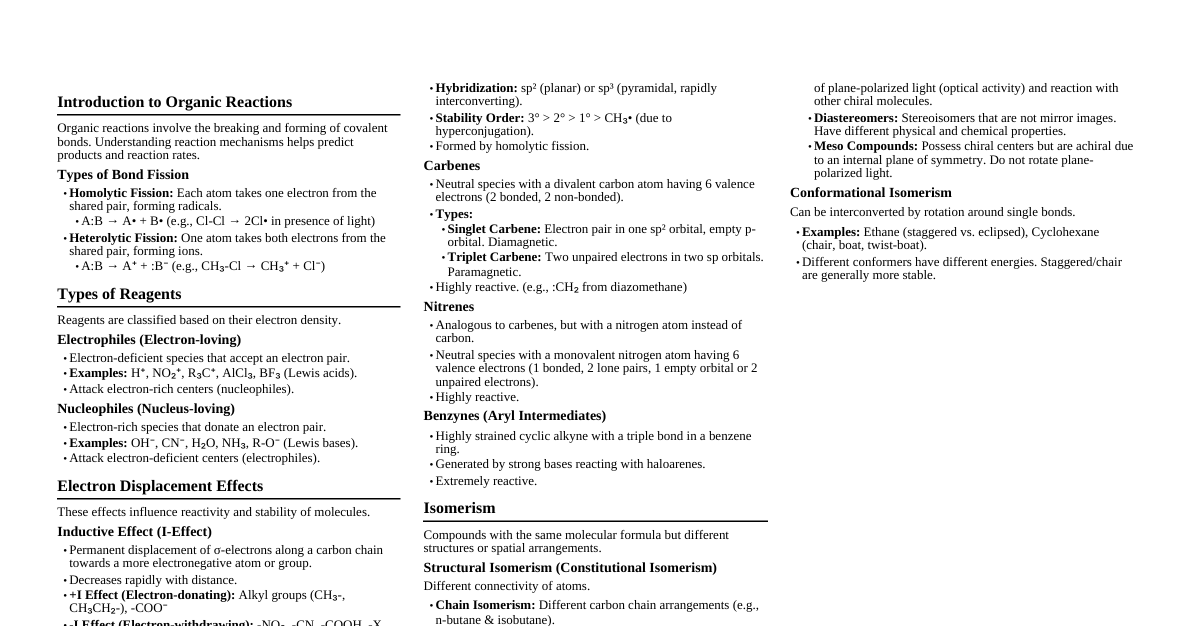
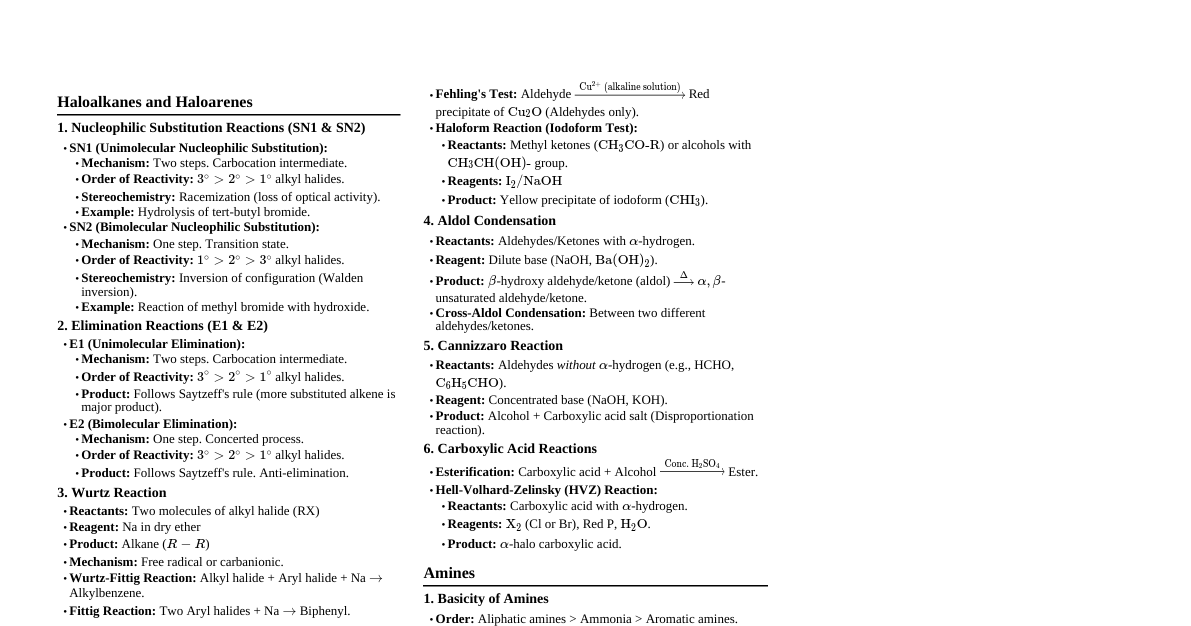
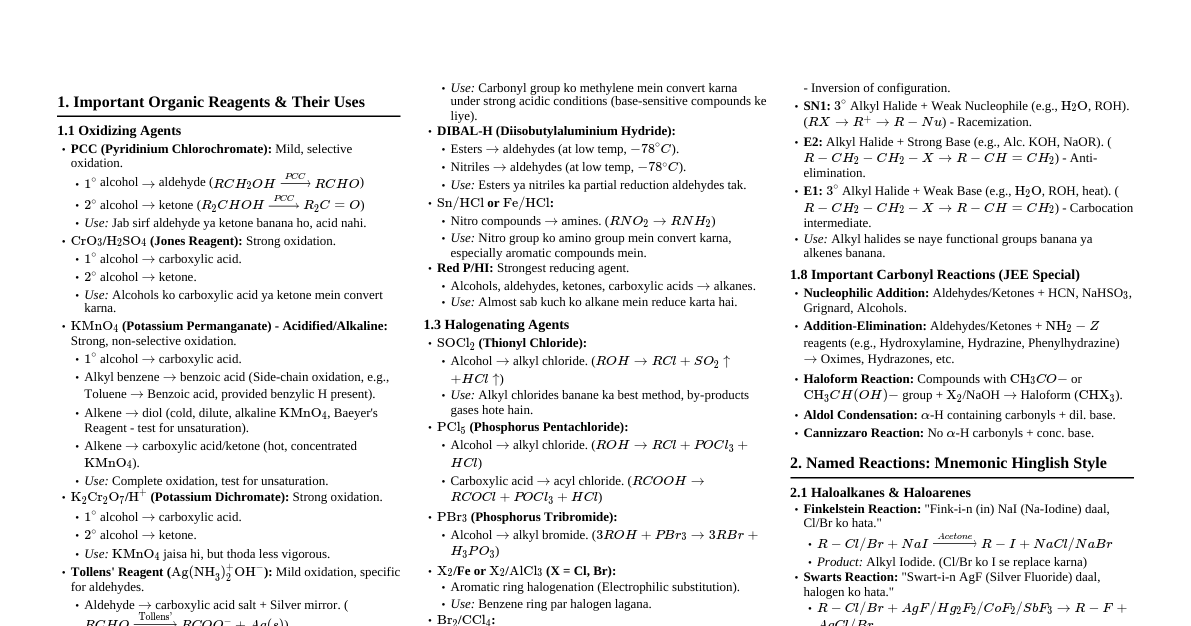
1. Types of Organic Reactions Substitution: Atom/group replaced by another. Addition: Atoms added across multiple bond (C=C, C≡C, C=O). Elimination: Atoms removed, forming a multiple bond. Rearrangement: Atoms/groups migrate within the molecule. 2. Reaction Intermediates Carbocation: Positively charged carbon, $sp^2$ hybridized, trigonal planar. Stability: $3^\circ > 2^\circ > 1^\circ > \text{methyl}$ (due to +I effect & hyperconjugation). Carbanion: Negatively charged carbon, $sp^3$ hybridized, pyramidal. Stability: $\text{methyl} > 1^\circ > 2^\circ > 3^\circ$ (due to -I effect & resonance). Free Radical: Carbon with an unpaired electron, $sp^2$ hybridized, trigonal planar. Stability: $3^\circ > 2^\circ > 1^\circ > \text{methyl}$ (due to hyperconjugation). Carbene: Neutral carbon with two unshared electrons. Singlet Carbene ($sp^2$, paired electrons), Triplet Carbene ($sp$, unpaired electrons). 3. Electrophiles & Nucleophiles Electrophile (Electron-loving): Electron-deficient species, Lewis Acids. Examples: $H^+$, $Br^+$, $NO_2^+$, $R_3C^+$, $AlCl_3$, $BF_3$. Nucleophile (Nucleus-loving): Electron-rich species, Lewis Bases. Examples: $OH^-$, $CN^-$, $NH_3$, $H_2O$, $R-O-H$, $\pi$-electrons of alkenes/alkynes. 4. Substitution Reactions 4.1. Nucleophilic Substitution ($S_N1$, $S_N2$) $S_N1$ (Unimolecular): Two steps: Carbocation formation (slow, RDS) then nucleophilic attack. Rate = $k[\text{Alkyl Halide}]$. Favored by: $3^\circ$ alkyl halides, polar protic solvents ($H_2O$, $ROH$). Stereochemistry: Racemization (formation of both enantiomers). $S_N2$ (Bimolecular): One step: Nucleophile attacks from back side, leaving group departs (concerted). Rate = $k[\text{Alkyl Halide}][\text{Nucleophile}]$. Favored by: $1^\circ$ alkyl halides, strong nucleophiles, polar aprotic solvents (DMSO, Acetone). Stereochemistry: Inversion of configuration (Walden Inversion). Reactivity Order: Alkyl Halides: $RI > RBr > RCl > RF$. Substrate for $S_N1$: $3^\circ > 2^\circ > 1^\circ$. Substrate for $S_N2$: $\text{methyl} > 1^\circ > 2^\circ > 3^\circ$. 4.2. Electrophilic Substitution (Aromatic) Characteristic of Benzene and its derivatives. Mechanism: Generation of Electrophile ($E^+$). Attack of $E^+$ on benzene ring forming carbocation (resonance stabilized). Loss of $H^+$ from carbocation to restore aromaticity. Examples: Nitration ($NO_2^+$), Halogenation ($X^+$), Sulfonation ($SO_3$), Friedel-Crafts Alkylation ($R^+$), Friedel-Crafts Acylation ($RCO^+$). Directing Groups: Ortho/Para-directing & Activating: $-OH, -NH_2, -OR, -NHCOR, -R, -Ar$. Ortho/Para-directing & Deactivating: Halogens (weakly deactivating). Meta-directing & Deactivating: $-NO_2, -CN, -CHO, -COOH, -SO_3H, -COR$. 5. Addition Reactions 5.1. Electrophilic Addition Characteristic of Alkenes and Alkynes. Mechanism: Electrophile ($E^+$) attacks $\pi$-bond, forming carbocation. Nucleophile ($Nu^-$) attacks carbocation. Markovnikov's Rule: In addition of $HX$ to unsymmetrical alkene, $H$ adds to carbon with more $H$ atoms, and $X$ adds to carbon with fewer $H$ atoms. (Forms more stable carbocation). Anti-Markovnikov's Rule (Peroxide Effect): In addition of $HBr$ to unsymmetrical alkene in presence of peroxides, $H$ adds to carbon with fewer $H$ atoms. (Free radical mechanism). Examples: Addition of $H_2$ (Hydrogenation), $X_2$ (Halogenation), $HX$ (Hydrohalogenation), $H_2O$ (Hydration). 5.2. Nucleophilic Addition Characteristic of Aldehydes and Ketones (due to polar $C=O$ bond). Mechanism: Nucleophile attacks electrophilic carbon of carbonyl group. Protonation of oxygen. Reactivity: Aldehydes $>$ Ketones (due to steric hindrance and +I effect of alkyl groups in ketones). Examples: Addition of $HCN$, $NaHSO_3$, Grignard Reagents, Alcohols. 5.3. Free Radical Addition Example: Anti-Markovnikov addition of $HBr$ to alkenes in presence of peroxides. Mechanism: Initiation: Peroxide breaks into free radicals. Propagation: Radical reacts with $HBr$, then alkyl radical reacts with alkene. Termination: Radicals combine. 6. Elimination Reactions 6.1. E1 (Unimolecular) Two steps: Carbocation formation (slow, RDS) then loss of $H^+$ from adjacent carbon. Rate = $k[\text{Alkyl Halide}]$. Favored by: $3^\circ$ alkyl halides, polar protic solvents, weak bases, high temperature. Competition with $S_N1$. 6.2. E2 (Bimolecular) One step: Base removes $H^+$, leaving group departs, double bond forms (concerted). Rate = $k[\text{Alkyl Halide}][\text{Base}]$. Favored by: $1^\circ$ or $2^\circ$ alkyl halides, strong bases, high temperature. Competition with $S_N2$. 6.3. Saytzeff's Rule (Zaitsev's Rule) In elimination reactions, the major product is the more substituted (more stable) alkene. $CH_3-CH_2-CH(Br)-CH_3 \xrightarrow{Alc. KOH} CH_3-CH=CH-CH_3 \text{ (Major)} + CH_3-CH_2-CH=CH_2 \text{ (Minor)}$ 6.4. Hofmann Rule When the leaving group is bulky (e.g., quaternary ammonium salts) or a bulky base is used, the least substituted alkene is the major product. 7. Oxidation & Reduction Oxidation: Increase in oxygen atoms, decrease in hydrogen atoms. Alcohols to Aldehydes/Ketones/Carboxylic Acids ($K_2Cr_2O_7/H^+$, $KMnO_4$). Alkenes to Diols ($Baeyer's \text{ reagent}$, cold dil. $KMnO_4$). Ozonolysis of Alkenes/Alkynes. Reduction: Decrease in oxygen atoms, increase in hydrogen atoms. Aldehydes/Ketones to Alcohols ($LiAlH_4$, $NaBH_4$). Carboxylic Acids to Alcohols ($LiAlH_4$). Alkenes/Alkynes to Alkanes ($H_2/Ni, Pd, Pt$). Nitro compounds to Amines ($Fe/HCl$, $Sn/HCl$). 8. Important Named Reactions & Mechanisms Cannizzaro Reaction: Aldehydes without $\alpha$-H, disproportionation. $2 R-CHO \xrightarrow{Conc. NaOH} R-CH_2OH + R-COONa$ Aldol Condensation: Aldehydes/Ketones with $\alpha$-H, form $\beta$-hydroxy carbonyl. $2 CH_3CHO \xrightarrow{Dil. NaOH} CH_3CH(OH)CH_2CHO$ Wurtz Reaction: $2 R-X + 2 Na \xrightarrow{Dry Ether} R-R + 2 NaX$ (for alkanes). Fittig Reaction: $2 Ar-X + 2 Na \xrightarrow{Dry Ether} Ar-Ar + 2 NaX$ (for biphenyls). Wurtz-Fittig Reaction: $R-X + Ar-X + 2 Na \xrightarrow{Dry Ether} R-Ar + 2 NaX$. Reimer-Tiemann Reaction: Phenol to Salicylaldehyde. $\text{Phenol} + CHCl_3 + NaOH \rightarrow \text{Salicylaldehyde}$ (involves Dichlorocarbene). Kolbe's Reaction: Phenol to Salicylic acid. $\text{Phenol} + CO_2 + NaOH \rightarrow \text{Salicylic Acid}$. Hell-Volhard-Zelinsky (HVZ) Reaction: Carboxylic acids with $\alpha$-H to $\alpha$-halo carboxylic acids. $R-CH_2-COOH \xrightarrow{X_2/Red P} R-CH(X)-COOH$. Hoffmann Bromamide Degradation: Amides to primary amines (with one less carbon). $R-CONH_2 + Br_2 + 4 NaOH \rightarrow R-NH_2 + Na_2CO_3 + 2 NaBr + 2 H_2O$. Gattermann-Koch Reaction: Benzene to Benzaldehyde. $\text{Benzene} + CO + HCl \xrightarrow{Anhy. AlCl_3/CuCl} \text{Benzaldehyde}$.