Complex Analysis Series & Resi
Cheatsheet Content
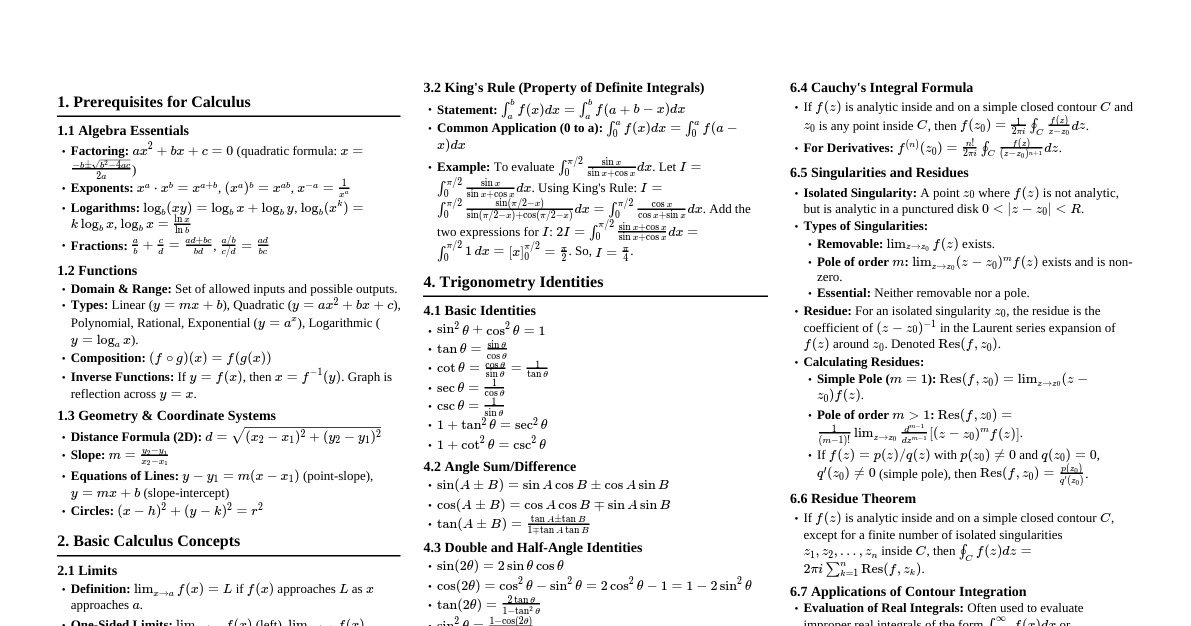
### Sequences - **Definition:** A sequence is a function $f: \mathbb{N} \to \mathbb{C}$, denoted by $\{z_1, z_2, \dots, z_n, \dots\}$ or $\{z_n\}$. - **Limit:** $\lim_{n \to \infty} z_n = z_0$ if for every $\epsilon > 0$, there exists $n_0 \in \mathbb{N}$ such that $|z_n - z_0| ### Series - **Definition:** For a given sequence $\{z_n\}$, $\sum_{n=0}^{\infty} z_n$ is called an infinite series. - **Convergence:** A series $\sum_{n=0}^{\infty} z_n$ is convergent if the sequence of partial sums $S_N = \sum_{n=1}^{N} z_n$ converges to $S$; we then write $\sum_{n=0}^{\infty} z_n = S$. ### Taylor Series - Let $f(z)$ be analytic throughout a disk $|z - z_0| ### Maclaurin Series - Taylor Series about the point $z_0 = 0$ is called Maclaurin series: $$f(z) = \sum_{n=0}^{\infty} a_n z^n$$ in $|z| ### Common Series Expansions 1. $e^z = \sum_{n=0}^{\infty} \frac{z^n}{n!} \quad (|z| ### Laurent's Theorem - Suppose that a function $f(z)$ is analytic throughout an annular domain $D: R_1 ### Residue - The coefficient $b_1$ in the Laurent series expansion (i.e., the coefficient of $\frac{1}{z-z_0}$) is called the **residue** of $f(z)$ at $z_0$, denoted as $b_1 = \text{Res}_{z=z_0} f(z)$. - From the formula for $b_n$, for $n=1$: $$\int_C f(z) dz = 2\pi i \text{Res}_{z=z_0} f(z)$$ ### Singular Point - A point $z_0$ is a **singular point** or **singularity** of $f(z)$ if $f(z)$ is not analytic at $z_0$, but is analytic at some points in every neighborhood of $z_0$. ### Isolated Singularity - A singularity $z_0$ of $f(z)$ is called **isolated** if $f(z)$ is analytic in some deleted neighborhood of $z_0$. - **Example:** For $f(z) = \frac{z+1}{z(z^2+1)}$, the isolated singular points are $z=0$ and $z=\pm i$. - **Non-isolated singularity example:** For $f(z) = \frac{1}{\sin(\pi/z)}$, the singular points are $z=0$ and $z=1/n$ for $n = \pm 1, \pm 2, \dots$. Each $z=1/n$ is isolated, but $z=0$ is not isolated because every neighborhood of $z=0$ contains other singular points ($1/n$ for large $n$). ### Classification of Isolated Singularities The behavior of $b_n$ coefficients in the Laurent series $\sum_{n=0}^{\infty} a_n(z - z_0)^n + \sum_{n=1}^{\infty} \frac{b_n}{(z - z_0)^n}$ classifies isolated singularities: #### Removable Singularity - If there is no principal part (PP), i.e., $b_n = 0$ for all $n \ge 1$, then $z_0$ is called a **removable singularity** of $f(z)$. - **Examples:** 1. For $f(z) = \frac{\sin z}{z} = 1 - \frac{z^2}{3!} + \frac{z^4}{5!} - \dots$, $z=0$ is a removable singularity. 2. For $f(z) = \frac{1 - \cos z}{z^2} = \frac{1}{2!} - \frac{z^2}{4!} + \frac{z^4}{6!} - \dots$, $z=0$ is a removable singularity. #### Pole - If there are a finite number of terms in the principal part, i.e., $b_m \ne 0$ for some $m \ge 1$ and $b_n = 0$ for all $n > m$, then $z_0$ is called a **pole of order $m$**. $$PP = \frac{b_1}{z - z_0} + \frac{b_2}{(z - z_0)^2} + \dots + \frac{b_m}{(z - z_0)^m}$$ - If $m=1$, it's called a **simple pole**. - **Example:** For $f(z) = \frac{z+1}{z^2-2z} = -\frac{3}{4}\left(1+\frac{z}{2}+\frac{z^2}{4}+\dots\right) - \frac{1}{2z}$, the term $-\frac{1}{2z}$ is the only term in PP, so $z=0$ is a simple pole. - **Example:** For $f(z) = \frac{1}{z^2(1+z)} = 1 - z + z^2 + \dots - \frac{1}{z} + \frac{1}{z^2}$, $z=0$ is a pole of order 2. #### Essential Singularity - If there are infinitely many terms in the principal part, i.e., $b_n \ne 0$ for infinitely many values of $n$, then $z_0$ is called an **essential singularity** of $f(z)$. $$PP = \frac{b_1}{z - z_0} + \frac{b_2}{(z - z_0)^2} + \dots + \frac{b_n}{(z - z_0)^n} + \dots$$ - **Examples:** 1. For $f(z) = \sin\left(\frac{1}{z}\right) = \frac{1}{z} - \frac{1}{3!z^3} + \frac{1}{5!z^5} - \dots$, $z=0$ is an essential singularity. 2. For $f(z) = e^{1/z} = 1 + \frac{1}{z} + \frac{1}{2!z^2} + \frac{1}{3!z^3} + \dots$, $z=0$ is an essential singularity. ### Cauchy's Residue Theorem - Let $C$ be a positively oriented simple closed contour. Suppose that $f(z)$ is analytic inside and on $C$ except for a finite number of singular points $z_k$ ($k = 1, 2, \dots, n$) inside $C$. Then: $$\int_C f(z) dz = 2\pi i \sum_{k=1}^{n} \text{Res}_{z=z_k} f(z)$$ ### Residue at Poles #### Simple Pole (Pole of Order 1) - If $f(z)$ has a simple pole at $z_0$, the residue is: $$\text{Res}_{z=z_0} f(z) = \lim_{z \to z_0} [(z - z_0) f(z)]$$ #### Pole of Order $m$ - If $f(z)$ has a pole of order $m$ at $z_0$, the residue is: $$\text{Res}_{z=z_0} f(z) = \frac{1}{(m - 1)!} \lim_{z \to z_0} \left[\frac{d^{m-1}}{dz^{m-1}} ((z - z_0)^m f(z))\right]$$ #### Alternative for Pole of Order $m$ - If $z_0$ is a pole of order $m$ for $f(z)$, then $f(z)$ can be written as $f(z) = \frac{\phi(z)}{(z - z_0)^m}$, where $\phi(z)$ is analytic and non-zero at $z_0$. - If $m=1$: $\text{Res}_{z=z_0} f(z) = \phi(z_0)$ - If $m \ge 2$: $\text{Res}_{z=z_0} f(z) = \frac{1}{(m-1)!} \phi^{(m-1)}(z_0)$ #### Residue for $p(z)/q(z)$ (Simple Pole) - If $p(z)$ and $q(z)$ are analytic at $z_0$, $p(z_0) \ne 0$, $q(z_0) = 0$, and $q'(z_0) \ne 0$ (meaning $z_0$ is a simple zero of $q(z)$), then $f(z) = p(z)/q(z)$ has a simple pole at $z_0$ and: $$\text{Res}_{z=z_0} \frac{p(z)}{q(z)} = \frac{p(z_0)}{q'(z_0)}$$ ### Zeros of an Analytic Function - Let $f(z)$ be analytic in a domain $D$. If $f(z_0) = 0$ for some $z_0 \in D$, then $z_0$ is called a **zero** of $f(z)$. - **Order of a Zero:** If $f(z_0) = f'(z_0) = \dots = f^{(m-1)}(z_0) = 0$ and $f^{(m)}(z_0) \ne 0$, then $z_0$ is a zero of **order $m$**. - A zero of order 1 is called a **simple zero**. - **Theorem:** Let $f(z)$ be analytic at a point $z_0$. Then $z_0$ is a zero of $f$ of order $m$ if and only if $f(z)$ can be written in the form $f(z) = (z - z_0)^m \phi(z)$, where $\phi(z)$ is analytic at $z_0$ and $\phi(z_0) \ne 0$. ### Relation between Zeros and Poles - **Theorem:** Suppose that two functions $p(z)$ and $q(z)$ are analytic at a point $z_0$. (a) If $p(z_0) \ne 0$ and $q(z)$ has a zero of order $m$ at $z_0$, then the quotient $p(z)/q(z)$ has a pole of order $m$ at $z_0$. (b) If $p(z_0) \ne 0$, $q(z_0) = 0$ and $q'(z_0) \ne 0$ (i.e., $z_0$ is a simple zero of $q(z)$), then $z_0$ is a simple pole of $p(z)/q(z)$ and $\text{Res}_{z=z_0} \frac{p(z)}{q(z)} = \frac{p(z_0)}{q'(z_0)}$.