Integration: Real Analysis & Engineering
Cheatsheet Content
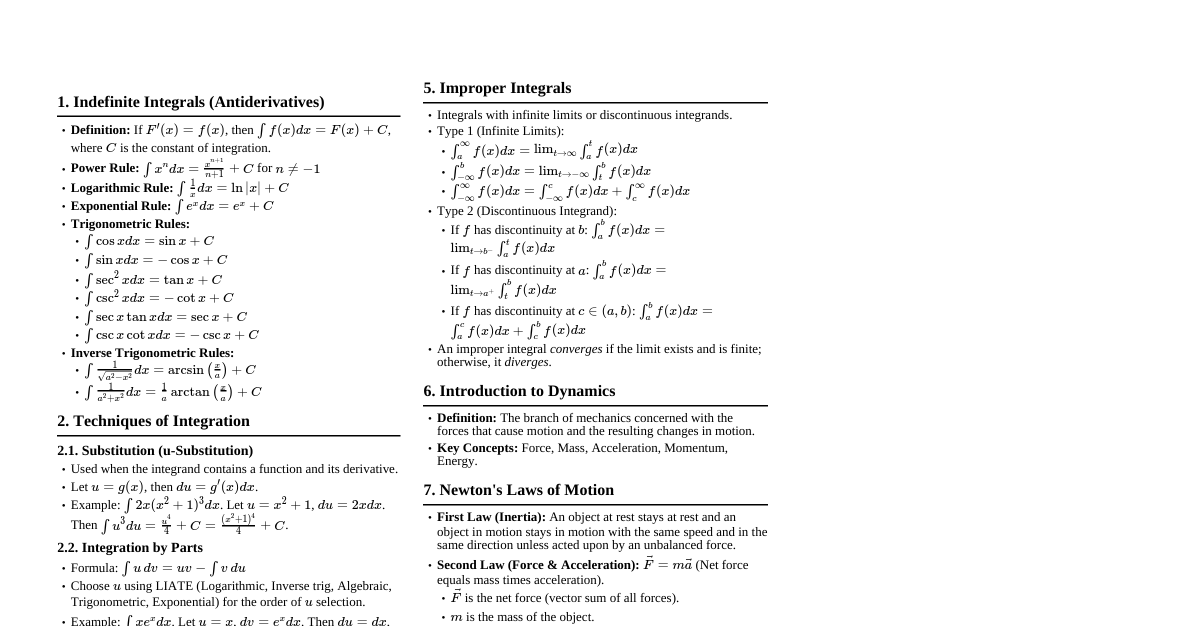
1. Riemann Integral (Real Analysis) 1.1 Definition Partition: For $[a,b]$, $P = \{x_0, x_1, \dots, x_n\}$ where $a=x_0 Mesh: $\Delta x_k = x_k - x_{k-1}$. Mesh size $\max \Delta x_k$. Upper Sum: $U(f,P) = \sum_{k=1}^n M_k \Delta x_k$, where $M_k = \sup_{x \in [x_{k-1}, x_k]} f(x)$. Lower Sum: $L(f,P) = \sum_{k=1}^n m_k \Delta x_k$, where $m_k = \inf_{x \in [x_{k-1}, x_k]} f(x)$. Upper Integral: $\overline{\int_a^b} f(x) dx = \inf_P U(f,P)$. Lower Integral: $\underline{\int_a^b} f(x) dx = \sup_P L(f,P)$. Riemann Integrable: $f$ is Riemann integrable on $[a,b]$ if $\overline{\int_a^b} f(x) dx = \underline{\int_a^b} f(x) dx$. The common value is $\int_a^b f(x) dx$. 1.2 Properties Linearity: $\int_a^b (cf(x) + dg(x)) dx = c\int_a^b f(x) dx + d\int_a^b g(x) dx$. Additivity: If $c \in (a,b)$, $\int_a^b f(x) dx = \int_a^c f(x) dx + \int_c^b f(x) dx$. Comparison: If $f(x) \le g(x)$ on $[a,b]$, then $\int_a^b f(x) dx \le \int_a^b g(x) dx$. Mean Value Theorem for Integrals: If $f$ is continuous on $[a,b]$, there exists $c \in [a,b]$ such that $\int_a^b f(x) dx = f(c)(b-a)$. Fundamental Theorem of Calculus (FTC): Part 1: If $F(x) = \int_a^x f(t) dt$, then $F'(x) = f(x)$ for $f$ continuous. Part 2: If $F'(x) = f(x)$, then $\int_a^b f(x) dx = F(b) - F(a)$. 1.3 Integrability Conditions Every continuous function on $[a,b]$ is Riemann integrable. Every monotonic function on $[a,b]$ is Riemann integrable. Functions with a finite number of discontinuities on $[a,b]$ are Riemann integrable. Bounded functions with a set of discontinuities of measure zero are Riemann integrable. 2. Indefinite Integrals (Antiderivatives) 2.1 Basic Formulas Function Integral $\int k dx$ $kx + C$ $\int x^n dx$ $\frac{x^{n+1}}{n+1} + C$ (for $n \ne -1$) $\int \frac{1}{x} dx$ $\ln|x| + C$ $\int e^x dx$ $e^x + C$ $\int a^x dx$ $\frac{a^x}{\ln a} + C$ $\int \sin x dx$ $-\cos x + C$ $\int \cos x dx$ $\sin x + C$ $\int \sec^2 x dx$ $\tan x + C$ $\int \csc^2 x dx$ $-\cot x + C$ $\int \sec x \tan x dx$ $\sec x + C$ $\int \csc x \cot x dx$ $-\csc x + C$ $\int \frac{1}{\sqrt{a^2 - x^2}} dx$ $\arcsin(\frac{x}{a}) + C$ $\int \frac{1}{a^2 + x^2} dx$ $\frac{1}{a} \arctan(\frac{x}{a}) + C$ $\int \frac{1}{x\sqrt{x^2 - a^2}} dx$ $\frac{1}{a} \operatorname{arcsec}(\frac{x}{a}) + C$ 3. Integration Techniques (Engineering Math) 3.1 Substitution Rule $\int f(g(x))g'(x) dx = \int f(u) du$, where $u = g(x)$ and $du = g'(x) dx$. Definite Integral: $\int_a^b f(g(x))g'(x) dx = \int_{g(a)}^{g(b)} f(u) du$. 3.2 Integration by Parts $\int u dv = uv - \int v du$. LIATE Rule for choosing $u$: Logarithmic, Inverse trig, Algebraic, Trigonometric, Exponential. Useful for products of functions (e.g., $x \sin x$, $x e^x$, $\ln x$). 3.3 Trigonometric Integrals Products of $\sin^m x \cos^n x$: If $m$ is odd, let $u = \cos x$. If $n$ is odd, let $u = \sin x$. If both $m,n$ are even, use half-angle identities: $\sin^2 x = \frac{1-\cos(2x)}{2}$, $\cos^2 x = \frac{1+\cos(2x)}{2}$. Products of $\sec^m x \tan^n x$: If $m$ is even, let $u = \tan x$. If $n$ is odd, let $u = \sec x$. 3.4 Trigonometric Substitution Expression Substitution Identity $\sqrt{a^2 - x^2}$ $x = a \sin \theta$, $dx = a \cos \theta d\theta$ $a^2 \cos^2 \theta$ $\sqrt{a^2 + x^2}$ $x = a \tan \theta$, $dx = a \sec^2 \theta d\theta$ $a^2 \sec^2 \theta$ $\sqrt{x^2 - a^2}$ $x = a \sec \theta$, $dx = a \sec \theta \tan \theta d\theta$ $a^2 \tan^2 \theta$ 3.5 Partial Fractions Used for rational functions $\frac{P(x)}{Q(x)}$ where $\deg(P) Factorize $Q(x)$ into linear and irreducible quadratic factors. Linear factor $(ax+b)^n$: $\frac{A_1}{ax+b} + \frac{A_2}{(ax+b)^2} + \dots + \frac{A_n}{(ax+b)^n}$. Quadratic factor $(ax^2+bx+c)^n$: $\frac{A_1x+B_1}{ax^2+bx+c} + \dots + \frac{A_nx+B_n}{(ax^2+bx+c)^n}$. 3.6 Improper Integrals Type 1 (Infinite Interval): $\int_a^\infty f(x) dx = \lim_{t \to \infty} \int_a^t f(x) dx$. $\int_{-\infty}^b f(x) dx = \lim_{t \to -\infty} \int_t^b f(x) dx$. $\int_{-\infty}^\infty f(x) dx = \int_{-\infty}^c f(x) dx + \int_c^\infty f(x) dx$. Type 2 (Discontinuity): If $f$ has discontinuity at $b$: $\int_a^b f(x) dx = \lim_{t \to b^-} \int_a^t f(x) dx$. If $f$ has discontinuity at $a$: $\int_a^b f(x) dx = \lim_{t \to a^+} \int_t^b f(x) dx$. If $f$ has discontinuity at $c \in (a,b)$: $\int_a^b f(x) dx = \int_a^c f(x) dx + \int_c^b f(x) dx$. An improper integral converges if the limit exists and is finite; otherwise, it diverges . p-test: $\int_1^\infty \frac{1}{x^p} dx$ converges if $p>1$, diverges if $p \le 1$. p-test: $\int_0^1 \frac{1}{x^p} dx$ converges if $p 4. Applications of Integration Area between curves: $A = \int_a^b |f(x) - g(x)| dx$. Volume of Revolution: Disk Method: $V = \pi \int_a^b [R(x)]^2 dx$ (around x-axis). Washer Method: $V = \pi \int_a^b ([R(x)]^2 - [r(x)]^2) dx$ (around x-axis). Shell Method: $V = 2\pi \int_a^b x h(x) dx$ (around y-axis). Arc Length: $L = \int_a^b \sqrt{1 + [f'(x)]^2} dx$ or $L = \int_c^d \sqrt{1 + [g'(y)]^2} dy$. Surface Area of Revolution: Around x-axis: $S_x = 2\pi \int_a^b f(x) \sqrt{1 + [f'(x)]^2} dx$. Around y-axis: $S_y = 2\pi \int_a^b x \sqrt{1 + [f'(x)]^2} dx$. Work: $W = \int_a^b F(x) dx$. Centroid: $M_y = \int_a^b x f(x) dx$, $M_x = \int_a^b \frac{1}{2} [f(x)]^2 dx$. $\bar{x} = \frac{M_y}{A}$, $\bar{y} = \frac{M_x}{A}$, where $A=\int_a^b f(x) dx$.