Complex Analysis (MTS6 B11)
Cheatsheet Content
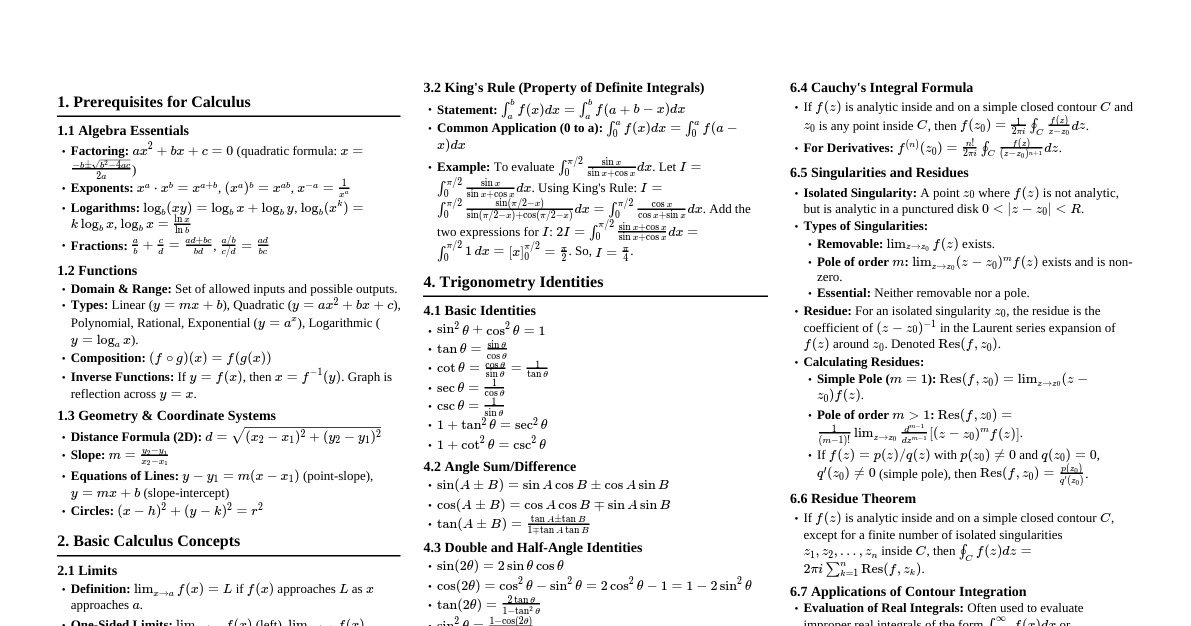
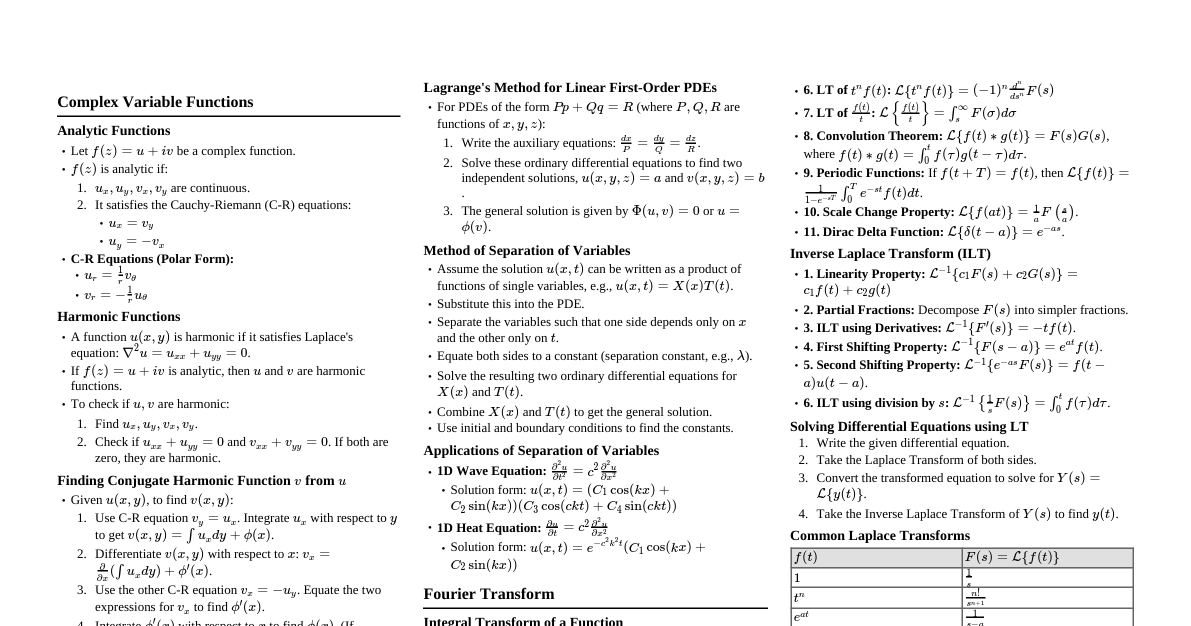
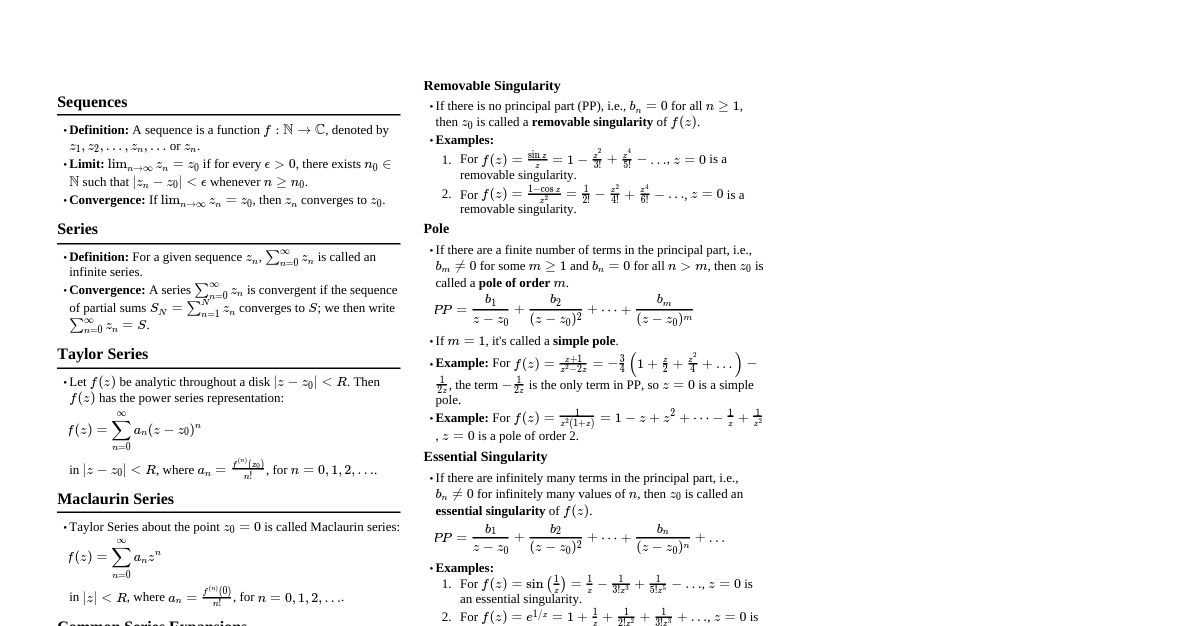
1. Analytic Functions - Preliminaries Functions of a Complex Variable A function $f$ on a set $D$ assigns to each $z \in D$ a complex number $w = f(z)$. Domain: Set $D$. Range: Set of values $f(z)$ assumes. If $z = x + iy$, then $f(z) = u(x, y) + iv(x, y)$, where $u(x, y)$ is the real part and $v(x, y)$ is the imaginary part. If $z = re^{i\theta}$, then $f(z) = u(r, \theta) + iv(r, \theta)$. Limit of a Complex Function $\lim_{z \to z_0} f(z) = L$ if for every $\epsilon > 0$, there exists $\delta > 0$ such that $|f(z) - L| Uniqueness: If a limit exists, it is unique. If $\lim_{z \to z_0} f(z) = L_1$ and $\lim_{z \to z_0} g(z) = L_2$, then: $\lim_{z \to z_0} [f(z) \pm g(z)] = L_1 \pm L_2$ $\lim_{z \to z_0} [f(z)g(z)] = L_1 L_2$ $\lim_{z \to z_0} \frac{f(z)}{g(z)} = \frac{L_1}{L_2}$, if $L_2 \ne 0$. Limits at Infinity and Infinite Limits $\lim_{z \to \infty} f(z) = L \iff \lim_{z \to 0} f(1/z) = L$. $\lim_{z \to z_0} f(z) = \infty \iff \lim_{z \to z_0} \frac{1}{f(z)} = 0$. $\lim_{z \to \infty} f(z) = \infty \iff \lim_{z \to 0} \frac{1}{f(1/z)} = 0$. Continuity $f$ is continuous at $z_0$ if: $f(z_0)$ is defined. $\lim_{z \to z_0} f(z)$ exists. $\lim_{z \to z_0} f(z) = f(z_0)$. $f(z) = u(x,y) + iv(x,y)$ is continuous at $z_0 = x_0 + iy_0$ iff $u(x,y)$ and $v(x,y)$ are continuous at $(x_0, y_0)$. Sums, products, and quotients (denominator non-zero) of continuous functions are continuous. Polynomials are continuous on the entire complex plane. If $f$ is continuous on a closed and bounded region $R$, then $|f(z)|$ attains a maximum $M$ for at least one $z \in R$. Branches A branch of a multiple-valued function $F$ is a function $f$ that is continuous on some domain and assigns exactly one of the multiple values of $F$ to each point $z$ in that domain. Example: The principal square root function $f(z) = \sqrt{r}e^{i\theta/2}$ for $z=re^{i\theta}$ with $-\pi Differentiability $f$ is differentiable at $z_0$ if $f'(z_0) = \lim_{\Delta z \to 0} \frac{f(z_0 + \Delta z) - f(z_0)}{\Delta z}$ exists. If $f$ is differentiable at $z_0$, then $f$ is continuous at $z_0$. Differentiation Rules: Sum, product, quotient, and chain rules are analogous to real calculus. 2. Analytic Functions Analytic Functions $f$ is analytic at $z_0$ if $f$ is differentiable at $z_0$ and at every point in some neighborhood of $z_0$. $f$ is analytic in a domain $D$ if it is analytic at every point in $D$. Entire Function: A function analytic at every point in the entire finite complex plane (e.g., polynomials, $e^z$). Singular Point: A point $z_0$ where $f$ fails to be analytic. Cauchy-Riemann Equations (Necessary Condition for Analyticity) If $f(z) = u(x, y) + iv(x, y)$ is differentiable at $z_0 = x_0 + iy_0$, then the first-order partial derivatives of $u$ and $v$ exist at $(x_0, y_0)$ and satisfy: $$ \frac{\partial u}{\partial x} = \frac{\partial v}{\partial y} \quad \text{and} \quad \frac{\partial u}{\partial y} = -\frac{\partial v}{\partial x} $$ In polar coordinates ($z=re^{i\theta}$): $$ \frac{\partial u}{\partial r} = \frac{1}{r}\frac{\partial v}{\partial \theta} \quad \text{and} \quad \frac{\partial v}{\partial r} = -\frac{1}{r}\frac{\partial u}{\partial \theta} $$ If C-R equations are not satisfied at every point in a domain, $f$ cannot be analytic in that domain. Sufficient Condition for Analyticity If $u(x, y)$ and $v(x, y)$ have continuous first-order partial derivatives in a domain $D$ and satisfy the Cauchy-Riemann equations at all points in $D$, then $f(z) = u(x, y) + iv(x, y)$ is analytic in $D$. The derivative is $f'(z) = \frac{\partial u}{\partial x} + i\frac{\partial v}{\partial x} = \frac{\partial v}{\partial y} - i\frac{\partial u}{\partial y}$. L'Hôpital's Rule If $f$ and $g$ are analytic at $z_0$, $f(z_0)=0$, $g(z_0)=0$, and $g'(z_0) \ne 0$, then $\lim_{z \to z_0} \frac{f(z)}{g(z)} = \frac{f'(z_0)}{g'(z_0)}$. Harmonic Functions A real-valued function $\phi(x,y)$ is harmonic in a domain $D$ if it has continuous first and second-order partial derivatives and satisfies Laplace's equation: $$ \frac{\partial^2 \phi}{\partial x^2} + \frac{\partial^2 \phi}{\partial y^2} = 0 $$ If $f(z) = u(x,y) + iv(x,y)$ is analytic in $D$, then $u(x,y)$ and $v(x,y)$ are harmonic in $D$. Harmonic Conjugate: If $u$ is harmonic, $v$ is its harmonic conjugate if $u+iv$ is analytic. $v$ can be found by integrating the C-R equations. 3. Elementary Functions Complex Exponential Function Definition: $e^z = e^{x+iy} = e^x (\cos y + i \sin y)$. Analyticity: $e^z$ is an entire function, and $\frac{d}{dz} e^z = e^z$. Modulus: $|e^z| = e^x$. Argument: $\arg(e^z) = y + 2k\pi$. Conjugate: $\overline{e^z} = e^{\overline{z}}$. Properties: $e^{z_1}e^{z_2} = e^{z_1+z_2}$ $e^{z_1}/e^{z_2} = e^{z_1-z_2}$ $(e^z)^n = e^{nz}$ Periodicity: $e^z$ is periodic with period $2\pi i$, i.e., $e^{z+2\pi i} = e^z$. Fundamental Region: The infinite strip $-\pi Complex Logarithmic Function Definition: $\text{Log } z = \ln|z| + i \arg(z) = \ln r + i(\theta + 2k\pi)$, for $z \ne 0$. This is a multiple-valued function. Principal Value: $\text{Log } z = \ln|z| + i \text{Arg}(z)$, where $-\pi Analyticity: The principal branch $\text{Log } z$ is analytic in the domain $|z|>0, -\pi Properties: (for principal values, careful with branch cuts) $\text{Log}(z_1 z_2) = \text{Log } z_1 + \text{Log } z_2$ $\text{Log}(z_1 / z_2) = \text{Log } z_1 - \text{Log } z_2$ $\text{Log}(z^n) = n \text{Log } z$ Complex Trigonometric Functions Definitions: $\sin z = \frac{e^{iz} - e^{-iz}}{2i}$ $\cos z = \frac{e^{iz} + e^{-iz}}{2}$ $\tan z = \frac{\sin z}{\cos z}$, etc. Identities: Most real trigonometric identities hold (e.g., $\sin^2 z + \cos^2 z = 1$). Periodicity: $\sin z$ and $\cos z$ are periodic with period $2\pi$. Real and Imaginary Parts: $\sin z = \sin x \cosh y + i \cos x \sinh y$ $\cos z = \cos x \cosh y - i \sin x \sinh y$ Modulus: $|\sin z|^2 = \sin^2 x + \sinh^2 y$ $|\cos z|^2 = \cos^2 x + \sinh^2 y$ Zeros: $\sin z = 0 \iff z = k\pi$ for $k \in \mathbb{Z}$. $\cos z = 0 \iff z = \frac{\pi}{2} + k\pi$ for $k \in \mathbb{Z}$. Analyticity: $\sin z$ and $\cos z$ are entire functions. $\frac{d}{dz} \sin z = \cos z$ $\frac{d}{dz} \cos z = -\sin z$ Complex Hyperbolic Functions Definitions: $\sinh z = \frac{e^z - e^{-z}}{2}$ $\cosh z = \frac{e^z + e^{-z}}{2}$ $\tanh z = \frac{\sinh z}{\cosh z}$, etc. Relations to Trigonometric Functions: $\sinh(iz) = i \sin z$ $\cosh(iz) = \cos z$ $\sin(iz) = i \sinh z$ $\cos(iz) = \cosh z$ Analyticity: $\sinh z$ and $\cosh z$ are entire functions. $\frac{d}{dz} \sinh z = \cosh z$ $\frac{d}{dz} \cosh z = \sinh z$ 4. Integration in the Complex Plane Complex Integral (Contour Integral) A curve $C$ in the complex plane is a contour (or path) if it is piecewise smooth. If $f(z)$ is continuous on a smooth curve $C$ parametrized by $z(t) = x(t) + iy(t)$ for $a \le t \le b$: $$ \int_C f(z) dz = \int_a^b f(z(t)) z'(t) dt $$ Properties: $\int_C k f(z) dz = k \int_C f(z) dz$ $\int_C [f(z) + g(z)] dz = \int_C f(z) dz + \int_C g(z) dz$ $\int_{C_1+C_2} f(z) dz = \int_{C_1} f(z) dz + \int_{C_2} f(z) dz$ $\int_{-C} f(z) dz = -\int_C f(z) dz$ ML-Inequality (Bounding Theorem): If $f$ is continuous on $C$, $|f(z)| \le M$ for all $z \in C$, and $L$ is the length of $C$, then: $$ \left| \int_C f(z) dz \right| \le ML $$ Cauchy-Goursat Theorem Simply Connected Domain: A domain where every simple closed contour can be shrunk to a point within the domain. If $f$ is analytic in a simply connected domain $D$, then for every simple closed contour $C$ in $D$: $$ \oint_C f(z) dz = 0 $$ For Multiply Connected Domains: If $f$ is analytic in a domain $D$ with a boundary consisting of an outer contour $C$ and inner contours $C_k$ (all oriented counter-clockwise), then: $$ \oint_C f(z) dz = \sum_{k=1}^n \oint_{C_k} f(z) dz $$ (Note: $C_k$ are usually clockwise in problems, so $\oint_C f(z)dz = \sum -\oint_{C_k} f(z)dz$) Independence of Path If $f$ is analytic in a simply connected domain $D$, then $\int_C f(z) dz$ is independent of the path $C$ between two points $z_1$ and $z_2$ in $D$. Fundamental Theorem for Contour Integrals: If $F'(z) = f(z)$ in $D$, then for any contour $C$ from $z_1$ to $z_2$ in $D$: $$ \int_C f(z) dz = F(z_2) - F(z_1) $$ Existence of an Antiderivative: If $f$ is analytic in a simply connected domain $D$, then $f$ has an antiderivative in $D$. Cauchy's Integral Formulas If $f$ is analytic in a simply connected domain $D$, and $C$ is a simple closed contour in $D$ (counter-clockwise), then for any point $z_0$ inside $C$: $$ f(z_0) = \frac{1}{2\pi i} \oint_C \frac{f(\zeta)}{\zeta - z_0} d\zeta $$ For Derivatives: For the $n$-th derivative of $f$: $$ f^{(n)}(z_0) = \frac{n!}{2\pi i} \oint_C \frac{f(\zeta)}{(\zeta - z_0)^{n+1}} d\zeta $$ Derivative of an Analytic Function is Analytic: If $f$ is analytic in $D$, then $f^{(n)}$ is also analytic in $D$. Consequences of Cauchy's Integral Formulas Cauchy's Inequality: If $f$ is analytic in $D$, $C$ is a circle $|z-z_0|=R$ in $D$, and $|f(z)| \le M$ on $C$, then: $$ |f^{(n)}(z_0)| \le \frac{n!M}{R^n} $$ Liouville's Theorem: The only bounded entire functions are constants. Fundamental Theorem of Algebra: Every non-constant polynomial $P(z)$ has at least one root. Morera's Theorem: If $f$ is continuous in a simply connected domain $D$ and $\oint_C f(z) dz = 0$ for every closed contour $C$ in $D$, then $f$ is analytic in $D$. Maximum Modulus Theorem: If $f$ is analytic and non-constant on a closed region $R$ bounded by a simple closed curve $C$, then $|f(z)|$ attains its maximum on $C$. 5. Series Sequences and Series A sequence $\{z_n\}$ converges to $L$ if for every $\epsilon > 0$, there exists $N$ such that $|z_n - L| N$. $\{z_n\} = \{x_n + iy_n\}$ converges to $L = X+iY$ iff $\{x_n\}$ converges to $X$ and $\{y_n\}$ converges to $Y$. An infinite series $\sum_{n=1}^\infty z_n$ converges if its sequence of partial sums $S_N = \sum_{n=1}^N z_n$ converges. Geometric Series: $\sum_{n=0}^\infty a r^n = \frac{a}{1-r}$ if $|r| Necessary Condition for Convergence: If $\sum z_n$ converges, then $\lim_{n \to \infty} z_n = 0$. (The converse is false). Absolute Convergence: $\sum z_n$ is absolutely convergent if $\sum |z_n|$ converges. Absolute convergence implies convergence. Ratio Test: For $\sum z_n$, if $\lim_{n \to \infty} \left| \frac{z_{n+1}}{z_n} \right| = L$: If $L If $L > 1$, series diverges. If $L = 1$, test is inconclusive. Root Test: For $\sum z_n$, if $\lim_{n \to \infty} \sqrt[n]{|z_n|} = L$: If $L If $L > 1$, series diverges. If $L = 1$, test is inconclusive. Power Series Form: $\sum_{n=0}^\infty a_n (z-z_0)^n$. $z_0$ is the center. Circle of Convergence: Every power series has a radius of convergence $R \ge 0$. It converges absolutely for $|z-z_0| R$. $R = 0$: converges only at $z_0$. $R = \infty$: converges for all $z$. Radius of convergence $R$: $R = \frac{1}{\lim_{n \to \infty} |a_{n+1}/a_n|}$ or $R = \frac{1}{\lim_{n \to \infty} \sqrt[n]{|a_n|}}$. A power series represents a continuous and infinitely differentiable (analytic) function within its circle of convergence. Term-by-term differentiation and integration are allowed, with the same radius of convergence. Taylor Series If $f$ is analytic in a domain $D$ and $z_0 \in D$, then $f(z)$ has a unique Taylor series representation: $$ f(z) = \sum_{n=0}^\infty \frac{f^{(n)}(z_0)}{n!} (z-z_0)^n $$ valid for the largest circle centered at $z_0$ that lies entirely within $D$. Maclaurin Series: A Taylor series with $z_0 = 0$. $$ f(z) = \sum_{n=0}^\infty \frac{f^{(n)}(0)}{n!} z^n $$ Common Maclaurin Series: $e^z = \sum_{n=0}^\infty \frac{z^n}{n!}$, $R=\infty$ $\sin z = \sum_{n=0}^\infty (-1)^n \frac{z^{2n+1}}{(2n+1)!}$, $R=\infty$ $\cos z = \sum_{n=0}^\infty (-1)^n \frac{z^{2n}}{(2n)!}$, $R=\infty$ $\frac{1}{1-z} = \sum_{n=0}^\infty z^n$, $R=1$ Laurent Series If $f$ is analytic in an annular domain $R_1 The sum of positive powers is the analytic part . The sum of negative powers is the principal part . Zeros and Poles (Isolated Singularities) An isolated singularity $z_0$ of $f$ is a point where $f$ is not analytic, but there is a deleted neighborhood $0 Classification based on Laurent Series principal part: Removable Singularity: All $b_n=0$. Laurent series only has non-negative powers. $\lim_{z \to z_0} f(z)$ exists. Pole of Order $m$: A finite number of $b_n$ are non-zero, with $b_m \ne 0$ and $b_{m+1}, b_{m+2}, \dots = 0$. $f(z) = \frac{\phi(z)}{(z-z_0)^m}$ where $\phi(z)$ is analytic at $z_0$ and $\phi(z_0) \ne 0$. A pole of order 1 is a simple pole . Essential Singularity: Infinitely many $b_n$ are non-zero. Zeros: $z_0$ is a zero of order $m$ if $f(z_0)=f'(z_0)=\dots=f^{(m-1)}(z_0)=0$ but $f^{(m)}(z_0) \ne 0$. $f(z) = (z-z_0)^m \phi(z)$ where $\phi(z)$ is analytic at $z_0$ and $\phi(z_0) \ne 0$. If $f(z)$ has a zero of order $m$ at $z_0$, then $1/f(z)$ has a pole of order $m$ at $z_0$. If $f(z) = p(z)/q(z)$ where $p,q$ are analytic at $z_0$, $p(z_0) \ne 0$, and $q(z)$ has a zero of order $m$ at $z_0$, then $f(z)$ has a pole of order $m$ at $z_0$. 6. Residues Residues and Residue Theorem Residue: The coefficient $b_1$ (or $a_{-1}$) in the Laurent series expansion of $f(z)$ about an isolated singularity $z_0$ is called the residue of $f$ at $z_0$, denoted $\text{Res}(f, z_0)$. Formula for Simple Pole: If $f$ has a simple pole at $z_0$: $$ \text{Res}(f, z_0) = \lim_{z \to z_0} (z-z_0) f(z) $$ Formula for Pole of Order $m$: If $f$ has a pole of order $m$ at $z_0$: $$ \text{Res}(f, z_0) = \frac{1}{(m-1)!} \lim_{z \to z_0} \frac{d^{m-1}}{dz^{m-1}} [(z-z_0)^m f(z)] $$ Cauchy's Residue Theorem: If $f$ is analytic inside and on a simple closed contour $C$ (counter-clockwise), except for a finite number of isolated singularities $z_k$ inside $C$, then: $$ \oint_C f(z) dz = 2\pi i \sum_{k=1}^n \text{Res}(f, z_k) $$ Evaluation of Real Integrals using Residues Real Trigonometric Integrals: $\int_0^{2\pi} F(\cos\theta, \sin\theta) d\theta$. Substitute $z = e^{i\theta}$, $dz = ie^{i\theta} d\theta \implies d\theta = dz/(iz)$. $\cos\theta = \frac{z+1/z}{2}$, $\sin\theta = \frac{z-1/z}{2i}$. The integral becomes a contour integral over the unit circle $|z|=1$. Real Improper Integrals: $\int_{-\infty}^\infty f(x) dx$. Evaluate as $\lim_{R \to \infty} \int_{-R}^R f(x) dx = \text{P.V.} \int_{-\infty}^\infty f(x) dx$. Consider $\oint_C f(z) dz$ where $C$ is a contour consisting of $[-R, R]$ on the real axis and a semicircle $C_R$ in the upper half-plane. If $f(z)$ satisfies certain conditions (e.g., $|f(z)| \le M/R^k$ for $k>1$ on $C_R$), then $\int_{C_R} f(z) dz \to 0$ as $R \to \infty$. Then $\int_{-\infty}^\infty f(x) dx = 2\pi i \sum \text{Res}(f, z_k)$ for poles $z_k$ in the upper half-plane. Argument Principle and Rouche's Theorem Argument Principle: If $f$ is analytic inside and on a simple closed contour $C$ (counter-clockwise), except for a finite number of poles inside $C$, and $f(z) \ne 0$ on $C$, then: $$ \frac{1}{2\pi i} \oint_C \frac{f'(z)}{f(z)} dz = N - P $$ where $N$ is the number of zeros and $P$ is the number of poles of $f$ inside $C$, counted with multiplicity. Rouche's Theorem: If $f$ and $g$ are analytic inside and on a simple closed contour $C$, and $|g(z)|