Calculus & Complex Analysis Cheatsheet
Cheatsheet Content
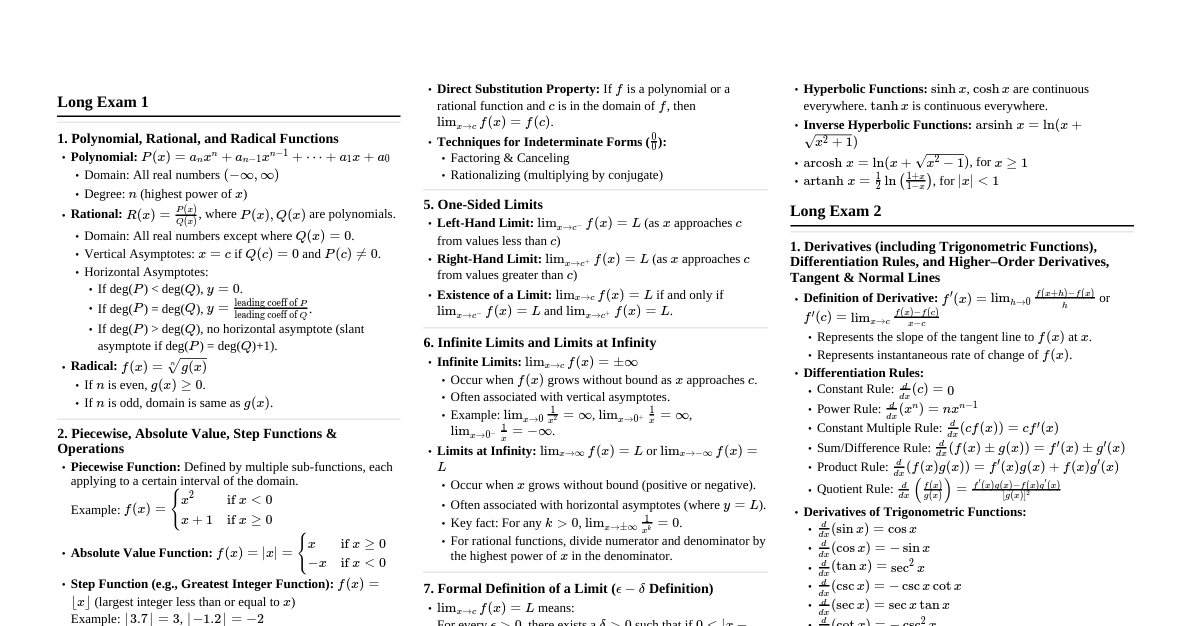
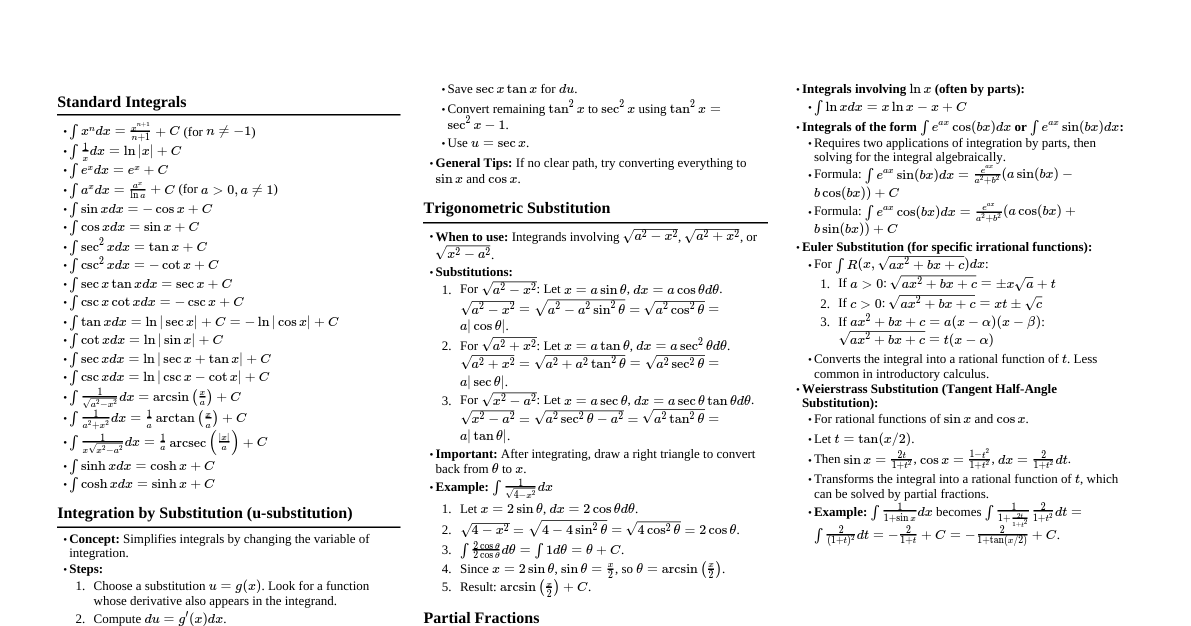
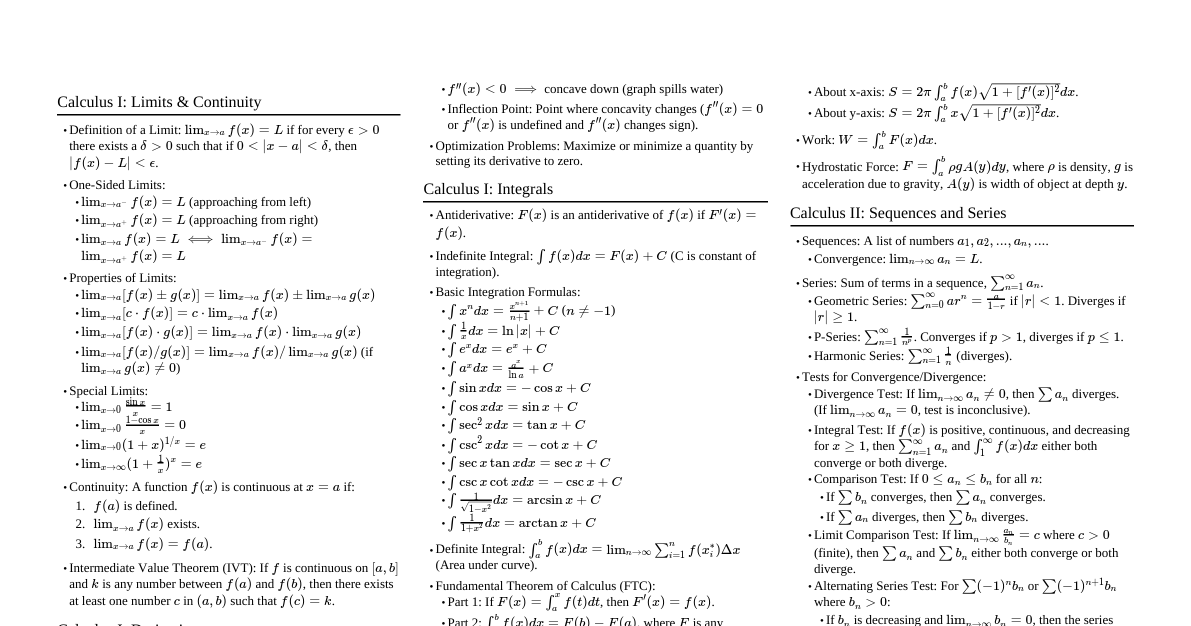
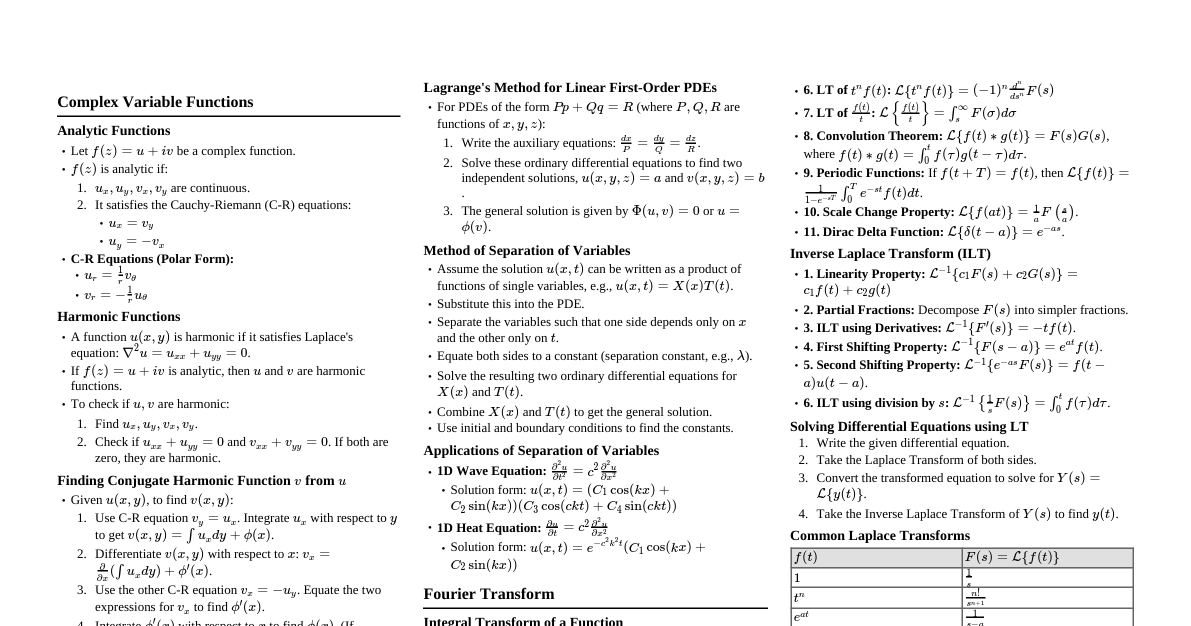
1. Prerequisites for Calculus 1.1 Algebra Essentials Factoring: $ax^2 + bx + c = 0$ (quadratic formula: $x = \frac{-b \pm \sqrt{b^2-4ac}}{2a}$) Exponents: $x^a \cdot x^b = x^{a+b}$, $(x^a)^b = x^{ab}$, $x^{-a} = \frac{1}{x^a}$ Logarithms: $\log_b(xy) = \log_b x + \log_b y$, $\log_b(x^k) = k \log_b x$, $\log_b x = \frac{\ln x}{\ln b}$ Fractions: $\frac{a}{b} + \frac{c}{d} = \frac{ad+bc}{bd}$, $\frac{a/b}{c/d} = \frac{ad}{bc}$ 1.2 Functions Domain & Range: Set of allowed inputs and possible outputs. Types: Linear ($y=mx+b$), Quadratic ($y=ax^2+bx+c$), Polynomial, Rational, Exponential ($y=a^x$), Logarithmic ($y=\log_a x$). Composition: $(f \circ g)(x) = f(g(x))$ Inverse Functions: If $y=f(x)$, then $x=f^{-1}(y)$. Graph is reflection across $y=x$. 1.3 Geometry & Coordinate Systems Distance Formula (2D): $d = \sqrt{(x_2-x_1)^2 + (y_2-y_1)^2}$ Slope: $m = \frac{y_2-y_1}{x_2-x_1}$ Equations of Lines: $y - y_1 = m(x - x_1)$ (point-slope), $y = mx+b$ (slope-intercept) Circles: $(x-h)^2 + (y-k)^2 = r^2$ 2. Basic Calculus Concepts 2.1 Limits Definition: $\lim_{x \to a} f(x) = L$ if $f(x)$ approaches $L$ as $x$ approaches $a$. One-Sided Limits: $\lim_{x \to a^-} f(x)$ (left), $\lim_{x \to a^+} f(x)$ (right). Existence: $\lim_{x \to a} f(x)$ exists iff $\lim_{x \to a^-} f(x) = \lim_{x \to a^+} f(x)$. L'Hôpital's Rule: For indeterminate forms $\frac{0}{0}$ or $\frac{\infty}{\infty}$, $\lim_{x \to a} \frac{f(x)}{g(x)} = \lim_{x \to a} \frac{f'(x)}{g'(x)}$. 2.2 Continuity A function $f(x)$ is continuous at $x=a$ if: $f(a)$ is defined. $\lim_{x \to a} f(x)$ exists. $\lim_{x \to a} f(x) = f(a)$. 2.3 Derivatives Definition: $f'(x) = \lim_{h \to 0} \frac{f(x+h)-f(x)}{h}$ (slope of tangent line, instantaneous rate of change). Power Rule: $\frac{d}{dx}(x^n) = nx^{n-1}$ Product Rule: $\frac{d}{dx}(uv) = u'v + uv'$ Quotient Rule: $\frac{d}{dx}\left(\frac{u}{v}\right) = \frac{u'v - uv'}{v^2}$ Chain Rule: $\frac{d}{dx}(f(g(x))) = f'(g(x))g'(x)$ Common Derivatives: $\frac{d}{dx}(\sin x) = \cos x$ $\frac{d}{dx}(\cos x) = -\sin x$ $\frac{d}{dx}(e^x) = e^x$ $\frac{d}{dx}(\ln x) = \frac{1}{x}$ 2.4 Integrals Antiderivative: $F(x)$ is an antiderivative of $f(x)$ if $F'(x)=f(x)$. Indefinite Integral: $\int f(x) dx = F(x) + C$ Definite Integral: $\int_a^b f(x) dx = F(b) - F(a)$ (area under curve). Fundamental Theorem of Calculus (FTC): Part 1: $\frac{d}{dx} \int_a^x f(t) dt = f(x)$ Part 2: $\int_a^b f(x) dx = F(b) - F(a)$ Common Integrals: $\int x^n dx = \frac{x^{n+1}}{n+1} + C$ ($n \neq -1$) $\int \frac{1}{x} dx = \ln|x| + C$ $\int e^x dx = e^x + C$ $\int \sin x dx = -\cos x + C$ $\int \cos x dx = \sin x + C$ 3. Calculus Question Solving Methods 3.1 Integration Techniques Substitution (u-sub): $\int f(g(x))g'(x) dx = \int f(u) du$ where $u=g(x)$. Integration by Parts: $\int u \, dv = uv - \int v \, du$ (LIATE for picking $u$). Trigonometric Integrals: Use identities (see Section 4) to simplify powers of sines, cosines, etc. Trigonometric Substitution: $\sqrt{a^2-x^2} \implies x = a \sin \theta$ $\sqrt{a^2+x^2} \implies x = a \tan \theta$ $\sqrt{x^2-a^2} \implies x = a \sec \theta$ Partial Fraction Decomposition: For rational functions $\frac{P(x)}{Q(x)}$ where $\deg(P) 3.2 King's Rule (Property of Definite Integrals) Statement: $\int_a^b f(x) dx = \int_a^b f(a+b-x) dx$ Common Application (0 to a): $\int_0^a f(x) dx = \int_0^a f(a-x) dx$ Example: To evaluate $\int_0^{\pi/2} \frac{\sin x}{\sin x + \cos x} dx$. Let $I = \int_0^{\pi/2} \frac{\sin x}{\sin x + \cos x} dx$. Using King's Rule: $I = \int_0^{\pi/2} \frac{\sin(\pi/2-x)}{\sin(\pi/2-x) + \cos(\pi/2-x)} dx = \int_0^{\pi/2} \frac{\cos x}{\cos x + \sin x} dx$. Add the two expressions for $I$: $2I = \int_0^{\pi/2} \frac{\sin x + \cos x}{\sin x + \cos x} dx = \int_0^{\pi/2} 1 \, dx = [x]_0^{\pi/2} = \frac{\pi}{2}$. So, $I = \frac{\pi}{4}$. 4. Trigonometry Identities 4.1 Basic Identities $\sin^2 \theta + \cos^2 \theta = 1$ $\tan \theta = \frac{\sin \theta}{\cos \theta}$ $\cot \theta = \frac{\cos \theta}{\sin \theta} = \frac{1}{\tan \theta}$ $\sec \theta = \frac{1}{\cos \theta}$ $\csc \theta = \frac{1}{\sin \theta}$ $1 + \tan^2 \theta = \sec^2 \theta$ $1 + \cot^2 \theta = \csc^2 \theta$ 4.2 Angle Sum/Difference $\sin(A \pm B) = \sin A \cos B \pm \cos A \sin B$ $\cos(A \pm B) = \cos A \cos B \mp \sin A \sin B$ $\tan(A \pm B) = \frac{\tan A \pm \tan B}{1 \mp \tan A \tan B}$ 4.3 Double and Half-Angle Identities $\sin(2\theta) = 2 \sin \theta \cos \theta$ $\cos(2\theta) = \cos^2 \theta - \sin^2 \theta = 2\cos^2 \theta - 1 = 1 - 2\sin^2 \theta$ $\tan(2\theta) = \frac{2 \tan \theta}{1 - \tan^2 \theta}$ $\sin^2 \theta = \frac{1 - \cos(2\theta)}{2}$ $\cos^2 \theta = \frac{1 + \cos(2\theta)}{2}$ 4.4 Product-to-Sum and Sum-to-Product $2 \sin A \cos B = \sin(A+B) + \sin(A-B)$ $2 \cos A \cos B = \cos(A+B) + \cos(A-B)$ $2 \sin A \sin B = \cos(A-B) - \cos(A+B)$ 5. Complex Numbers and Polar Form 5.1 Complex Numbers Basics Definition: $z = x + iy$, where $i = \sqrt{-1}$ ($i^2 = -1$). Real Part: $\text{Re}(z) = x$ Imaginary Part: $\text{Im}(z) = y$ Conjugate: $\bar{z} = x - iy$ Modulus (Magnitude): $|z| = \sqrt{x^2+y^2}$ Properties: $z \bar{z} = |z|^2$ $\overline{z_1+z_2} = \bar{z_1}+\bar{z_2}$ $\overline{z_1z_2} = \bar{z_1}\bar{z_2}$ 5.2 Polar Form (Trigonometric Form) Representation: $z = r(\cos \theta + i \sin \theta)$, where: $r = |z| = \sqrt{x^2+y^2}$ (modulus) $\theta = \arg(z)$ (argument/angle), $\tan \theta = \frac{y}{x}$. $\theta$ is typically in $(-\pi, \pi]$ or $[0, 2\pi)$. Conversion: From Rectangular to Polar: $r = \sqrt{x^2+y^2}$, $\theta = \operatorname{atan2}(y, x)$ (or consider quadrant for $\tan^{-1}(y/x)$). From Polar to Rectangular: $x = r \cos \theta$, $y = r \sin \theta$. 5.3 Euler's Formula $e^{i\theta} = \cos \theta + i \sin \theta$ Exponential Form: $z = re^{i\theta}$ 5.4 Operations in Polar/Exponential Form Multiplication: $z_1 z_2 = (r_1 e^{i\theta_1})(r_2 e^{i\theta_2}) = r_1 r_2 e^{i(\theta_1+\theta_2)}$ Division: $\frac{z_1}{z_2} = \frac{r_1 e^{i\theta_1}}{r_2 e^{i\theta_2}} = \frac{r_1}{r_2} e^{i(\theta_1-\theta_2)}$ Powers (De Moivre's Theorem): $z^n = (re^{i\theta})^n = r^n e^{in\theta} = r^n (\cos(n\theta) + i \sin(n\theta))$ Roots: For $z^{1/n}$, there are $n$ distinct roots: $z_k = r^{1/n} e^{i(\frac{\theta+2\pi k}{n})}$ for $k=0, 1, \dots, n-1$. 6. Contour Integration (Complex Analysis) 6.1 Complex Functions Definition: $f(z) = u(x,y) + iv(x,y)$, where $z=x+iy$. Analytic Function: A function $f(z)$ is analytic at a point $z_0$ if it's differentiable in a neighborhood of $z_0$. Cauchy-Riemann Equations: For $f(z)=u(x,y)+iv(x,y)$ to be analytic, $\frac{\partial u}{\partial x} = \frac{\partial v}{\partial y}$ and $\frac{\partial u}{\partial y} = -\frac{\partial v}{\partial x}$. 6.2 Complex Integrals Line Integral (Contour Integral): $\int_C f(z) dz$. If $C$ is parameterized by $z(t) = x(t) + iy(t)$ for $a \le t \le b$, then $\int_C f(z) dz = \int_a^b f(z(t))z'(t) dt$. 6.3 Cauchy's Integral Theorem If $f(z)$ is analytic inside and on a simple closed contour $C$, then $\oint_C f(z) dz = 0$. 6.4 Cauchy's Integral Formula If $f(z)$ is analytic inside and on a simple closed contour $C$ and $z_0$ is any point inside $C$, then $f(z_0) = \frac{1}{2\pi i} \oint_C \frac{f(z)}{z-z_0} dz$. For Derivatives: $f^{(n)}(z_0) = \frac{n!}{2\pi i} \oint_C \frac{f(z)}{(z-z_0)^{n+1}} dz$. 6.5 Singularities and Residues Isolated Singularity: A point $z_0$ where $f(z)$ is not analytic, but is analytic in a punctured disk $0 Types of Singularities: Removable: $\lim_{z \to z_0} f(z)$ exists. Pole of order $m$: $\lim_{z \to z_0} (z-z_0)^m f(z)$ exists and is non-zero. Essential: Neither removable nor a pole. Residue: For an isolated singularity $z_0$, the residue is the coefficient of $(z-z_0)^{-1}$ in the Laurent series expansion of $f(z)$ around $z_0$. Denoted $\text{Res}(f, z_0)$. Calculating Residues: Simple Pole ($m=1$): $\text{Res}(f, z_0) = \lim_{z \to z_0} (z-z_0)f(z)$. Pole of order $m > 1$: $\text{Res}(f, z_0) = \frac{1}{(m-1)!} \lim_{z \to z_0} \frac{d^{m-1}}{dz^{m-1}} [(z-z_0)^m f(z)]$. If $f(z) = p(z)/q(z)$ with $p(z_0) \neq 0$ and $q(z_0)=0$, $q'(z_0) \neq 0$ (simple pole), then $\text{Res}(f, z_0) = \frac{p(z_0)}{q'(z_0)}$. 6.6 Residue Theorem If $f(z)$ is analytic inside and on a simple closed contour $C$, except for a finite number of isolated singularities $z_1, z_2, \dots, z_n$ inside $C$, then $\oint_C f(z) dz = 2\pi i \sum_{k=1}^n \text{Res}(f, z_k)$. 6.7 Applications of Contour Integration Evaluation of Real Integrals: Often used to evaluate improper real integrals of the form $\int_{-\infty}^{\infty} f(x) dx$ or $\int_0^{2\pi} R(\cos \theta, \sin \theta) d\theta$. Jordan's Lemma: Useful for integrals involving $e^{i\alpha z}$ over a large semi-circular contour.