Chemistry Unit 1 Essentials
Cheatsheet Content
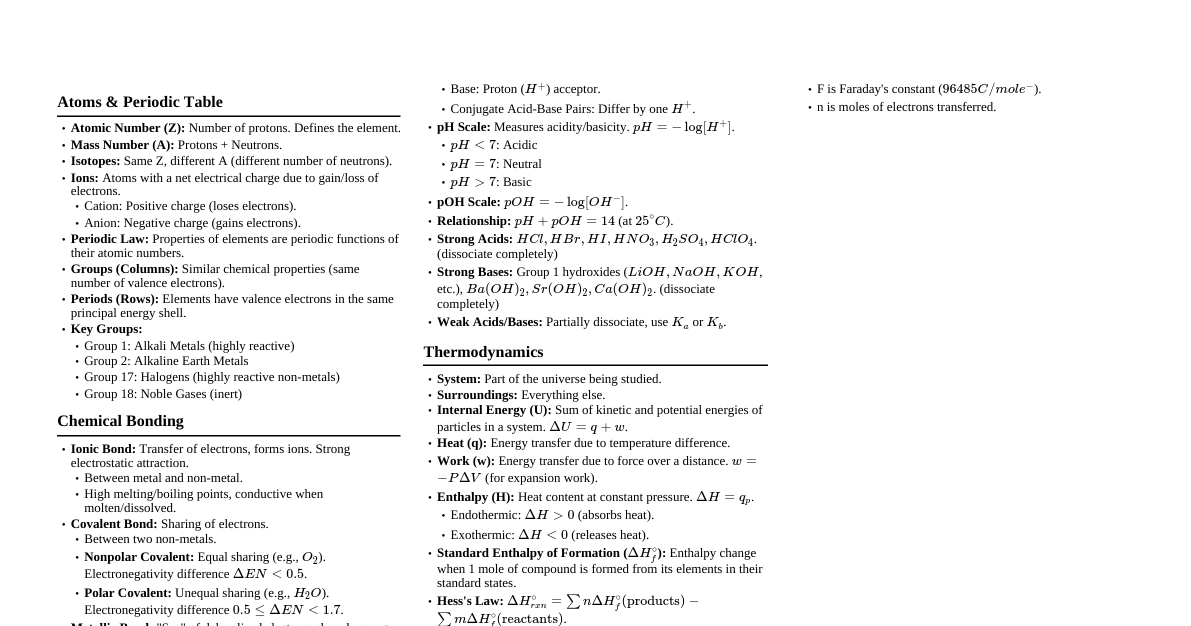
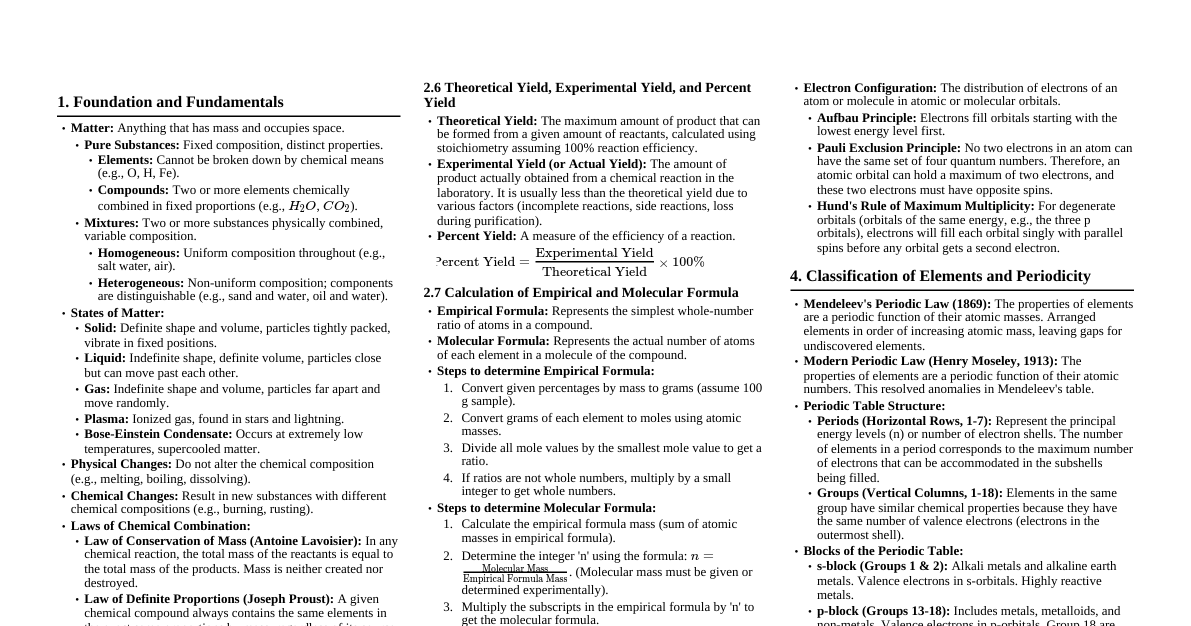
Atomic Structure Orbit vs. Orbital: Orbit: Fixed path for electrons (classical view, Bohr model). Orbital: Region of space where an electron is most likely to be found (quantum mechanical view). Electron Configuration Rules: Pauli's Exclusion Principle: No two electrons in an atom can have the same set of four quantum numbers. Max 2 electrons per orbital with opposite spins. Hund's Rule of Maximum Multiplicity: Electrons fill orbitals of the same energy level singly before pairing up, and all single electrons have the same spin. Aufbau Principle: Electrons fill atomic orbitals of the lowest available energy levels before occupying higher levels. Electronic Configuration: Arrangement of electrons in orbitals (learn for elements 1-30). Chemical Bonding Concept of Chemical Bond: Force holding atoms together. Octet Rule: Atoms tend to gain, lose, or share electrons to achieve a stable configuration of eight valence electrons (like noble gases). Types of Chemical Bonds: Ionic (Electrovalent) Bond: Complete transfer of electrons between atoms. Usually between a metal and a non-metal. Example: $NaCl$ (Na loses an electron, Cl gains one). Covalent Bond: Sharing of electrons between atoms. Usually between non-metals. Non-polar Covalent Bond: Equal sharing of electrons. Examples: $H_2, O_2, N_2, CH_4$. Polar Covalent Bond: Unequal sharing of electrons due to difference in electronegativity. Examples: $HCl, H_2O, NH_3$. Coordinate Covalent (Dative) Bond: One atom donates both shared electrons. Examples: $NH_4^+, H_3O^+$. Metallic Bond: Attraction between positively charged metal ions and a "sea" of delocalized electrons. Characteristics: good conductivity, malleability, ductility. Hydrogen Bond: Special type of dipole-dipole interaction between hydrogen bonded to a highly electronegative atom (N, O, F) and another electronegative atom. Significance: affects properties of water, DNA structure. Intermolecular Forces (van der Waals Bond): Weak attractive forces between molecules. Include London Dispersion Forces, Dipole-Dipole interactions. Structure of Solids Ionic Solids: Held by electrostatic forces (e.g., $NaCl$). Molecular Solids: Held by weak intermolecular forces (e.g., Ice, $CO_2$). Network Solids (Covalent Solids): Atoms held by strong covalent bonds in a giant lattice (e.g., Diamond, Quartz). Metallic Solids: Metal atoms in a "sea" of delocalized electrons (e.g., Iron, Copper). Solutions Definitions: Solute: Substance being dissolved. Solvent: Substance doing the dissolving. Solution: Homogeneous mixture of solute and solvent. Concentration: Amount of solute in a given amount of solvent or solution. Modes of Expressing Concentration: Molarity (M): Moles of solute per liter of solution ($mol/L$). Normality (N): Gram equivalent weight of solute per liter of solution. Molality (m): Moles of solute per kilogram of solvent ($mol/kg$). Mass Percentage (%w/w): $((\text{mass of solute}) / (\text{mass of solution})) \times 100$. Volume Percentage (%v/v): $((\text{volume of solute}) / (\text{volume of solution})) \times 100$. Mass by Volume Percentage (%w/v): $((\text{mass of solute}) / (\text{volume of solution})) \times 100$. Mole Fraction ($\chi$): Moles of component / Total moles of all components. Parts per Million (ppm): $(\text{mass of solute in mg}) / (\text{volume of solution in mL})$.