Chemistry Essentials
Cheatsheet Content
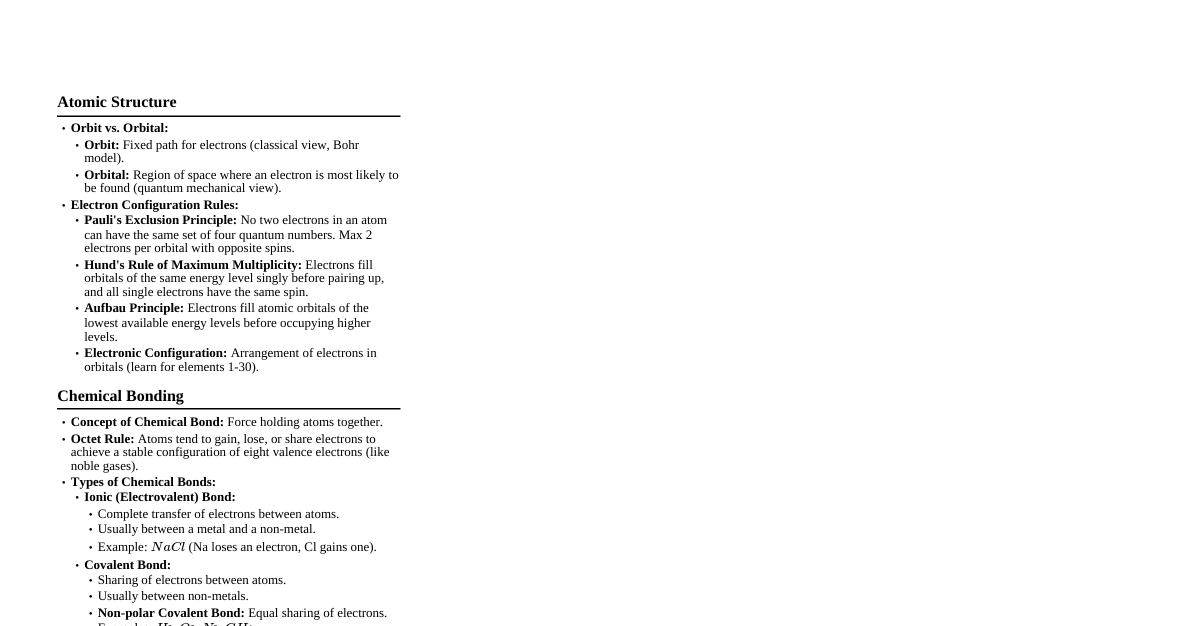
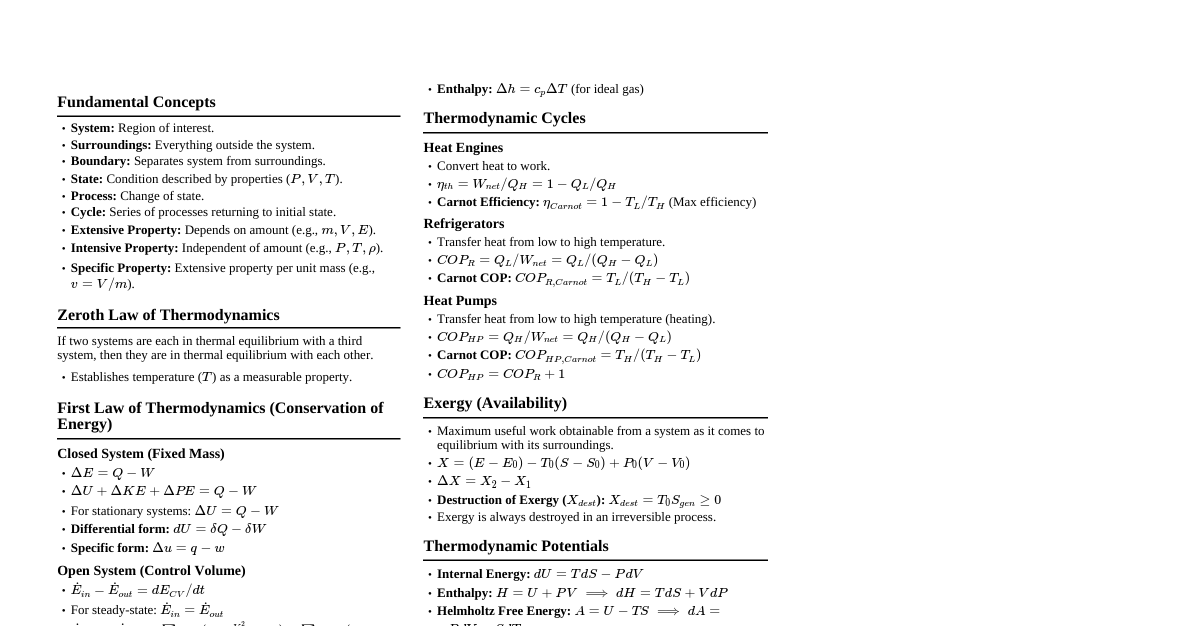
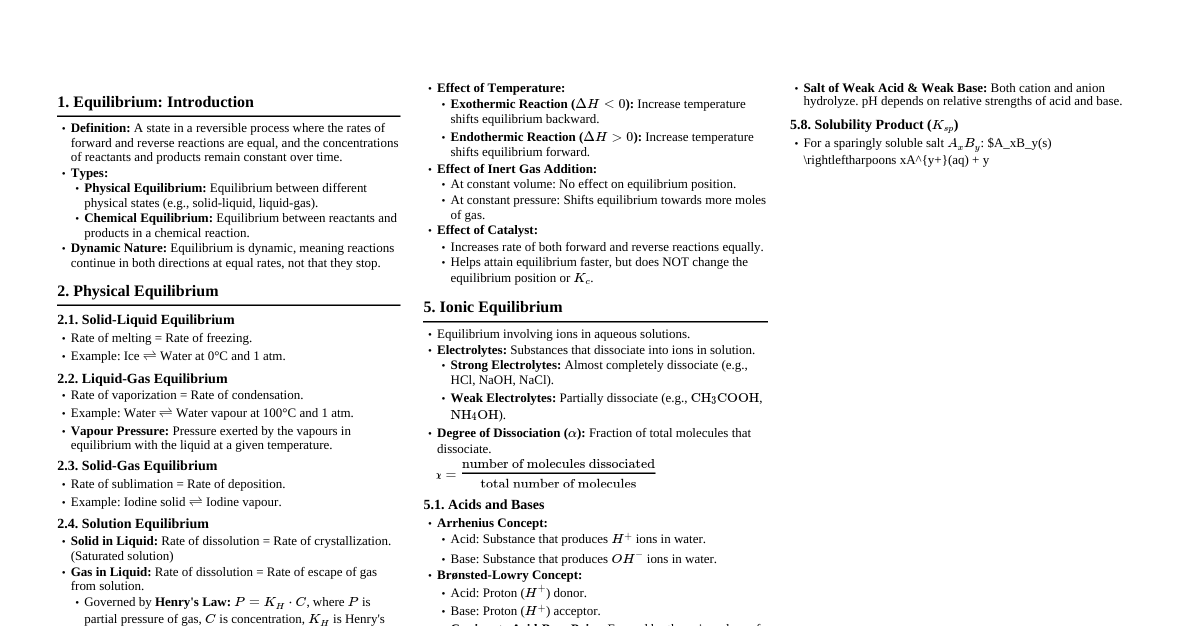
Atoms & Periodic Table Atomic Number (Z): Number of protons. Defines the element. Mass Number (A): Protons + Neutrons. Isotopes: Same Z, different A (different number of neutrons). Ions: Atoms with a net electrical charge due to gain/loss of electrons. Cation: Positive charge (loses electrons). Anion: Negative charge (gains electrons). Periodic Law: Properties of elements are periodic functions of their atomic numbers. Groups (Columns): Similar chemical properties (same number of valence electrons). Periods (Rows): Elements have valence electrons in the same principal energy shell. Key Groups: Group 1: Alkali Metals (highly reactive) Group 2: Alkaline Earth Metals Group 17: Halogens (highly reactive non-metals) Group 18: Noble Gases (inert) Chemical Bonding Ionic Bond: Transfer of electrons, forms ions. Strong electrostatic attraction. Between metal and non-metal. High melting/boiling points, conductive when molten/dissolved. Covalent Bond: Sharing of electrons. Between two non-metals. Nonpolar Covalent: Equal sharing (e.g., $O_2$). Electronegativity difference $\Delta EN Polar Covalent: Unequal sharing (e.g., $H_2O$). Electronegativity difference $0.5 \le \Delta EN Metallic Bond: "Sea" of delocalized electrons shared among metal atoms. Good conductors of heat/electricity, malleable, ductile. Electronegativity: Tendency of an atom to attract electrons in a bond. Increases across a period, decreases down a group. Fluorine (F) is the most electronegative. Lewis Structures: Represent valence electrons as dots to show bonding. VSEPR Theory: Predicts molecular geometry based on repulsion between electron pairs. Linear: $AX_2$ (e.g., $CO_2$) Trigonal Planar: $AX_3$ (e.g., $BF_3$) Tetrahedral: $AX_4$ (e.g., $CH_4$) Trigonal Pyramidal: $AX_3E_1$ (e.g., $NH_3$) Bent: $AX_2E_2$ (e.g., $H_2O$) Stoichiometry & Reactions Mole: $6.022 \times 10^{23}$ particles (Avogadro's number). Molar Mass: Mass of one mole of a substance (g/mol). Balancing Equations: Ensure same number of each type of atom on both sides. Limiting Reactant: Reactant that is completely consumed, determines amount of product. Percent Yield: $(\text{Actual Yield} / \text{Theoretical Yield}) \times 100\%$. Types of Reactions: Combination: $A + B \to AB$ Decomposition: $AB \to A + B$ Single Replacement: $A + BC \to AC + B$ Double Replacement: $AB + CD \to AD + CB$ Combustion: Fuel + $O_2 \to CO_2 + H_2O$ Acid-Base (Neutralization): Acid + Base $\to$ Salt + Water Solutions Solute: Substance dissolved. Solvent: Substance doing the dissolving (usually in larger amount). Solution: Homogeneous mixture. Molarity (M): Moles of solute / Liters of solution ($mol/L$). Molality (m): Moles of solute / kg of solvent ($mol/kg$). Dilution: $M_1V_1 = M_2V_2$. Solubility Rules: General guidelines for ionic compounds in water. Most nitrates ($NO_3^-$), acetates ($CH_3COO^-$), group 1 salts are soluble. Most chlorides ($Cl^-$), bromides ($Br^-$), iodides ($I^-$) are soluble, except with $Ag^+$, $Pb^{2+}$, $Hg_2^{2+}$. Most sulfates ($SO_4^{2-}$) are soluble, except with $Ba^{2+}$, $Pb^{2+}$, $Ca^{2+}$, $Sr^{2+}$. Most carbonates ($CO_3^{2-}$), phosphates ($PO_4^{3-}$), sulfides ($S^{2-}$), hydroxides ($OH^-$) are insoluble, except with group 1 or $NH_4^+$. Acids and Bases Arrhenius: Acid: Produces $H^+$ in water. Base: Produces $OH^-$ in water. Brønsted-Lowry: Acid: Proton ($H^+$) donor. Base: Proton ($H^+$) acceptor. Conjugate Acid-Base Pairs: Differ by one $H^+$. pH Scale: Measures acidity/basicity. $pH = -\log[H^+]$. $pH $pH = 7$: Neutral $pH > 7$: Basic pOH Scale: $pOH = -\log[OH^-]$. Relationship: $pH + pOH = 14$ (at $25^\circ C$). Strong Acids: $HCl, HBr, HI, HNO_3, H_2SO_4, HClO_4$. (dissociate completely) Strong Bases: Group 1 hydroxides ($LiOH, NaOH, KOH$, etc.), $Ba(OH)_2, Sr(OH)_2, Ca(OH)_2$. (dissociate completely) Weak Acids/Bases: Partially dissociate, use $K_a$ or $K_b$. Thermodynamics System: Part of the universe being studied. Surroundings: Everything else. Internal Energy (U): Sum of kinetic and potential energies of particles in a system. $\Delta U = q + w$. Heat (q): Energy transfer due to temperature difference. Work (w): Energy transfer due to force over a distance. $w = -P\Delta V$ (for expansion work). Enthalpy (H): Heat content at constant pressure. $\Delta H = q_p$. Endothermic: $\Delta H > 0$ (absorbs heat). Exothermic: $\Delta H Standard Enthalpy of Formation ($\Delta H_f^\circ$): Enthalpy change when 1 mole of compound is formed from its elements in their standard states. Hess's Law: $\Delta H_{rxn}^\circ = \sum n \Delta H_f^\circ (\text{products}) - \sum m \Delta H_f^\circ (\text{reactants})$. Entropy (S): Measure of disorder or randomness. Increases with increasing temperature, volume, number of particles, or complexity. Gibbs Free Energy (G): Predicts spontaneity. $\Delta G = \Delta H - T\Delta S$. $\Delta G $\Delta G = 0$: At equilibrium $\Delta G > 0$: Non-spontaneous (reverse is spontaneous) Kinetics Reaction Rate: Change in concentration of reactant/product per unit time. Rate Law: $Rate = k[A]^x[B]^y$. x, y are reaction orders (determined experimentally). k is the rate constant. Activation Energy ($E_a$): Minimum energy required for a reaction to occur. Arrhenius Equation: $k = Ae^{-E_a/RT}$. Catalyst: Increases reaction rate by lowering $E_a$ without being consumed. Equilibrium Reversible Reaction: Proceeds in both forward and reverse directions. Chemical Equilibrium: Rates of forward and reverse reactions are equal. Concentrations remain constant. Equilibrium Constant (K): For $aA + bB \rightleftharpoons cC + dD$, $K_c = \frac{[C]^c[D]^d}{[A]^a[B]^b}$. Only aqueous and gaseous species are included. Large K: Products favored. Small K: Reactants favored. Le Chatelier's Principle: System at equilibrium subjected to stress will shift to relieve the stress. Concentration: Add reactant, shift right; add product, shift left. Temperature: Treat heat as reactant (endothermic) or product (exothermic). Pressure/Volume: (For gases) Increase pressure (decrease volume), shift to side with fewer moles of gas. Electrochemistry Redox Reactions: Transfer of electrons. Oxidation: Loss of electrons (LEO - Loss of Electrons is Oxidation). Oxidation number increases. Reduction: Gain of electrons (GER - Gain of Electrons is Reduction). Oxidation number decreases. Oxidizing Agent: Gets reduced. Reducing Agent: Gets oxidized. Electrochemical Cells: Convert chemical energy to electrical energy (or vice versa). Galvanic/Voltaic Cell: Spontaneous redox reaction produces electricity. Anode: Oxidation occurs (negative electrode). Cathode: Reduction occurs (positive electrode). Electrons flow from anode to cathode. Electrolytic Cell: Non-spontaneous reaction driven by external power. Standard Electrode Potential ($E^\circ$): Measures tendency of a half-reaction to occur as reduction. Cell Potential ($E_{cell}^\circ$): $E_{cell}^\circ = E_{cathode}^\circ - E_{anode}^\circ$. $E_{cell}^\circ > 0$: Spontaneous. Gibbs Free Energy & Cell Potential: $\Delta G^\circ = -nFE_{cell}^\circ$. F is Faraday's constant ($96485 C/mol e^-$). n is moles of electrons transferred.