Infinite Series Essentials
Shared 12/7/2025•77 views
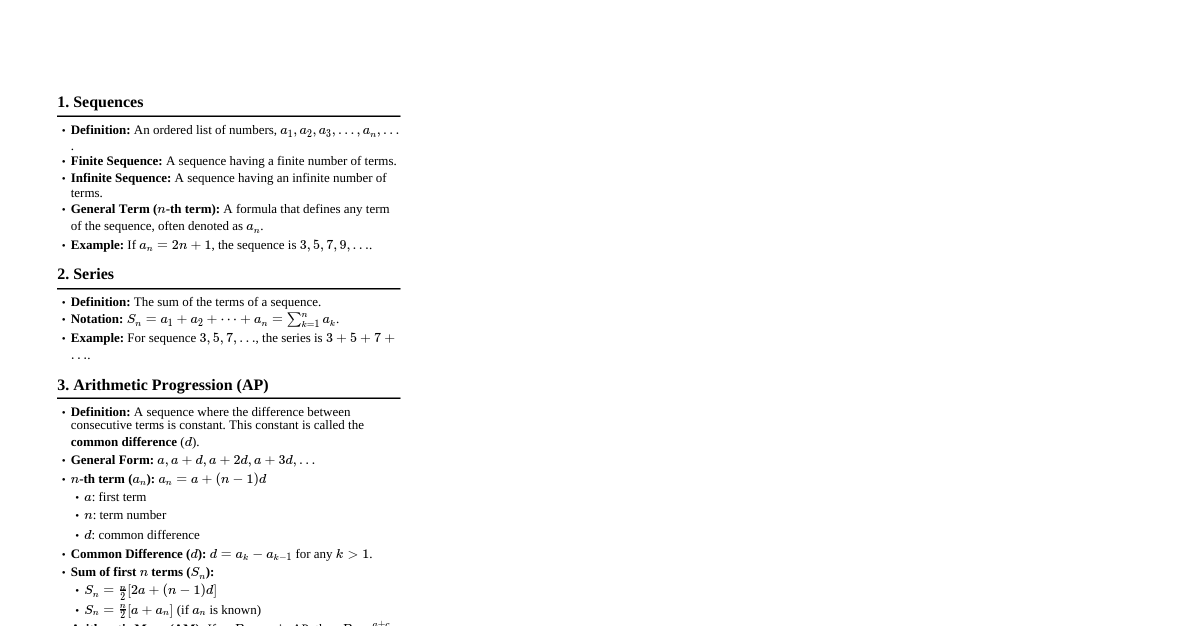
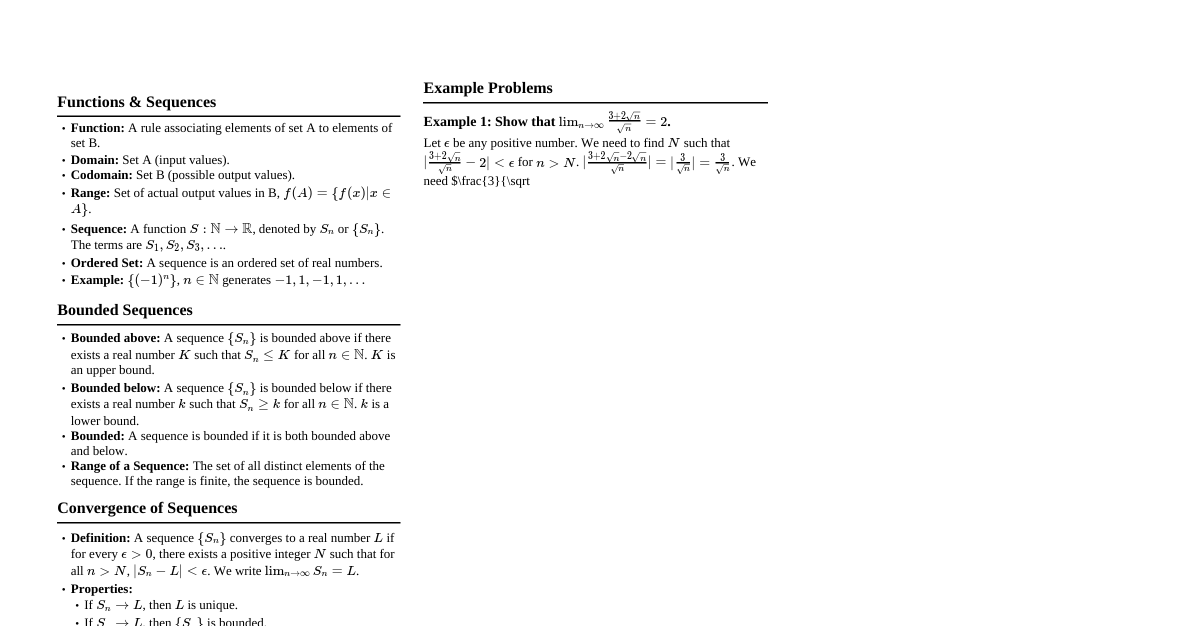
1. Sequences Definition: A sequence is an ordered list of numbers. Each number in the list is called a term. We denote the $n$-th term by $a_n$. Convergence of a Sequence: A sequence $(a_n)$ is said to **converge** to a limit $L$ if, as $n$ gets very large (approaches infinity), the terms $a_n$ get arbitrarily close to $L$. In mathematical notation, this is written as $\lim_{n \to \infty} a_n = L$, where $L$ is a finite and unique real number. Divergence of a Sequence: If a sequence does not converge to a finite and unique limit, it is said to **diverge**. There are two main ways a sequence can diverge: The terms $a_n$ grow without bound (approach $\infty$ or $-\infty$). The terms $a_n$ do not approach a single, unique value; they might oscillate between different values or follow no clear pattern. This is called **oscillation**. Practice Problems on Sequences Basic: Examine the convergence of $a_n = \frac{3n-1}{1+2n}$. Examine the convergence of $a_n = 2^n$. Examine the convergence of $a_n = \frac{1}{n}$. Medium: Examine the convergence of $a_n = 3 + (-1)^n$. Examine the convergence of $a_n = \frac{n^2-2n}{3n^2+n}$. Solutions Problem: Examine the convergence of $a_n = 3 + (-1)^n$. Step-by-step Solution: Understand the sequence definition: The given sequence is $a_n = 3 + (-1)^n$. This means we substitute different integer values for $n$ (starting usually from $n=1$) to find the terms of the sequence. Calculate the first few terms: For $n=1$: $a_1 = 3 + (-1)^1 = 3 - 1 = 2$. For $n=2$: $a_2 = 3 + (-1)^2 = 3 + 1 = 4$. For $n=3$: $a_3 = 3 + (-1)^3 = 3 - 1 = 2$. For $n=4$: $a_4 = 3 + (-1)^4 = 3 + 1 = 4$. The sequence is $2, 4, 2, 4, 2, 4, \dots$ Analyze the behavior of the terms as $n \to \infty$: We observe that the terms of the sequence alternate between $2$ and $4$. When $n$ is an **odd** integer, $(-1)^n = -1$, so $a_n = 3 - 1 = 2$. When $n$ is an **even** integer, $(-1)^n = 1$, so $a_n = 3 + 1 = 4$. As $n$ approaches infinity, the terms of the sequence do not settle down to a single, unique value. Instead, they keep jumping back and forth between $2$ and $4$. Conclusion based on definition of convergence: Since the terms of the sequence do not approach a single, unique finite limit as $n \to \infty$, the sequence does not converge. It is not diverging to $\infty$ or $-\infty$, but rather it is **oscillating** between two distinct values. Therefore, the sequence $a_n = 3 + (-1)^n$ is **oscillatory (divergent)**. $\lim_{n \to \infty} \frac{3n-1}{1+2n} = \lim_{n \to \infty} \frac{3-1/n}{1/n+2} = \frac{3}{2}$. Since the limit is finite and unique, the sequence is **convergent**. $\lim_{n \to \infty} 2^n = \infty$. The sequence is **divergent**. $\lim_{n \to \infty} \frac{1}{n} = 0$. The sequence is **convergent**. $\lim_{n \to \infty} \frac{n^2-2n}{3n^2+n} = \lim_{n \to \infty} \frac{1-2/n}{3+1/n} = \frac{1}{3}$. Since the limit is finite and unique, the sequence is **convergent**. 2. Series: Convergence, Divergence, Oscillation Definition: An infinite series is the sum of terms of an infinite sequence, denoted by $\sum u_n = u_1 + u_2 + u_3 + \dots$. The sum of its first $n$ terms is $s_n = u_1 + u_2 + \dots + u_n$. Convergence: If $\lim_{n \to \infty} s_n = L$ (a finite limit), the series $\sum u_n$ is **convergent**. Divergence: If $\lim_{n \to \infty} s_n = \pm \infty$, the series $\sum u_n$ is **divergent**. Oscillation: If $\lim_{n \to \infty} s_n$ does not tend to a unique limit, the series $\sum u_n$ is **oscillatory** (or non-convergent). Necessary Condition for Convergence: If $\sum u_n$ is convergent, then $\lim_{n \to \infty} u_n = 0$. (The converse is not necessarily true). Test for Divergence: If $\lim_{n \to \infty} u_n \neq 0$, then $\sum u_n$ must be divergent. Practice Problems on Series Convergence Basic: Examine the series $\sum_{n=1}^\infty n$. Examine the series $\sum_{n=1}^\infty (-1)^{n-1}$. Examine the series $\sum_{n=1}^\infty \frac{1}{n(n+1)}$. (Hint: $u_n = \frac{1}{n} - \frac{1}{n+1}$) Medium: Examine the series $1 - 1 + 1 - 1 + \dots$. Examine the geometric series $\sum_{n=0}^\infty r^n$. Solutions Here $u_n = n$. $s_n = \frac{n(n+1)}{2}$. $\lim_{n \to \infty} s_n = \infty$. The series is **divergent**. Here $u_n = (-1)^{n-1}$. $\lim_{n \to \infty} u_n \neq 0$ (it oscillates between $1$ and $-1$). Thus, the series is **divergent**. $s_n = \sum_{k=1}^n (\frac{1}{k} - \frac{1}{k+1}) = (1 - \frac{1}{2}) + (\frac{1}{2} - \frac{1}{3}) + \dots + (\frac{1}{n} - \frac{1}{n+1}) = 1 - \frac{1}{n+1}$. $\lim_{n \to \infty} s_n = 1$. The series is **convergent**. Here $s_n$ is $1$ if $n$ is odd, and $0$ if $n$ is even. The limit is not unique, so the series is **oscillatory**. If $|r| < 1$, $s_n = \frac{1-r^n}{1-r}$. $\lim_{n \to \infty} s_n = \frac{1}{1-r}$ (finite). **Convergent**. If $r = 1$, $s_n = n$. $\lim_{n \to \infty} s_n = \infty$. **Divergent**. If $r = -1$, $s_n$ oscillates between $1$ and $0$. **Oscillatory**. If $r > 1$, $\lim_{n \to \infty} s_n = \infty$. **Divergent**. If $r < -1$, $s_n$ oscillates. **Oscillatory**. 3. General Properties of Series Adding or removing a finite number of terms does not affect the convergence or divergence of an infinite series. Multiplying each term of a series by a finite non-zero number does not affect its convergence or divergence. If all terms of a convergent series are positive, it remains convergent even if some terms become negative. Practice Problems on General Properties Basic: If $\sum u_n$ converges, does $\sum (u_n + c)$ (for constant $c \neq 0$) converge? If $\sum u_n$ diverges, does $\sum (u_n + u_{n+1})$ diverge? If $\sum u_n$ converges, does $\sum (k \cdot u_n)$ (for constant $k \neq 0$) converge? Medium: If $\sum u_n$ converges, what can be said about $\sum (u_n + u_{n+1} + \dots + u_{n+k})$ for a fixed $k$? If $\sum u_n$ converges, and $v_n = u_n$ for all $n > M$ (for some integer $M$), does $\sum v_n$ converge? Solutions No. If $\sum u_n = S$, then $\sum (u_n + c) = \sum u_n + \sum c = S + \infty$, which diverges. Not necessarily. For example, if $u_n = (-1)^n$, $\sum u_n$ diverges. But $u_n + u_{n+1} = (-1)^n + (-1)^{n+1} = 0$, so $\sum (u_n + u_{n+1}) = \sum 0 = 0$, which converges. Yes. If $\sum u_n = S$, then $\sum (k \cdot u_n) = k \cdot \sum u_n = kS$, which is finite. If $\sum u_n$ converges to $S$, then $s_n \to S$. The sum of a finite number of terms ($u_1 + \dots + u_k$) is finite. So adding or removing these terms from the sum of the series ($S$) results in a new finite sum. Thus, $\sum (u_n + u_{n+1} + \dots + u_{n+k})$ also converges. Yes. The first $M$ terms differ, but the convergence of an infinite series is determined by the behavior of its terms as $n \to \infty$. A finite number of initial terms does not affect the convergence. 4. Series of Positive Terms Definition: An infinite series is a **positive term series** if all its terms (after some particular term) are positive. A series of positive terms either converges or diverges to $+\infty$. It cannot oscillate. Practice Problems on Positive Term Series Basic: Is $\sum_{n=1}^\infty \frac{1}{n^2}$ a positive term series? Is $\sum_{n=1}^\infty \frac{(-1)^{n+1}}{n}$ a positive term series? If $\sum u_n$ is a positive term series and $\lim_{n \to \infty} u_n = 0$, does it guarantee convergence? Medium: If $\sum u_n$ is a positive term series and $s_n$ is bounded above, what can be concluded about its convergence? Construct a positive term series that diverges. Solutions Yes, all terms $1/n^2$ are positive. No, this is an alternating series. No. For example, the harmonic series $\sum 1/n$ is a positive term series, $\lim_{n \to \infty} 1/n = 0$, but it diverges. If $s_n$ is bounded above and the terms are positive, then $s_n$ is a monotonic increasing sequence. A monotonic increasing sequence that is bounded above must converge. Thus, the series **converges**. The harmonic series $\sum_{n=1}^\infty \frac{1}{n}$ is a positive term series that **diverges**. 5. Comparison Tests I. Direct Comparison Test: Let $\sum u_n$ and $\sum v_n$ be two positive term series. If $\sum v_n$ converges and $u_n \leq v_n$ for all $n$ (or for $n \geq M$), then $\sum u_n$ also converges. If $\sum v_n$ diverges and $u_n \geq v_n$ for all $n$ (or for $n \geq M$), then $\sum u_n$ also diverges. III. Limit Form (Limit Comparison Test): Let $\sum u_n$ and $\sum v_n$ be two positive term series. If $\lim_{n \to \infty} \frac{u_n}{v_n} = L$, where $L$ is a finite non-zero number, then both series converge or diverge together. Auxiliary Series (p-series): The series $\sum_{n=1}^\infty \frac{1}{n^p}$ (p-series) Converges if $p > 1$. Diverges if $p \leq 1$. Practice Problems on Comparison Tests Basic: Test the convergence of $\sum_{n=1}^\infty \frac{1}{n^2+1}$. Test the convergence of $\sum_{n=1}^\infty \frac{n}{n^2-1}$. Test the convergence of $\sum_{n=1}^\infty \frac{1}{\sqrt{n}}$. Medium: Test the convergence of $\sum_{n=1}^\infty \frac{n^2+2n+3}{n^4+n^2+1}$. Test the convergence of $\sum_{n=1}^\infty \sin(\frac{1}{n})$. (Hint: For small $x$, $\sin x \approx x$) Solutions Let $u_n = \frac{1}{n^2+1}$. Choose $v_n = \frac{1}{n^2}$. $\lim_{n \to \infty} \frac{u_n}{v_n} = \lim_{n \to \infty} \frac{n^2}{n^2+1} = 1$. Since $\sum v_n = \sum \frac{1}{n^2}$ is a p-series with $p=2 > 1$ (convergent), $\sum u_n$ is also **convergent**. Let $u_n = \frac{n}{n^2-1}$. Choose $v_n = \frac{n}{n^2} = \frac{1}{n}$. $\lim_{n \to \infty} \frac{u_n}{v_n} = \lim_{n \to \infty} \frac{n/(n^2-1)}{1/n} = \lim_{n \to \infty} \frac{n^2}{n^2-1} = 1$. Since $\sum v_n = \sum \frac{1}{n}$ is a p-series with $p=1$ (divergent), $\sum u_n$ is also **divergent**. This is a p-series $\sum \frac{1}{n^{1/2}}$ with $p=1/2 \leq 1$. So it is **divergent**. Let $u_n = \frac{n^2+2n+3}{n^4+n^2+1}$. Choose $v_n = \frac{n^2}{n^4} = \frac{1}{n^2}$. $\lim_{n \to \infty} \frac{u_n}{v_n} = \lim_{n \to \infty} \frac{(n^2+2n+3)/(n^4+n^2+1)}{1/n^2} = \lim_{n \to \infty} \frac{n^2(n^2+2n+3)}{n^4+n^2+1} = \lim_{n \to \infty} \frac{n^4+2n^3+3n^2}{n^4+n^2+1} = 1$. Since $\sum v_n = \sum \frac{1}{n^2}$ is a p-series with $p=2 > 1$ (convergent), $\sum u_n$ is also **convergent**. Let $u_n = \sin(\frac{1}{n})$. For large $n$, $\sin(\frac{1}{n}) \approx \frac{1}{n}$. So choose $v_n = \frac{1}{n}$. $\lim_{n \to \infty} \frac{u_n}{v_n} = \lim_{n \to \infty} \frac{\sin(1/n)}{1/n} = 1$. Since $\sum v_n = \sum \frac{1}{n}$ is a p-series with $p=1$ (divergent), $\sum u_n$ is also **divergent**. 6. Integral Test Let $\sum u_n$ be a positive term series and $f(x)$ be a function such that $f(n) = u_n$. If $f(x)$ is positive, continuous, and decreasing for $x \geq 1$, then $\sum u_n$ and $\int_1^\infty f(x) dx$ either both converge or both diverge. Practice Problems on Integral Test Basic: Test the convergence of $\sum_{n=1}^\infty \frac{1}{n}$. Test the convergence of $\sum_{n=1}^\infty \frac{1}{n^2}$. Test the convergence of $\sum_{n=2}^\infty \frac{1}{n \ln n}$. Medium: Test the convergence of $\sum_{n=1}^\infty \frac{n}{e^{n^2}}$. Test the convergence of $\sum_{n=2}^\infty \frac{1}{n (\ln n)^p}$ for $p > 1$. Solutions Let $f(x) = \frac{1}{x}$. $\int_1^\infty \frac{1}{x} dx = [\ln x]_1^\infty = \infty - 0 = \infty$. The integral diverges, so $\sum \frac{1}{n}$ **diverges**. Let $f(x) = \frac{1}{x^2}$. $\int_1^\infty \frac{1}{x^2} dx = [-\frac{1}{x}]_1^\infty = 0 - (-1) = 1$. The integral converges, so $\sum \frac{1}{n^2}$ **converges**. Let $f(x) = \frac{1}{x \ln x}$. $\int_2^\infty \frac{1}{x \ln x} dx = [\ln(\ln x)]_2^\infty = \infty - \ln(\ln 2) = \infty$. The integral diverges, so $\sum \frac{1}{n \ln n}$ **diverges**. Let $f(x) = \frac{x}{e^{x^2}}$. $\int_1^\infty x e^{-x^2} dx$. Let $u = x^2$, $du = 2x dx$. So $\frac{1}{2} \int e^{-u} du = -\frac{1}{2} e^{-u} = -\frac{1}{2} e^{-x^2}$. $[-\frac{1}{2} e^{-x^2}]_1^\infty = 0 - (-\frac{1}{2} e^{-1}) = \frac{1}{2e}$. The integral converges, so $\sum \frac{n}{e^{n^2}}$ **converges**. Let $f(x) = \frac{1}{x (\ln x)^p}$. $\int_2^\infty \frac{1}{x (\ln x)^p} dx$. Let $u = \ln x$, $du = \frac{1}{x} dx$. So $\int (\ln 2)^\infty \frac{1}{u^p} du$. This is a p-integral, which converges if $p > 1$. Thus, the series **converges** for $p > 1$. 7. D'Alembert's Ratio Test (Ratio Test) Let $\sum u_n$ be a positive term series. Calculate $L = \lim_{n \to \infty} \frac{u_{n+1}}{u_n}$. If $L < 1$, the series **converges**. If $L > 1$ (or $L = \infty$), the series **diverges**. If $L = 1$, the test **fails**, and another test must be used. Practice Problems on Ratio Test Basic: Test the convergence of $\sum_{n=1}^\infty \frac{n!}{n^n}$. Test the convergence of $\sum_{n=1}^\infty \frac{2^n}{n!}$. Test the convergence of $\sum_{n=1}^\infty \frac{n^2}{2^n}$. Medium: Test the convergence of $\sum_{n=1}^\infty \frac{x^n}{n}$ for $x > 0$. Test the convergence of $\sum_{n=1}^\infty \frac{(n!)^2}{(2n)!}$. Solutions $u_n = \frac{n!}{n^n}$. $\frac{u_{n+1}}{u_n} = \frac{(n+1)!}{(n+1)^{n+1}} \cdot \frac{n^n}{n!} = \frac{n+1}{(n+1)^{n+1}} \cdot n^n = \frac{n^n}{(n+1)^n} = (\frac{n}{n+1})^n = (\frac{1}{1+1/n})^n$. $\lim_{n \to \infty} \frac{u_{n+1}}{u_n} = \frac{1}{e}$. Since $1/e < 1$, the series **converges**. $u_n = \frac{2^n}{n!}$. $\frac{u_{n+1}}{u_n} = \frac{2^{n+1}}{(n+1)!} \cdot \frac{n!}{2^n} = \frac{2}{n+1}$. $\lim_{n \to \infty} \frac{u_{n+1}}{u_n} = 0$. Since $0 < 1$, the series **converges**. $u_n = \frac{n^2}{2^n}$. $\frac{u_{n+1}}{u_n} = \frac{(n+1)^2}{2^{n+1}} \cdot \frac{2^n}{n^2} = \frac{(n+1)^2}{2n^2} = \frac{1}{2}(1+\frac{1}{n})^2$. $\lim_{n \to \infty} \frac{u_{n+1}}{u_n} = \frac{1}{2}$. Since $1/2 < 1$, the series **converges**. $u_n = \frac{x^n}{n}$. $\frac{u_{n+1}}{u_n} = \frac{x^{n+1}}{n+1} \cdot \frac{n}{x^n} = x \frac{n}{n+1}$. $\lim_{n \to \infty} \frac{u_{n+1}}{u_n} = x$. If $x < 1$, the series **converges**. If $x > 1$, the series **diverges**. If $x = 1$, the test fails. For $x=1$, the series is $\sum \frac{1}{n}$, which diverges (harmonic series). $u_n = \frac{(n!)^2}{(2n)!}$. $\frac{u_{n+1}}{u_n} = \frac{((n+1)!)^2}{(2(n+1))!} \cdot \frac{(2n)!}{(n!)^2} = \frac{(n+1)^2}{(2n+2)(2n+1)}$. $\lim_{n \to \infty} \frac{(n+1)^2}{(2n+2)(2n+1)} = \lim_{n \to \infty} \frac{n^2+2n+1}{4n^2+6n+2} = \frac{1}{4}$. Since $1/4 < 1$, the series **converges**. 8. Raabe's Test & Logarithmic Test Raabe's Test: If the Ratio Test fails ($L=1$), let $\sum u_n$ be a positive term series. Calculate $L = \lim_{n \to \infty} n \left( \frac{u_n}{u_{n+1}} - 1 \right)$. If $L > 1$, the series **converges**. If $L < 1$, the series **diverges**. If $L = 1$, the test **fails**. Logarithmic Test: If Raabe's Test fails ($L=1$), calculate $L = \lim_{n \to \infty} (\ln n) \left( \frac{u_n}{u_{n+1}} - 1 \right)$. This test is usually applied when $n$ occurs as an exponent. If $L > 1$, the series **converges**. If $L < 1$, the series **diverges**. If $L = 1$, the test **fails**. Practice Problems on Raabe's Test Basic: Test the convergence of $\sum_{n=1}^\infty \frac{1}{n^p}$ using ratio test and then Raabe's test for $p=1$. Test the convergence of $\sum_{n=1}^\infty \frac{1 \cdot 3 \cdot 5 \dots (2n-1)}{2 \cdot 4 \cdot 6 \dots (2n)} \cdot \frac{1}{n}$. Test the convergence of $\sum_{n=1}^\infty \frac{n!}{x^n}$ where $x$ is a positive constant. (First apply Ratio Test) Medium: Test the convergence of the series $1 + \frac{1}{2} \cdot \frac{x}{1} + \frac{1 \cdot 3}{2 \cdot 4} \cdot \frac{x^2}{1} + \frac{1 \cdot 3 \cdot 5}{2 \cdot 4 \cdot 6} \cdot \frac{x^3}{1} + \dots$ for $x=1$. Test the convergence of $\sum_{n=1}^\infty \left( \frac{n}{n+1} \right)^{n^2}$. (Use Cauchy's Root Test first, then maybe Raabe's) Solutions For $\sum \frac{1}{n^p}$, $\frac{u_{n+1}}{u_n} = \frac{n^p}{(n+1)^p} = (\frac{n}{n+1})^p = (\frac{1}{1+1/n})^p$. $\lim_{n \to \infty} \frac{u_{n+1}}{u_n} = 1$. Ratio test fails. Now Raabe's Test for $p=1$: $\frac{u_n}{u_{n+1}} = \frac{n+1}{n} = 1+\frac{1}{n}$. $\lim_{n \to \infty} n \left( \frac{u_n}{u_{n+1}} - 1 \right) = \lim_{n \to \infty} n \left( (1+\frac{1}{n}) - 1 \right) = \lim_{n \to \infty} n \cdot \frac{1}{n} = 1$. Raabe's test fails. (We know $\sum 1/n$ diverges by p-series). $u_n = \frac{1 \cdot 3 \cdot 5 \dots (2n-1)}{2 \cdot 4 \cdot 6 \dots (2n)} \cdot \frac{1}{n}$. $\frac{u_{n+1}}{u_n} = \frac{2n+1}{2n+2} \cdot \frac{n}{n+1}$. $\lim_{n \to \infty} \frac{u_{n+1}}{u_n} = 1 \cdot 1 = 1$. Ratio test fails. Now Raabe's Test: $\frac{u_n}{u_{n+1}} = \frac{2n+2}{2n+1} \cdot \frac{n+1}{n} = \frac{(2n+2)(n+1)}{n(2n+1)} = \frac{2n^2+4n+2}{2n^2+n}$. $n \left( \frac{u_n}{u_{n+1}} - 1 \right) = n \left( \frac{2n^2+4n+2}{2n^2+n} - 1 \right) = n \left( \frac{3n+2}{2n^2+n} \right) = \frac{3n^2+2n}{2n^2+n}$. $\lim_{n \to \infty} \frac{3n^2+2n}{2n^2+n} = \frac{3}{2}$. Since $3/2 > 1$, the series **converges**. $u_n = \frac{n!}{x^n}$. $\frac{u_{n+1}}{u_n} = \frac{(n+1)!}{x^{n+1}} \cdot \frac{x^n}{n!} = \frac{n+1}{x}$. $\lim_{n \to \infty} \frac{u_{n+1}}{u_n} = \infty$ for any fixed $x$. So the series **diverges**. For $x=1$, $u_n = \frac{1 \cdot 3 \cdot 5 \dots (2n-1)}{2 \cdot 4 \cdot 6 \dots (2n)}$. (The term is $\frac{1 \cdot 3 \cdot \dots \cdot (2n-1)}{2 \cdot 4 \cdot \dots \cdot (2n)} x^n$. For $n=0$, $u_0=1$. For $n \geq 1$, $u_n = \frac{1 \cdot 3 \cdot \dots \cdot (2n-1)}{2 \cdot 4 \cdot \dots \cdot (2n)}$). $\frac{u_{n+1}}{u_n} = \frac{2n+1}{2n+2}$. $\lim_{n \to \infty} \frac{u_{n+1}}{u_n} = 1$. Ratio test fails. Now Raabe's Test: $\frac{u_n}{u_{n+1}} = \frac{2n+2}{2n+1}$. $n \left( \frac{u_n}{u_{n+1}} - 1 \right) = n \left( \frac{2n+2}{2n+1} - 1 \right) = n \left( \frac{1}{2n+1} \right) = \frac{n}{2n+1}$. $\lim_{n \to \infty} \frac{n}{2n+1} = \frac{1}{2}$. Since $1/2 < 1$, the series **diverges**. $u_n = \left( \frac{n}{n+1} \right)^{n^2}$. Apply Cauchy's Root Test: $(u_n)^{1/n} = \left( \left( \frac{n}{n+1} \right)^{n^2} \right)^{1/n} = \left( \frac{n}{n+1} \right)^n = \left( \frac{1}{1+1/n} \right)^n$. $\lim_{n \to \infty} (u_n)^{1/n} = \frac{1}{e}$. Since $1/e < 1$, the series **converges**. (No need for Raabe's or Logarithmic Test here). 9. Cauchy's Root Test Let $\sum u_n$ be a positive term series. Calculate $L = \lim_{n \to \infty} (u_n)^{1/n}$. If $L < 1$, the series **converges**. If $L > 1$ (or $L = \infty$), the series **diverges**. If $L = 1$, the test **fails**. Practice Problems on Cauchy's Root Test Basic: Test the convergence of $\sum_{n=1}^\infty \left( \frac{n}{2n+1} \right)^n$. Test the convergence of $\sum_{n=1}^\infty \left( \frac{n+1}{n} \right)^{n^2}$. Test the convergence of $\sum_{n=1}^\infty \left( \frac{1}{n} \right)^n$. Medium: Test the convergence of $\sum_{n=1}^\infty \left( \frac{n^2+1}{2n^2+n} \right)^n$. Test the convergence of $\sum_{n=2}^\infty \frac{1}{(\ln n)^n}$. Solutions $u_n = \left( \frac{n}{2n+1} \right)^n$. $(u_n)^{1/n} = \frac{n}{2n+1}$. $\lim_{n \to \infty} (u_n)^{1/n} = \lim_{n \to \infty} \frac{1}{2+1/n} = \frac{1}{2}$. Since $1/2 < 1$, the series **converges**. $u_n = \left( \frac{n+1}{n} \right)^{n^2}$. $(u_n)^{1/n} = \left( \frac{n+1}{n} \right)^n = \left( 1+\frac{1}{n} \right)^n$. $\lim_{n \to \infty} (u_n)^{1/n} = e$. Since $e > 1$, the series **diverges**. $u_n = \left( \frac{1}{n} \right)^n$. $(u_n)^{1/n} = \frac{1}{n}$. $\lim_{n \to \infty} (u_n)^{1/n} = 0$. Since $0 < 1$, the series **converges**. $u_n = \left( \frac{n^2+1}{2n^2+n} \right)^n$. $(u_n)^{1/n} = \frac{n^2+1}{2n^2+n}$. $\lim_{n \to \infty} (u_n)^{1/n} = \lim_{n \to \infty} \frac{1+1/n^2}{2+1/n} = \frac{1}{2}$. Since $1/2 < 1$, the series **converges**. $u_n = \frac{1}{(\ln n)^n}$. $(u_n)^{1/n} = \frac{1}{\ln n}$. $\lim_{n \to \infty} (u_n)^{1/n} = 0$. Since $0 < 1$, the series **converges**. 10. Alternating Series & Leibnitz's Rule Alternating Series: A series whose terms are alternately positive and negative, e.g., $\sum (-1)^{n-1} u_n = u_1 - u_2 + u_3 - u_4 + \dots$ where $u_n > 0$. Leibnitz's Rule (Alternating Series Test): An alternating series $\sum (-1)^{n-1} u_n$ converges if: The terms are numerically decreasing: $u_{n+1} \leq u_n$ for all $n$. The limit of the $n$-th term is zero: $\lim_{n \to \infty} u_n = 0$. Practice Problems on Alternating Series Basic: Test the convergence of $\sum_{n=1}^\infty (-1)^{n-1} \frac{1}{n}$. (Alternating Harmonic Series) Test the convergence of $\sum_{n=1}^\infty (-1)^{n-1} \frac{1}{\sqrt{n}}$. Test the convergence of $\sum_{n=1}^\infty (-1)^{n-1}$. Medium: Test the convergence of $\sum_{n=1}^\infty (-1)^{n-1} \frac{n}{n+1}$. Test the convergence of $\sum_{n=1}^\infty (-1)^{n-1} \frac{\ln n}{n}$. Solutions Here $u_n = \frac{1}{n}$. $u_{n+1} = \frac{1}{n+1} \leq \frac{1}{n} = u_n$. (Decreasing) $\lim_{n \to \infty} \frac{1}{n} = 0$. Both conditions are met, so the series **converges**. Here $u_n = \frac{1}{\sqrt{n}}$. $u_{n+1} = \frac{1}{\sqrt{n+1}} \leq \frac{1}{\sqrt{n}} = u_n$. (Decreasing) $\lim_{n \to \infty} \frac{1}{\sqrt{n}} = 0$. Both conditions are met, so the series **converges**. Here $u_n = 1$. $u_{n+1} = 1 \leq 1 = u_n$. (Condition 1 met) $\lim_{n \to \infty} 1 = 1 \neq 0$. (Condition 2 not met) The series **diverges** (or oscillates). Here $u_n = \frac{n}{n+1}$. $u_{n+1} = \frac{n+1}{n+2}$. $u_n = \frac{n}{n+1}$. $u_{n+1} \leq u_n$ is equivalent to $\frac{n+1}{n+2} \leq \frac{n}{n+1}$, which means $(n+1)^2 \leq n(n+2)$, or $n^2+2n+1 \leq n^2+2n$, or $1 \leq 0$, which is false. So $u_n$ is not decreasing. (Actually, $\frac{n}{n+1} = 1 - \frac{1}{n+1}$, which is increasing). Alternatively, if $u_n$ is increasing, then $u_{n+1} \geq u_n$. The condition $u_{n+1} \leq u_n$ is not met. $\lim_{n \to \infty} \frac{n}{n+1} = 1 \neq 0$. Since condition 2 is not met, the series **diverges**. Here $u_n = \frac{\ln n}{n}$. Consider $f(x) = \frac{\ln x}{x}$. $f'(x) = \frac{1/x \cdot x - \ln x \cdot 1}{x^2} = \frac{1-\ln x}{x^2}$. For $x > e$, $1-\ln x < 0$, so $f'(x) < 0$. Thus, $u_n$ is decreasing for $n \geq 3$. (Condition 1 met for $n \geq 3$) $\lim_{n \to \infty} \frac{\ln n}{n} = 0$ (by L'Hopital's Rule). (Condition 2 met) Since both conditions are met (after a few initial terms), the series **converges**. 11. Series of Positive and Negative Terms (Absolute & Conditional Convergence) Absolutely Convergent: A series $\sum u_n$ is **absolutely convergent** if the series of its absolute values $\sum |u_n|$ converges. Conditionally Convergent: A series $\sum u_n$ is **conditionally convergent** if $\sum u_n$ converges, but $\sum |u_n|$ diverges. Theorem: If a series is absolutely convergent, then it is convergent. Practice Problems on Absolute and Conditional Convergence Basic: Test the convergence of $\sum_{n=1}^\infty (-1)^{n-1} \frac{1}{n^2}$. Test the convergence of $\sum_{n=1}^\infty (-1)^{n-1} \frac{1}{n}$. Test the convergence of $\sum_{n=1}^\infty \frac{\cos(n\pi)}{n^3}$. Medium: Test the convergence of $\sum_{n=1}^\infty \frac{\sin n}{n^2}$. Test the convergence of $\sum_{n=1}^\infty (-1)^{n-1} \frac{n}{n^2+1}$. Solutions Consider $\sum |u_n| = \sum \frac{1}{n^2}$. This is a p-series with $p=2 > 1$, so it converges. Therefore, the original series is **absolutely convergent** (and thus convergent). Consider $\sum |u_n| = \sum \frac{1}{n}$. This is a p-series with $p=1$, so it diverges. Now check $\sum u_n = \sum (-1)^{n-1} \frac{1}{n}$ using Leibnitz's Rule. $u_n = \frac{1}{n}$ is decreasing and $\lim_{n \to \infty} \frac{1}{n} = 0$. So $\sum (-1)^{n-1} \frac{1}{n}$ converges. Since $\sum u_n$ converges but $\sum |u_n|$ diverges, the series is **conditionally convergent**. Note that $\cos(n\pi) = (-1)^n$. So the series is $\sum_{n=1}^\infty \frac{(-1)^n}{n^3}$. Consider $\sum |u_n| = \sum \frac{1}{n^3}$. This is a p-series with $p=3 > 1$, so it converges. Therefore, the original series is **absolutely convergent** (and thus convergent). Consider $\sum |u_n| = \sum \left| \frac{\sin n}{n^2} \right|$. We know $|\sin n| \leq 1$. So $\left| \frac{\sin n}{n^2} \right| \leq \frac{1}{n^2}$. Since $\sum \frac{1}{n^2}$ converges (p-series with $p=2 > 1$), by comparison test, $\sum \left| \frac{\sin n}{n^2} \right|$ also converges. Therefore, the series $\sum \frac{\sin n}{n^2}$ is **absolutely convergent** (and thus convergent). Consider $\sum |u_n| = \sum \frac{n}{n^2+1}$. Use Limit Comparison Test with $v_n = \frac{n}{n^2} = \frac{1}{n}$. $\lim_{n \to \infty} \frac{u_n}{v_n} = \lim_{n \to \infty} \frac{n/(n^2+1)}{1/n} = \lim_{n \to \infty} \frac{n^2}{n^2+1} = 1$. Since $\sum v_n = \sum \frac{1}{n}$ diverges, $\sum |u_n|$ also diverges. Now check $\sum u_n = \sum (-1)^{n-1} \frac{n}{n^2+1}$ using Leibnitz's Rule. Here $u_n = \frac{n}{n^2+1}$. Let $f(x) = \frac{x}{x^2+1}$. $f'(x) = \frac{(x^2+1) - x(2x)}{(x^2+1)^2} = \frac{1-x^2}{(x^2+1)^2}$. For $x > 1$, $f'(x) < 0$, so $u_n$ is decreasing for $n > 1$. $\lim_{n \to \infty} \frac{n}{n^2+1} = 0$. Since both conditions are met, $\sum u_n$ converges. Since $\sum u_n$ converges but $\sum |u_n|$ diverges, the series is **conditionally convergent**. 12. Power Series Definition: A series of the form $\sum_{n=0}^\infty a_n x^n = a_0 + a_1 x + a_2 x^2 + \dots$ is called a **power series** in $x$. Interval of Convergence: For a power series $\sum a_n x^n$, the Ratio Test is often used. Let $L = \lim_{n \to \infty} \left| \frac{a_{n+1} x^{n+1}}{a_n x^n} \right| = |x| \lim_{n \to \infty} \left| \frac{a_{n+1}}{a_n} \right|$. Let $R = \frac{1}{\lim_{n \to \infty} |a_{n+1}/a_n|}$ (if the limit exists and is non-zero). $R$ is called the **radius of convergence**. The series converges absolutely if $|x| < R$. The series diverges if $|x| > R$. The test fails if $|x| = R$. The convergence at the endpoints $x = R$ and $x = -R$ must be checked separately using other tests. Practice Problems on Power Series Basic: Find the radius and interval of convergence for $\sum_{n=1}^\infty \frac{x^n}{n}$. Find the radius and interval of convergence for $\sum_{n=0}^\infty n! x^n$. Find the radius and interval of convergence for $\sum_{n=0}^\infty \frac{x^n}{n!}$. (Exponential series) Medium: Find the radius and interval of convergence for $\sum_{n=1}^\infty \frac{(-1)^n x^n}{n^2}$. Find the radius and interval of convergence for $\sum_{n=1}^\infty \frac{(2x-1)^n}{n}$. Solutions $a_n = \frac{1}{n}$. $\lim_{n \to \infty} \left| \frac{a_{n+1}}{a_n} \right| = \lim_{n \to \infty} \left| \frac{1/(n+1)}{1/n} \right| = \lim_{n \to \infty} \frac{n}{n+1} = 1$. $R = 1/1 = 1$. The series converges for $|x| < 1$. Endpoints: For $x=1$: $\sum \frac{1}{n}$, which diverges (harmonic series). For $x=-1$: $\sum \frac{(-1)^n}{n}$, which converges by Leibnitz's Rule. Interval of convergence: $[-1, 1)$. $a_n = n!$. $\lim_{n \to \infty} \left| \frac{a_{n+1}}{a_n} \right| = \lim_{n \to \infty} \left| \frac{(n+1)!}{n!} \right| = \lim_{n \to \infty} (n+1) = \infty$. $R = 1/\infty = 0$. The series converges only for $x=0$. Interval of convergence: $[0,0]$. $a_n = \frac{1}{n!}$. $\lim_{n \to \infty} \left| \frac{a_{n+1}}{a_n} \right| = \lim_{n \to \infty} \left| \frac{1/(n+1)!}{1/n!} \right| = \lim_{n \to \infty} \frac{1}{n+1} = 0$. $R = 1/0 = \infty$. The series converges for all $x$. Interval of convergence: $(-\infty, \infty)$. $a_n = \frac{(-1)^n}{n^2}$. $\lim_{n \to \infty} \left| \frac{a_{n+1}}{a_n} \right| = \lim_{n \to \infty} \left| \frac{(-1)^{n+1}/(n+1)^2}{(-1)^n/n^2} \right| = \lim_{n \to \infty} \frac{n^2}{(n+1)^2} = 1$. $R = 1/1 = 1$. The series converges for $|x| < 1$. Endpoints: For $x=1$: $\sum \frac{(-1)^n}{n^2}$. Consider absolute values $\sum \frac{1}{n^2}$, which converges (p-series $p=2 > 1$). So it is absolutely convergent. For $x=-1$: $\sum \frac{(-1)^n (-1)^n}{n^2} = \sum \frac{1}{n^2}$, which converges. Interval of convergence: $[-1, 1]$. The series is $\sum_{n=1}^\infty \frac{y^n}{n}$ where $y = 2x-1$. For $\sum \frac{y^n}{n}$, the radius of convergence is $R_y=1$. So it converges for $|y| < 1$. $|2x-1| < 1 \implies -1 < 2x-1 < 1 \implies 0 < 2x < 2 \implies 0 < x < 1$. Endpoints for $y$: For $y=1$: $\sum \frac{1}{n}$, diverges. So $2x-1=1 \implies x=1$ is not included. For $y=-1$: $\sum \frac{(-1)^n}{n}$, converges. So $2x-1=-1 \implies x=0$ is included. Radius of convergence for $x$: $R_x = 1/2$. Interval of convergence: $[0, 1)$. 13. Weierstrass's M-Test Weierstrass's M-Test: A series of functions $\sum u_n(x)$ converges uniformly on an interval $[a, b]$ if there exists a convergent series of positive constants $\sum M_n$ such that $|u_n(x)| \leq M_n$ for all $x$ in $[a, b]$ and for all $n$. If $\sum u_n(x)$ converges uniformly, then the sum function $S(x) = \sum u_n(x)$ is continuous if each $u_n(x)$ is continuous. Practice Problems on Weierstrass's M-Test Basic: Test the uniform convergence of $\sum_{n=1}^\infty \frac{\cos(nx)}{n^2}$ on $(-\infty, \infty)$. Test the uniform convergence of $\sum_{n=1}^\infty \frac{\sin(nx)}{n^3}$ on $(-\infty, \infty)$. Test the uniform convergence of $\sum_{n=1}^\infty \frac{x^n}{n!}$ on any finite interval $[-R, R]$. Medium: Test the uniform convergence of $\sum_{n=1}^\infty \frac{1}{n^2+x^2}$ on $(-\infty, \infty)$. Test the uniform convergence of $\sum_{n=1}^\infty \frac{x}{n(n+x)}$ on $[0,1]$. Solutions We have $|u_n(x)| = \left| \frac{\cos(nx)}{n^2} \right| \leq \frac{1}{n^2}$ since $|\cos(nx)| \leq 1$. Let $M_n = \frac{1}{n^2}$. The series $\sum M_n = \sum \frac{1}{n^2}$ is a p-series with $p=2 > 1$, so it converges. By Weierstrass's M-Test, $\sum \frac{\cos(nx)}{n^2}$ **converges uniformly** on $(-\infty, \infty)$. We have $|u_n(x)| = \left| \frac{\sin(nx)}{n^3} \right| \leq \frac{1}{n^3}$ since $|\sin(nx)| \leq 1$. Let $M_n = \frac{1}{n^3}$. The series $\sum M_n = \sum \frac{1}{n^3}$ is a p-series with $p=3 > 1$, so it converges. By Weierstrass's M-Test, $\sum \frac{\sin(nx)}{n^3}$ **converges uniformly** on $(-\infty, \infty)$. For $x \in [-R, R]$, we have $|x| \leq R$. So $|u_n(x)| = \left| \frac{x^n}{n!} \right| = \frac{|x|^n}{n!} \leq \frac{R^n}{n!}$. Let $M_n = \frac{R^n}{n!}$. The series $\sum M_n = \sum \frac{R^n}{n!}$ is the exponential series for $e^R$, which is known to converge for any finite $R$. By Weierstrass's M-Test, $\sum \frac{x^n}{n!}$ **converges uniformly** on any finite interval $[-R, R]$. We have $|u_n(x)| = \left| \frac{1}{n^2+x^2} \right|$. Since $x^2 \geq 0$, $n^2+x^2 \geq n^2$. So $\frac{1}{n^2+x^2} \leq \frac{1}{n^2}$. Let $M_n = \frac{1}{n^2}$. The series $\sum M_n = \sum \frac{1}{n^2}$ converges (p-series $p=2 > 1$). By Weierstrass's M-Test, $\sum \frac{1}{n^2+x^2}$ **converges uniformly** on $(-\infty, \infty)$. For $x \in [0,1]$, we have $0 \leq x \leq 1$. $|u_n(x)| = \left| \frac{x}{n(n+x)} \right| = \frac{x}{n(n+x)}$. Since $x \leq 1$ and $n+x \geq n$, we have $\frac{x}{n(n+x)} \leq \frac{1}{n(n)}$. So $\frac{x}{n(n+x)} \leq \frac{1}{n^2}$. Let $M_n = \frac{1}{n^2}$. The series $\sum M_n = \sum \frac{1}{n^2}$ converges (p-series $p=2 > 1$). By Weierstrass's M-Test, $\sum \frac{x}{n(n+x)}$ **converges uniformly** on $[0,1]$.