Class 10 Biology Cheatsheet
Cheatsheet Content
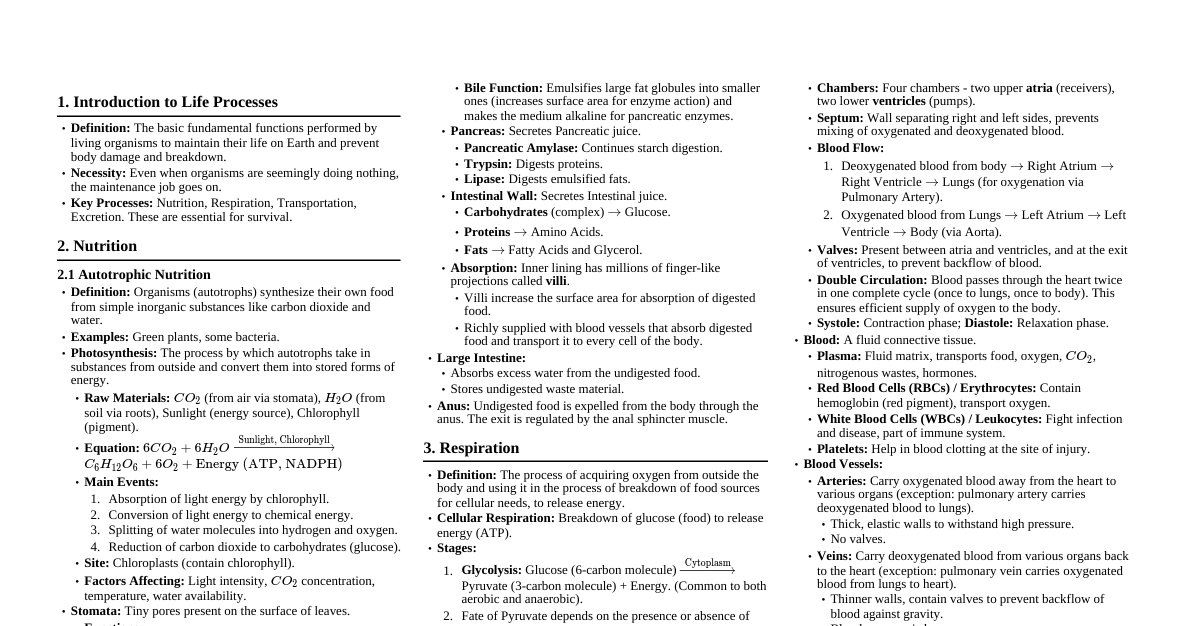
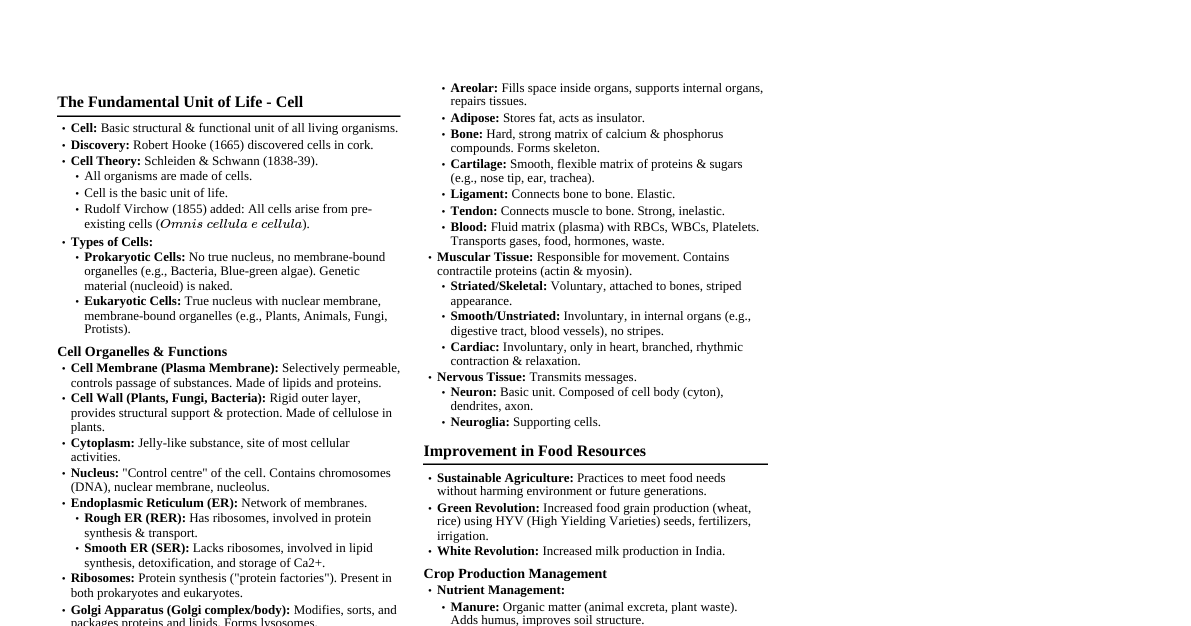
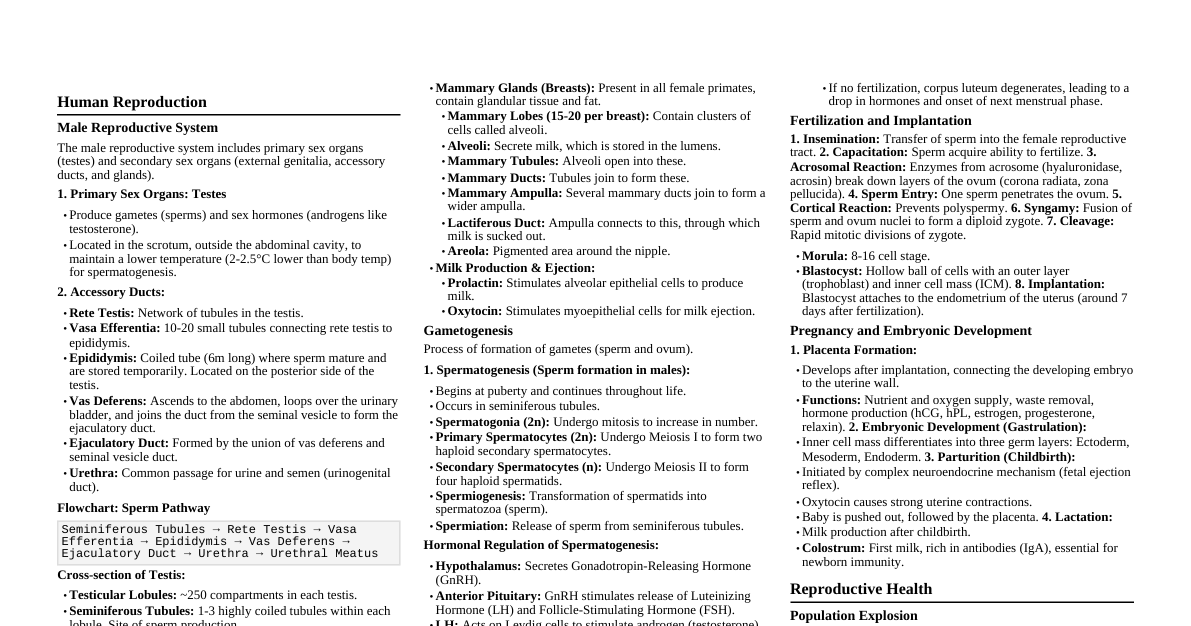
1. Life Processes 1.1 Nutrition Autotrophic: Organisms make their own food (e.g., plants via photosynthesis). Photosynthesis: $6CO_2 + 6H_2O \xrightarrow{Sunlight} C_6H_{12}O_6 + 6O_2$ Stomata: Pores for gas exchange ($CO_2$ intake, $O_2$ release) and transpiration. Heterotrophic: Organisms depend on others for food. Holozoic: Ingestion, digestion, absorption, assimilation, egestion (e.g., amoeba, humans). Saprophytic: Feed on dead and decaying matter (e.g., fungi). Parasitic: Live on or in another organism (host) and derive food from it (e.g., leeches, cuscuta). Human Digestive System: Mouth $\rightarrow$ Esophagus $\rightarrow$ Stomach $\rightarrow$ Small Intestine $\rightarrow$ Large Intestine $\rightarrow$ Anus. Saliva (amylase): Digests starch. Stomach (HCl, pepsin): Digests proteins. Small Intestine (villi): Complete digestion & absorption. Pancreatic enzymes (amylase, lipase, trypsin) & bile from liver. 1.2 Respiration Aerobic Respiration: Occurs in presence of oxygen. Produces more energy. Glucose $\rightarrow$ Pyruvate (cytoplasm) $\rightarrow$ $CO_2 + H_2O + Energy$ (mitochondria) Anaerobic Respiration: Occurs without oxygen. Less energy. In Yeast: Glucose $\rightarrow$ Pyruvate (cytoplasm) $\rightarrow$ Ethanol + $CO_2 + Energy$ In Muscle Cells: Glucose $\rightarrow$ Pyruvate (cytoplasm) $\rightarrow$ Lactic Acid + Energy (during strenuous exercise) Human Respiratory System: Nasal passage $\rightarrow$ Pharynx $\rightarrow$ Larynx $\rightarrow$ Trachea $\rightarrow$ Bronchi $\rightarrow$ Bronchioles $\rightarrow$ Alveoli (gas exchange). 1.3 Transportation Plants: Xylem: Transports water and minerals from roots to leaves (unidirectional). Phloem: Transports food (sugars) from leaves to other parts (bidirectional). Humans (Circulatory System): Heart: Four chambers (2 atria, 2 ventricles). Double circulation (pulmonary & systemic). Blood: Plasma, RBCs (oxygen), WBCs (immunity), Platelets (clotting). Blood Vessels: Arteries (away from heart, oxygenated), Veins (towards heart, deoxygenated), Capillaries (exchange). 1.4 Excretion Plants: Oxygen, water vapour (transpiration), waste stored in vacuoles, gums, resins. Humans (Excretory System): Kidneys (filter blood), Ureters, Urinary Bladder, Urethra. Nephron: Functional unit of kidney. Filters blood, reabsorbs useful substances, forms urine. 2. Control and Coordination 2.1 Animals: Nervous System Neurons: Structural and functional units. Dendrite $\rightarrow$ Cell body $\rightarrow$ Axon $\rightarrow$ Nerve ending. Synapse: Gap between two neurons where impulse is transmitted. Reflex Arc: Rapid, automatic response to a stimulus. Stimulus $\rightarrow$ Receptor $\rightarrow$ Sensory neuron $\rightarrow$ Spinal cord (relay neuron) $\rightarrow$ Motor neuron $\rightarrow$ Effector $\rightarrow$ Response. Brain: Forebrain: Cerebrum (thought, memory, voluntary actions), Hypothalamus (hunger, thirst, sleep), Thalamus. Midbrain: Reflexes for sight and hearing. Hindbrain: Cerebellum (balance, posture), Pons (respiration), Medulla (involuntary actions: heart rate, blood pressure, vomiting). 2.2 Animals: Endocrine System (Hormones) Pituitary Gland: Master gland. Growth Hormone, TSH, FSH, LH, ADH. Thyroid Gland: Thyroxine (metabolism). Pancreas: Insulin (lowers blood sugar), Glucagon (raises blood sugar). Adrenal Gland: Adrenaline (fight or flight). Testes (males): Testosterone (secondary sexual characteristics). Ovaries (females): Estrogen, Progesterone (secondary sexual characteristics, menstrual cycle, pregnancy). 2.3 Plants: Coordination Phytohormones (Plant Hormones): Auxin: Cell elongation, phototropism, gravitropism. Gibberellins: Stem growth, seed germination. Cytokinins: Cell division, breaking dormancy. Abscisic Acid (ABA): Growth inhibitor, dormancy, wilting. Ethylene: Fruit ripening. Tropisms: Directional growth in response to stimuli. Phototropism: Towards light. Geotropism: Towards gravity (roots), away from gravity (shoots). Hydrotropism: Towards water. Chemotropism: Towards chemicals (e.g., pollen tube growth). Thigmotropism: Towards touch (e.g., tendrils). 3. How Do Organisms Reproduce? 3.1 Asexual Reproduction Involves a single parent. No gamete formation. Offspring are genetically identical (clones). Fission: Binary Fission: Parent divides into two (e.g., Amoeba, Paramecium). Multiple Fission: Parent divides into many (e.g., Plasmodium). Budding: Outgrowth develops into a new individual (e.g., Hydra, Yeast). Spore Formation: Spores germinate into new individuals (e.g., Fungi, Ferns). Fragmentation: Body breaks into fragments, each growing into a new individual (e.g., Spirogyra). Regeneration: Ability to regrow lost body parts (e.g., Planaria, Starfish). Not true reproduction. Vegetative Propagation (Plants): New plants from vegetative parts (root, stem, leaf). Natural: Runners, rhizomes, bulbs, tubers. Artificial: Layering, cutting, grafting. 3.2 Sexual Reproduction Involves two parents. Fusion of male and female gametes. Offspring show variations. Flowering Plants: Flower parts: Sepals, Petals, Stamens (male: anther, filament), Pistil/Carpel (female: stigma, style, ovary). Pollination: Transfer of pollen from anther to stigma. (Self-pollination, Cross-pollination). Fertilization: Fusion of male gamete (from pollen) with female gamete (ovule) in the ovary. Forms zygote. Post-fertilization: Ovary $\rightarrow$ Fruit, Ovule $\rightarrow$ Seed, Zygote $\rightarrow$ Embryo. Human Reproduction: Male System: Testes (sperm, testosterone), Scrotum, Vas deferens, Urethra, Penis, Accessory glands (seminal vesicles, prostate). Female System: Ovaries (ova, estrogen, progesterone), Oviduct/Fallopian tube, Uterus, Vagina. Fertilization: Occurs in oviduct. Zygote implants in uterus. Menstrual Cycle: Monthly cycle of changes in female reproductive system. Reproductive Health: STDs, contraception (barrier, hormonal, surgical methods). 4. Heredity 4.1 Basics of Heredity Heredity: Transmission of traits from parents to offspring. Variation: Differences among individuals of a species. Genetics: Study of heredity and variation. Chromosomes: Thread-like structures in nucleus, carry genes. Made of DNA and protein. DNA (Deoxyribonucleic Acid): Genetic material. Double helix structure. Gene: Segment of DNA that codes for a specific protein/trait. Alleles: Different forms of a gene (e.g., Tall vs. Dwarf). Dominant Trait: Expressed even in presence of recessive allele. Recessive Trait: Expressed only when two recessive alleles are present. Genotype: Genetic constitution of an organism (e.g., Tt, TT). Phenotype: Observable characteristics (e.g., Tall, Dwarf). Homozygous: Both alleles are identical (e.g., TT, tt). Heterozygous: Alleles are different (e.g., Tt). 4.2 Mendel's Laws Law of Dominance: In a cross of parents with contrasting traits, only one form of the trait will appear in the $F_1$ generation (dominant trait). Law of Segregation: During gamete formation, the two alleles for a heritable character separate (segregate) from each other such that each gamete carries only one allele. Monohybrid Cross: Cross involving one pair of contrasting traits (e.g., Tall x Dwarf). Phenotypic Ratio ($F_2$): $3:1$ Genotypic Ratio ($F_2$): $1:2:1$ Dihybrid Cross: Cross involving two pairs of contrasting traits. Phenotypic Ratio ($F_2$): $9:3:3:1$ 4.3 Sex Determination In humans, 23 pairs of chromosomes. 22 pairs are autosomes, 1 pair is sex chromosomes (XX for female, XY for male). Father determines the sex of the child (sperm carries either X or Y chromosome). Mother contributes only X chromosome. 4.4 Evolution Accumulation of Variation: Basis for evolution. Sexual reproduction leads to more variation than asexual. Mutations also cause variation. Natural Selection: Process where organisms better adapted to their environment tend to survive and produce more offspring. Speciation: Formation of new species due to reproductive isolation, genetic drift, natural selection. Homologous Organs: Similar structure, different function (e.g., forelimbs of whale, bat, human). Indicate common ancestry. Analogous Organs: Different structure, similar function (e.g., wings of bird and insect). Indicate convergent evolution. Fossils: Preserved remains of past life. Provide evidence for evolution. Human Evolution: Traced through fossils, DNA studies. Not a ladder, but a branching bush. 5. Our Environment 5.1 Ecosystem Ecosystem: All living organisms (biotic components) in an area interacting with non-living components (abiotic components like temperature, water, soil). Biotic Components: Producers: Make their own food (e.g., plants). Consumers: Feed on other organisms. Herbivores: Eat plants. Carnivores: Eat animals. Omnivores: Eat both plants and animals. Decomposers: Break down dead organic matter (e.g., bacteria, fungi). Food Chain: Shows how energy is transferred from one organism to another (e.g., Grass $\rightarrow$ Deer $\rightarrow$ Tiger). Food Web: Interconnected food chains. Trophic Levels: Position an organism occupies in a food chain. Producers (1st trophic level) Primary Consumers (Herbivores - 2nd trophic level) Secondary Consumers (Carnivores - 3rd trophic level) Tertiary Consumers (Top Carnivores - 4th trophic level) 10% Law of Energy Transfer: Only about 10% of energy is transferred from one trophic level to the next. The rest is lost as heat. Biological Magnification: Accumulation of non-biodegradable chemicals (e.g., pesticides like DDT) in increasing concentrations at successive trophic levels. 5.2 Environmental Problems Ozone Layer Depletion: Ozone ($O_3$) layer in stratosphere protects Earth from harmful UV radiation. Depleted by CFCs (Chlorofluorocarbons). Waste Management: Biodegradable Waste: Can be broken down by decomposers (e.g., food scraps, paper). Non-biodegradable Waste: Cannot be broken down (e.g., plastics, glass, DDT). Methods: Reduce, Reuse, Recycle, Composting, Landfills, Incineration.