Electrostatics & Electromagnet
Cheatsheet Content
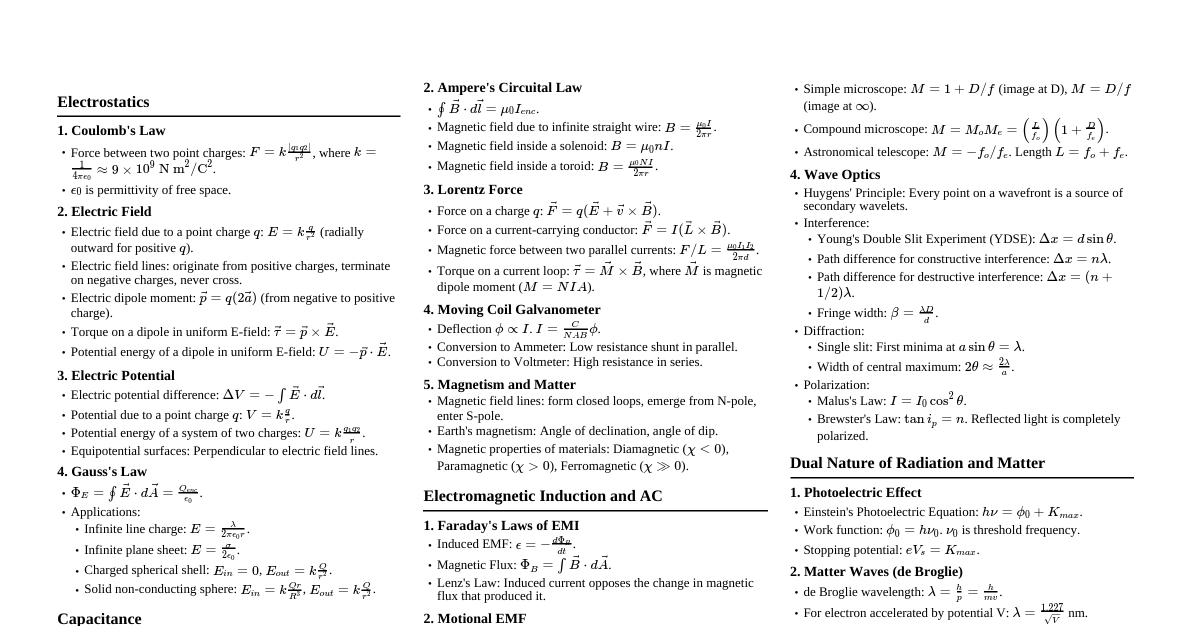
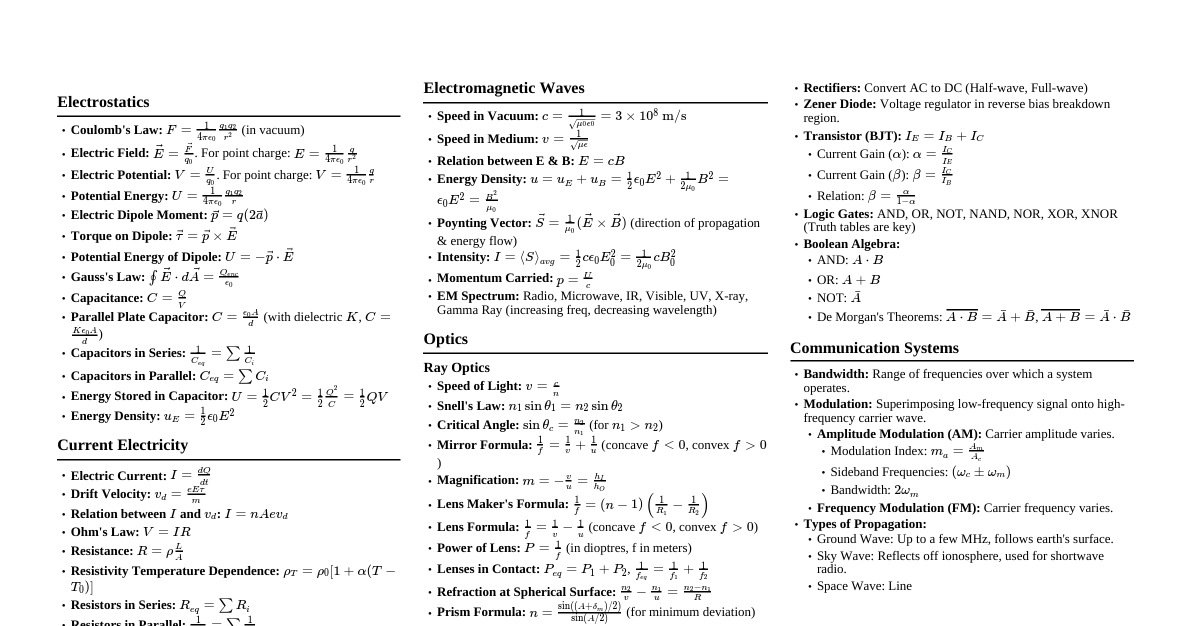
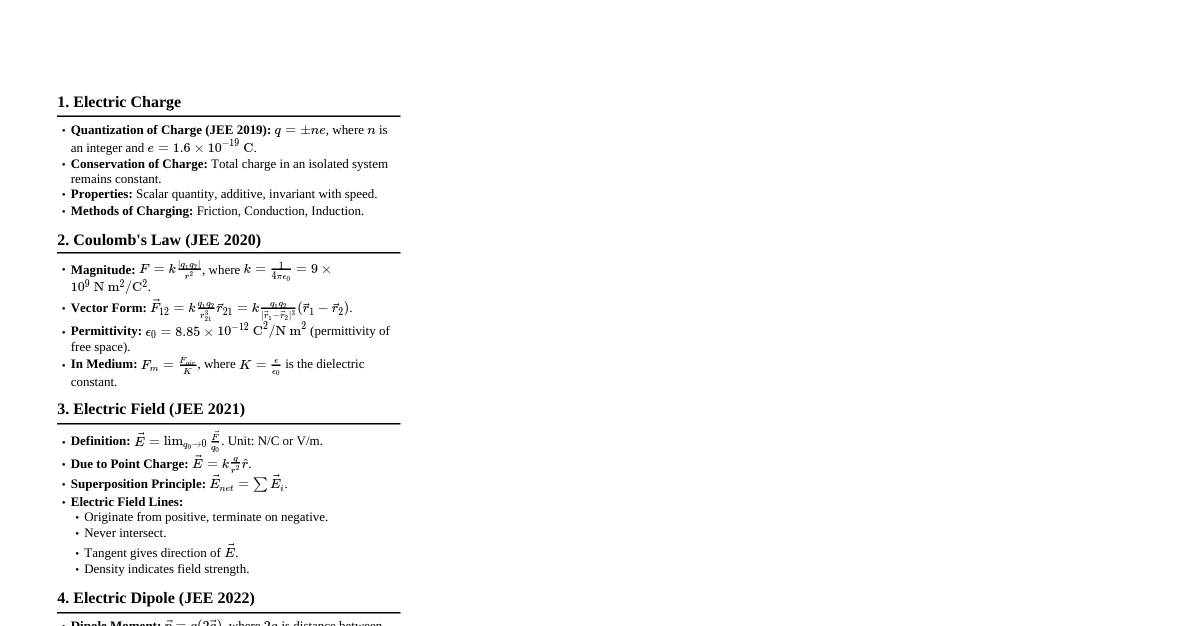
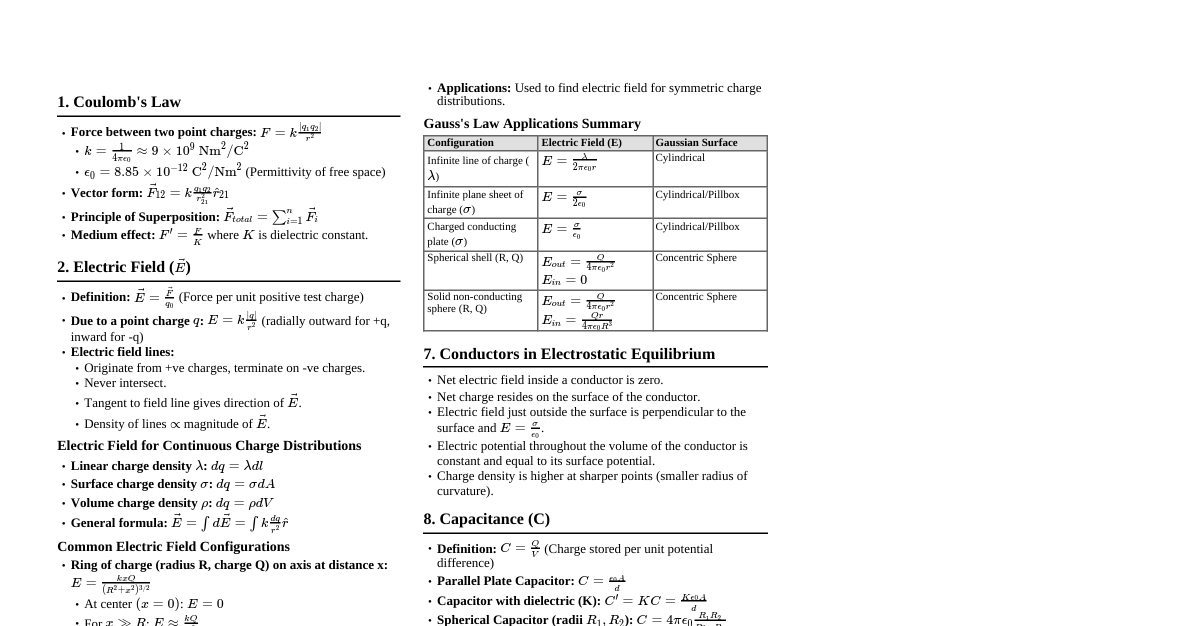
### Introduction: Electrostatics Electrostatics is the branch of physics that deals with the study of electric charges at rest. It encompasses the forces, fields, and potentials associated with these static charges. ### Case 1: Creation by a charge at rest A charge at rest creates an electric field. The electric field radiates outward from the charge if it is positive, and inward towards the charge if it is negative. ### Case 2: Creation by a charge moving with a constant velocity A charge moving with a constant velocity creates both an electric field and a magnetic field. Even when a charge is moving, it still creates an electric field, similar to when it is at rest. However, the distribution and configuration of the electric field can be affected by the motion of the charge. A moving charge constitutes an electric current, and according to Ampère's Law and the Biot-Savart Law, an electric current generates a magnetic field. The magnetic field (B) created by a moving charge can be determined using the Biot-Savart Law or the right-hand rule. For a point charge moving with a constant velocity, the magnetic field at a point in space is given by: $$ B = \frac{\mu_0}{4\pi} \frac{q \mathbf{v} \times \mathbf{r}}{r^3} $$ where: - $\mu_0$ is the permeability of free space ($4\pi \times 10^{-7} \text{ N/A}^2$) - $q$ is the charge, - $\mathbf{v}$ is the velocity of the charge, - $\mathbf{r}$ is the position vector from the charge to the point where the magnetic field is being calculated, - $r$ is the magnitude of $\mathbf{r}$. ### Combined electric field and magnetic field: **Electromagnetic field:** Together, the electric and magnetic fields form what is known as an electromagnetic field. The interaction of these fields is described by Maxwell's equations. **Lorentz Force:** A charged particle moving through these fields experiences a force known as the Lorentz force, which is given by: $$ \mathbf{F} = q(\mathbf{E} + \mathbf{v} \times \mathbf{B}) $$ Where $\mathbf{E}$ is the electric field and $\mathbf{B}$ is the magnetic field. This force is the combination of the electric force ($q\mathbf{E}$) and the magnetic force ($q\mathbf{v} \times \mathbf{B}$). #### Visualization of fields: - **Electric field lines:** Similar to a static charge, the electric field lines radiate outwards or inwards depending on the charge's sign. For a moving charge, these lines may appear distorted due to relativistic effects at high velocities. - **Magnetic field lines:** For a charge moving with constant velocity, the magnetic field lines form concentric circles around the path of the charge. The direction of the magnetic field lines can be determined using the right-hand rule: if you point the thumb of your right hand in the direction of the charge's velocity, your fingers will curl in the direction of the magnetic field lines. #### Practical applications: - **Electromagnetic waves:** Charges oscillating back and forth generate changing electric and magnetic fields that propagate as electromagnetic waves (e.g., radio waves, light). - **Particle accelerators:** The motion of charged particles in accelerators is controlled using electric and magnetic fields.