Hydrocarbons
Shared 4/2/2026•50 views
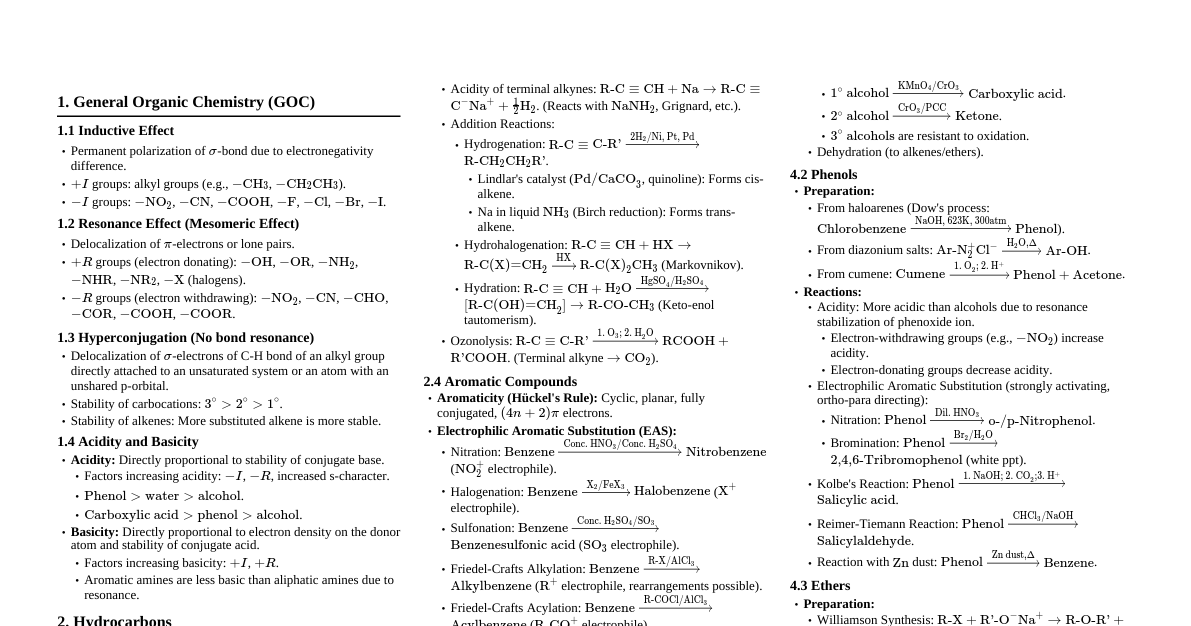
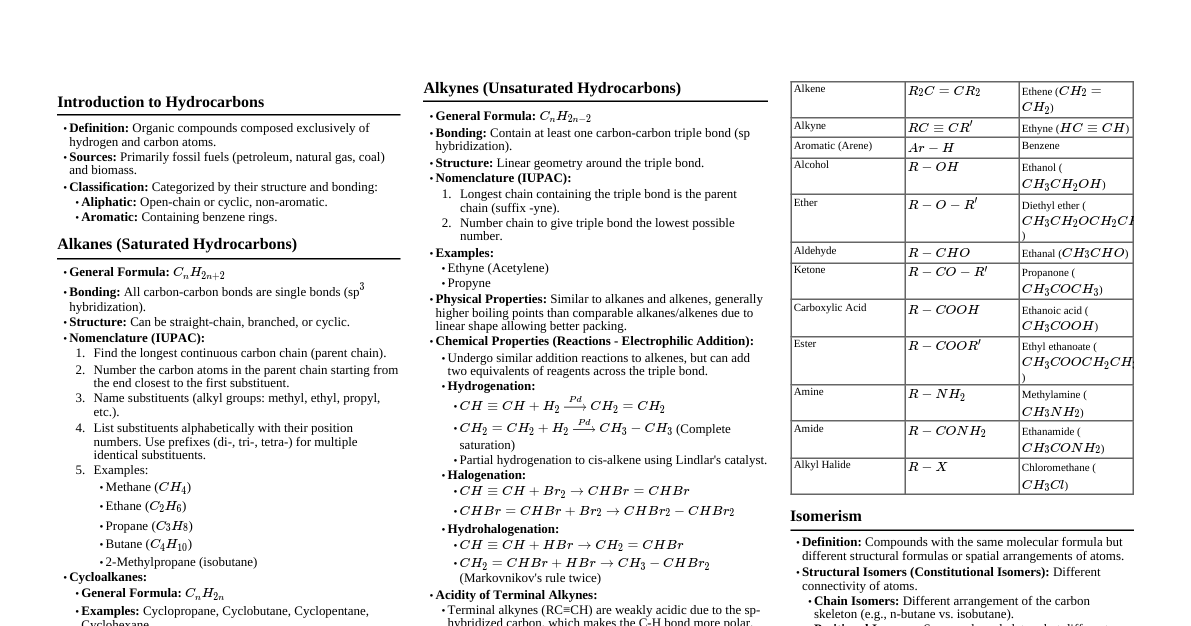
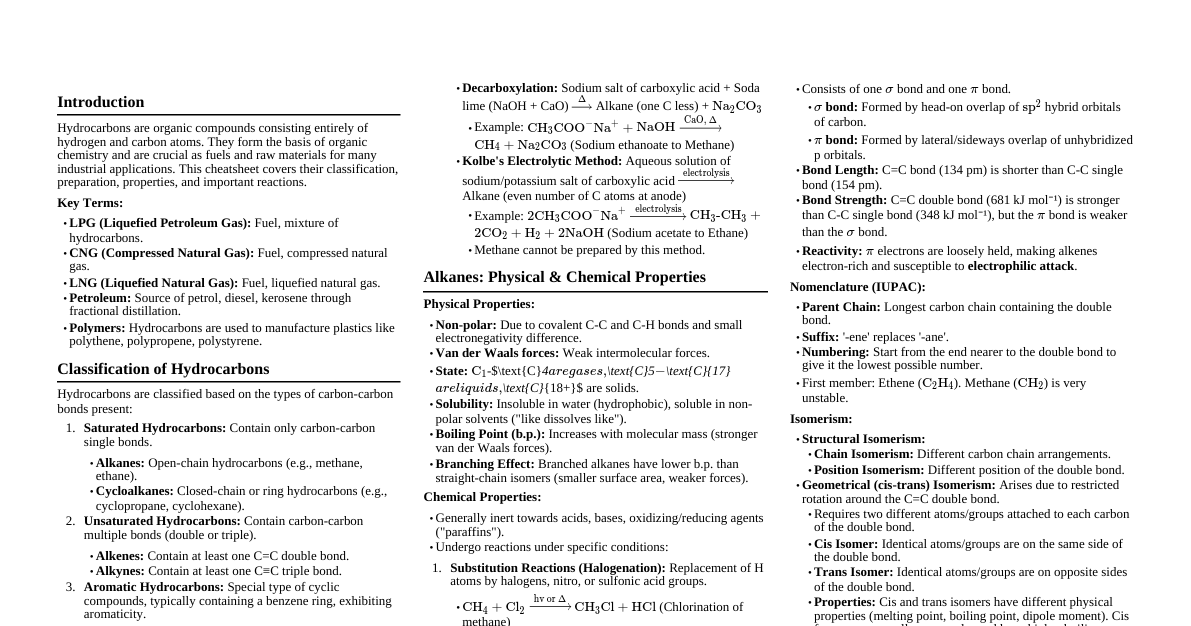
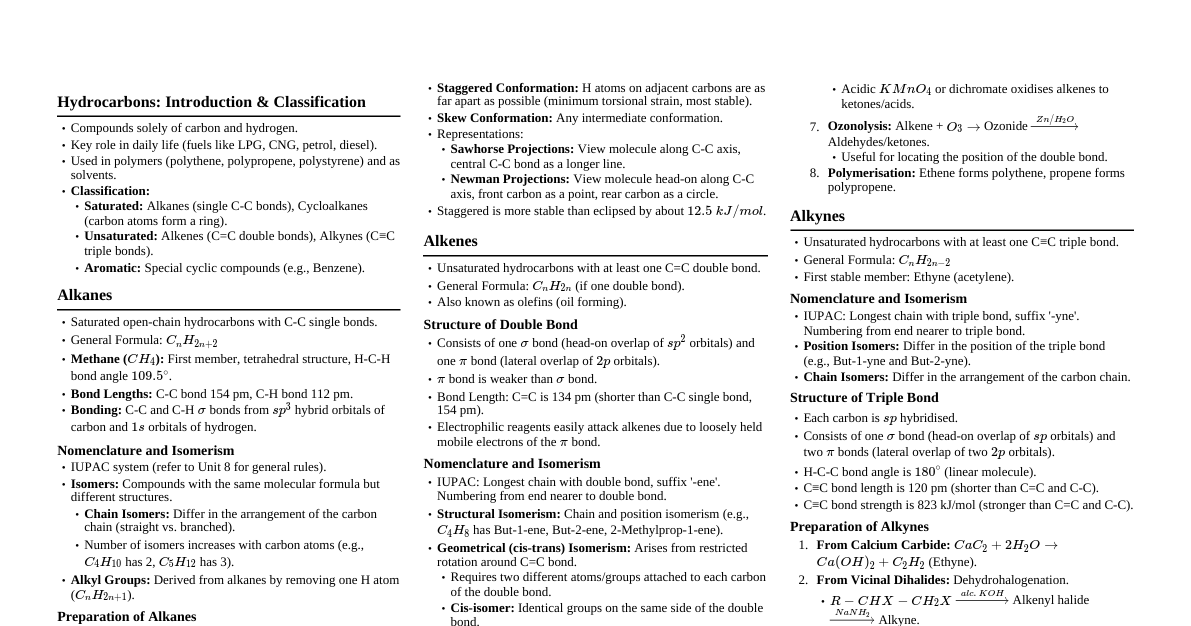
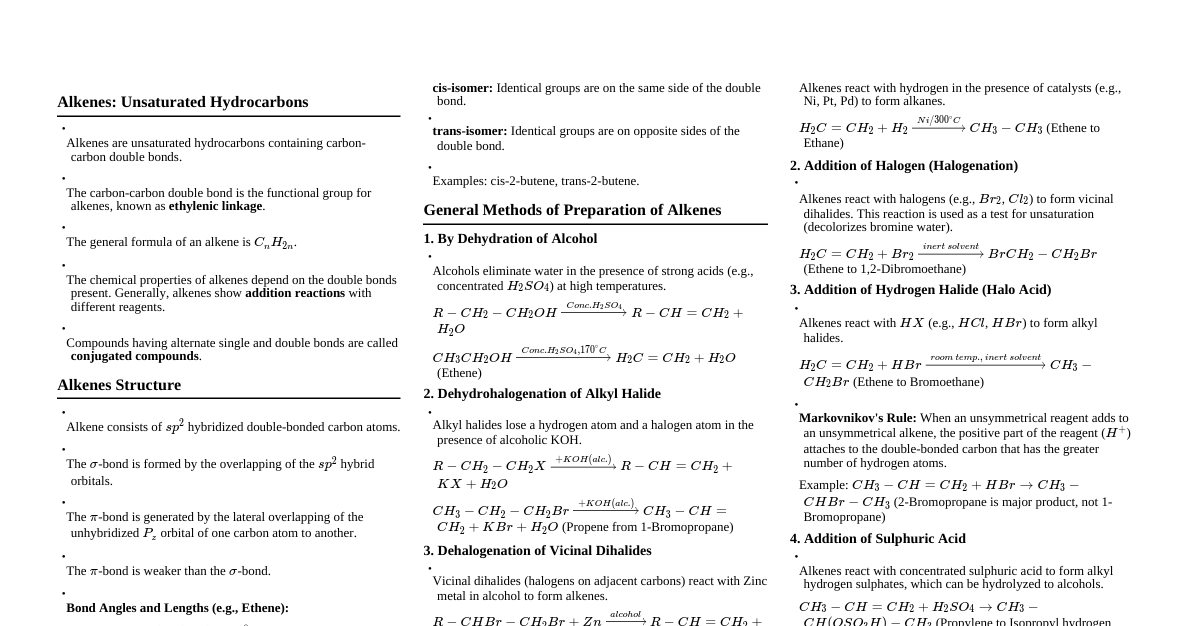
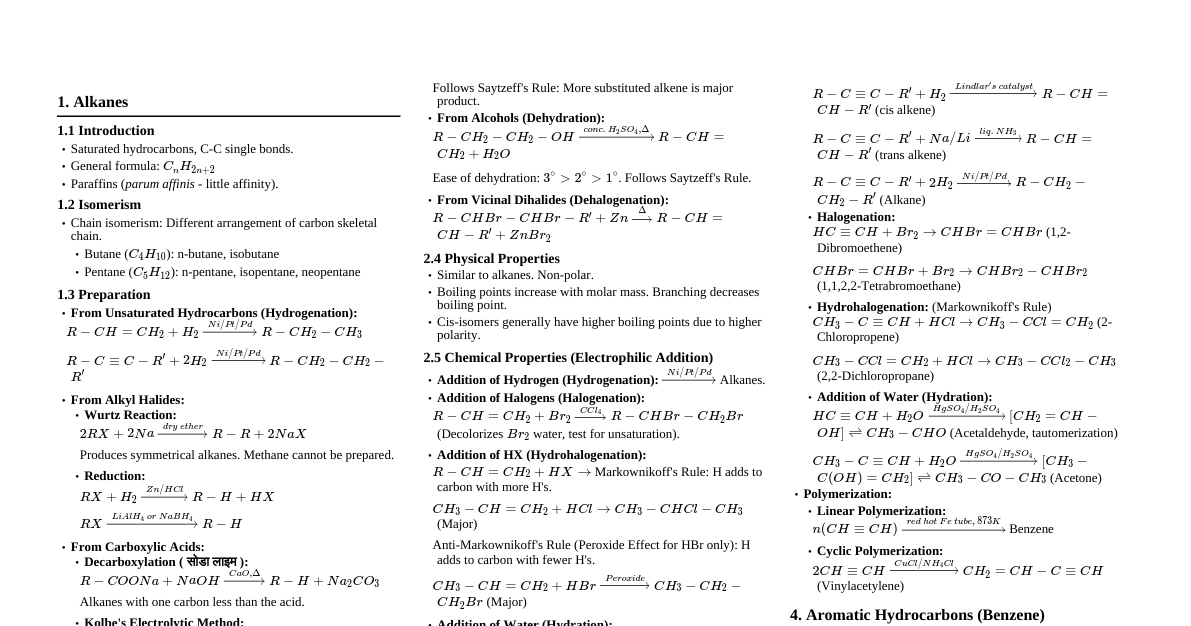
### Introduction to Hydrocarbons - **Definition:** Organic compounds composed exclusively of hydrogen and carbon atoms. - **Sources:** Petroleum, natural gas, coal. - **Classification:** Based on the type of carbon-carbon bonds present. 1. **Acyclic (Open-chain) Hydrocarbons:** * **Saturated:** Alkanes (single bonds). * **Unsaturated:** Alkenes (at least one double bond), Alkynes (at least one triple bond). 2. **Cyclic Hydrocarbons:** * **Alicyclic:** Cycloalkanes, Cycloalkenes, Cycloalkynes (ring structures, similar properties to open-chain). * **Aromatic:** Benzene and its derivatives (special stability due to delocalized $\pi$-electrons). ### Alkanes (Saturated Hydrocarbons) - **General Formula:** $C_nH_{2n+2}$ - **Bonding:** Carbon atoms are $sp^3$ hybridized, forming sigma ($\sigma$) bonds. All C-C and C-H bonds are single bonds. - **Nomenclature (IUPAC):** 1. Longest continuous carbon chain is parent alkane. 2. Number chain from end giving lowest numbers to substituents. 3. Name substituents alphabetically (e.g., ethyl before methyl). 4. Use prefixes di-, tri-, tetra- for multiple identical substituents. *Example:* 2,2,4-Trimethylpentane - **Isomerism:** * **Chain Isomerism:** Different arrangement of carbon skeleton (e.g., n-butane and isobutane). - **Preparation:** 1. **From Unsaturated Hydrocarbons (Hydrogenation):** $CH_2=CH_2 + H_2 \xrightarrow{Ni/Pt/Pd} CH_3-CH_3$ (Ethene to Ethane) 2. **From Alkyl Halides:** * **Wurtz Reaction:** $2RX + 2Na \xrightarrow{dry \ ether} R-R + 2NaX$ (for symmetrical alkanes) * **Reduction:** $RX + H_2 \xrightarrow{Zn/HCl} RH + HX$ 3. **Decarboxylation of Carboxylic Acids:** $RCOONa + NaOH \xrightarrow{CaO, \Delta} RH + Na_2CO_3$ 4. **Kolbe's Electrolytic Method:** $2RCOONa + 2H_2O \xrightarrow{electrolysis} R-R + 2CO_2 + H_2 + 2NaOH$ - **Physical Properties:** * Non-polar, insoluble in water, soluble in organic solvents. * Lower members ($C_1-C_4$) are gases, $C_5-C_{17}$ are liquids, higher members are solids at room temperature. * Boiling point increases with molecular mass, decreases with branching. - **Chemical Properties (Low Reactivity - Paraffins):** 1. **Halogenation (Free Radical Substitution):** $CH_4 + Cl_2 \xrightarrow{hv} CH_3Cl + HCl$ (Methyl chloride) * Mechanism: Initiation, Propagation, Termination. * Reactivity: $F_2 > Cl_2 > Br_2 > I_2$. 2. **Combustion:** $CH_4 + 2O_2 \xrightarrow{\Delta} CO_2 + 2H_2O + \text{Energy}$ 3. **Controlled Oxidation:** $CH_4 + O_2 \xrightarrow{Cu/523K/100atm} CH_3OH$ (Methanol) 4. **Isomerization:** Straight-chain alkanes $\xrightarrow{AlCl_3/HCl} $ Branched alkanes. 5. **Aromatization:** n-Hexane $\xrightarrow{Cr_2O_3/Al_2O_3, \ 773K, \ 10-20atm} $ Benzene. 6. **Pyrolysis/Cracking:** Higher alkanes $\xrightarrow{\Delta} $ Lower alkanes/alkenes. ### Alkenes (Unsaturated Hydrocarbons) - **General Formula:** $C_nH_{2n}$ - **Bonding:** At least one C=C double bond. Carbon atoms are $sp^2$ hybridized. One $\sigma$ bond and one $\pi$ bond. - **Nomenclature (IUPAC):** 1. Longest chain containing the double bond is parent alkene. 2. Number chain to give lowest number to double bond. 3. Suffix '-ene'. *Example:* But-1-ene, But-2-ene - **Isomerism:** * **Chain Isomerism:** (e.g., But-1-ene and 2-Methylprop-1-ene). * **Position Isomerism:** (e.g., But-1-ene and But-2-ene). * **Geometrical (cis-trans) Isomerism:** Due to restricted rotation around C=C bond (e.g., cis-But-2-ene and trans-But-2-ene). Requires different groups on each carbon of the double bond. - **Preparation:** 1. **From Alkynes (Partial Hydrogenation):** $RC \equiv CR' + H_2 \xrightarrow{Lindlar's \ catalyst} RCH=CHR'$ (cis-alkene) $RC \equiv CR' + H_2 \xrightarrow{Na/liquid \ NH_3} RCH=CHR'$ (trans-alkene) 2. **From Alkyl Halides (Dehydrohalogenation):** $R-CH_2-CH_2-X + KOH(alc.) \xrightarrow{\Delta} R-CH=CH_2 + KX + H_2O$ * **Saytzeff's Rule:** Major product is the more substituted alkene. 3. **From Alcohols (Dehydration):** $R-CH_2-CH_2-OH \xrightarrow{conc. \ H_2SO_4, \Delta} R-CH=CH_2 + H_2O$ 4. **From Vicinal Dihalides (Dehalogenation):** $Br-CH_2-CH_2-Br + Zn \xrightarrow{\Delta} CH_2=CH_2 + ZnBr_2$ - **Physical Properties:** Similar to alkanes, but slightly higher boiling points due to weak polarity. - **Chemical Properties (Electrophilic Addition Reactions - due to $\pi$-electron cloud):** 1. **Hydrogenation:** $CH_2=CH_2 + H_2 \xrightarrow{Ni/Pt/Pd} CH_3-CH_3$ 2. **Halogenation:** $CH_2=CH_2 + Br_2 \xrightarrow{CCl_4} BrCH_2-CH_2Br$ (Decolorizes bromine water test) 3. **Hydrohalogenation (Addition of HX):** $CH_2=CH_2 + HCl \rightarrow CH_3-CH_2Cl$ * **Markovnikov's Rule:** For unsymmetrical alkenes, the negative part of the addendum ($X^-$) adds to the carbon atom of the double bond which has fewer hydrogen atoms. * **Anti-Markovnikov's Rule (Peroxide Effect):** In presence of peroxides, HBr adds to unsymmetrical alkenes in the opposite way. (Only for HBr) 4. **Addition of Water (Hydration):** $CH_2=CH_2 + H_2O \xrightarrow{H_2SO_4} CH_3-CH_2OH$ (Alcohol formation) 5. **Ozonolysis:** $R_2C=CR_2 + O_3 \rightarrow \text{Ozonide} \xrightarrow{Zn/H_2O} R_2C=O + O=CR_2$ (Ketones/Aldehydes) 6. **Polymerization:** $n(CH_2=CH_2) \xrightarrow{\text{high T, P, catalyst}} (-CH_2-CH_2-)_n$ (Polyethylene) ### Alkynes (Unsaturated Hydrocarbons) - **General Formula:** $C_nH_{2n-2}$ - **Bonding:** At least one C$\equiv$C triple bond. Carbon atoms are $sp$ hybridized. One $\sigma$ bond and two $\pi$ bonds. - **Nomenclature (IUPAC):** 1. Longest chain containing the triple bond is parent alkyne. 2. Number chain to give lowest number to triple bond. 3. Suffix '-yne'. *Example:* Ethyne, Propyne - **Acidity of Terminal Alkynes:** * Terminal alkynes ($R-C \equiv C-H$) have acidic hydrogen due to $sp$ hybridized carbon (high electronegativity), leading to carbanion stabilization. * React with strong bases (e.g., Na, NaNH$_2$) to form metal acetylides. $HC \equiv CH + Na \rightarrow HC \equiv C^-Na^+ + 1/2 H_2$ - **Preparation:** 1. **From Calcium Carbide:** $CaC_2 + 2H_2O \rightarrow CH \equiv CH + Ca(OH)_2$ (Ethyne) 2. **From Vicinal Dihalides (Dehydrohalogenation):** $BrCH_2-CH_2Br + 2KOH(alc.) \xrightarrow{\Delta} CH \equiv CH + 2KBr + 2H_2O$ (Requires strong base like $NaNH_2$ for second dehydrohalogenation) - **Physical Properties:** Similar to alkanes/alkenes, slightly higher boiling points. - **Chemical Properties (Electrophilic Addition Reactions):** 1. **Hydrogenation:** $HC \equiv CH + H_2 \xrightarrow{Lindlar's \ catalyst} CH_2=CH_2 \xrightarrow{H_2} CH_3-CH_3$ (Can be stopped at alkene stage using Lindlar's catalyst) 2. **Halogenation:** $HC \equiv CH + Br_2 \rightarrow BrCH=CHBr \xrightarrow{Br_2} Br_2CH-CHBr_2$ 3. **Hydrohalogenation:** $HC \equiv CH + HCl \rightarrow CH_2=CHCl$ (Vinyl chloride) $\xrightarrow{HCl} CH_3-CHCl_2$ * Follows Markovnikov's rule. 4. **Addition of Water (Hydration):** $HC \equiv CH + H_2O \xrightarrow{HgSO_4/H_2SO_4} CH_2=CHOH \rightleftharpoons CH_3CHO$ (Acetaldehyde) * Forms enol intermediate which tautomerizes to aldehyde/ketone. 5. **Polymerization:** * **Linear Polymerization:** $n(CH \equiv CH) \xrightarrow{Cu_2Cl_2} (-CH=CH-CH=CH-)_n$ (Polyacetylene) * **Cyclic Polymerization:** $3CH \equiv CH \xrightarrow{red \ hot \ Fe \ tube, \ 873K} C_6H_6$ (Benzene) ### Aromatic Hydrocarbons (Arenes) - **Definition:** Cyclic, planar compounds exhibiting special stability (aromaticity) due to delocalized $\pi$-electron systems. - **Hückel's Rule:** A compound is aromatic if it is: 1. Cyclic 2. Planar 3. Fully conjugated (each atom in the ring has a p-orbital) 4. Contains $(4n+2)$ $\pi$-electrons (where n=0, 1, 2...). *Example:* Benzene (n=1, $6\pi$-electrons) - **Structure of Benzene:** * Planar hexagonal ring. * All C-C bond lengths are equal (139 pm, between C-C single and C=C double bond). * All C-H bond lengths are equal (109 pm). * Each carbon is $sp^2$ hybridized, with one unhybridized p-orbital perpendicular to the ring, forming a delocalized $\pi$-electron cloud above and below the ring. - **Preparation of Benzene:** 1. **Cyclic Polymerization of Ethyne:** $3CH \equiv CH \xrightarrow{red \ hot \ Fe \ tube, \ 873K} C_6H_6$ 2. **Decarboxylation of Benzoic Acid:** $C_6H_5COONa + NaOH \xrightarrow{CaO, \Delta} C_6H_6 + Na_2CO_3$ 3. **Reduction of Phenol:** $C_6H_5OH + Zn \xrightarrow{\Delta} C_6H_6 + ZnO$ - **Chemical Properties (Electrophilic Substitution Reactions):** Due to high electron density of $\pi$-cloud, but stability prevents addition. 1. **Nitration:** $C_6H_6 + HNO_3 \xrightarrow{conc. \ H_2SO_4, \Delta} C_6H_5NO_2 + H_2O$ (Nitrobenzene) * Electrophile: $NO_2^+$ 2. **Halogenation:** $C_6H_6 + Cl_2 \xrightarrow{anhydrous \ FeCl_3} C_6H_5Cl + HCl$ (Chlorobenzene) * Electrophile: $Cl^+$ 3. **Sulfonation:** $C_6H_6 + H_2SO_4(conc.) \xrightarrow{\Delta} C_6H_5SO_3H + H_2O$ (Benzenesulfonic acid) * Electrophile: $SO_3$ 4. **Friedel-Crafts Alkylation:** $C_6H_6 + RCl \xrightarrow{anhydrous \ AlCl_3} C_6H_5R + HCl$ (Alkylbenzene) * Electrophile: $R^+$ 5. **Friedel-Crafts Acylation:** $C_6H_6 + RCOCl \xrightarrow{anhydrous \ AlCl_3} C_6H_5COR + HCl$ (Acylbenzene/Ketone) * Electrophile: $RCO^+$ - **Directive Influence of Substituents:** * **Ortho-para directing & Activating:** -OH, -NH$_2$, -OR, -CH$_3$, -X (halogens are deactivating but o,p-directing) * **Meta directing & Deactivating:** -NO$_2$, -COOH, -CHO, -CN, -SO$_3H$