Alkenes: Unsaturated Hydrocarbons
Cheatsheet Content
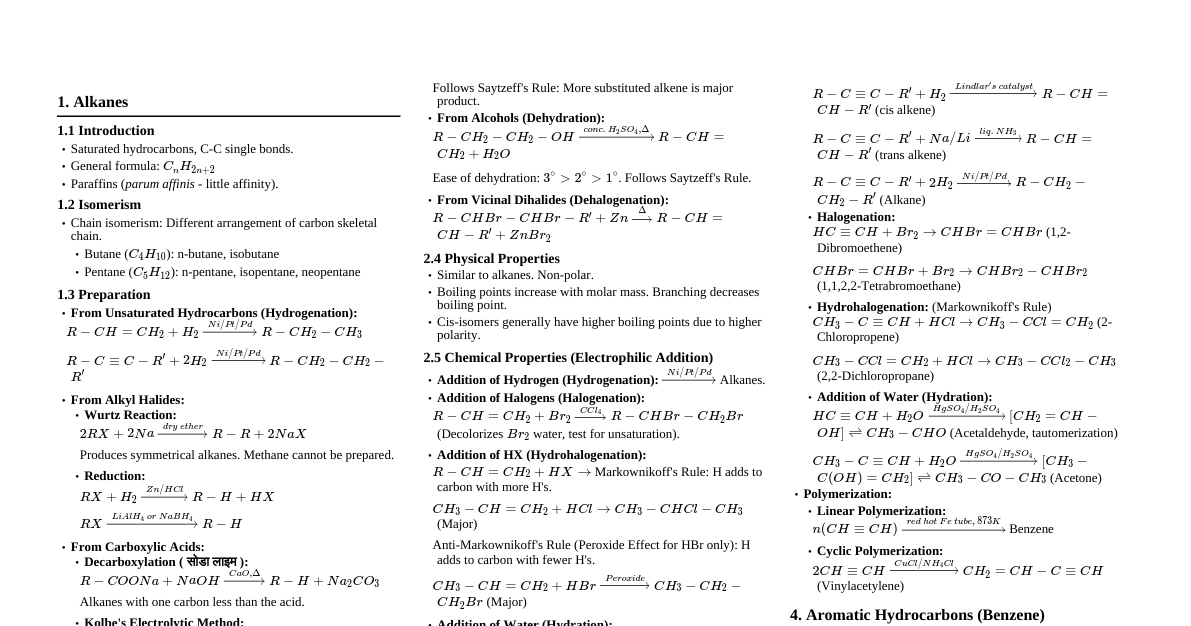
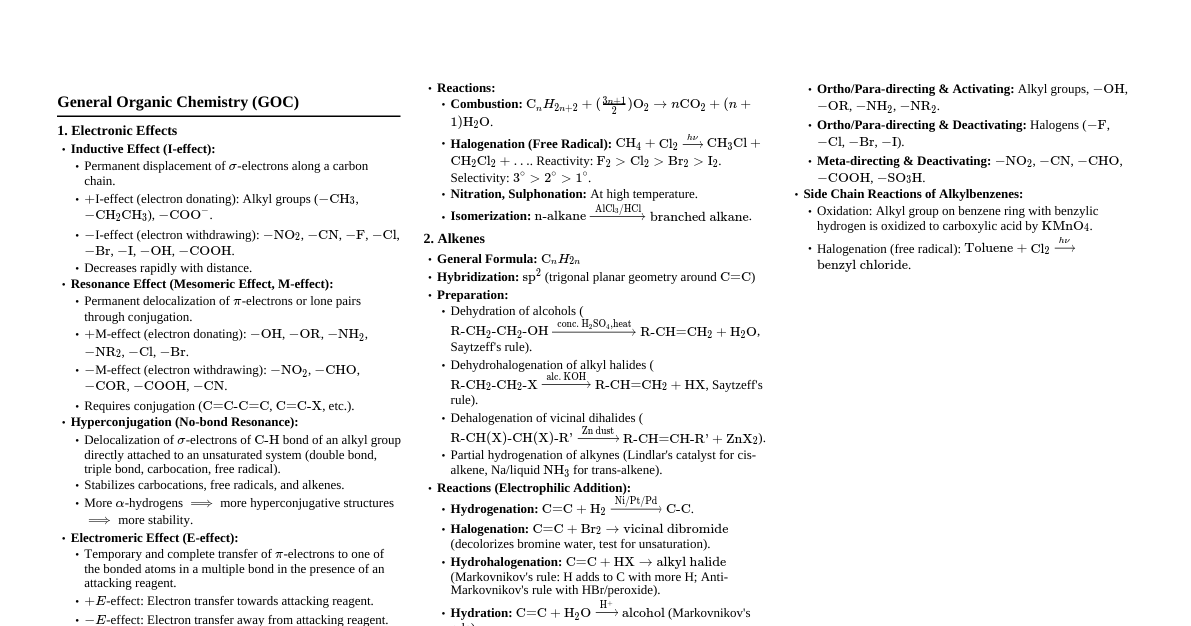
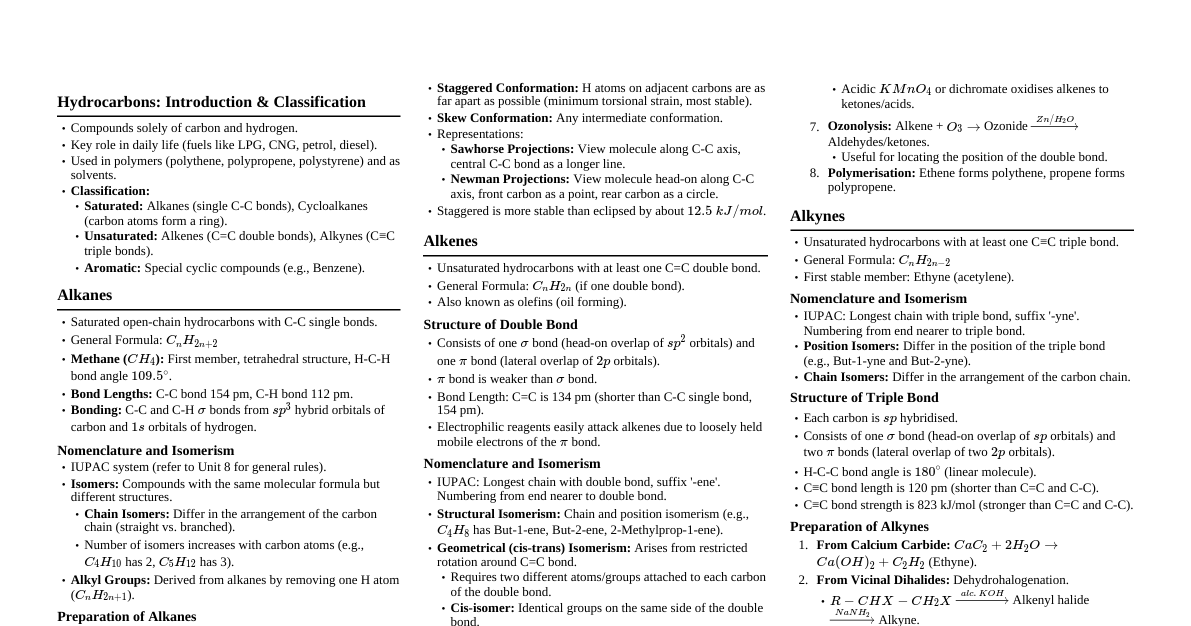
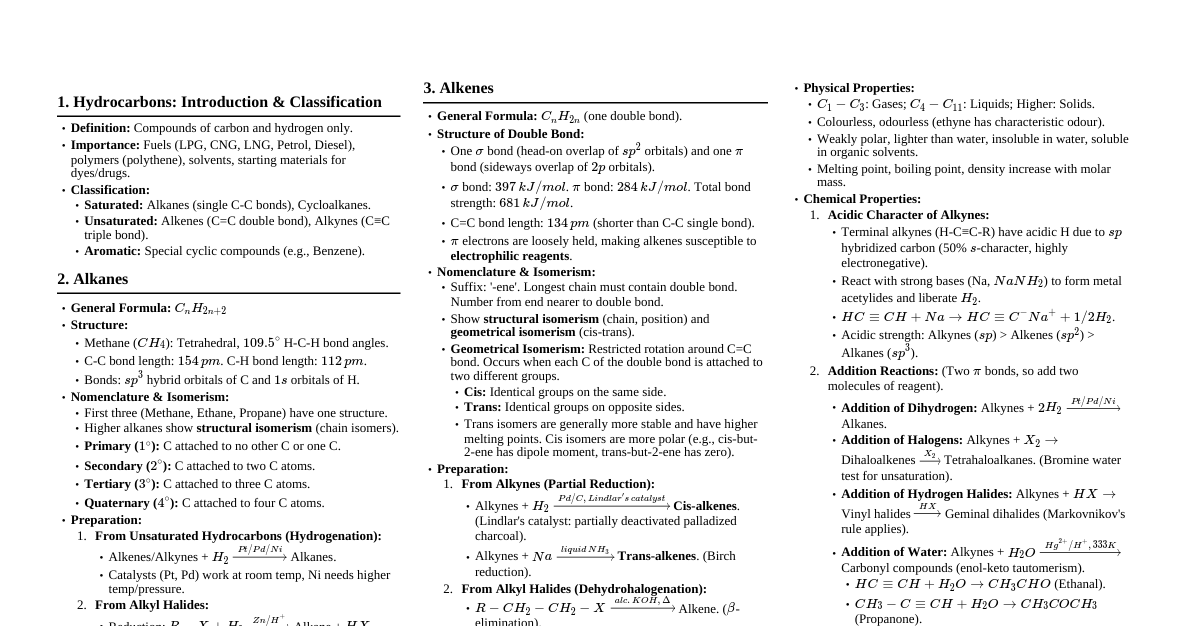
Alkenes: Unsaturated Hydrocarbons Alkenes are unsaturated hydrocarbons containing carbon-carbon double bonds. The carbon-carbon double bond is the functional group for alkenes, known as ethylenic linkage . The general formula of an alkene is $C_nH_{2n}$. The chemical properties of alkenes depend on the double bonds present. Generally, alkenes show addition reactions with different reagents. Compounds having alternate single and double bonds are called conjugated compounds . Alkenes Structure Alkene consists of $sp^2$ hybridized double-bonded carbon atoms. The $\sigma$-bond is formed by the overlapping of the $sp^2$ hybrid orbitals. The $\pi$-bond is generated by the lateral overlapping of the unhybridized $P_z$ orbital of one carbon atom to another. The $\pi$-bond is weaker than the $\sigma$-bond. Bond Angles and Lengths (e.g., Ethene): $H-C-H$ bond angle: $120^\circ$ $H-C-C$ bond angle: $120^\circ$ $C=C$ bond length: $1.34 \text{ Å}$ $C-H$ bond length: $1.09 \text{ Å}$ Alkenes Nomenclature 1. Common Name System Alkanes are named by changing the ending -ane of corresponding alkanes by -ylene. Greek letters are used to distinguish isomeric alkenes (e.g., $\alpha$-Butylene, $\beta$-Butylene). Examples: Ethylene (for Ethene) Propylene (for Propene) Butylene (for Butene) 2. IUPAC System IUPAC names of alkenes are derived from corresponding alkanes by changing the ending -ane to -ene. The hydrocarbon name is based on the parent alkene having the longest carbon chain. The chain is numbered from the end near the double bond, and its position is indicated by the number of a carbon atom at which the double bond originates. The position of other substituents is specified with the appropriate number, and its name is prefixed to the parent alkene. If a molecule has two or three double bonds, the corresponding alkane's ending -ane is changed with -adiene, -atriene to form the name of hydrocarbon. Examples: 1-Butene 2-Butene 2-Methyl-1-butene 1,3-Butadiene 1,3,5-Hexatriene Ethenyl (vinyl) 2-Propenyl (Allyl) Isomerism 1. Positional Isomers Compounds with the same molecular formula but different positions of the double bond or substituents. Examples: 1-Butene, 2-Butene, 2-Methylpropene. 2. Geometrical Isomerism (cis-trans isomerism) Occurs due to restricted rotation around the carbon-carbon double bond. cis-isomer: Identical groups are on the same side of the double bond. trans-isomer: Identical groups are on opposite sides of the double bond. Examples: cis-2-butene, trans-2-butene. General Methods of Preparation of Alkenes 1. By Dehydration of Alcohol Alcohols eliminate water in the presence of strong acids (e.g., concentrated $H_2SO_4$) at high temperatures. $R-CH_2-CH_2OH \xrightarrow{Conc. H_2SO_4} R-CH=CH_2 + H_2O$ $CH_3CH_2OH \xrightarrow{Conc. H_2SO_4, 170^\circ C} H_2C=CH_2 + H_2O$ (Ethene) 2. Dehydrohalogenation of Alkyl Halide Alkyl halides lose a hydrogen atom and a halogen atom in the presence of alcoholic KOH. $R-CH_2-CH_2X \xrightarrow{+KOH (alc.)} R-CH=CH_2 + KX + H_2O$ $CH_3-CH_2-CH_2Br \xrightarrow{+KOH (alc.)} CH_3-CH=CH_2 + KBr + H_2O$ (Propene from 1-Bromopropane) 3. Dehalogenation of Vicinal Dihalides Vicinal dihalides (halogens on adjacent carbons) react with Zinc metal in alcohol to form alkenes. $R-CHBr-CH_2Br + Zn \xrightarrow{alcohol} R-CH=CH_2 + ZnBr_2$ $CH_3-CHBr-CH_2Br + Zn \xrightarrow{alcohol} CH_3-CH=CH_2 + ZnBr_2$ (Propene from 1,2-Dibromopropane) 4. By Controlled Hydrogenation of Alkynes Partial hydrogenation of alkynes yields alkenes. cis-Alkene: Using Lindlar's catalyst ($Pd/C$): $RC \equiv CR' + H_2 \xrightarrow{Pd/C} \text{cis-}RCH=CHR'$ trans-Alkene: Using Sodium in liquid Ammonia ($Na/liquid NH_3$): $RC \equiv CR' + H_2 \xrightarrow{Na/liquid NH_3} \text{trans-}RCH=CHR'$ Examples: $CH \equiv CH + H_2 \xrightarrow{Pd/C} CH_2=CH_2$ (Ethene) $CH_3-C \equiv CH + H_2 \xrightarrow{Pd/C} CH_3-C=CH_2$ (Propene) 5. By Cracking of Alkanes Alkanes decompose into smaller alkanes and alkenes at high temperatures (pyrolysis or cracking). $CH_3-CH_3 \xrightarrow{600^\circ C} H_2C=CH_2 + H_2$ (Ethane to Ethene) $CH_3-CH_2-CH_3 \xrightarrow{600^\circ C} H_2C=CH_2 + CH_4$ (Propane to Ethene + Methane) or $CH_3-CH_2-CH_3 \xrightarrow{600^\circ C} CH_3-CH=CH_2 + H_2$ (Propane to Propene) Physical Properties of Alkenes Lower members (up to $C_4$) are gases, middle members ($C_5$ to $C_{17}$) are liquids, and higher members ($C_{18}$ onwards) are solids. They are colorless and odorless, except for Ethene, which has a faintly sweet odor. Alkenes are insoluble in water but readily soluble in organic solvents. Melting point, boiling point, and specific gravity increase with an increase in molecular weight in a homologous series. Alkenes are less volatile than corresponding alkanes. IR spectrum: $C-H$ stretching absorption: $3000-3100 \text{ cm}^{-1}$ $C=C$ stretching absorption: $1620-1680 \text{ cm}^{-1}$ $C-H$ bending vibration: $600-1000 \text{ cm}^{-1}$ Chemical Properties of Alkenes (Addition Reactions) 1. Addition of Hydrogen (Hydrogenation) Alkenes react with hydrogen in the presence of catalysts (e.g., Ni, Pt, Pd) to form alkanes. $H_2C=CH_2 + H_2 \xrightarrow{Ni/300^\circ C} CH_3-CH_3$ (Ethene to Ethane) 2. Addition of Halogen (Halogenation) Alkenes react with halogens (e.g., $Br_2$, $Cl_2$) to form vicinal dihalides. This reaction is used as a test for unsaturation (decolorizes bromine water). $H_2C=CH_2 + Br_2 \xrightarrow{inert \ solvent} BrCH_2-CH_2Br$ (Ethene to 1,2-Dibromoethane) 3. Addition of Hydrogen Halide (Halo Acid) Alkenes react with $HX$ (e.g., $HCl$, $HBr$) to form alkyl halides. $H_2C=CH_2 + HBr \xrightarrow{room \ temp., \ inert \ solvent} CH_3-CH_2Br$ (Ethene to Bromoethane) Markovnikov's Rule: When an unsymmetrical reagent adds to an unsymmetrical alkene, the positive part of the reagent ($H^+$) attaches to the double-bonded carbon that has the greater number of hydrogen atoms. Example: $CH_3-CH=CH_2 + HBr \rightarrow CH_3-CHBr-CH_3$ (2-Bromopropane is major product, not 1-Bromopropane) 4. Addition of Sulphuric Acid Alkenes react with concentrated sulphuric acid to form alkyl hydrogen sulphates, which can be hydrolyzed to alcohols. $CH_3-CH=CH_2 + H_2SO_4 \rightarrow CH_3-CH(OSO_3H)-CH_3$ (Propylene to Isopropyl hydrogen sulphate) $CH_3-CH(OSO_3H)-CH_3 + H_2O \xrightarrow{\Delta} CH_3-CH(OH)-CH_3 + H_2SO_4$ (to 2-Propanol) 5. Addition of Water (Hydration) Alkenes react with water in the presence of an acid catalyst (e.g., $H_3PO_4$) at high temperature and pressure to form alcohols. $H_2C=CH_2 + H_2O \xrightarrow{H_3PO_4, 70 \ atm, 300^\circ C} CH_3CH_2OH$ (Ethene to Ethanol) Chemical Properties of Alkenes (Oxidation Reactions) 1. Hydroboration-Oxidation Reaction Alkenes react with borane ($BH_3$) to form trialkyl boranes, which upon oxidation with $H_2O_2$ in alkaline medium yield alcohols (anti-Markovnikov addition of water). $H_2C=CH_2 + BH_3 \rightarrow (CH_3CH_2)_3B$ (Ethene to Trialkyl borane) $(CH_3CH_2)_3B + 3H_2O_2 \xrightarrow{H_2O/OH^-} 3CH_3CH_2OH$ (to Ethanol) 2. Combustion Reaction Alkenes burn in excess oxygen to produce carbon dioxide, water, and heat. $H_2C=CH_2 + 3O_2 \rightarrow 2CO_2 + 2H_2O + Heat$ 3. Oxidation with $KMnO_4$ (Baeyer's Test) Cold, dilute, alkaline $KMnO_4$ (Baeyer's reagent): Oxidizes alkenes to vicinal diols (glycols). This reaction is used to test for unsaturation (decolorizes the purple $KMnO_4$). $H_2C=CH_2 + KMnO_4 + H_2O \rightarrow H_2C(OH)-CH_2(OH)$ (Ethene to Ethylene glycol) Hot, concentrated $KMnO_4$: Causes oxidative cleavage of the double bond, leading to carboxylic acids, ketones, or $CO_2$, depending on the substitution pattern of the alkene. $CH_3-CH=CH_2 + (hot) KMnO_4 \xrightarrow{[O]} CH_3COOH + CO_2 + H_2O$ (Propene to Acetic acid + Carbon dioxide) 4. Catalytic Oxidation Ethene reacts with oxygen in the presence of a silver catalyst to form ethylene oxide (an epoxide). $H_2C=CH_2 + O_2 \xrightarrow{Ag} \text{Ethylene oxide}$ 5. Oxidation with Ozone (Ozonolysis) Alkenes react with ozone ($O_3$) to form ozonides, which are then cleaved by reductive workup (e.g., $Zn/H_2O$) to produce carbonyl compounds (aldehydes or ketones). $R_2C=CR_2 + O_3 \rightarrow \text{Ozonide} \xrightarrow{Zn/H_2O} R_2C=O + O=CR_2$ (Alkene to Carbonyl compounds) 6. Polymerization Reaction Alkenes undergo addition polymerization to form long-chain polymers. $n \ H_2C=CH_2 \rightarrow -(H_2C-CH_2)_n-$ (Ethylene to Polyethylene) Alkenes Uses Building block to prepare complex organic compounds. Manufacture of polyethylene (polythene pipes, buckets, toys). Ethylene oxide (from ethylene) is used as cellosolves. Ethylene glycol (from ethene) is used as an anti-freeze agent in automobile radiators. Ethene is used for the artificial ripening of fruits and as an anesthetic. Ethene acts as a starting material for the preparation of ethanol, which is a solvent and constituent of cleaning preparations. Oxy-ethylene (derived from ethylene) is utilized in the production of mustard gas, alcohol, and its flame for metal cutting and welding.