Hydrocarbons Class 11
Cheatsheet Content
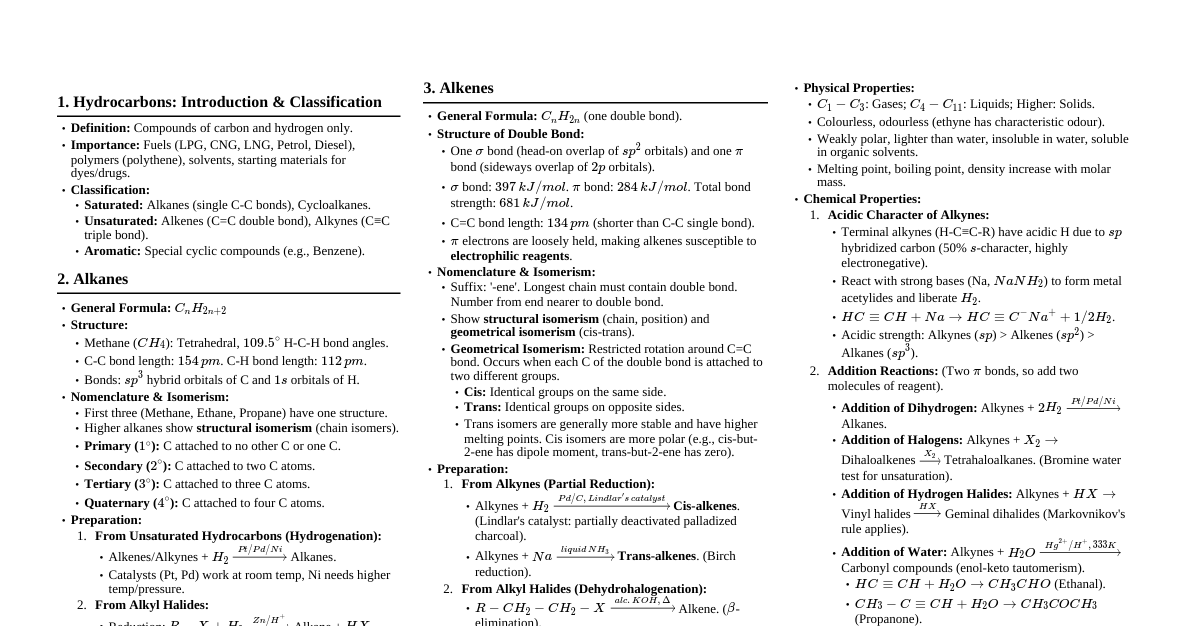
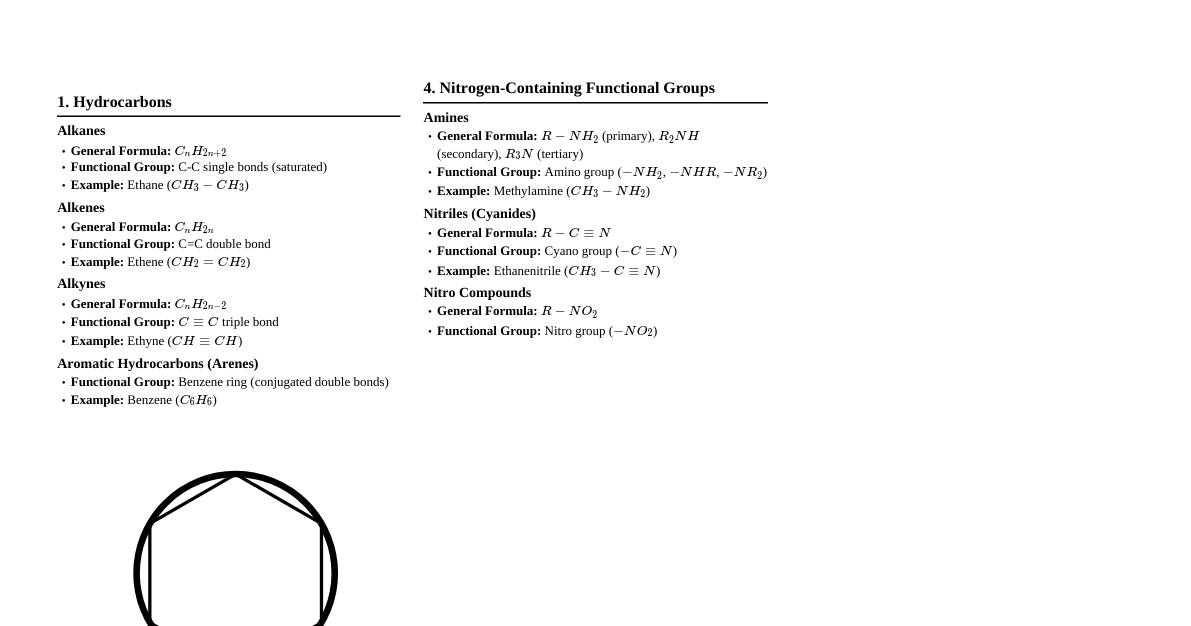
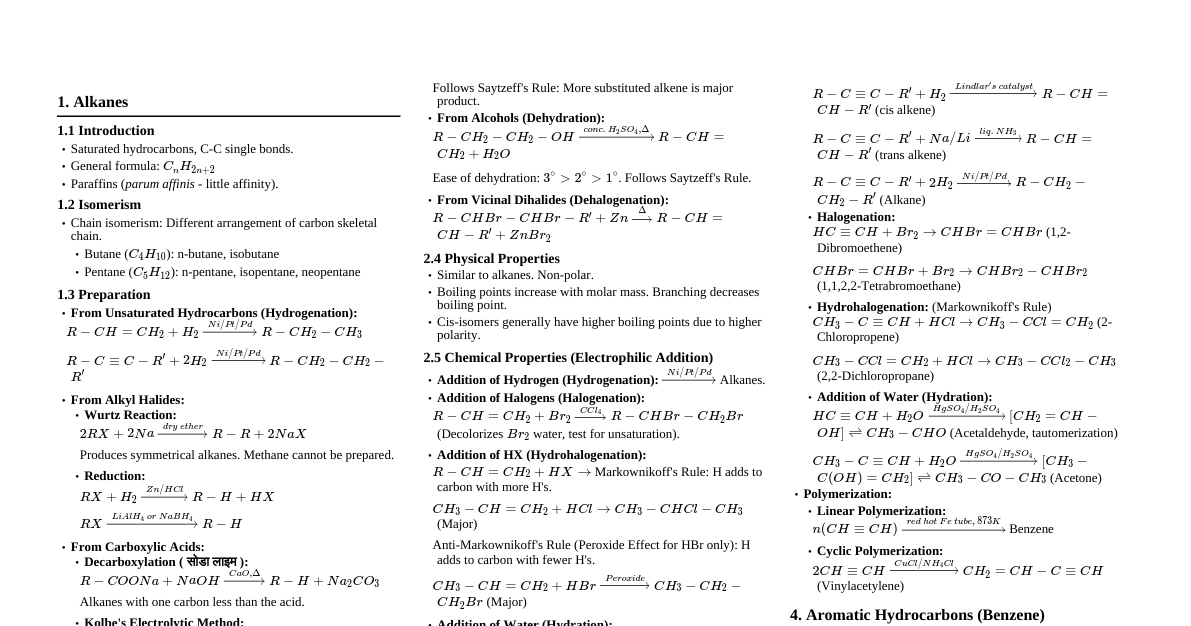
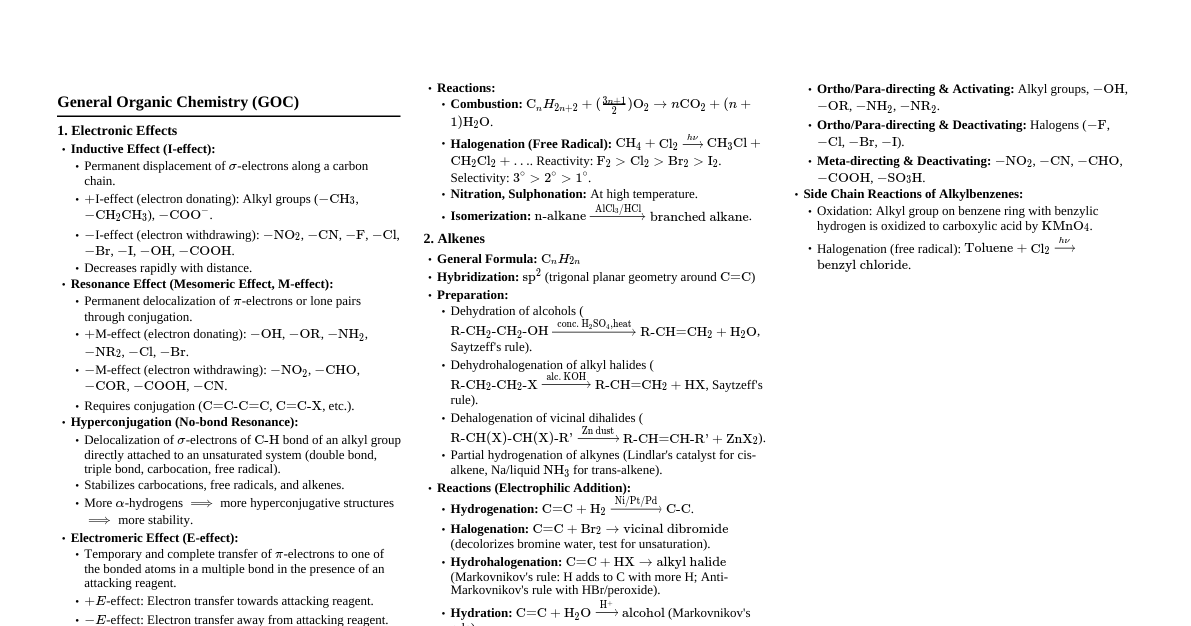
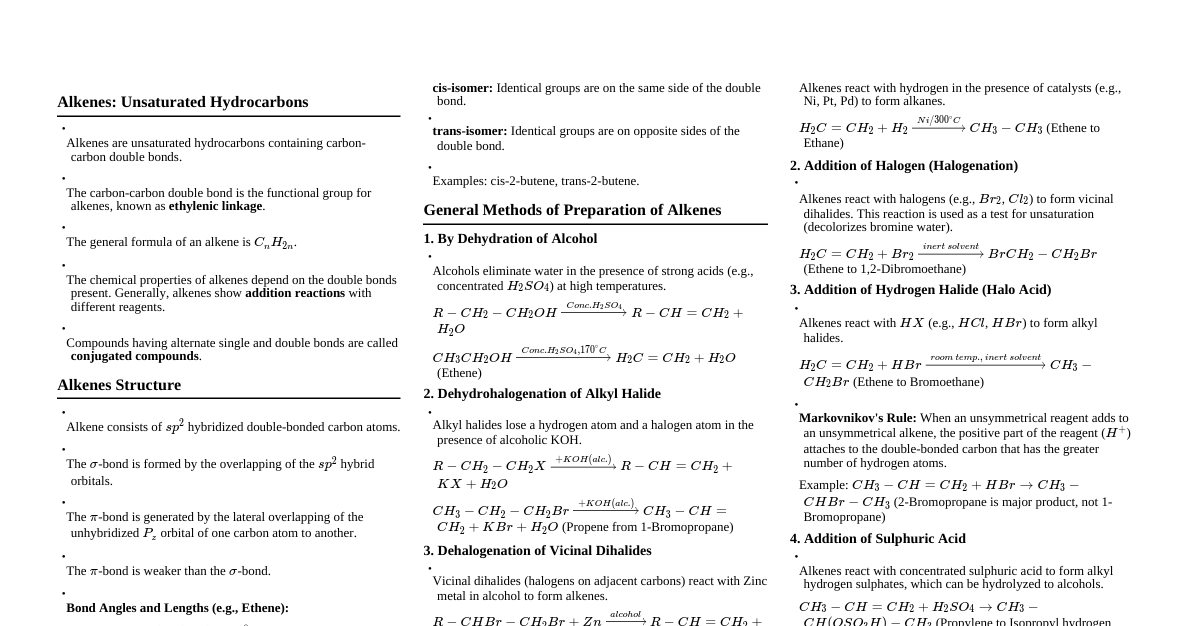
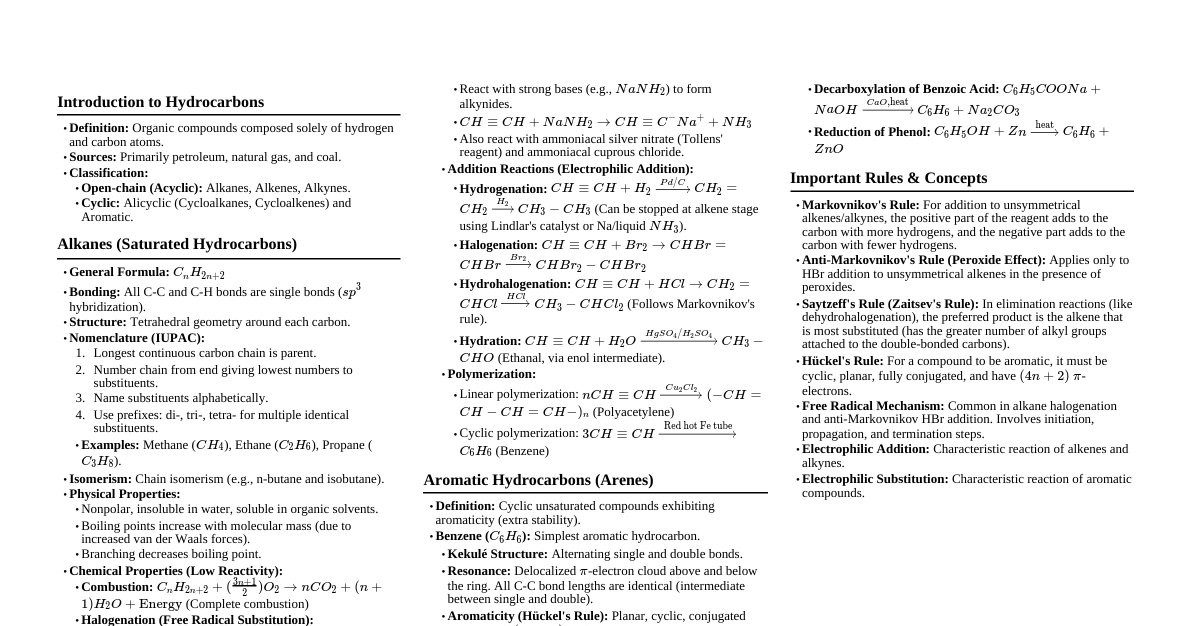
Hydrocarbons: Introduction & Classification Compounds solely of carbon and hydrogen. Key role in daily life (fuels like LPG, CNG, petrol, diesel). Used in polymers (polythene, polypropene, polystyrene) and as solvents. Classification: Saturated: Alkanes (single C-C bonds), Cycloalkanes (carbon atoms form a ring). Unsaturated: Alkenes (C=C double bonds), Alkynes (C≡C triple bonds). Aromatic: Special cyclic compounds (e.g., Benzene). Alkanes Saturated open-chain hydrocarbons with C-C single bonds. General Formula: $C_nH_{2n+2}$ Methane ($CH_4$): First member, tetrahedral structure, H-C-H bond angle $109.5^\circ$. Bond Lengths: C-C bond 154 pm, C-H bond 112 pm. Bonding: C-C and C-H $\sigma$ bonds from $sp^3$ hybrid orbitals of carbon and $1s$ orbitals of hydrogen. Nomenclature and Isomerism IUPAC system (refer to Unit 8 for general rules). Isomers: Compounds with the same molecular formula but different structures. Chain Isomers: Differ in the arrangement of the carbon chain (straight vs. branched). Number of isomers increases with carbon atoms (e.g., $C_4H_{10}$ has 2, $C_5H_{12}$ has 3). Alkyl Groups: Derived from alkanes by removing one H atom ($C_nH_{2n+1}$). Preparation of Alkanes From Unsaturated Hydrocarbons (Hydrogenation): Alkenes/Alkynes + $H_2 \xrightarrow{Pt/Pd/Ni}$ Alkanes Example: $CH_2=CH_2 + H_2 \xrightarrow{Pt/Pd/Ni} CH_3-CH_3$ (Ethane) From Alkyl Halides: Reduction: $R-X + H_2 \xrightarrow{Zn, H^+} R-H + HX$ Wurtz Reaction: $2R-X + 2Na \xrightarrow{dry \ ether} R-R + 2NaX$ (for even number of carbon atoms) From Carboxylic Acids: Decarboxylation: $RCOONa + NaOH \xrightarrow{CaO, \Delta} R-H + Na_2CO_3$ Kolbe's Electrolytic Method: $2RCOO^-Na^+ + 2H_2O \xrightarrow{electrolysis} R-R + 2CO_2 + H_2 + 2NaOH$ (for even number of carbon atoms) Properties of Alkanes Physical: Non-polar molecules (weak van der Waals forces). $C_1-C_4$ are gases, $C_5-C_{17}$ are liquids, $C_{18+}$ are solids. Colourless, odourless, insoluble in water. Boiling point increases with molecular mass. Branching decreases boiling point (smaller surface area, weaker forces). Chemical: Generally inert, but undergo reactions under certain conditions. Substitution Reactions: Replace H atoms with halogens, nitro group, sulphonic acid group. Halogenation: Occurs at high temperature or with UV light. Example: $CH_4 + Cl_2 \xrightarrow{hv} CH_3Cl + HCl$ Mechanism: Free radical chain (initiation, propagation, termination). Combustion: Burn in air/dioxygen, producing $CO_2$ and $H_2O$ with large heat release. Complete: $C_nH_{2n+2} + (\frac{3n+1}{2})O_2 \rightarrow nCO_2 + (n+1)H_2O$ Incomplete: Forms carbon black. Controlled Oxidation: Form alcohols, aldehydes, acids under specific conditions. $2CH_4 + O_2 \xrightarrow{Cu/523K/100atm} 2CH_3OH$ (Methanol) Alkanes with tertiary H atom can be oxidized by $KMnO_4$. Isomerisation: n-Alkanes $\xrightarrow{Anhy. AlCl_3/HCl}$ Branched-chain alkanes. Aromatization (Reforming): n-Alkanes ($C_{6+}$) $\xrightarrow{Cr_2O_3/V_2O_5/Mo_2O_3, 773K, 10-20 atm}$ Aromatic compounds. Reaction with Steam: $CH_4 + H_2O \xrightarrow{Ni, 1273K} CO + 3H_2$ (Industrial $H_2$ production) Pyrolysis (Cracking): Higher alkanes $\xrightarrow{heat}$ Lower alkanes/alkenes. Conformations of Ethane Free rotation around C-C single bond leads to different spatial arrangements (conformations/conformers/rotamers). Rotation is hindered by torsional strain (repulsive interaction between adjacent bonds). Eclipsed Conformation: H atoms on adjacent carbons are as close as possible (maximum torsional strain, least stable). Staggered Conformation: H atoms on adjacent carbons are as far apart as possible (minimum torsional strain, most stable). Skew Conformation: Any intermediate conformation. Representations: Sawhorse Projections: View molecule along C-C axis, central C-C bond as a longer line. Newman Projections: View molecule head-on along C-C axis, front carbon as a point, rear carbon as a circle. Staggered is more stable than eclipsed by about $12.5 \ kJ/mol$. Alkenes Unsaturated hydrocarbons with at least one C=C double bond. General Formula: $C_nH_{2n}$ (if one double bond). Also known as olefins (oil forming). Structure of Double Bond Consists of one $\sigma$ bond (head-on overlap of $sp^2$ orbitals) and one $\pi$ bond (lateral overlap of $2p$ orbitals). $\pi$ bond is weaker than $\sigma$ bond. Bond Length: C=C is 134 pm (shorter than C-C single bond, 154 pm). Electrophilic reagents easily attack alkenes due to loosely held mobile electrons of the $\pi$ bond. Nomenclature and Isomerism IUPAC: Longest chain with double bond, suffix '-ene'. Numbering from end nearer to double bond. Structural Isomerism: Chain and position isomerism (e.g., $C_4H_8$ has But-1-ene, But-2-ene, 2-Methylprop-1-ene). Geometrical (cis-trans) Isomerism: Arises from restricted rotation around C=C bond. Requires two different atoms/groups attached to each carbon of the double bond. Cis-isomer: Identical groups on the same side of the double bond. Trans-isomer: Identical groups on opposite sides of the double bond. Trans isomers are generally more stable and often have higher melting points. Cis isomers are generally more polar than trans isomers (e.g., cis-But-2-ene has dipole moment, trans-But-2-ene is non-polar). Preparation of Alkenes From Alkynes: Partial reduction (Hydrogenation): $\xrightarrow{Pd/C \ (Lindlar's \ catalyst)}$ Cis-alkenes $\xrightarrow{Na/liquid \ NH_3}$ Trans-alkenes From Alkyl Halides (Dehydrohalogenation): $R-CH_2-CH_2-X \xrightarrow{alc. \ KOH, \Delta} R-CH=CH_2 + HX$ This is a $\beta$-elimination reaction. Reactivity of HX: $HI > HBr > HCl$. Reactivity of alkyl groups: tertiary > secondary > primary. From Vicinal Dihalides (Dehalogenation): $R-CHBr-CH_2Br + Zn \rightarrow R-CH=CH_2 + ZnBr_2$ From Alcohols (Acidic Dehydration): $R-CH_2-CH_2-OH \xrightarrow{Conc. \ H_2SO_4, \Delta} R-CH=CH_2 + H_2O$ This is also a $\beta$-elimination reaction. Properties of Alkenes Physical: $C_2-C_4$ are gases, $C_5-C_{18}$ are liquids, $C_{19+}$ are solids. Colourless, odourless (ethene has faint sweet smell), insoluble in water. Boiling point increases with molecular mass; branching decreases it. Chemical: Characterized by addition reactions due to $\pi$ electrons. Addition of Dihydrogen (Hydrogenation): $\xrightarrow{Pt/Pd/Ni}$ Alkanes (Section 9.2.2). Addition of Halogens: $R-CH=CH_2 + Br_2 \rightarrow R-CHBr-CH_2Br$ (vicinal dihalides). Used as a test for unsaturation (decolourises reddish-orange bromine water). Electrophilic addition via cyclic halonium ion. Addition of Hydrogen Halides: $R-CH=CH_2 + HX \rightarrow R-CHX-CH_3$ (alkyl halides). Reactivity: $HI > HBr > HCl$. Markovnikov's Rule: Negative part of addendum adds to the carbon with fewer hydrogen atoms. Anti-Markovnikov Addition (Peroxide Effect/Kharash Effect): In presence of peroxides, HBr adds opposite to Markovnikov's rule (only for HBr). Mechanism: Free radical chain. Addition of Sulphuric Acid: Cold conc. $H_2SO_4$ adds according to Markovnikov's rule to form alkyl hydrogen sulphates. Addition of Water (Hydration): In presence of conc. $H_2SO_4$, forms alcohols according to Markovnikov's rule. Oxidation: Baeyer's reagent (cold, dilute, aqueous $KMnO_4$) forms vicinal diols (glycols). Acidic $KMnO_4$ or dichromate oxidises alkenes to ketones/acids. Ozonolysis: Alkene + $O_3 \rightarrow$ Ozonide $\xrightarrow{Zn/H_2O}$ Aldehydes/ketones. Useful for locating the position of the double bond. Polymerisation: Ethene forms polythene, propene forms polypropene. Alkynes Unsaturated hydrocarbons with at least one C≡C triple bond. General Formula: $C_nH_{2n-2}$ First stable member: Ethyne (acetylene). Nomenclature and Isomerism IUPAC: Longest chain with triple bond, suffix '-yne'. Numbering from end nearer to triple bond. Position Isomers: Differ in the position of the triple bond (e.g., But-1-yne and But-2-yne). Chain Isomers: Differ in the arrangement of the carbon chain. Structure of Triple Bond Each carbon is $sp$ hybridised. Consists of one $\sigma$ bond (head-on overlap of $sp$ orbitals) and two $\pi$ bonds (lateral overlap of two $2p$ orbitals). H-C-C bond angle is $180^\circ$ (linear molecule). C≡C bond length is 120 pm (shorter than C=C and C-C). C≡C bond strength is 823 kJ/mol (stronger than C=C and C-C). Preparation of Alkynes From Calcium Carbide: $CaC_2 + 2H_2O \rightarrow Ca(OH)_2 + C_2H_2$ (Ethyne). From Vicinal Dihalides: Dehydrohalogenation. $R-CHX-CH_2X \xrightarrow{alc. \ KOH}$ Alkenyl halide $\xrightarrow{NaNH_2}$ Alkyne. Properties of Alkynes Physical: $C_2-C_4$ are gases, $C_5-C_{12}$ are liquids, $C_{13+}$ are solids. Colourless, ethyne has characteristic odour, others odourless. Weakly polar, lighter than water, insoluble in water, soluble in organic solvents. Melting point, boiling point, density increase with molecular mass. Chemical: Acidic Character: H atoms on triply bonded carbons are acidic due to high electronegativity of $sp$ hybridised carbon. React with strong bases ($Na, NaNH_2$) to form metal acetylides. Acidic behaviour: Alkynes > Alkenes > Alkanes. Addition Reactions: Add up to two molecules of dihydrogen, halogens, hydrogen halides, water. Addition takes place according to Markovnikov's rule for unsymmetrical alkynes. Example: $HC≡CH + H_2 \xrightarrow{Pt/Pd/Ni}$ Ethane. Example: $CH_3-C≡CH + Br_2 \rightarrow CH_3-CBr=CHBr \xrightarrow{Br_2} CH_3-CBr_2-CHBr_2$ Addition of water $\xrightarrow{Hg^{2+}/H^+}$ forms carbonyl compounds (e.g., ethyne forms ethanal). Polymerisation: Linear: Forms polyacetylene (conducts electricity). Cyclic: Ethyne $\xrightarrow{red \ hot \ iron \ tube, 873K}$ Benzene. Aromatic Hydrocarbons (Arenes) Possess pleasant odour. Most contain benzene ring. Benzene ring is highly unsaturated but its unsaturation is retained in most reactions. Benzenoids: Contain benzene ring. Non-benzenoids: Do not contain benzene ring (e.g., cyclopentadienyl anion). Nomenclature and Isomerism Benzene: All 6 H atoms are equivalent. Disubstituted Benzene: Ortho (o-): 1,2 or 1,6 positions. Meta (m-): 1,3 or 1,5 positions. Para (p-): 1,4 positions. Structure of Benzene (Kekulé's Structure) Cyclic arrangement of 6 carbon atoms with alternating single and double bonds. Each carbon attached to one hydrogen atom. Kekulé proposed oscillating nature of double bonds. Benzene is a resonance hybrid of Kekulé structures. All 6 C-C bond lengths are equal (139 pm, intermediate between single and double bond). Aromaticity (Hückel Rule) Criteria for aromatic compounds: Planarity. Complete delocalisation of $\pi$ electrons in the ring. Presence of $(4n+2)\pi$ electrons, where $n = 0, 1, 2, ...$ Benzene has $6\pi$ electrons ($n=1$), hence aromatic. Delocalised $\pi$ electron cloud above and below the ring makes benzene very stable. Preparation of Benzene Cyclic Polymerisation of Ethyne: (Section 9.4.4). Decarboxylation of Aromatic Acids: $RCOONa + NaOH \xrightarrow{CaO, \Delta}$ Benzene + $Na_2CO_3$. Reduction of Phenol: Phenol $\xrightarrow{Zn, \Delta}$ Benzene + $ZnO$. Properties of Benzene Physical: Non-polar, colourless liquids/solids, characteristic aroma, immiscible with water, burn with sooty flame. Chemical: Characterized by electrophilic substitution reactions. Electrophilic Substitution Reactions: Mechanism: Generation of electrophile ($E^+$). Formation of carbocation intermediate (arenium ion/$\sigma$-complex). Removal of proton from carbocation intermediate. Nitration: Benzene + $HNO_3/H_2SO_4 \rightarrow$ Nitrobenzene. Halogenation: Benzene + $X_2 \xrightarrow{Anhyd. \ AlX_3}$ Halobenzene. Sulphonation: Benzene + Fuming $H_2SO_4 \rightarrow$ Benzenesulphonic acid. Friedel-Crafts Alkylation: Benzene + $R-X \xrightarrow{Anhyd. \ AlCl_3}$ Alkylbenzene. Friedel-Crafts Acylation: Benzene + $RCOCl \xrightarrow{Anhyd. \ AlCl_3}$ Acylbenzene. Addition Reactions: Under vigorous conditions. Hydrogenation: Benzene + $3H_2 \xrightarrow{Ni}$ Cyclohexane. Halogenation (UV light): Benzene + $3Cl_2 \xrightarrow{UV, \ 500K}$ Benzene hexachloride (BHC). Combustion: Benzene burns with sooty flame. Directive Influence of Functional Group in Monosubstituted Benzene Substituents already present on the benzene ring direct incoming electrophile to specific positions (ortho/para or meta). Ortho/Para Directing Groups: Direct incoming groups to ortho and para positions. Examples: $-OH, -NH_2, -CH_3, -OCH_3$, halogens (halogens are deactivating but o/p directing). Generally activating groups (except halogens). Resonance increases electron density at o/p positions. Meta Directing Groups: Direct incoming groups to meta positions. Examples: $-NO_2, -CN, -CHO, -COOH, -SO_3H$. Generally deactivating groups. Electron-withdrawing groups decrease electron density at o/p positions more than at meta. Carcinogenicity and Toxicity Polynuclear hydrocarbons (more than two fused benzene rings) are carcinogenic (cancer-producing). Formed from incomplete combustion of organic materials (tobacco, coal, petroleum). Damage DNA and cause cancer. Examples: 1,2-Benzanthracene, 3-Methylcholanthrene, 1,2,5,6-Dibenzanthracene, 1,2-Benzpyrene.